


Biography | Kathleen Mary Nunneley — a colonial title taken in Sydney in May 1896, and thirteen New Zealand championships in a row
· 1896-5
Personal memoryBy kevin · · Report an issue











































Find memories left by people near you.
Distribute Bounty
This will distribute the bounty equally among all qualifying memories. This action cannot be undone.
Cancel Bounty
Are you sure you want to cancel this bounty? The remaining amount will be refunded to your account.
Success!
Operation completed successfully.
Error
Something went wrong.
Biography | Kathleen Mary Nunneley — a colonial title taken in Sydney in May 1896, and thirteen New Zealand championships in a row
kevin
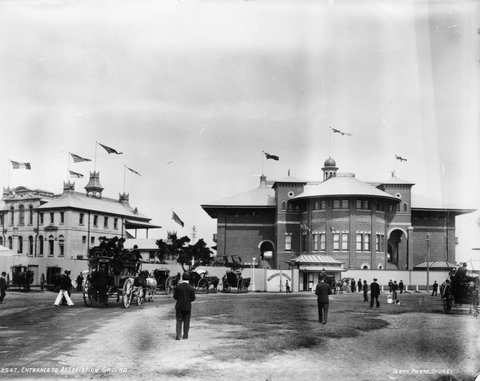
This pin is the Association Ground at Moore Park in Sydney, now the Sydney Cricket Ground. It is not where Kathleen Nunneley was born, lived or died. It is where the best-documented single result of her career outside New Zealand was won, in May 1896, and it is the one place in her life that this platform can pin to a coordinate honestly. Why the more obvious Wellington anchors could not be used is set out below.
BEFORE NEW ZEALAND
Kathleen Mary Nunneley was born on 16 September 1872 at Little Bowden in Leicestershire, England, the daughter of a wholesale grocer, John Alexander Nunneley, and his wife Kate. She was winning tournaments before she was fifteen. The Dictionary of New Zealand Biography credits her with the Brighton handicap singles in 1891 and, in 1893 alone, wins at Liverpool, Leicester, Nottingham, Northampton and Wellingborough.
Her father died in 1893. She emigrated the following year and reached Wellington in December 1894.
She joined the Thorndon Lawn Tennis Club, one of the oldest in the country — founded in 1879 — and one of the three bodies whose representatives, with Auckland and Hawke's Bay, formed the New Zealand Lawn Tennis Association in December 1886.
DECEMBER 1895, WELLINGTON
A year after arriving she entered her first national tournament, held at Wellington in December 1895, and won the ladies' singles and the ladies' doubles. Two independent sources record it: the Dictionary of New Zealand Biography, and L. O. S. Poidevin, a New South Wales player who was in Wellington at the time and who wrote the Australasian chapter of Lawn Tennis at Home and Abroad in 1903. Poidevin was there by accident — he was playing cricket against a visiting New South Wales side, and the match finished one-sidedly enough to let him go and watch the tennis finals.
He describes her forehand drive as the feature of the tournament, and reaches for an odd and rather good comparison: her method, he writes, was of the "allegro" variety and reminded him of a rhapsody of Liszt's.
MAY 1896, THE ASSOCIATION GROUND
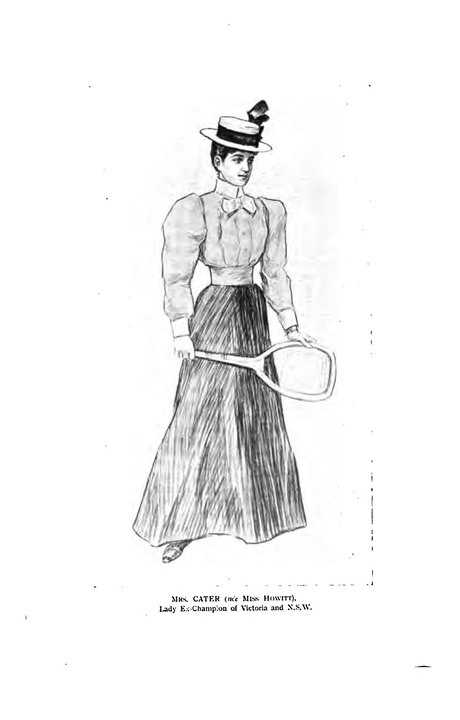
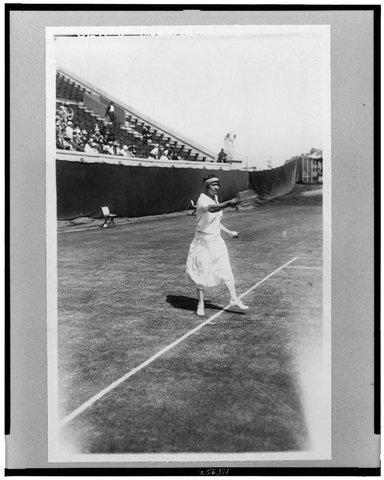
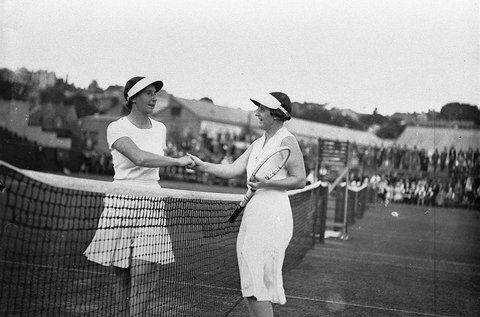
Five months later she was in Sydney for the Championship of New South Wales, played on this ground. The women's singles was decided by a challenge round — the holder waited while everyone else played out an all comers' event, then met the winner of it in a separate match for the title. The holder was Mrs Cater, née Miss Howitt, who had held the New South Wales and Victorian titles together for years.
Nunneley beat her. Poidevin, writing seven years afterwards, calls her "dashing and brilliant, with a wonderful reserve of lasting powers", and sums the match up in a sentence: "She took the lady champion by storm rather than by ambush." He calls it perhaps her greatest success, and records that Miss Howitt regained the title the year after. The Dictionary of New Zealand Biography, independently, says Nunneley took both women's titles at that meeting.
WHAT SHE PLAYED FOR, AND WHY A MODERN FLAG MISLEADS
She was English-born, had been winning English tournaments as recently as 1893, and in May 1896 won a New South Wales championship. She played as a New Zealander throughout, because the association a player came through, not the country of birth, decided what a colonial result was called.
Modern databases file her under New Zealand. That is correct for her representation and explains none of the rest. Say who a player represented at the time of the event, and the record stops contradicting itself.
THE RECORD
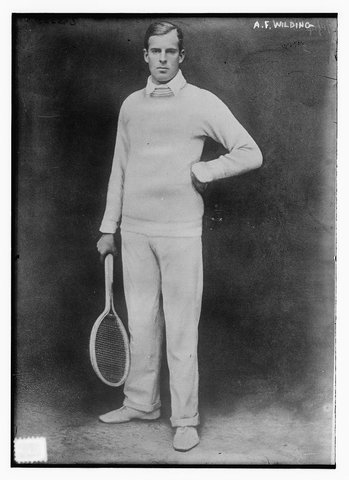
Thirteen New Zealand singles championships in a row, from 1895 to 1907. Ten national doubles titles and nine mixed. Thirty-two national senior titles in all. She partnered Anthony Wilding twice in mixed doubles, and toured New South Wales again in 1909. The Dictionary of New Zealand Biography records that she beat Blanche Hillyard, a repeated Wimbledon champion, and notes that Nunneley herself never entered the All England championships. That entry does not date the Hillyard match and no primary source for it was read here, so it is given as that entry gives it and no further.
THIRTY YEARS AT A REFERENCE DESK
The interesting fact about a record like that, in a sport organised as tennis then was, is what it did not come with. She could not be paid to play. She worked at the Wellington Public Library for about thirty years, latterly as the assistant in charge of the reference section, and retired in 1935.
What the game gave her was medals. In 1928 she had her gold medals made into a trophy — the Nunneley Casket — awarded each year to the winning provincial women's team. It is still competed for.
She did not marry, was made a life member of several tennis associations, and died at Wellington on 28 September 1956, aged eighty-four.
WHAT COULD NOT BE ESTABLISHED, AND WHY THE PIN IS IN SYDNEY
Three Wellington anchors were tried and all three failed the coordinate standard this vertical uses, which is two independent readings or an explicit statement in the text that the standard was not met.
The Thorndon Lawn Tennis Club, the club she actually joined, has no Wikidata item and no named feature in OpenStreetMap anywhere in a wide box over Thorndon and central Wellington. Where its courts stood in the 1890s is not given by any source read here.
The venue of the December 1895 national tournament is not named by Poidevin, by the Dictionary of New Zealand Biography, or by the Te Ara encyclopaedia article on early New Zealand tennis. Poidevin says only that the meeting rotated between Auckland, Christchurch, Wellington, Dunedin and occasionally Nelson or Napier, and was staged by whichever provincial association's courts it happened to fall on.
The Wellington Public Library she worked in was the 1893 building at Mercer and Wakefield Streets, not the 1940 building in Civic Square that later became the City Gallery. Only a single geocoder reading for the street could be obtained, and no independent second source was found.
No private address of hers was sought, and would not have been pinned in any case.
So the pin is the ground where the May 1896 challenge round was played, which is dual-sourced. Wikidata item Q856393 carries -33.891667, 151.224722. OpenStreetMap way 387975057, tagged leisure=stadium and carrying no wikidata reference of its own, centres on -33.891431, 151.224767. The two readings are about 27 metres apart, which confirms they describe one enclosure rather than two adjacent places. The pin is their midpoint, with a precision radius of 250 metres covering the whole ground. The pin is the ground, not the court: the sources read place colonial tennis meetings on the ground itself, but no document consulted shows where the courts were pegged within it.
One further gap worth recording. Trove, the National Library of Australia's newspaper archive, returned an access-denied page on every route tried in this session, and the New Zealand equivalent, PapersPast, returned an empty stub. A Wellington paper of December 1895 or a Sydney paper of May 1896 would give the venue, the dates and the scores in a single column, and would settle whether "both championship titles" means the singles and the doubles or the singles and the mixed. Neither was reachable.
COVER IMAGE
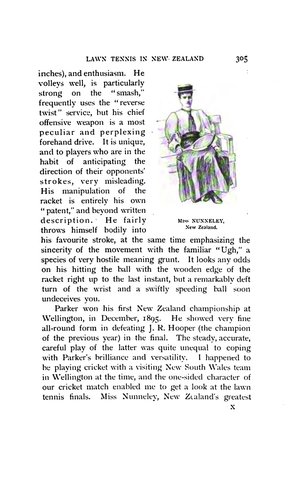
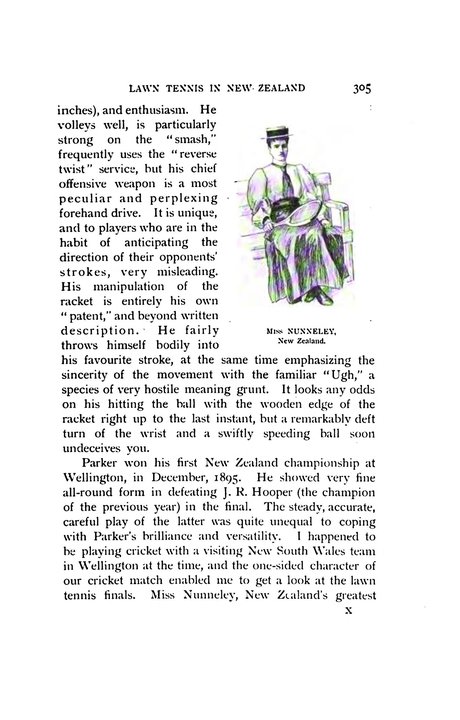
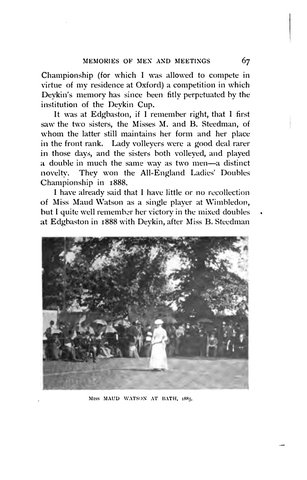
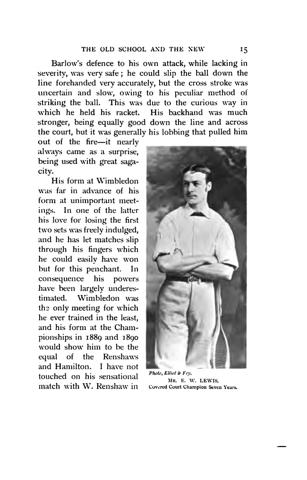
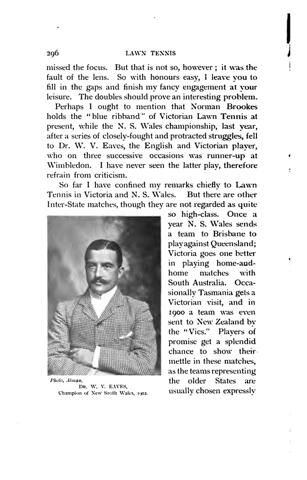
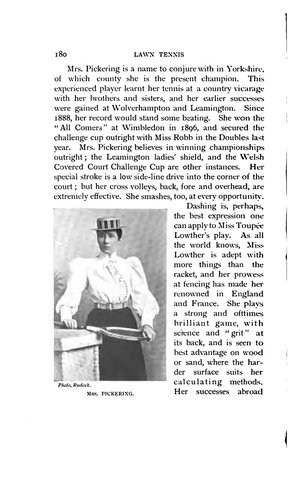
Page 305 of Lawn Tennis at Home and Abroad, edited by A. Wallis Myers, London, 1903 — a work in the public domain by age, digitised by Google and hosted by the Internet Archive. The plate at the upper right is captioned "Miss Nunneley, New Zealand." It is a printed portrait, not a photograph: she sits in a slatted wooden garden chair in a straw boater with a dark band, a high-collared blouse and a dark tie, a long dark skirt, a large-headed wooden racket lying face-up across her lap.
The whole page is shown rather than the plate alone, so the caption stands where the book put it. Two disclosures follow from that. The letterpress surrounding the portrait is not about her — it is the end of the book's assessment of H. A. Parker, the New Zealand men's champion, and the paragraph below the plate begins the passage about her own December 1895 win. And the scan carries visible colour fringing across the halftone, an artefact of the digitisation of a black-and-white page, not of the original printing.
SECOND IMAGE
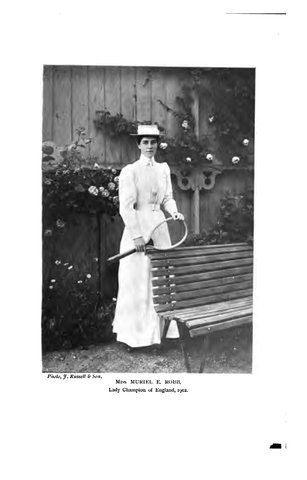
Page 299 of the same volume: the full-page plate captioned "Mrs. Cater (née Miss Howitt), Lady Ex-Champion of Victoria and N.S.W." — the champion Nunneley beat in the challenge round described above. Same source and status.
The volume's full text, from which every quotation above is taken verbatim: https://archive.org/download/lawntennisathom00myergoog/lawntennisathom00myergoog_djvu.txt — the Wellington and Sydney passages are on printed pages 305 and 306. Item page: https://archive.org/details/lawntennisathom00myergoog
Biographical facts are from Margaret Hammer's entry on Nunneley in the Dictionary of New Zealand Biography, published by Te Ara, the Encyclopedia of New Zealand: https://teara.govt.nz/en/biographies/3n13/nunneley-kathleen-mary — with club and association dates from the same encyclopaedia's article on the development of New Zealand tennis: https://teara.govt.nz/en/tennis/page-1
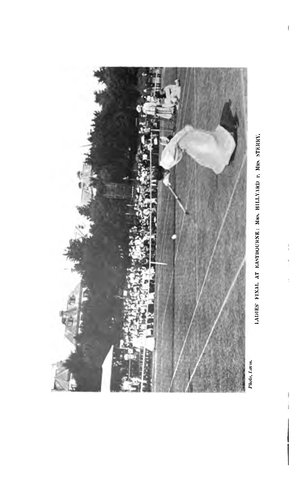
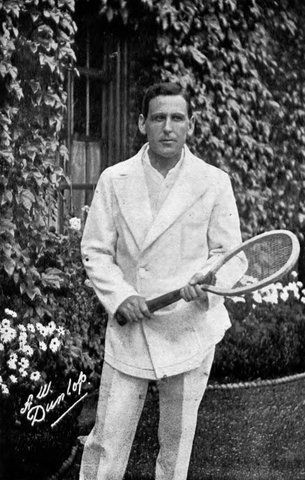
Related memories on this platform: the Association Ground, Moore Park, May 1896, which tells the same afternoon from the tournament's side; Lancaster Park, Christchurch, December 1900, and Alfred Wallace Dunlop, on the New Zealand championship that changed its rules to admit an Australian; and Blanche Hillyard at Devonshire Park, Eastbourne.

changes?
delete this memory?
We detected that you have a Blox in your crypto wallet! We will import the Blox into your account.
Click on done below to complete the import.
Welcome Back!
Sign in to preserve cherished moments
Don't have an account?
Welcome!!
Sign up and start preserving cherished moments
?
?

Choose your payment method
Buy with Metablox Credit
Do you want to mint Blox with Metablox Credit?
Which Crypto would you like to use?
Purchase Confirmed!
Your Blox is being minted on-chain and will appear in your profile shortly.
Log in or sign up to claim your Blox.
How many credits do you want to buy?
$100 USD = 1 Metablox Credit = 1 Blox.
Use Metablox Credit to mint any Blox you want on the map.
 expand_more