


Biography | Elisabeth Moore — the challenger played 164 games and the holder 47, and the association's next rule book held women to three sets, Philadelphia, 1901
· 1901-6
Unreviewed contributionBy kevin · · updated · Report an issue

















































Find memories left by people near you.
Distribute Bounty
This will distribute the bounty equally among all qualifying memories. This action cannot be undone.
Cancel Bounty
Are you sure you want to cancel this bounty? The remaining amount will be refunded to your account.
Success!
Operation completed successfully.
Error
Something went wrong.
Biography | Elisabeth Moore — the challenger played 164 games and the holder 47, and the association's next rule book held women to three sets, Philadelphia, 1901
kevin
On Friday 28 June 1901 and again on Saturday 29 June, on the grass of the Philadelphia Cricket Club at St. Martin's, Elisabeth Moore played two five-set matches on consecutive days and finished the second of them as champion of the United States. She played 164 games across the week to get there. The woman she beat in the last of them had played 47, because the rules of the United States National Lawn Tennis Association excused the holder from everything up to that point. When the association next printed its rules, it had added to them a footnote that neither of the earlier editions checked here carries: every match in which women took part, in any tournament under its auspices, was to be the best two in three sets.
This is the third entry pinned at this ground on this platform, and the three describe three different instruments. The entry for June 1915 is about the rule that let a Norwegian win an American championship because a New York club had taken her in. The entry for June 1904 is about a published draw sheet that is a list of club memberships. This one is about how much tennis the association required each woman in that draw to play, and about the rule that changed it.
**The challenge round, counted.**
The championship was not a knockout ending in a final. The field played out an all-comers competition, and its winner earned one match against the previous year's champion. Until that match, the champion did not play at all.
In 1901 Moore was the challenger. The association's own annual, the Wright and Ditson Officially Adopted Lawn Tennis Guide for 1902, prints the whole draw. She beat Rachael Harlan of the Belmont Cricket Club 6-3, 6-1 in the preliminary round; Carrie Neely 6-1, 7-5 in the first; Juliette Atkinson, three times champion, 6-2, 9-7 in the semi-final; and Marion Jones, the 1899 champion, 4-6, 1-6, 9-7, 9-7, 6-3 in the all-comers final. That is 58 games in the final alone and 117 in the four matches before the challenge round. The challenge round against Myrtle McAteer went 6-4, 3-6, 7-5, 2-6, 6-2, another 47 games. Moore's total for the week is 164 games in five matches. McAteer's is 47 in one.
The guide, which is the association's own publication, notices the cost and draws nothing from it. Of the all-comers final it says that Jones took the first two sets, that Moore then started in apparently fresher than ever, that the match was only levelled after two 9-7 sets, and that Moore's superior physical condition told in the last. Of the challenge round the next day it says her hard match seemed to have left her a trifle tired, and that she was not as strong or fresh as she had been the day before. The same volume records the women's doubles final going to Atkinson and McAteer by default against Moore and Jones.
**Saturday 29 June 1901.**
The dispatch that went out from Philadelphia that evening was printed the following morning in at least three papers, set by three different printers, which is the raw-text condition this platform requires before anything is quoted:
"By defeating Miss Myrtle McAteer, of Pittsburg, Miss Elizabeth Moore, of the Kings County Tennis Club, to-day regained the woman's tennis championship of the United States. Miss Moore lost the title to Miss McAteer last year. The contest to-day was keen, and five sets were played before a result was attained. Both players were exhausted at the end of the match, and Miss Moore decided to forfeit the doubles, in which she and Miss Jones were to meet Miss McAteer and Miss Atkinson."
That is the New-York Tribune of 30 June 1901, page nine, with one machine reading repaired: the Tribune's scan renders played as plaved, and both other settings read played. The San Francisco Call printed the same copy the same morning on page sixteen, and the Indianapolis Journal on page four. The divergences are small and worth naming rather than smoothing. The Tribune puts a comma after the word keen and the other two settings do not, which is a compositor's choice and not a machine reading, because a comma is a separate piece of type. The Indianapolis Journal stops the dispatch after the words a result was attained and prints nothing about the exhaustion or the forfeited doubles, which is an editor cutting to fit rather than a divergence in the copy. The Call's summary line renders the first set of the championship round as an unreadable fragment where the Tribune has 6-4; the association's guide gives 6-4 and the Tribune is followed. The Call names Marion Jones's mixed doubles partner as D. P. Little and the Tribune as R. D. Little; the Tribune had already called him R. D. Little of Princeton two days earlier and the guide calls him R. D. Little, so the Call is the outlier.
**1902, from the holder's side.**
The next June she was the champion, and the rule that had made her play five matches to win the title now excused her from every match but one. Marion Jones came through the all-comers and challenged her on the Saturday of that week, 28 June 1902. The association's guide for 1903 records the result of that challenge round as 6-1, 1-0, defaulted.
A second dispatch, again in two independent settings, reports what happened:
"Miss Moore was taken sick on Saturday, while playing her second set with Miss Jones, and play was postponed until to-day. Miss Moore's indisposition proved more serious than anticipated, and she was unable to conclude the game. Miss Jones was thereupon declared champion."
That is the New-York Tribune of 1 July 1902, page five. The Minneapolis Journal of the same date, page five, carries the same copy. Inside the quoted stretch the two settings diverge twice, and both are choices rather than damage: the Tribune has to-day where the Journal has yesterday, the same sentence adjusted for a morning and an evening publication, and the Tribune has her second set where the Journal has her contest. The sentence immediately before the quoted stretch, which is not quoted here, diverges twice more in a way worth recording: the Tribune spells her opponent's first name Marian and calls Moore Elizabeth, while the Journal spells the opponent Marion and calls Moore Elisabeth, in the same wire on the same morning. Every other difference in the Journal's setting is damage to its scan.
Two other papers carried different copy, and they do not agree with each other. The Evening Star of Washington, 1 July, adds that Jones had won the first set, that Moore fainted while playing at the beginning of the second, that Jones declined to accept the championship by default and agreed to play the following afternoon, and that Moore, whom it describes as not having been in the best of health lately, then formally notified the committee that she would default. The Jersey City News of 2 July also has Jones refusing a walkover, calls it a fainting spell, and says the match was postponed until Tuesday rather than Monday. Nothing about her health is established here beyond what those papers printed in that week, and this entry does not extend it.
**The rule.**
The Wright and Ditson guide was printed under the authority of the association. The volume for the 1902 season carries a letter from the association's secretary, dated Boston, 28 February 1902, stating that the constitution, by-laws and official rules of the game for the season of 1902 are printed in accordance with a vote passed at the annual meeting of the United States National Lawn Tennis Association held in New York City that February; the day is given as the sixteenth in a scan whose year digits are damaged.
In that volume, and not in the volumes for 1899 or 1901, a footnote is attached to the law governing rests and interruptions:
"All matches in which women take part in tournaments held under the auspices of the United States National Lawn Tennis Association shall be the best two in three sets, with a rest not exceeding seven minutes after the second set."
The same footnote stands at the same point in the volume for 1903. The 1901 volume, at exactly the same passage, runs straight on without it, and its general law provides for a rest at the end of the third set of a match, which is the shape of a five-set match.
Two things follow and a third does not. The rule is the association's, written in its own rule book, and it applied to every tournament under its auspices rather than to the championship alone. It first appears in the edition printed for the season immediately after the two days described above. What does not follow is that the one caused the other: the guide attaches the footnote to no vote and gives it no date, and the association's meeting minutes, which would settle it, were not obtained for this entry. The sequence is stated here and the causation is not.
What the rule did not do is remove the challenge round. A woman could still be required to win an entire all-comers competition and then play a fresh champion, and the champion could still play once. The cap was on the length of each match, not on the number of them. The championship at this ground in June 1904, pinned separately on this platform, was decided in two sets, which is consistent with the footnote still standing.
**Her name, and whose club she was.**
She is Elisabeth in the plate caption of the 1902 guide, which prints Miss Elisabeth H. Moore, Lady Champion of the United States; Bessie in that same volume's draw sheet; and Elizabeth in the 1903 volume's draw sheet. The association's own annual therefore renders her three ways in two years, which is a stronger measure of how loose this record is than any disagreement between two newspapers could be, because it removes the possibility that two sources simply had different information.
The papers do the same with her club. All three settings of the 1901 championship dispatch call her Miss Elizabeth Moore of the Kings County Tennis Club. The New-York Tribune, reporting the all-comers final in the same week, calls her Miss Bessie Moore of Ridgewood, New Jersey. The wire of 1904 quoted in the entry at this ground for that year calls her Miss Elizabeth Moore of New-York. No club is adopted here.
She was born on 5 March 1876 in Brooklyn and died on 22 January 1959 at Starke, Florida. She won the women's national singles championship four times, in 1896, 1901, 1903 and 1905, the doubles in 1896 and 1903, and the mixed doubles in 1902 and 1904. The 1902 mixed doubles was won in the same week she lost the singles title by default, with W. C. Grant of New York.
**Amateur-era record.**
Every result above was won in a game closed to anyone who had been paid, and they belong on the same footing as the other pre-1968 records pinned on this platform.
**Gaps this entry declares.**
The association's minutes for its February 1902 annual meeting were not obtained, and they are what would show whether the footnote was debated, who proposed it and what was said. The meeting's venue is not established either, which is why this entry is pinned where the tennis was played rather than where the rule was written. No statement by Elisabeth Moore about the rule, in her own name, was found; this entry therefore does not report what she thought of it. How long the footnote stood is not established here either, and the Wright and Ditson volumes for 1904 onwards are the route.
**Coordinate.** 40.063473, -75.210644, precision radius 300 m. This is the Philadelphia Cricket Club pin already established on this platform for the championships of June 1915 and June 1904, reused here deliberately and with disclosure. The club settled on its West Willow Grove Avenue site in 1883 and the guide for 1903 states that the women's national championship had been held since its inception at Wissahickon, the home of the Philadelphia Cricket Club, near Chestnut Hill, which is an independent confirmation of the venue span the 1915 entry sets out. That pin was fixed from two independent sources about 38 m apart, the City of Philadelphia's own property records and OpenStreetMap's building outline, and set at their midpoint. The radius covers the club's grounds rather than the clubhouse door, because no source consulted here fixes which of its courts held either of the 1901 matches. This pin now carries three entries, level with the Church Road pin in Wimbledon and behind the six at Forest Hills, and the choice was made deliberately: the argument here is about a rule applied at this tournament, and moving it to a less crowded pin would have meant pinning a person somewhere she happened to live rather than pinning an event where it happened.
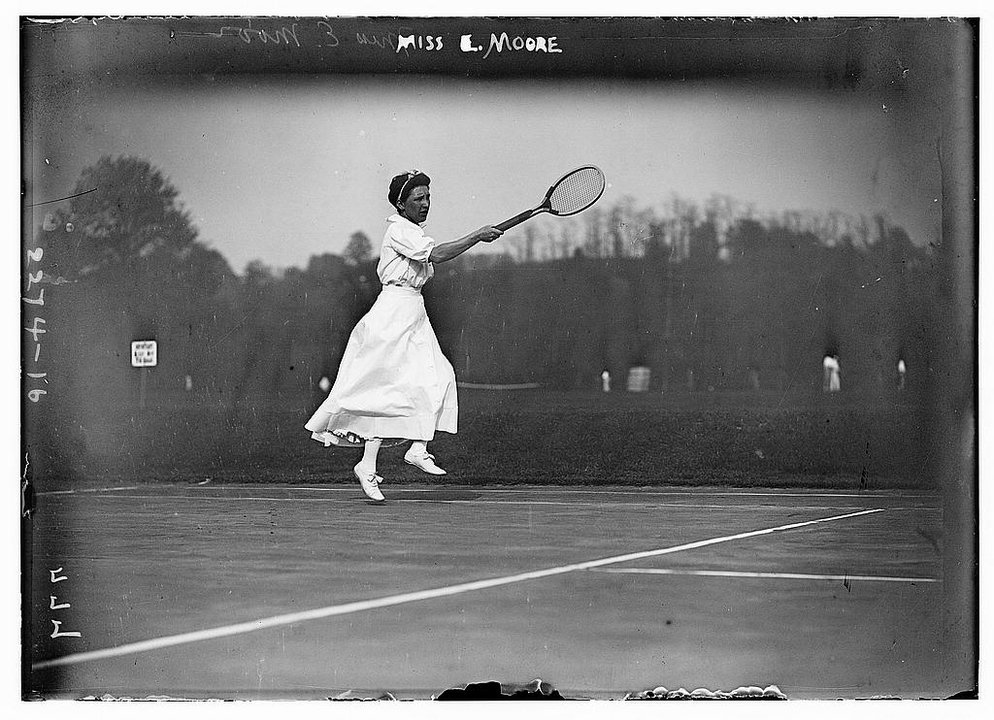
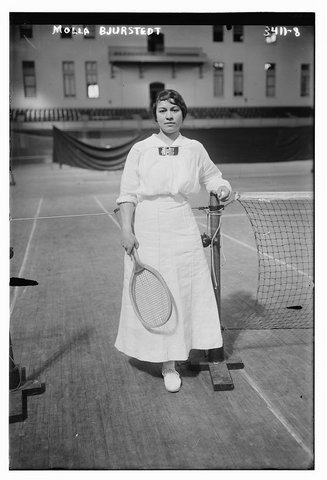
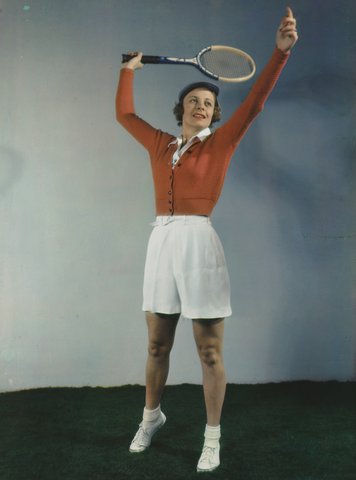
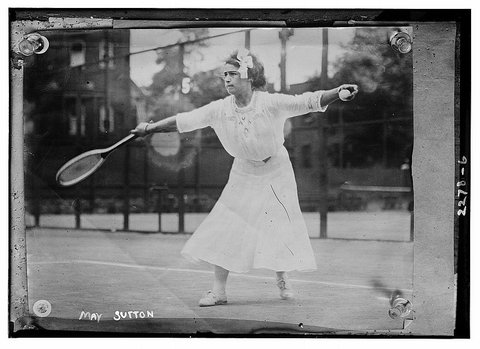
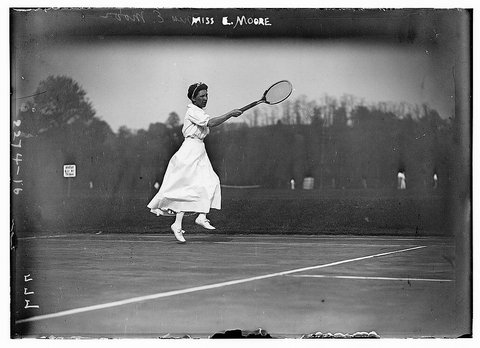
**Cover.** Miss E. Moore, Bain News Service, glass negative, call number LC-B2- 2274-16, reproduction number LC-DIG-ggbain-09640, Library of Congress Prints and Photographs Division, item 2014689625, no known restrictions on publication, 1024 x 742 px. A woman in a long white skirt buttoned down the front, a white blouse with elbow-length sleeves, white stockings and white shoes, both feet clear of the ground, driving a forehand with a flat-topped wooden racket. The court is dark and smooth rather than grass, the lines are painted, a second court with players on it runs across the middle distance, and the trees behind are bare. The negative is inked MISS E. MOORE across the top and 2274-16 down the left edge, which matches the call number the Library assigns. A fainter earlier inscription of what appears to be the same name runs alongside it in the opposite orientation. What the frame does not give is a place or a date. The Library dates it only as between about 1910 and about 1915, nine or more years after the matches this entry is about, and nothing in it identifies the ground. It is not a photograph of the Philadelphia championship and is not offered as one. The negative's call number sits four numbers from LC-B2- 2278-6, the May Sutton negative used on the 1904 entry at this pin, so the two women were photographed in the same run of plates. Following the standing check on this platform, the frame was searched for printed matter that might identify it: there is a small placard on a post at the left, carrying three lines of text, and it is out of the plane of focus and unreadable even in the Library's 5729 x 4154 master scan. Present but not resolvable is a different result from absent, and it is recorded as such.
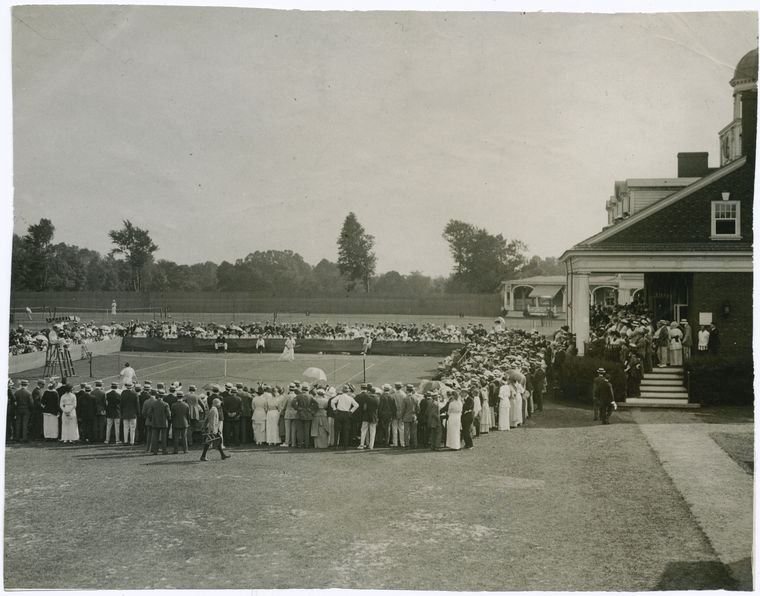
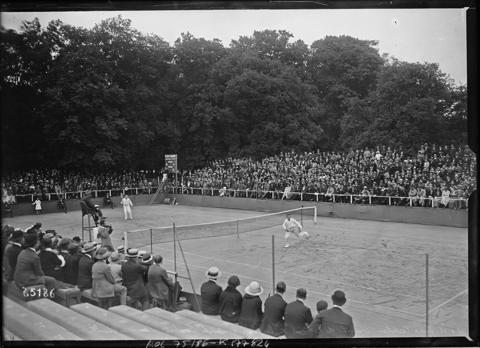
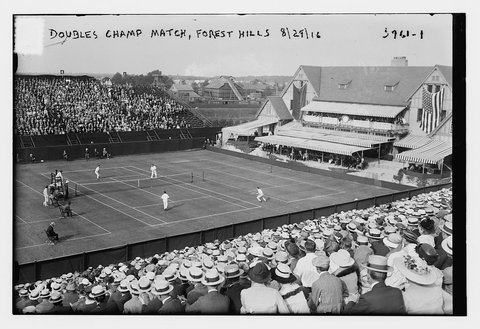
**Second image.** National Women's Tennis Tournament at the Cricket Club, St. Martins, Philadelphia, photographed by Paul Thompson, from the New York Public Library, public domain, 760 x 596 px. This is the ground. A grass court with a match in play, ringed three and four deep by a standing crowd in hats and long white dresses; a high umpire's chair at the left; tiered seating along the far side of the court; a second court in play beyond it; and at the right a shingled clubhouse with a two-storey porch and a cupola, its steps crowded with spectators. Beside the clubhouse door, a white sheet is posted in a dark frame with two people standing at it, one of them in tennis whites: a draw sheet or an order of play, being read. It is the same instrument the 1904 entry at this pin is about, and it is illegible here. This image is offered on subject rather than on resolution, and it is the smaller of the two used here. It answers, in part, a gap that both of the other entries at this pin declare: neither found a photograph of these courts. Its date is not established. Paul Thompson worked from about 1900 into the 1920s and the women's national championship was held on this ground from 1887 to 1920, so the frame sits somewhere inside a thirty-three year span and the dress in it suggests the later part of that range. It is not a photograph of 1901 and is not offered as one.
**Sourcing note.** Three passages are quoted above and each meets this platform's condition in a different way. The 1901 championship dispatch survives in three independent printers' settings and the 1902 default dispatch in two, both read as machine-read text of the scanned pages. The association's footnote is quoted from two separate typesettings of the same rule, the volumes for 1902 and 1903, a year apart; that is a weaker instance of the same test than a wire, because both were printed by the same firm and a house-style error would carry across, and it is offered on the narrower ground that two typesettings rule out a machine reading having invented the sentence. The 1902 setting is clean; the 1903 setting is damaged in its scan at seven points inside the quoted sentence, reading he for be, hcst for best, zest for rest, exceedm for exceeding, sev for seven, imnntes for minutes and secon for second, all of which are machine damage rather than differences of word. Everything else here is attributed paraphrase.
**Sources.** Wright and Ditson Officially Adopted Lawn Tennis Guide, 1902 season, for the laws, the secretary's authorising letter and the 1901 women's championship narrative and draw: https://archive.org/download/wrightditsonoff03unkngoog/wrightditsonoff03unkngoog_djvu.txt . The same guide for the 1903 season, for the 1902 championship draw and the footnote's second printing: https://archive.org/download/wrightditsonoff07unkngoog/wrightditsonoff07unkngoog_djvu.txt . The same guide for the 1901 season, checked at the same passage and carrying no such footnote: https://archive.org/download/wrightditsonoff10unkngoog/wrightditsonoff10unkngoog_djvu.txt . The 1899 volume, likewise: https://archive.org/download/wrightditsonoff16unkngoog/wrightditsonoff16unkngoog_djvu.txt . New-York Tribune, 30 June 1901, page 9: https://www.loc.gov/resource/sn83030214/1901-06-30/ed-1/?sp=9 . The San Francisco Call, 30 June 1901, page 16: https://www.loc.gov/resource/sn85066387/1901-06-30/ed-1/?sp=16 . The Indianapolis Journal, 30 June 1901, page 4: https://www.loc.gov/resource/sn82015679/1901-06-30/ed-1/?sp=4 . New-York Tribune, 29 June 1901, page 10, for the all-comers final: https://www.loc.gov/resource/sn83030214/1901-06-29/ed-1/?sp=10 . New-York Tribune, 28 June 1901, page 2, for the semi-finals and the order of play: https://www.loc.gov/resource/sn83030214/1901-06-28/ed-1/?sp=2 . New-York Tribune, 1 July 1902, page 5: https://www.loc.gov/resource/sn83030214/1902-07-01/ed-1/?sp=5 . The Minneapolis Journal, 1 July 1902, page 5: https://www.loc.gov/resource/sn83045366/1902-07-01/ed-1/?sp=5 . Evening Star, Washington, 1 July 1902, page 9: https://www.loc.gov/resource/sn83045462/1902-07-01/ed-1/?sp=9 . The Jersey City News, 2 July 1902, page 7: https://www.loc.gov/resource/sn87068097/1902-07-02/ed-1/?sp=7 . Birth and death dates and the list of titles from the encyclopaedia article on Elisabeth Moore; where the encyclopaedia and the contemporaneous sources differ, the contemporaneous sources are followed.

changes?
delete this memory?
We detected that you have a Blox in your crypto wallet! We will import the Blox into your account.
Click on done below to complete the import.
Welcome Back!
Sign in to preserve cherished moments
Don't have an account?
Welcome!!
Sign up and start preserving cherished moments
?
?


Choose your payment method
Buy with Metablox Credit
Do you want to mint Blox with Metablox Credit?
Which Crypto would you like to use?
Purchase Confirmed!
Your Blox is being minted on-chain and will appear in your profile shortly.
Log in or sign up to claim your Blox.
How many credits do you want to buy?
$100 USD = 1 Metablox Credit = 1 Blox.
Use Metablox Credit to mint any Blox you want on the map.
 expand_more