
NFL History | Los Angeles Memorial Coliseum — Two Networks, One Game, Because the Contracts Did Not Merge
· 1967-1
Personal memoryBy kevin · · Report an issue





















Find memories left by people near you.
Distribute Bounty
This will distribute the bounty equally among all qualifying memories. This action cannot be undone.
Cancel Bounty
Are you sure you want to cancel this bounty? The remaining amount will be refunded to your account.
Success!
Operation completed successfully.
Error
Something went wrong.

.jpg?width=1600)
NFL History | Los Angeles Memorial Coliseum — Two Networks, One Game, Because the Contracts Did Not Merge
kevin
On Sunday 15 January 1967 the Green Bay Packers beat the Kansas City Chiefs 35-10 in this building. Pro-Football-Reference files the venue as Los Angeles Memorial Coliseum and gives the quarters as 7-0, 14-10, 28-10, 35-10, with the game listed at a neutral site. The Packers' own account and the Chiefs' own account agree on the date and the score. It is the game retrospectively numbered Super Bowl I, and at the time it was not called that in the paperwork: both clubs describe the official designation as the AFL-NFL World Championship Game, while the magazine Cigar Aficionado, writing about the missing recordings, inverts the order of the two league names, which is a small sign of how unfixed the title was.
This entry is not about the football. It is about a fact that has never happened again and that has a mechanical explanation almost nobody gives: two American television networks carried this game live, at the same time, with two separate crews, two sets of cameras and two sets of announcers, and neither of them had done anything unusual to obtain it.
The reason is that the merger did not merge the contracts.
The two leagues announced a merger agreement on 8 June 1966. What they agreed to was a common draft, a championship game between the leagues at the end of the 1966 season, and a full combination later; the leagues did not unite their operations or integrate their regular-season schedules until 1970, a point argued in this series at the Cotton Bowl. Their broadcasting arrangements were part of what stayed separate. The National Football League's games were sold to CBS. The American Football League's games were sold to NBC, an arrangement whose significance for a new league is discussed in this series at the United States Capitol. When the two leagues produced a joint event in January 1967, each network held a live claim to one of the two clubs on the field, and the only arrangement that satisfied both claims was for both to broadcast it.
So they did. NFL.com, describing its own league's history, records the game as the only one of its kind carried simultaneously on two network channels, with Curt Gowdy, Paul Christman and Charlie Jones for NBC and Ray Scott, Jack Whitaker, Frank Gifford and Pat Summerall for CBS. Fox News, reporting on the broadcast's later unavailability, puts the combined audience across the two telecasts at about fifty million people, roughly a quarter of the population of the United States at the time.
The interesting part is that the arrangement broke, on the field, in a way that is still visible in the game's record.
The kickoff that opened the second half was taken twice. The officials stopped play after the first attempt and had it kicked again. That much is agreed. Why is not. NFL.com reports it as a rumour, attributed to the CBS producer Bill Creasy, that NBC was still in a commercial break when Green Bay kicked. The Kansas City club, in its own account of the game, gives a different and more specific reason: that NBC missed the kickoff because it was conducting an interview with Bob Hope. This entry does not choose between them, because the two accounts have different standards behind them and neither is a document. What is worth holding onto is the structural point underneath both versions: when one event is sold to two buyers, one of them can be somewhere else when it starts, and in 1967 the remedy was to do the event again.
The other consequence of the two-contract arrangement is the one the crowd saw. The game was blacked out on live television in Los Angeles. The league's local blackout rule, drawn as a radius in miles and argued in this series at the Peace Bridge in Buffalo, applied to this game as it applied to any other, so the city hosting the event could not watch it as it happened. Accounts of the day report the Coliseum well short of full: something in the order of 33,000 seats unsold in a building whose capacity was above ninety thousand. The attendance figure itself is not settled. The Kansas City club prints 61,948; the figure carried elsewhere in this series, taken from NBC Sports, is 61,946. Two people counted, or two people copied, and the difference has survived sixty years. Tickets were priced at six, ten and twelve dollars.
Set those two things beside each other and the afternoon looks less like a coronation than like a product that had not yet found its buyer. The event was worth enough for two networks to insist on carrying it, and not worth enough for the city it was played in to fill the building, partly because the city it was played in was not allowed to see it.
There is a coda that belongs to the same mechanism. Neither network kept a complete recording. NFL.com's account of the search for the tapes is that both CBS and NBC recorded over their copies, videotape being expensive and reusable, and that a partial recording later turned up in an attic in Pennsylvania, with halftime and part of the third quarter still missing. So the one game in the sport's history that two networks fought to televise is the one game from that era for which no network's own broadcast survives intact. A rights arrangement that produced two masters produced, in the end, none.
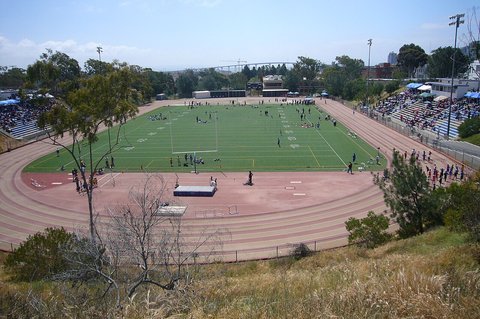
A note on the name, because the cover photograph settles part of it. The official designation in 1967 was the AFL-NFL World Championship Game, and the point at which the nickname became the formal title is argued in this series at Tulane Stadium in New Orleans. But the photograph on this entry, taken at this game, shows large freestanding letter boxes along the track in front of the near stand spelling out the two words of the nickname, and the end zones painted with the two club names. Whatever the letterhead said, the field furniture on the day had already adopted the shorter name. That observation is this entry's own reading of the image, not a claim taken from a source.
The building is older than any of this and was designed for a different purpose. The National Park Service nomination that made it a National Historic Landmark, reference number 84003866, describes it as a reinforced concrete cast-in-place structure in the form of a giant elliptical bowl, about 1,038 feet long by 738 feet wide at its midpoint, rising 106 feet from field level to the top rim, with the field 32 feet below grade because the bowl was cut into a sand and gravel pit inside an old racetrack oval. It was built in 1921-23. Its third bank of 25 tiers was added in 1930-31 to fit it for the 1932 Olympic Games, raising the seating from 75,000 to nearly 102,000, which is why a football crowd of sixty-two thousand looked thin in it. The nomination records the building's other name as Olympic Stadium. The peristyle, with its triumphal arch and fourteen smaller arches and the concrete torch added for the Games, is on the east end, facing Figueroa Street. This series pins the same building once already, in 1946, for a lease condition attached to a different question entirely.
Status as read on 8 September 2026. The Coliseum is still in use and is operated on behalf of the Coliseum Commission by the University of Southern California; the OpenStreetMap record for the site carries a USC contact address and the venue's own website. A reader arriving later should check the building's current operator and naming rights before repeating either.
Coordinate. The pin is at 34.014015 north, 118.287879 west, with a precision radius of 50 metres, placed at the centre of the stadium footprint. It was computed here as the shoelace centroid of the outer ring of OpenStreetMap way 443675312, retrieved from the OpenStreetMap raw API and stitched from its 69 nodes; that ring is the site perimeter and encloses about 293 metres north to south by 410 metres east to west, wider than the bowl itself because it takes in the peristyle forecourt on the Figueroa side.
This coordinate rests on one method, and the entry says so rather than dressing up the checks as a second. Two checks were run and both are weaker than a second method. Wikimedia Commons geosearch within 250 metres returns 100 geotagged files carrying only six distinct coordinate values, and 80 of the 100 repeat a single value to six decimal places; that is a published figure copied between uploads, not eighty observations, and the median over the distinct values falls 6.6 metres from the computed centroid. The United States Census TIGER geocoder resolves the Coliseum's postal address, returned verbatim as 3911 S Figueroa St, Los Angeles, CA, 90037, to a point about 470 metres east of the centroid. That is not a disagreement about where the stadium is. It is the mailing address on the street, and the Park Service nomination independently explains the offset by putting the peristyle and the entrance on the east end while the bowl sits back inside Exposition Park. The National Historic Landmark nomination's own map references were read and are too badly transcribed in the scanned form to convert reliably, so they were not used. The Wikidata identifier for the arena is carried as a tag on the OpenStreetMap object itself, which makes the two a declared linked pair rather than two methods.
Cover image: the halftime of this game at this stadium on 15 January 1967, uploaded to Wikimedia Commons by the contributor Jimberg13 as own work under a Creative Commons Attribution-ShareAlike 4.0 licence, with the file's own date field giving 15 January 1967 and its description naming the University of Arizona Symphonic Marching Band, the Grambling State University Marching Band, Al Hirt, and the Anaheim High School Drill Team and Flag Girls. The file was opened and examined before use. It is a composite rather than a single exposure: an inset roundel at the lower left shows a trumpeter on a podium, added to a wide view from high in the stand. The wide view shows the two club names painted in the end zones, the letter boxes on the track spelling out the nickname, balloons released over the far rim, and, at the left of the frame, sections of upper deck visibly thinner than the rest, which is the unsold third of the building described above.
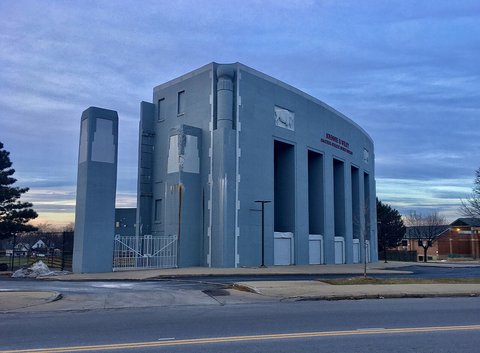
Second image: the peristyle and its triumphal arch seen from outside on the Figueroa Street side, photographed on 17 May 2016 by Anthony Kernich and published on Wikimedia Commons under a Creative Commons Attribution 2.0 licence. It was opened and examined. It is a modern photograph, forty-nine years after the game, and is included for two reasons: the frame identifies the building by the name carved across the arch, and it shows the east end that the Park Service nomination describes and that explains why the postal address and the stadium footprint sit almost half a kilometre apart. The Olympic rings mounted below the lettering and the torch above it are the building's other identity, which predates its football history by thirty-five years.

changes?
delete this memory?
We detected that you have a Blox in your crypto wallet! We will import the Blox into your account.
Click on done below to complete the import.
Welcome Back!
Sign in to preserve cherished moments
Don't have an account?
Welcome!!
Sign up and start preserving cherished moments
?
?
Choose your payment method
Buy with Metablox Credit
Do you want to mint Blox with Metablox Credit?
Which Crypto would you like to use?
Purchase Confirmed!
Your Blox is being minted on-chain and will appear in your profile shortly.
Log in or sign up to claim your Blox.
How many credits do you want to buy?
$100 USD = 1 Metablox Credit = 1 Blox.
Use Metablox Credit to mint any Blox you want on the map.
 expand_more