Biography | Lew Hoad — the record stops in 1957 because that is the year he was paid, Kooyong, December 1953
volume_up
Listen
directions
Directions
On Monday 28 December 1953 the Davis Cup challenge round opened at Kooyong, and the United States expected to take the first match. Vic Seixas, that year's Wimbledon champion, had played Lewis Hoad six times and won all six, four of them in 1953. Hoad was nineteen.
Hoad won 6-4, 6-2, 6-3. The Associated Press reported it from Melbourne the same day, in front of what its correspondent called a packed audience of 17,500, and noted that the defeat was "particularly galling" for the Americans precisely because Seixas had never lost to him before. Tony Trabert levelled the tie by beating Ken Rosewall, also nineteen, later that afternoon. Kooyong Lawn Tennis Club's own account of the week has Australia trailing 1-2 after the doubles and being saved in the reverse singles by the two Sydney teenagers, Hoad beating Trabert and Rosewall beating Seixas. Australia kept the cup for a fourth consecutive year.
**What the four-title record is a record of.** The International Tennis Hall of Fame, which inducted him in 1980, credits Hoad with four major singles titles: the Australian Championships and the French Championships in 1956, and The Championships, Wimbledon, in 1956 and 1957. It records him as a finalist at the US National Championships in 1956, beaten there by Rosewall.
That 1956 line is worth stating carefully, because "Grand Slam" carries two meanings in this sport and they are routinely run together. In the sense of the four tournaments, Hoad won four. In the sense of all four in a single calendar year — the sense in which Don Budge is credited with 1938 and Rod Laver with 1962 — Hoad won three of the four in 1956 and lost the fourth in its final.
The count of four covers two seasons, 1956 and 1957, and no others. It stops in the middle of 1957, and what stopped it was not form.
**July 1957.** Within days of winning Wimbledon for a second consecutive year, Hoad agreed terms with the promoter Jack Kramer. The Associated Press carried the story on 7 July 1957, before the contract was signed: a record 125,000-dollar, two-year professional contract, with a debut the following Saturday in Kramer's Tournament of Champions at Forest Hills, then Los Angeles from 29 July, then a tour of Europe, South Africa and Australia. Kramer, quoted in that report, said: "I made Lew a $100,000 offer which still stands." He had raised it to 125,000 dollars, he said, because of the Wimbledon result, and put that figure at 50,000 dollars more than any player had been offered before.
A second Associated Press report the next day, 8 July, has Hoad in transit and still short of signing. Asked whether he might refuse, he said: "The chance of my turning it down are about 1 in 100." He also said he thought he could play for Kramer for about six years — a man giving the length of an earning window, not of a career.
For scale within this platform's own records: six years later, the professional tour that Rod Laver joined at the end of 1962 offered a top prize of 35,000 dollars for a fifty-city season.
**Why the number is a rule and not a measurement.** The four championships at Melbourne, Paris, London and New York admitted only players who had never been paid to play. That condition was written and enforced by the International Lawn Tennis Federation and the national associations affiliated to it, and it was those bodies — not any tournament committee acting alone — that decided a player who took Kramer's money was no longer eligible for their events. The federation did not vote to abolish the distinction until 30 March 1968.
So Hoad, who had been ranked the world's leading player in 1956, entered no major championship between the summer of 1957 and 1968. He was 33 by the time the tournaments opened, and he did not win another. Nothing here is a claim about how good he would have been in those draws; the point is narrower and harder to argue with. His four is a count of the seasons in which he was both at his peak and permitted to enter, and those two conditions overlapped for eighteen months.
The rule is often described as having protected something. In Hoad's case what it protected the four championships from was Hoad.
**A note on Kooyong's capacity, and a disagreement.** The Associated Press described the ground in December 1953 as "Kooyong's vast 17,500-seat stadium" and gave the challenge-round crowd as 17,500. An earlier memory on this platform puts the stadium's historic capacity at around 15,000. Both figures are reported here rather than reconciled: challenge rounds routinely used temporary seating, and a 1953 press figure and a general statement of a ground's capacity are not measuring quite the same thing. Neither has been checked against a club or association record.
**Sources and their limits.** The 1953 challenge round is read from *Evening Star* pages digitised by the Library of Congress: the preview, the record of previous Seixas-Hoad meetings and the description of the stadium from 27 December 1953, page 28 (https://www.loc.gov/resource/sn83045462/1953-12-27/ed-1/?sp=28); the result, the scores and the crowd figure from 28 December 1953, page 11 (https://www.loc.gov/resource/sn83045462/1953-12-28/ed-1/?sp=11). The professional contract is from two separate papers carrying Associated Press copy: *Evening Star*, 7 July 1957, page 53 (https://www.loc.gov/resource/sn83045462/1957-07-07/ed-1/?sp=53), and *The Key West Citizen*, 8 July 1957, page 8 (https://www.loc.gov/resource/sn83016244/1957-07-08/ed-1/?sp=8). The optical character recognition of these pages is rough and the two quotations are given in corrected spelling and figures; the page images at those addresses carry the wording as printed. The 8 July quotation retains the grammar as set.
One detail in the 27 December preview is not usable as printed. Its subheading reads "Hoad 4-to-1 Choice," while a sentence in the body offers 4 to 1 on Seixas failing, which points the other way. The two cannot both be right as scanned, so no betting price is asserted here. The six straight defeats are stated in the same column and are not ambiguous.
The birth and death dates, the title years, the 1956 world ranking and the induction year are from the International Tennis Hall of Fame's inductee entry (https://www.tennisfame.com/hall-of-famers/inductees/lew-hoad), an institutional record rather than a primary document. The account of the reverse singles is Kooyong Lawn Tennis Club's own (https://www.kooyong.com.au/the-davis-cup), read as the club's account of itself.
Hoad was born in Glebe, New South Wales, on 23 November 1934 and died on 3 July 1994. He played for Australia throughout the period described here.
**Status note, September 2026.** Lew Hoad died in 1994. Ken Rosewall, who appears here as a nineteen-year-old team-mate and as the man who beat Hoad in the 1956 US final, was living when this was written; nothing is said of him beyond those match results.
**Coordinate.** -37.838356, 145.031049, precision radius 250 metres. This memory deliberately reuses the pin already established for Kooyong Stadium on this platform rather than setting a second one a few metres away: two independently maintained sources support it, Wikidata at -37.838333, 145.031944 and OpenStreetMap's sports-centre extent at -37.838380, 145.030154, about 157 metres apart. The pin is the club grounds on Glenferrie Road in Toorak, not the court the 1953 matches were played on, and the radius covers the site. Kooyong is roughly 4.8 km east-south-east of Melbourne Park, where the Australian Open has been played since 1988.
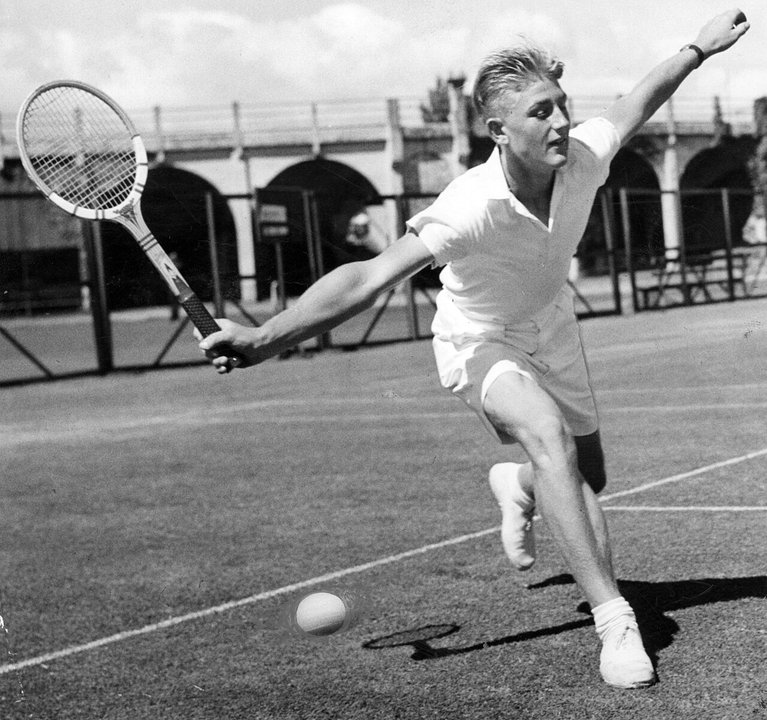
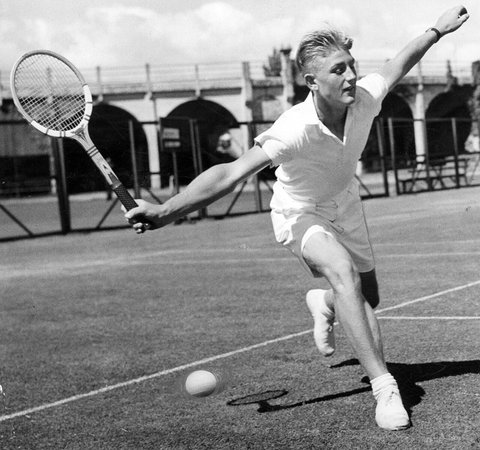
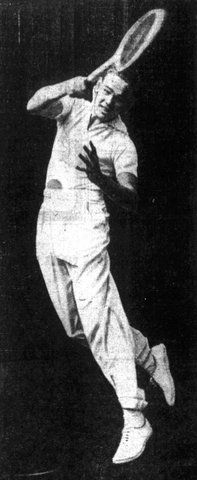
**Cover image.** "Australian tennis player Lewis Hoad at age 15 competing at Kooyong in Inter State Tennis" — photograph by Len Drummond, dated 1949, held by the State Library of Victoria and in the public domain in Australia on expiry of its copyright term. The caption's date is given only as the year, so the age it states has not been checked against his November birthday. He is stretched wide to a low forehand on grass. The structure behind him is the reason this frame is usable as a Kooyong photograph independently of its caption: an arcaded lower concourse with arched openings, a railed walkway above it and folding chairs stacked against the fence — fixed architecture rather than a plain backdrop. One honest oddity: the ball lying on the grass has the soft halo of hand-retouching, which was ordinary practice on press prints of the period, and he appears to be holding a second ball in his raised left hand.
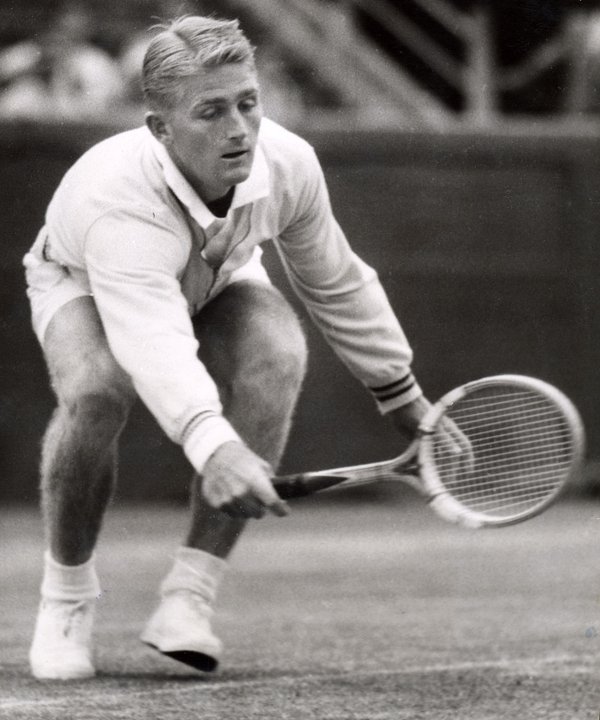
**Second image.** "Australian tennis player Lew Hoad at Kooyong in 1954" — photograph by C. T. Halmarick, dated 1954, also State Library of Victoria and also public domain in Australia by expiry of term. Hoad grown, crouched almost to the turf for a low backhand, in a long-sleeved white sweater with banded cuffs. The background is thrown out of focus and carries no fixed structure, so the venue here rests on the library's catalogue record and not on anything visible in the frame. Between this photograph and the cover is the whole of what the amateur championships were allowed to see of him.



























 expand_more