Biography | Suzanne Lenglen — The Riviera Club Where Her Father Built a World Champion, 1910
volume_up
Listen
directions
Directions
Her father handed her a racket in June 1910. She was eleven.
Charles Lenglen was not a coach and held no post in the sport. What he had was the means to spend every winter on the Riviera, and a daughter he decided to build.
Those winters went to the Nice Lawn Tennis Club, on clay. That surface is the reason a French girl arrived in England able to play a rally nobody there had seen.
What her father ran at Nice was not a childhood. He prescribed physical conditioning, set long daily practice sessions, and matched her against strong adult men on the Riviera circuit rather than against girls her own age.
Four years of it, and she was the best woman player in the world.
From 29 May to 8 June 1914, on the clay of the Stade Français at the Parc de Saint-Cloud outside Paris, the World Hard Court Championships were played. Lenglen — fifteen years old, having had the birthday five days before the first ball — won the women's singles from Germaine Golding 6-2, 6-1, took the doubles, and was runner-up in the mixed.
Two things about that are worth saying plainly.
The first is that no national association made her. A private club on the Côte d'Azur did, at the direction of one obsessive parent, and the sport's governing bodies received the finished article.
The second is what it cost to be an amateur. Nobody paid the Lenglens, and nobody had to: the money that produced the world's best player was the money it took to spend every winter in Nice and never need a wage from the game. Amateurism was a rule about who could afford to play, before it was a rule about anything else.
She spent the rest of her competitive life on that footing, and then she stopped. In 1926 she signed with the American promoter C. C. Pyle, turned professional, and by doing so put the four major championships permanently out of her own reach. She was twenty-seven, and she never entered one again.
Suzanne Lenglen died on 4 July 1938, aged thirty-nine. The avenue running to the gate of the club where her father taught her carries her name, and so does the second show court at Roland-Garros.
**Coordinate.** 43.704493, 7.252338, precision radius 150 m. Two independent national sources agree closely: the French national mapping agency's Géoplateforme geocoder returns 43.704543, 7.25258 for 5 Avenue Suzanne Lenglen, Nice, at a match score of 0.974, and OpenStreetMap's entry for the Nice Lawn Tennis Club itself gives 43.7044425, 7.2520955 — about 41 m apart. The pin is the midpoint. It marks the club, not a court: the club has laid out and relaid its courts many times since 1910, and nothing here identifies the ground she actually practised on.
**Cover image.** Suzanne Lenglen at fifteen, photographed on 7 June 1914 at the World Hard Court Championships. Agence de presse Meurisse, Bibliothèque nationale de France via Gallica, public domain. She is standing on grass at the edge of the Saint-Cloud grounds with three rackets, in the headband she wore for the rest of her career; the agency's negative number, 52500, is scratched into the plate at the right. Press-agency dates of this period are usually the date the plate was filed for circulation rather than the date of play, so treat 7 June as approximate to within days.
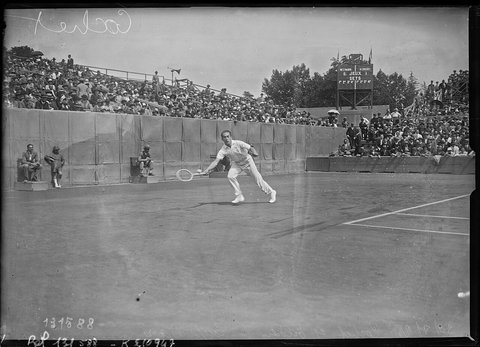
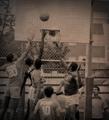
**Second image.** The same sequence, negative 52488: Lenglen playing at the baseline on the clay at Saint-Cloud, ball in the air above her, a full gallery behind a dark backdrop. Agence de presse Meurisse, BnF via Gallica, public domain. Neither photograph was taken at Nice — no free-licensed image of the Nice Lawn Tennis Club was found — and both are included because they show, four years after she was handed the racket, what the winters at Nice had produced.
**On sourcing.** The June 1910 racket, the Nice training regime and the practice against adult men are drawn from published biographical accounts rather than from a contemporaneous document; no primary record of the household's routine was located. The 1914 result, venue, dates and surface are documented independently of them.












































 expand_more