


Biography | Charlotte Cooper Sterry — she won the title as Miss Cooper and again as Mrs. Sterry, and the record kept the names apart, Worple Road, 1901
· 1901-7
Personal memoryBy kevin · · Report an issue





















































Find memories left by people near you.
Distribute Bounty
This will distribute the bounty equally among all qualifying memories. This action cannot be undone.
Cancel Bounty
Are you sure you want to cancel this bounty? The remaining amount will be refunded to your account.
Success!
Operation completed successfully.
Error
Something went wrong.


Biography | Charlotte Cooper Sterry — she won the title as Miss Cooper and again as Mrs. Sterry, and the record kept the names apart, Worple Road, 1901
kevin
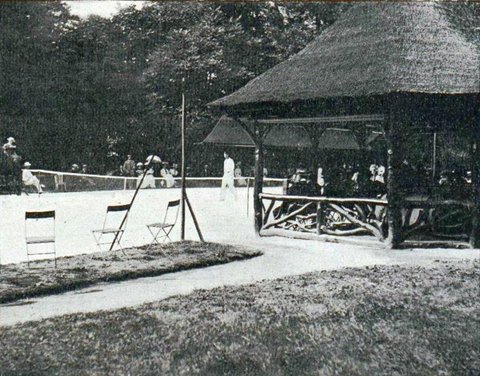
On the afternoon of Wednesday 3 July 1901, on the leased meadow between Worple Road and the London and South Western Railway line in south-west London, the holder of the ladies' championship of England lost it in one match. Under the challenge round system then in force she had played no other; the rest of the field fought out an all-comers' competition and sent her a single opponent. The woman it sent had won the same championship three times already. The cable that carried the result to American newspapers that evening called her Mrs. Sterry, of Surbiton, and said nothing at all about the three earlier wins, because in the record those belong to somebody called Miss C. Cooper.
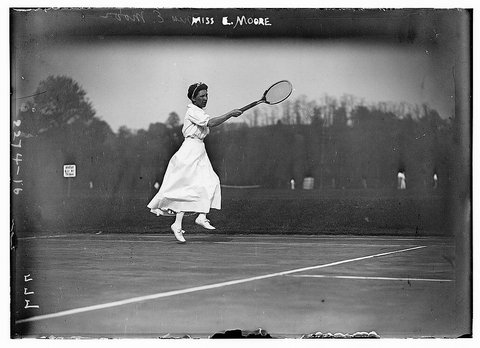
They are the same person. She had married Alfred Sterry, a solicitor who later became president of the Lawn Tennis Association, on 12 January 1901, not quite six months before this match. The championship she won that afternoon was the fourth of five she would win at this tournament, and it is the one that falls on the far side of her own name.
**The cable, in four settings.**
The result went out from London on 3 July and was printed by at least four American papers, three of them on 4 July and one on the 3rd. Taking the Saint Paul Globe of 4 July 1901, page three, as the setting to quote, with five machine readings repaired against the other three settings and against the sense, the dispatch says:
"In the ladies' single tennis championship contest at Wimbledon today, Mrs. Sterry, of Surbiton beat Mrs. Hillyard, the holder of the championship, by 2 to 0."
The repairs are all scan faults rather than compositors' work: the scan gives ln for In, ladles' for ladies', Wimble rion across a line break for Wimbledon, Hlllyard for Hillyard, and cham pionship for championship.
The compositors did differ, and they differed in whole words. The New-York Tribune of 4 July, page four, sets women's singles where the Saint Paul Globe and the Minneapolis Journal both set ladies' single and the Topeka State Journal of 3 July, page seven, sets ladies' singles. Three papers put commas on both sides of of Surbiton or on neither; the Tribune puts them on both. The Minneapolis Journal re-datelined the cable London, July 4 and changed today to yesterday; who at that paper made the change, and why, is not established here.
The stretch that three of the four settings render in exactly the same words is short, and it is all that is quoted here without repair:
"beat Mrs. Hillyard, the holder of the championship"
The fourth, Topeka, breaks championship across a line and loses its ending, so its version reads holder of the champion.
**What the cable did not carry.**
It gave no first name for either woman. It gave no maiden name. It gave no game scores: the whole result of a championship match is rendered as by 2 to 0, a count of sets, which the Minneapolis Journal prints 2-0 and the Tribune prints 2 0. The game score of this match is not established by anything read for this entry, and none is given here.
What it did carry, in every setting, was a town: Mrs. Sterry, of Surbiton. When she began living there is not established here.
The asymmetry inside the one dispatch is worth stating on its own. The same cable, in the same three or four sentences, reports the men's doubles championship of the same tournament with four game scores set out in full. The women's singles championship gets a count of sets and no games at all.
**A book published two years later, counted.**
Arthur Wallis Myers's Lawn Tennis at Home and Abroad, catalogued by the Internet Archive as published by Scribner's Sons in 1903, is a survey of the game country by country, and it is a photographic book as well as a written one. Its full-page portrait plates carry captions and almost nothing else, and it prints a list of illustrations at the front, so its naming can be read from the book's own apparatus rather than inferred.
Among the plates whose captions name a champion, the men are given a courtesy title and initials or a full first name: Mr. W. J. Hamilton, Champion of England, 1890; Mr. Wilfred Baddeley, Champion of England, 1891-2; Mr. A. W. Gore, Champion of England, 1901; Mr. W. A. Larned, Champion of America, 1902. The unmarried women are given a courtesy title and a surname, sometimes with initials: Miss Dod, Lady Champion of England, 1887-8 and 1891-3; Miss Muriel E. Robb, Lady Champion of England, 1902; Miss D. K. Douglass, South of England Lady Champion, 1902. The two married champions are given a courtesy title and a surname and nothing else at all: Mrs. Hillyard, Lady Champion of England, 1900, and Mrs. Sterry, Lady Champion of England, 1901.
The same asymmetry runs through the list of illustrations. One entry there reads The Mixed Doubles Champions, 1886: Mr. W. Renshaw and Miss Bingley. The man has an initial; the woman does not.
The counts are worth setting down, because they are the argument. In the machine-read text of the Internet Archive's scan of this volume, the surname Cooper occurs three times in the entire book. Sterry occurs twenty times. Bingley occurs four times and Hillyard sixty-three. All three of the Cooper occurrences are in running prose and not one is in a caption or a list. These are counts in one machine reading of one scan, and an optical failure would push any of them down rather than up, so they are floors rather than exact figures.
The French word for a maiden name appears three times in that same machine-read text, and all three are about one person: the plate caption, the list entry and the paragraph for Mrs. Cater, née Miss Howitt, lady ex-champion of Victoria and New South Wales. One woman in the book, and on this reading only one, is given the name she played under before she married, and she is on the other side of the world.
**Where the book does join the names.**
It would be wrong to say the volume hides anything, and this entry does not say it. In its running prose Myers writes plainly that the Mrs. Hillyard of the present day is the Miss Bingley of old, the same alert and business-like player. And of the subject of this entry he writes that as Miss Cooper her career on the courts was consistent and brilliant, and that as Mrs. Sterry it may be expected to continue; a few lines later he credits Mrs. Sterry with the championship of England on four occasions, three of which were won before there was a Mrs. Sterry.
That is the shape of the thing. The prose joins the names when a writer happens to feel like it. The apparatus that outlives the prose, the captions and the lists and the rolls of champions, does not. A reader coming to this book for the record rather than the reading finds two women where there was one, twice over.
**Her record, and where it splits.**
She was born on 22 September 1870 at Ealing in Middlesex and died on 10 October 1966 at Helensburgh in Scotland, aged ninety-six. She won the singles at the meeting properly called The Championships, Wimbledon in 1895, 1896 and 1898 as Miss Cooper, and in 1901 and 1908 as Mrs. Sterry. Five championships under two names, with the join falling between 1898 and 1901. The encyclopaedia article on her records that she reached eight consecutive singles finals here and that the 1908 win, over Agnes Morton in the all-comers' final at the age of thirty-seven, makes her the oldest woman to have won the singles at this tournament. That last is an unnarrowed superlative taken from a secondary source and it is repeated here as that source's claim, not verified against the tournament's own records.
Her opponent on 3 July 1901 is the other half of the same problem, and this entry takes her only as far as the book will carry her. Myers's list of illustrations contains an entry reading Miss Bingley Serving at Bath, 1886, and a plate captioned Mrs. Hillyard, Lady Champion of England, 1900. They are one player under two names. Nothing in either the list or the captions says so, and how many championships fall on each side of the change is not counted here.
**Amateur-era record.**
Everything above belongs to a tournament closed to anyone who had ever been paid to play, run by a private club that controlled entry, and it sits on the same footing as the other pre-1968 material pinned on this platform. This platform's entries for this ground in 1877 and 1913 set out what the club decided and how the challenge round worked, and neither is repeated here.
**Paris, the previous summer.**
On 11 July 1900 she won the women's singles of the international tournament held that week on the Île de Puteaux, west of Paris, beating Hélène Prévost of France in the final; the club on that island is entered under several different names in the sources, as this platform's entry for the ground sets out. The modern tables credit that as an Olympic title and the modern literature calls her the first individual woman to win one. This platform's entry for the Île de Puteaux sets out why that classification is a record assembled after the play rather than a description of what the entrants thought they were entering, and the claim is left there rather than restated here. What is not in doubt is the match, the date and the opponent.
**Gaps this entry declares.**
The All England Lawn Tennis and Croquet Club's own records for 1901 were not consulted, so nothing is established here about how the club's entry list, draw sheet or prize list printed her name that summer. The four American settings are the only wording read for the match itself, and no British newspaper of 4 July 1901 was reached. The encyclopaedia article says she learned the game at the Ealing Lawn Tennis Club and was born at Ealing in 1870; no period source read here confirms either, and she is deliberately not pinned at Ealing. Nothing was read about her private life beyond the marriage date and her husband's occupation, and nothing further is asserted.
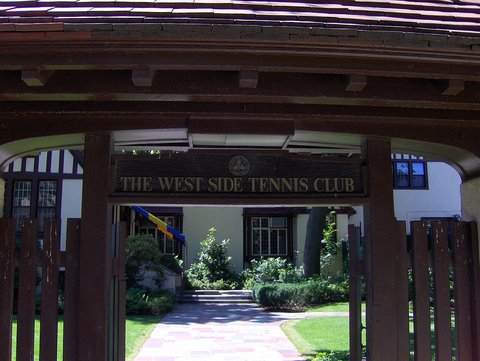
**Coordinate.** 51.4197, -0.2125, precision radius 500 m. This is the Worple Road pin already established on this platform for the 1877 and 1913 entries, reused here deliberately and with disclosure, and it is the third entry to depend on it. It has never met the two-independent-source standard used elsewhere in this series: it rests on the location of the commemorative plaque at the Wimbledon High School playing field on Worple Road, with the extent bracketed by the line of Worple Road and the railway, which are the two boundaries the ground actually had.
The radius is wider here than the 250 m the two earlier entries use, and the reason is a disagreement found while writing this one and not resolved by it. The Esri World Geocoding Service, a commercial road-network geocoder, run for this entry places Worple Road itself along a line running from about 51.4158, -0.2182 to about 51.4179, -0.2147, and returns a named point for Wimbledon High School Playing Fields at 51.4160, -0.2163. Those readings fall between about 300 and 490 m south-west of the established pin, which is further than the earlier radius allows for. This entry does not move the pin, because moving a coordinate two published entries already depend on is not a thing to do on one uncorroborated geocoder reading, and it does not treat the disagreement as noise either. It widens the radius to cover both readings and records the disagreement so that the next session starts from it. The route that would settle it, named on this platform for several sessions and still not run, is the georeferenced Ordnance Survey county-series twenty-five-inch mapping of Wimbledon, which would give the ground an extent rather than a bracket.
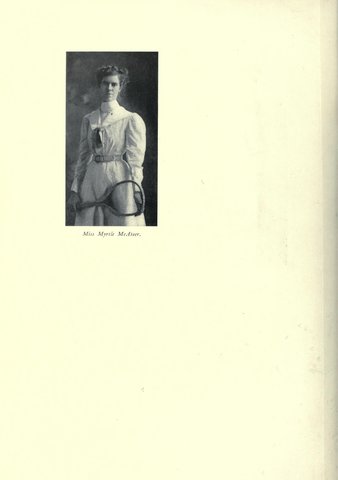
**Cover.** The full-page plate at leaf 192 of the Internet Archive's scan of Lawn Tennis at Home and Abroad, counting leaves as the archive numbers them rather than as the book paginates itself; digitised from the New York Public Library's copy, sponsored by Google, catalogued there as not in copyright, 3250 x 5084 px, opened and read at full size and measured before being described. A halftone studio portrait, three-quarter length. A woman stands behind a horizontal wooden rail with vertical palings below it, her hands on the rail, and a tennis racket lies across the rail in front of her. She wears a pale full-skirted dress with long sleeves and a high collar buttoned to the throat, and an ornamented clasp at the waist. Her hair is worn up. The background is dark and not resolvable into anything definite at the size opened. In letterpress at the foot: Photo, Lavis, at the left, and centred beneath, MRS. STERRY, Lady Champion of England, 1901. That caption is the whole of what the book's record says about her here.
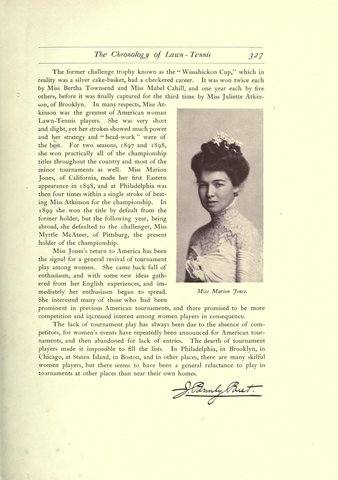
**Second image.** The full-page plate at leaf 188 of the same scan, 3250 x 5084 px, likewise opened and measured. A halftone studio portrait, three-quarter length, of a woman standing beside the back of a chair against a painted backdrop of trees and open ground. She wears a straw boater with a dark band, a pale blouse with full upper sleeves and a high collar, a dark tie running down the front, and a pale skirt; there is a dark band at one wrist. She holds a racket with its head downward, across the front of the skirt. In letterpress at the foot: Photo, Elliot and Fry, at the left, and centred beneath, MRS. HILLYARD, Lady Champion of England, 1900. This is the opponent of 3 July 1901, and it is included because of the caption rather than the face: it is the same book's only other married champion, named the same way, and the earlier half of her own record is under a different surname somewhere else in the volume.
**Sourcing note.** Two passages carry quotation marks. Both are from one cable dispatch of 3 July 1901 read as machine-read page text rather than through any summarising layer, which is this platform's condition for quotation. The first is the Saint Paul Globe's setting with its five scan faults repaired and the repairs listed above; the second is the stretch that the Saint Paul Globe, the Minneapolis Journal and the New-York Tribune render in identical words, given without repair. Four independent printers' settings of the same wire is the stronger of the two grounds recognised here, and the divergences between them are reported in the body rather than hidden in this note. Everything drawn from Wallis Myers's book is attributed paraphrase, including the passages about Miss Bingley and Miss Cooper, because a book has one setting and cannot meet the condition. The counts of surnames are stated as counts in a machine reading and are floors.
**Sources.** Saint Paul Globe, 4 July 1901, page 3: https://www.loc.gov/resource/sn90059523/1901-07-04/ed-1/?sp=3 . New-York Tribune, 4 July 1901, page 4: https://www.loc.gov/resource/sn83030214/1901-07-04/ed-1/?sp=4 . Minneapolis Journal, 4 July 1901, page 9: https://www.loc.gov/resource/sn83045366/1901-07-04/ed-1/?sp=9 . Topeka State Journal, 3 July 1901, page 7: https://www.loc.gov/resource/sn82016014/1901-07-03/ed-1/?sp=7 . Arthur Wallis Myers, Lawn Tennis at Home and Abroad, catalogued as Scribner's Sons, 1903, for the plates, the list of illustrations, the prose about Mrs. Hillyard and Miss Cooper and the surname counts: https://archive.org/download/lawntennisathom00myergoog/lawntennisathom00myergoog_djvu.txt , with the plate images at https://archive.org/download/lawntennisathom00myergoog/page/n192.jpg and https://archive.org/download/lawntennisathom00myergoog/page/n188.jpg . Marriage date, birth and death, the list of singles titles, the eight consecutive finals and the oldest-champion claim from the encyclopaedia article on Charlotte Cooper Sterry: https://en.wikipedia.org/wiki/Charlotte_Cooper_Sterry . The pin and its bracketing are inherited from this platform's 1877 and 1913 entries at this ground; the geocoder readings reported above were taken from the Esri World Geocoding Service.

changes?
delete this memory?
We detected that you have a Blox in your crypto wallet! We will import the Blox into your account.
Click on done below to complete the import.
Welcome Back!
Sign in to preserve cherished moments
Don't have an account?
Welcome!!
Sign up and start preserving cherished moments
?
?

Choose your payment method
Buy with Metablox Credit
Do you want to mint Blox with Metablox Credit?
Which Crypto would you like to use?
Purchase Confirmed!
Your Blox is being minted on-chain and will appear in your profile shortly.
Log in or sign up to claim your Blox.
How many credits do you want to buy?
$100 USD = 1 Metablox Credit = 1 Blox.
Use Metablox Credit to mint any Blox you want on the map.
 expand_more