
NFL History | Allianz Arena, Munich — The Territory Was Sold Before the Ground Was Chosen
· 2022-11
Personal memoryBy kevin · · Report an issue










































Find memories left by people near you.
Distribute Bounty
This will distribute the bounty equally among all qualifying memories. This action cannot be undone.
Cancel Bounty
Are you sure you want to cancel this bounty? The remaining amount will be refunded to your account.
Success!
Operation completed successfully.
Error
Something went wrong.
NFL History | Allianz Arena, Munich — The Territory Was Sold Before the Ground Was Chosen
kevin
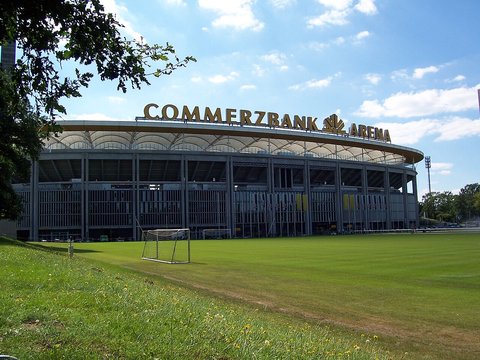
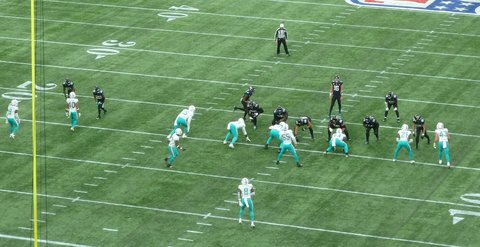
On Sunday 13 November 2022 the Tampa Bay Buccaneers beat the Seattle Seahawks 21-16 in this building, in front of 69,811 people, in two hours and forty-eight minutes. Pro-Football-Reference files the venue as Allianz Arena and lists Tampa Bay as the home club. The National Football League and the stadium both describe it as the first regular-season game the league played in Germany, and that narrower claim is the one worth keeping: American football had been played in this country for decades, and the league had run a developmental competition based in Germany for years, an arrangement pinned elsewhere in this series at the Waldstadion in Frankfurt; what was new was a regular-season fixture that counted in the American standings.
This entry is not really about the afternoon. It is about a question with an unobvious answer: why was Tampa Bay the home team in Munich?
The ordinary assumption is that the schedule decides it. A club gives up one of its eight home dates, the league moves the fixture abroad, and the club that gave up the date is nominally at home in a stadium it has never seen. That is the arrangement described elsewhere in this series at the Estadio Azteca. It is not what happened here, and the dates are the proof.
Work through them in order. On 12 October 2021 the league named three finalist cities for a German game, Dusseldorf, Frankfurt and Munich, chosen from a field of nine. On 15 December 2021 it announced something separate: eighteen clubs had been awarded international marketing rights in eight countries for five years beginning 1 January 2022, an arrangement the league called International Home Marketing Areas. Germany went to four clubs, the Carolina Panthers, the Kansas City Chiefs, the New England Patriots and the Tampa Bay Buccaneers. Christopher Halpin, the league executive who announced it, framed the point as fandom starting with the clubs rather than with the league, and the purpose as letting teams build direct relationships with supporters abroad. On 9 February 2022, fifty-six days later by this entry's arithmetic, the league named Munich as the host of the first German game, with four International Series games committed over four seasons, two in Munich and two in Frankfurt. Roger Goodell welcomed both cities; Dieter Reiter, the Lord Mayor of Munich, called it an honour for the city to stage the first one; Brett Gosper, the league's head of Europe at the time, said Dusseldorf might host in future.
So the commercial territory was allocated before the ground was chosen. When the league came to nominate a home club for a game in a country, it had already sold that country to four teams, and one of them got the fixture. Seattle could not have been the home club at Allianz Arena in 2022 for a reason that had nothing to do with the schedule: in the December 2021 allocation Seattle held Canada, jointly with Minnesota, and not Germany.
That is a claim about one game, which makes it an anecdote. The corpus of German games since is small but it does not contradict it. On 10 November 2024 the Carolina Panthers beat the New York Giants 20-17 in overtime in this stadium in front of 70,132 people, and Pro-Football-Reference lists Carolina as the home club. Carolina was one of the original four German rights holders. On 25 February 2026 the stadium announced that the Detroit Lions would be the home club for the 2026 Munich game, and Detroit had been awarded Germany, along with Canada, Austria and Switzerland, on 25 March 2024, for at least five years from 1 April that year. Three Munich games, three home clubs, three holders of German marketing rights. The stadium noted in its announcement that Detroit brings a receiver with German connections, which is the kind of detail the programme is designed to produce.
The interesting part is what has happened to the mechanism since.
The programme was renamed the Global Markets Program in 2022. At the league's 2023 spring meeting it grew to twenty-one clubs in fourteen markets, up from nineteen clubs in ten, and Germany went from four rights holders to five with the addition of the Atlanta Falcons. By the 2026 expansion, which added Italy, the league reported that all thirty-two clubs participate, holding rights across twenty-two international markets, and that eleven of them hold Germany: Atlanta, Carolina, Detroit, Green Bay, Indianapolis, Kansas City, New England, the New York Giants, Pittsburgh, Seattle and Tampa Bay.
Read that list against the 2022 game. Seattle, the club that could not have been designated the home team in Munich because it did not hold Germany, now holds Germany. So does the New York Giants club that visited in 2024. That comparison is this entry's own reading of the two published lists, not a claim anyone else has made. What it suggests is that a rule which genuinely constrained the choice in 2022, when four clubs out of thirty-two could host a German game, constrains almost nothing in 2026, when eleven can and every club is in the programme somewhere. The allocation still exists, it still explains why the first three Munich home clubs were the ones they were, and it is on its way to explaining nothing at all. That is a common life cycle for a commercial rule and it is rarely written down, because by the time anyone notices the rule it has usually stopped mattering.
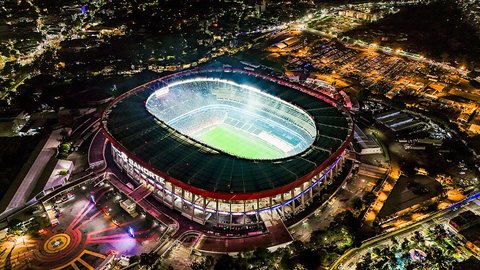
The building is worth a paragraph, because it is the other half of the tenancy question this series keeps returning to. The arena opened on 30 May 2005, after construction beginning in autumn 2002, to a design by Herzog and de Meuron with engineering by Arup and others; the facade is 2,874 inflated ETFE cushions of foil two tenths of a millimetre thick, each separately lit. It was commissioned by a company owned jointly by the city's two professional clubs, and FC Bayern bought out the fifty per cent share held by TSV 1860 Munich in 2006. Capacity is about 75,000 for domestic matches and about 70,000 for international ones, because the standing terraces a German league match uses have to be converted to seats. That second figure is the one that matters here: 69,811 people is a full house by roughly two hundred seats on this entry's arithmetic, not a stadium with room to spare.
And the field was somebody else's grass. The league painted its lines on a Bundesliga pitch, played on it for three hours, and gave it back. Compare the entry in this series for Tottenham Hotspur Stadium, which opened in 2019 with a permanent artificial American field built in underneath a retractable grass pitch: in London the league acquired a playing surface of its own, and in Munich it remained exactly what it had been in Mexico City and at Wembley, a tenant for an afternoon. The other German venue in this series, the Waldstadion in Frankfurt, sits about 298 kilometres north-west of this pin by this entry's calculation; the two are separate buildings in separate cities and the distance between the pins is not uncertainty about either.
One figure that circulates about this game should be handled carefully. The sports marketing agency SPORTFIVE, reporting on the German market, states that the organisers said they could have sold around three million tickets for the Munich game. That is a statement of unmet demand relayed by a commercial party with an interest in the number being large, not an audited count of registrations, and it is recorded here in that form. The firmer figures in the same account are that the league puts its German following at about nineteen million people with about 3.6 million following closely, and that the German Olympic Sports Confederation lists around five hundred registered American football clubs with more than seventy thousand members. Those describe a market that existed before the league arrived to sell it.
Status as read on 8 September 2026. Germany has now staged regular-season games at three venues, Munich, Frankfurt and Berlin. The 2026 Munich game is scheduled for Sunday 15 November 2026 at half past three in the afternoon local time, the Detroit Lions against the New England Patriots, and the league has committed to a further Munich game in 2028. Both of those clubs hold German marketing rights, which by 2026 is no longer a distinguishing fact. A reader arriving later should check whether Munich remains in the rotation and whether the Global Markets Program still assigns any market to fewer than all thirty-two clubs.
Coordinate. The pin is at 48.218792 north, 11.624701 east, with a precision radius of 40 metres, placed at the centre of the stadium footprint rather than at a gate or at the postal address on Franz-Beckenbauer-Platz. The primary value was computed here as the shoelace centroid of the outer ring of OpenStreetMap relation 18413487, retrieved from the OpenStreetMap raw API and stitched from its 49 outer nodes; the footprint it encloses measures about 267 metres north to south and 241 metres east to west, and the relation is tagged as a stadium building of seven levels with a capacity of 75,021 and the architects named. The independent leg is Wikimedia Commons geosearch: 100 geotagged files within 250 metres carry 26 distinct coordinate values, and the median of those distinct values falls at 48.218807 north, 11.624659 east, about 3.5 metres from the computed centroid. The distinction matters, because 65 of the 100 files repeat a single identical value to six decimal places, which is a published figure copied between uploads rather than 65 independent observations; the median was therefore taken over distinct values only. Wikidata carries a coordinate for the arena, but the OpenStreetMap relation itself carries the Wikidata identifier Q127429, so the two are a declared linked pair and count as one method rather than two; it is not used as a leg here.
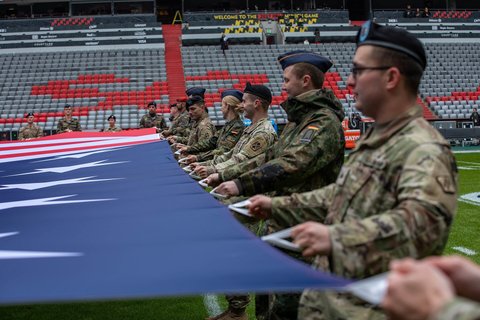
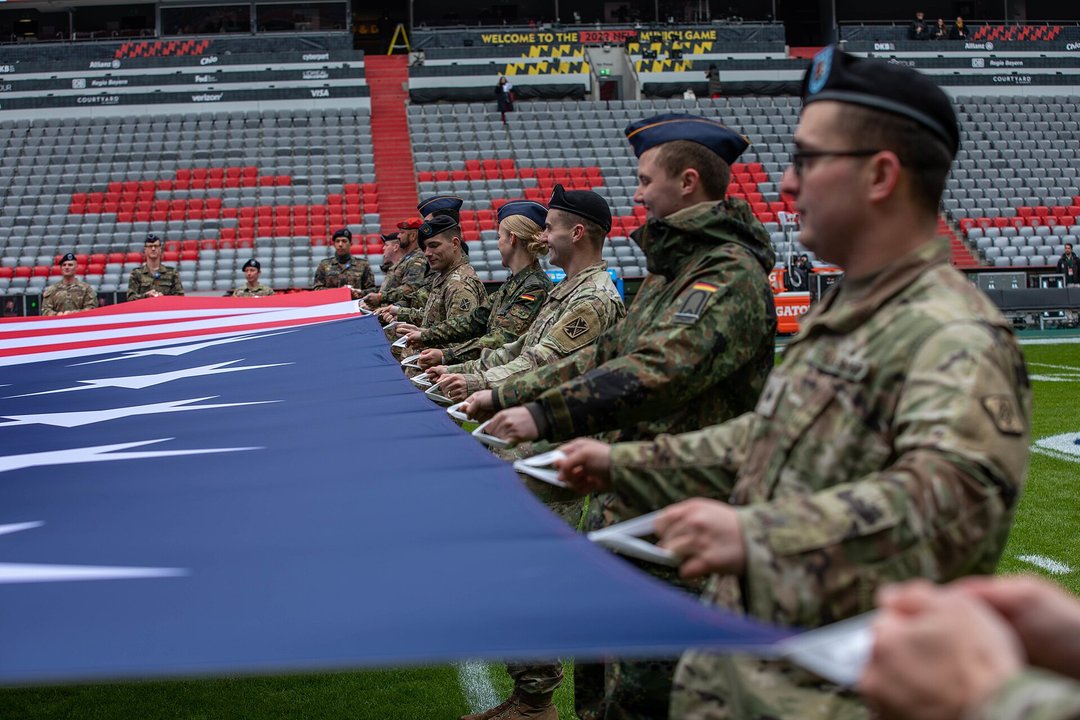
Cover image: soldiers of the United States and Germany holding the American flag on the field before the game, photographed at Allianz Arena on 13 November 2022 by Staff Sergeant Breanne Donnell, a work of the United States government in the public domain, via Wikimedia Commons. The file was opened and examined. It shows the arena empty in the hour before kickoff, the red and grey seats behind the joint colour party, natural grass marked out with American yard lines and hash marks, and the ribbon board along the upper tier carrying its own caption: a welcome to the 2022 NFL Munich Game. The frame therefore identifies and dates itself, which is why it was chosen over closer views of the ceremony.
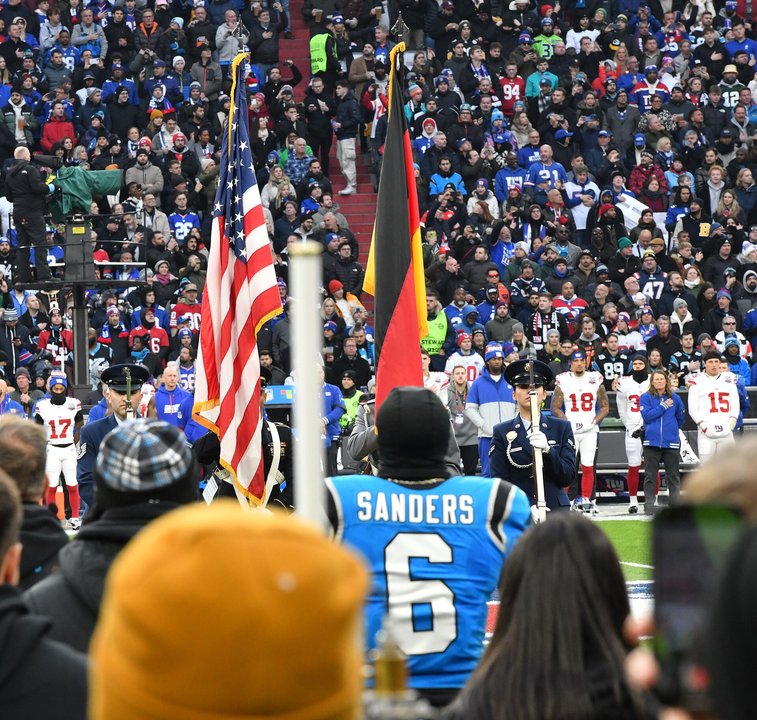
Second image: the pre-game ceremony at the same stadium on 10 November 2024, before the Giants and Panthers game, photographed by Sergeant Malik Retemiah, a work of the United States government in the public domain, via Wikimedia Commons. It was opened and examined. It shows a joint American and German colour guard with the two national flags, and behind them a full stand of spectators; the photographer's caption gives the crowd as 70,132, matching the attendance in the box score. It is included for what the crowd is wearing, which is the jerseys of a great many clubs other than the two playing that day, and which is the practical difficulty facing an arrangement that assigns a country to particular teams.

changes?
delete this memory?
We detected that you have a Blox in your crypto wallet! We will import the Blox into your account.
Click on done below to complete the import.
Welcome Back!
Sign in to preserve cherished moments
Don't have an account?
Welcome!!
Sign up and start preserving cherished moments
?
?


Choose your payment method
Buy with Metablox Credit
Do you want to mint Blox with Metablox Credit?
Which Crypto would you like to use?
Purchase Confirmed!
Your Blox is being minted on-chain and will appear in your profile shortly.
Log in or sign up to claim your Blox.
How many credits do you want to buy?
$100 USD = 1 Metablox Credit = 1 Blox.
Use Metablox Credit to mint any Blox you want on the map.
 expand_more