


Biography | Maud Watson — a Birmingham club ran a ladies' singles three years before the All England Club did, Edgbaston, July 1881
· 1881-7
Personal memoryBy kevin · · Report an issue




































Find memories left by people near you.
Distribute Bounty
This will distribute the bounty equally among all qualifying memories. This action cannot be undone.
Cancel Bounty
Are you sure you want to cancel this bounty? The remaining amount will be refunded to your account.
Success!
Operation completed successfully.
Error
Something went wrong.


Biography | Maud Watson — a Birmingham club ran a ladies' singles three years before the All England Club did, Edgbaston, July 1881
kevin
In July 1881 a Birmingham club held an open lawn tennis tournament with four competitions in it, and one of the four was a ladies' singles. It was won by a sixteen-year-old named Maud Watson, who beat her own sister Lilian in the final and then won the doubles with her. The All England Club at Wimbledon did not add a Ladies' Singles until 1884. Watson won that too, and is remembered for it.
The order of those two events is the point of this entry. The first competitive title of the first Wimbledon ladies' champion was not won at Wimbledon, was not won in London, and was not won at a championship. It was won at a provincial club tournament three years before the club that runs The Championships put on an event she could enter.
**What the club did.**
The Edgbaston Cricket and Lawn Tennis Club was founded in 1878 and staged its open tournament from 1881 until 1908, alongside the Midland Counties tournament which it began the following year and which outlived the open event by more than half a century. The club's successor records that Edgbaston had twelve courts to the neighbouring Priory club's six, and describes it in those decades as the more prominent, better resourced and more nationally visible of the two. In December 1964, after a fire destroyed the Priory club's premises in May 1963, the two merged as the Edgbaston Priory Club.
So the actor here is a club committee in Birmingham that decided its tournament would have a ladies' singles in it. Nobody made them. The governing body of the sport did not require it, and the club that owned the championship did not do it for another three years.
**What the record of 1881 actually says, and where it disagrees with itself.**
The account this entry rests on is a passage from Routledge's Sporting Annual for 1882, reviewing lawn tennis in 1881, reproduced in an encyclopaedia article on the tournament. The annual as reproduced there reports that on the 20th, 21st and 22nd of July the Edgbaston Open Tournament was held with four competitions; that the ladies' singles went to Miss M. Watson; that the doubles went to Miss Watson and Miss M. Watson; that the gentlemen's singles was won by W. W. Chamberlain; and that the gentlemen's doubles went to J. G. and W. W. Chamberlain.
Two things in that are worth stopping on.
The first is that the ladies' doubles pair is entered as Miss Watson and Miss M. Watson, which is to say by surname and by surname with an initial, for two sisters who both played. The finalists of the singles were the same two people. The sister's own name is not stable either: the encyclopaedia article on Maud Watson spells her Lilian in its text and Lillian in the link to her own article, in the same document. A period sporting annual could print a national result in which one of the two women has no distinguishing mark at all beyond not being the one with the initial.
The second is that the same body of sources gives four different datings of this one tournament. The encyclopaedia article's opening sentence says the event was first staged in June 1881. Its history section says the tournament was established on 21 July 1881. The annual it quotes says the play ran on 20, 21 and 22 July. The article introduces that quotation as a description of an event that concluded on 23 July 1881. This entry uses 20 July, the first of the three days the annual itself names, and prints the disagreement rather than choosing quietly. A separate encyclopaedia page on the women's season of 1881 gives the singles final score as 6-3, 6-1, 6-4 and dates the tournament to 23 July; that score is used here and that date is not.
**The two Edgbaston clubs, which are not the same club.**
There are two lawn tennis institutions in Edgbaston and confusing them is the easiest available error. The Edgbaston Archery and Lawn Tennis Society, informally the Archery, began as an archery society in 1860, moved in 1867 to premises beside the Birmingham Botanical Gardens, and describes itself as the oldest lawn tennis club in the world. It was still in operation at those premises according to the encyclopaedia article and the club's own pages read for this entry on 6 September 2026. That is a claim about survival rather than about founding, it is the club's own, and this entry neither adopts it nor tests it.
The tournament Maud Watson won was not held there. It was held by the Edgbaston Cricket and Lawn Tennis Club, a separate body founded eighteen years later, on a separate ground. Both are called Edgbaston, both play lawn tennis, and secondary writing runs them together constantly. This entry is about the second of them.
**Where the ground was, which is not settled.**
Two accounts locate the Edgbaston Cricket and Lawn Tennis Club's ground in two different places, and this entry cannot resolve them.
The encyclopaedia article cites the Birmingham Daily Post of 23 August 1883, reporting the second Midland Counties tournament as having begun on the club ground, Hall Hill Road. That newspaper was not read directly; only the citation was. A second and separate web source, the Harry Gem Project, a local history site devoted to the origins of lawn tennis in Birmingham, also puts a six-day open tournament of the Edgbaston Cricket and Lawn Tennis Club at Hall Hill Road, with dates given for 1882; whether it drew that from the same newspaper is not established here, so the two attestations should not be counted as fully independent.
What neither of them can do is put Hall Hill Road on a map. Neither of the two geocoding services used for this entry returns a Hall Hill Road anywhere in Edgbaston or in Birmingham, and a search for the bare name Hall Hill in Birmingham returns Hamstead Hall Road, four miles to the north-west, and nothing in Edgbaston at all.
The successor club's own history, written by its historian in 2013 and published on the club's website, says instead that the Edgbaston Cricket and Lawn Tennis Club was set in the grounds of The Vale, a large mansion on Edgbaston Park Road belonging to an engineer named Thomas Chatwin.
Both cannot be simply true of one ground at one moment. A club that lasted from 1878 to 1964 may well have played in more than one place, and the newspaper is describing 1883 while the historian is describing a period he does not date narrowly, so the two may be compatible in a way neither source says. What this entry will not do is average them or pick the more convenient one. The pin is placed at The Vale for one reason only: The Vale is a place two independent mapping authorities can locate and Hall Hill Road is not. That is a reason about maps, not about evidence, and the account it favours is the one with the weaker attestation of the two; the coordinate paragraph below says exactly how far that gets us and where it falls short of this series' standard.
**Wimbledon, 1884.**
The All England Club added a Ladies' Singles in 1884. Thirteen players entered. Watson, then nineteen, beat her sister in the final by 6-8, 6-3, 6-3 and received a silver flower basket valued at twenty guineas. A guinea was twenty-one shillings, so the prize was an object nominally worth twenty-one pounds in the money of 1884. This entry does not say what the gentlemen's champion received that year, because it did not establish it, and a prize figure with nothing to compare it against is a number rather than a fact about a sport.
She kept the title in 1885, beating Blanche Bingley by 6-1, 7-5 in a field of ten. In 1886, the year a challenge round was introduced for the women, Bingley took it from her.
1885 was her best season and the shape of it is the reason this platform's Dublin entry and this one belong together. She won the Irish title at the Fitzwilliam club, beating Louisa Martin by 6-2, 4-6, 6-3; she won at the Northern meeting in Manchester, beating Edith Davies; and she won at Wimbledon. Her biographical article calls that the first time a woman won all three major titles in one calendar year. Read carefully, that sentence is counting Wimbledon, the Irish and the Northern as the majors, which is the pre-1913 grouping this platform's Dublin entry sets out and expressly declines to adopt as this series' frame. The claim is reported here as that article's, in its own terms, and not adopted. What is checkable, and what this entry does assert, is that she won those three tournaments in the one season.
**She finished where she started.**
Her last competition, according to the biography of her published by the Wimbledon Lawn Tennis Museum in 1983 and summarised in her encyclopaedia article, was the Edgbaston tournament of June 1889. She entered three events, the doubles, the mixed doubles and a handicap singles, and won all three. She did not compete again. She was twenty-four.
The same sources record that she never married, that she worked as a nurse in the First World War and was appointed a Member of the Order of the British Empire, and that she died on 5 June 1946 at Charmouth in Dorset, aged eighty-one. Her house is not pinned and is not named here.
There is one more Edgbaston fact worth reporting with its weight marked. The successor club's history, published in 2013 and read on 6 September 2026, states that a trophy of hers serves as the prize for the tournament the club hosts. That is the club's own statement about its own silverware; nothing read for this entry establishes which object it is, whether it is the 1884 basket or something else that carries her name, and the difference between a trophy someone won and a trophy named after someone is the single most reliable error in this series. It is recorded, unresolved.
**A period witness, and the limits of him.**
H. S. Scrivener's chapter in the 1903 survey Lawn Tennis at Home and Abroad has a section headed Edgbaston. He liked the meeting, calling it as jolly a one as anybody could wish to go to, remembered beating J. R. Deykin there in 1888 in the Midland Counties Championship, and remembered seeing the sisters M. and B. Steedman there, who both volleyed and who he says played a doubles much as two men would, which he presents as a novelty among women at the time. Of Watson he writes that he has little or no recollection of her as a singles player at Wimbledon but remembers her winning the mixed doubles at Edgbaston in 1888 with Deykin, after their opponents had taken the first nine games of the final. He also records that she and Mrs. Hillyard were the first two women champions of the Welsh meeting, which began in 1886.
Scrivener is a witness to the Edgbaston tournament in the late 1880s and not to 1881, and he says himself that his memory of Watson's Wimbledon play is poor. He is used here for what he saw.
**Amateur-era record.**
Everything above sits inside competitions closed to anyone who had been paid to play, run by private clubs that set their own entry lists and their own prizes. Pre-1968 and post-1968 records are not one series and nothing here is counted across that line. Where this platform's entries at Worple Road, at St. Martin's in Philadelphia, on the Ile de Puteaux and at Upper Pembroke Street in Dublin set out how club membership and the challenge round shaped what a championship roll looks like afterwards, those arguments are not repeated here.
**Gaps this entry declares.**
Routledge's Sporting Annual for 1882 was not read directly; its passage is taken at one remove from an encyclopaedia article that reproduces it, which is why no wording from it is inside quotation marks anywhere in this entry. Neither was the Birmingham Daily Post of 23 August 1883, and that paper is the single document that would either place the club ground on Hall Hill Road or dislodge it. Nothing establishes how many women entered at Edgbaston in 1881, what the ladies' singles prize there was, who sat on the committee that put the event on the card, or whether the ladies' singles was on the card in 1879 or 1880 before the open tournament was constituted. Alan Little's 1983 biography of Watson was not read; it is cited here only as her encyclopaedia article cites it. No photograph of the Edgbaston ground, of Hall Hill Road, or of Watson at Edgbaston was found. The cover photograph shows her at Bath, not at Birmingham.
**Coordinate.** 52.461677, -1.925017, precision radius 400 m. The anchor is The Vale, Edgbaston: the estate off Edgbaston Park Road named by the successor club's historian as the setting of the Edgbaston Cricket and Lawn Tennis Club's ground.
The coordinate for The Vale itself is dual-sourced and the two readings are independent and of different kinds. Historic England's register of parks and gardens of special historic interest carries The Vale, Edgbaston as list entry 1001483, grade II, with the national grid reference SP 05244 84894; converted from the Ordnance Survey grid to WGS84 by the standard Airy 1830 projection and Helmert transformation that gives 52.461960, -1.924246. OpenStreetMap separately holds The Vale as way 23771438, whose reported position is 52.461395, -1.925788. The two lie about 122 m apart. The pin is their midpoint and sits about 61 m from each.
What is not dual-sourced is the identification of that place as the tournament ground. That rests on one source, the club's own historian, and a second source names a different street. This entry therefore falls short of this series' two-independent-source standard for the anchor, as distinct from the coordinate, and says so here rather than burying it. The radius is set at 400 m to cover the registered estate rather than a point within it, because nothing read here locates the courts inside the grounds, counts them or dates their layout. A club is not a court.
This is the first anchor in this tennis series in Birmingham. It is not the series' first English anchor outside London, and it would have been easy to say so and be wrong: the entry on the first open tournament of 1968 is pinned at the West Hants Club in Bournemouth, in Dorset. The nearest pin to it anywhere on this platform belongs to a different subject in a different series: a biography entry on Edgbaston Chapel Road, 1,241 m to the south, computed from this platform's own stored coordinates.
**Cover.** The illustration on leaf 88 of the Internet Archive's scan of Arthur Wallis Myers's Lawn Tennis at Home and Abroad, 1903, counting leaves as the archive numbers them rather than as the book paginates itself; digitised from the New York Public Library's copy, sponsored by Google, and catalogued there as not in copyright. The page is 3250 x 5084 px, mean brightness 217 of 255; it was opened at full size, measured and enlarged before being described. In letterpress beneath the picture: MISS MAUD WATSON AT BATH, 1885.
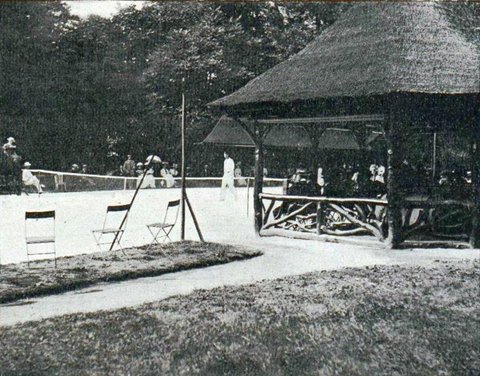
A woman stands alone on the near side of a grass court, right of centre, in a full-length white dress with a dark belt and a pale wide-brimmed hat, holding a racket low in front of her in both hands, her head turned slightly down. The net cord runs across the frame in front of her at about waist height. Behind it, packed along the far side under heavy overhanging trees, is a crowd, several rows deep in places and too closely overlapped in the halftone to count reliably. Several open parasols are held up in it, the men are in dark clothes and hats, and a group is seated on the grass at the left. A pale flat panel, possibly a screen or a marquee wall, closes the frame at the far left. A white court line runs across the foreground. No lettering, no scoreboard and no umpire's chair can be resolved anywhere inside the picture.
It is a picture of her four years after Edgbaston, at a different tournament in a different city, and it is the cover because it is the only photograph of her located for this entry. It also happens to show the thing the Dublin entry on this platform is about, from the other side: a woman playing a public tournament in front of a crowd standing close enough to lean on the net.
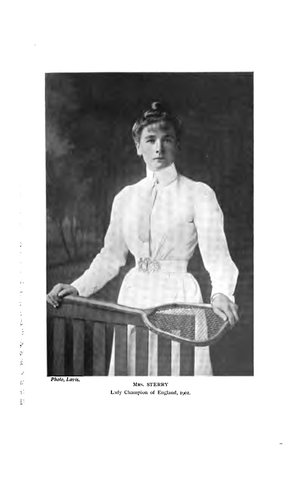
**Second image.** The full-page plate on leaf 138 of the same scan, likewise 3250 x 5084 px, mean brightness 200 of 255, opened, measured and looked at. It is printed sideways in the book. In letterpress at the foot: A GROUP OF LEADING LADY PLAYERS, 1885.
About seventeen women, counted from the plate itself and not from any printed list, arranged in three ranks on grass in front of what appear to be timber benches, with dark foliage behind. Eight stand at the back, seven are seated in a row in front of them, and two are seated low on the ground at the front. Most are in long pale dresses with high collars; four or five are in dark bodices and skirts; nearly all wear pale flat-crowned or boater hats. At least three racket heads can be made out among the seated women, and one furled parasol lies across the lap of the woman at front right. The count is approximate at the joins between the ranks, where figures overlap.
The caption names nobody. That is worth saying plainly, and worth not over-reading: this volume captions plenty of individual women by name and title, including Mrs. Hillyard as lady champion of England in 1900 and Miss Martin as lady champion of Ireland in 1902, and it also carries unnamed group plates of men. So the absence of names here is a fact about group photographs in this book and not, on this evidence, a fact about women in it. Nothing read for this entry identifies any person in the picture, and it is therefore not asserted that Maud Watson is among them. It is included because 1885 was the year she held the Wimbledon, Irish and Northern titles at once, and this is what the phrase leading lady players was attached to in that season, in the same volume that printed her photograph.
**Sourcing note.** No passage in this entry carries quotation marks, and that is deliberate. The 1903 survey is a book, and a book has one typesetting, which does not meet this series' condition for putting machine-read text inside quotation marks. The 1882 annual is quoted at one remove inside a secondary source and is paraphrased for that reason as well. The encyclopaedia articles and the club's own published history are secondary throughout and are named wherever they are the only support for a statement.
**Sources.** Encyclopaedia article on the Edgbaston Open, for the club's founding in 1878, the tournament's run from 1881 to 1908, the Midland Counties event, the merger of December 1964, the reproduced passage from Routledge's Sporting Annual (1882) and the Birmingham Daily Post citation of 23 August 1883: https://en.wikipedia.org/wiki/Edgbaston_Open . Encyclopaedia article on Maud Watson, for her dates, her first match at the Edgbaston Cricket and Lawn Tennis Club at sixteen, the 1884 and 1885 Wimbledon titles and the twenty-guinea flower basket, the 1885 Irish and Northern titles, the 1886 loss to Blanche Bingley, the Edgbaston tournament of June 1889, the MBE and her death at Charmouth, and for its citations of Alan Little (1983) and John Barrett (2001): https://en.wikipedia.org/wiki/Maud_Watson . Encyclopaedia article on the women's tennis season of 1881, for the singles final score: https://en.wikipedia.org/wiki/1881_women%27s_tennis_season . Encyclopaedia article on the Edgbaston Archery and Lawn Tennis Society, for its 1860 founding, the 1867 move to the Botanical Gardens and its oldest-club claim: https://en.wikipedia.org/wiki/Edgbaston_Archery_and_Lawn_Tennis_Society . Matt Cole, The History of Edgbaston Priory Club, 2013, published by the club, for the Edgbaston Cricket and Lawn Tennis Club at The Vale on Edgbaston Park Road, for Thomas Chatwin, for the twelve courts against the Priory's six, for the Watson sisters in the 1881 ladies' final and for the trophy statement: https://www.edgbastonpriory.com/wp-content/uploads/2018/11/Edgbaston-Priory-History.pdf . Arthur Wallis Myers, Lawn Tennis at Home and Abroad, 1903, for H. S. Scrivener's Edgbaston section, the Welsh championships passage and both images: https://archive.org/download/lawntennisathom00myergoog/lawntennisathom00myergoog_djvu.txt , with the pages at https://archive.org/download/lawntennisathom00myergoog/page/n88.jpg and https://archive.org/download/lawntennisathom00myergoog/page/n138.jpg . The Harry Gem Project, on the Edgbaston Archery and Lawn Tennis Society and on the Edgbaston Cricket and Lawn Tennis Club's tournament at Hall Hill Road: https://theharrygemproject.co.uk/edgbaston-archery-lawn-tennis-society/ . Historic England, register of parks and gardens, The Vale, Edgbaston, list entry 1001483: https://historicengland.org.uk/listing/the-list/list-entry/1001483 . OpenStreetMap way 23771438 via Nominatim. The neighbouring-pin distance was computed against this platform's own stored coordinates.


changes?
delete this memory?
We detected that you have a Blox in your crypto wallet! We will import the Blox into your account.
Click on done below to complete the import.
Welcome Back!
Sign in to preserve cherished moments
Don't have an account?
Welcome!!
Sign up and start preserving cherished moments
?
?
Choose your payment method
Buy with Metablox Credit
Do you want to mint Blox with Metablox Credit?
Which Crypto would you like to use?
Purchase Confirmed!
Your Blox is being minted on-chain and will appear in your profile shortly.
Log in or sign up to claim your Blox.
How many credits do you want to buy?
$100 USD = 1 Metablox Credit = 1 Blox.
Use Metablox Credit to mint any Blox you want on the map.
 expand_more