


Biography | May Sutton — the women's national championship was a different tournament in a different state, and a seventeen-year-old Californian won it, Philadelphia Cricket Club, June 1904
· 1904-6
Unreviewed contributionBy kevin · · updated · Report an issue











































Find memories left by people near you.
Distribute Bounty
This will distribute the bounty equally among all qualifying memories. This action cannot be undone.
Cancel Bounty
Are you sure you want to cancel this bounty? The remaining amount will be refunded to your account.
Success!
Operation completed successfully.
Error
Something went wrong.
Biography | May Sutton — the women's national championship was a different tournament in a different state, and a seventeen-year-old Californian won it, Philadelphia Cricket Club, June 1904
kevin
In June 1904 the United States had two national lawn tennis championships, and they were not held together. The men played at the Newport Casino in Rhode Island from 21 to 31 August. The women had already finished, here, on the grass of the Philadelphia Cricket Club at Chestnut Hill, between 21 and 25 June. Different month, different state, different ground, one name. Holcombe Ward won the men's title at Newport that August, and he appears on this platform already, as the third image on the entry for the first tie the Davis Cup ever had.
The Newport ground is pinned separately on this platform, and the entry there sets out how the American championship was three tournaments in three states as early as 1887. This entry is about what that arrangement still looked like seventeen years later, and about the seventeen-year-old who walked into it from the other side of the continent and walked out with the title.
**The ground.**
The Philadelphia Cricket Club was founded in 1854 and, in 1883, settled at the West Willow Grove Avenue site in the St. Martins section of Chestnut Hill that it still occupied when this entry was written in September 2026. The women's national singles was played on its grass from the first championship in September 1887 until 1920. The entry pinned here for June 1915, when Molla Bjurstedt of Norway won the title, describes the same courts.
The contemporaneous press of 1904 does not call the district St. Martin's. It calls it Wissahickon Heights, which was the name of Henry Houston's development before the neighbourhood took the name of its church. The New-York Tribune, the Courier-Journal of Louisville and the Evening Star of Washington all place the 1904 championship at Wissahickon Heights. It is the same ground under an older name, not a different one; the year the renaming took hold is not established here.
**Who was in the draw, and what the draw sheet recorded.**
The all-comers competition had eighteen entries. The New-York Tribune and the Evening Star of Washington both printed the early rounds on 23 June, under quite different narrative leads and over an identical block of results, which is what a wire results table plus a local rewrite looked like. Both tables give each player's club beside her name: Miss Homans of the West Side Tennis Club, Miss Roberts of Germantown, Miss Le Roy, Miss Duhring, Miss Rodgers, Miss Fetterman and Miss Howell of the Philadelphia Cricket Club, Miss Coffin of Staten Island, Miss Neely of Chicago, Miss Wimer of Washington, Miss Stotesbury of the Huntingdon Valley Country Club, Miss Chase of Merion, Miss Wallace of Moorestown.
That is the same instrument the 1915 entry at this pin describes. The United States National Lawn Tennis Association ran a championship entered through affiliated clubs, and the draw sheet recorded the club, not the state and not the country. In 1915 that rule let a Norwegian win an American championship because a New York club had taken her in. In 1904 it is simply visible: a national championship whose published draw is a list of club memberships.
**The rule that meant the holder did not have to play.**
The association ran the event on the challenge round system. The field played out an all-comers competition and its winner earned one match against the previous year's champion, whom the association's rules excused from playing at all until that point. The San Francisco Call of 25 June put the consequence in a single flat sentence, reporting that Elisabeth Moore was not required to play through the tournament under the rules.
May Sutton played four matches to earn that one, and here the contemporaneous papers correct the modern record. The published bracket in the reference article on this event shows her entering against Frances Stotesbury and playing three rounds. The Tribune and the Evening Star of 23 June both print a first round before that one, in which she beat Miss E. Howell of the Philadelphia Cricket Club, the Star giving the score as 6-2, 6-1 and the Tribune's line broken in the scan. Two papers on the same morning record a match the bracket does not contain. She then beat Stotesbury, Sarah Coffin, and Helen Homans in the all-comers final on 24 June.
The Tribune's narrative of the Stotesbury match says she allowed her opponent one game of the thirteen played, which is 6-1, 6-0 and agrees exactly with both papers' tables. The same paragraph describes her as the seventeen-year-old California girl, and that is the closest thing to a contemporaneous statement of her age this entry found.
**Saturday 25 June 1904.**
She then beat the holder in straight sets. The wire dispatch that went out from Philadelphia that evening was printed the next morning in at least two papers, and because the same copy was set by two different printers it can be quoted here:
"Miss May Sutton, of Pasadena, Cal., to-day became the national woman tennis champion by defeating Miss Elizabeth Moore, of New-York, in straight sets. She was also one of the winners in the women's doubles championship match, but was defeated in the mixed doubles. Miss Sutton's playing was the feature of the tournament, which was held on the courts of the Philadelphia Cricket Club, at Wissahickon Heights. Her skill was marvellous, and she played with a confidence born of her superior ability."
That is the New-York Tribune's setting of 26 June 1904, page ten. The Courier-Journal of Louisville printed the same dispatch the same morning on image nineteen of its third section, and the two settings are not identical. Four divergences are worth recording rather than smoothing away. The Tribune spells marvellous with two letters l and the Courier-Journal spells it with one, which is a compositor's house style and not a reading error. The Tribune closes the paragraph with the words The summary and the Courier-Journal with the word Summaries. The Tribune's Wissahickon is the Courier-Journal's Wissahicken, and the Tribune's women's doubles is the Courier-Journal's women's double, either of which could be the printer or could be the machine reading of a worn page. The headlines are entirely different, as headlines always were: the Tribune's reads that Miss Sutton takes the national title from Miss Moore in straight sets, the Courier-Journal's reads that California gets the tennis championship.
The scores in the two summaries agree: 6-1, 6-2 in the singles, and 3-6, 6-3, 6-3 in the women's doubles, which Sutton won with Miriam Hall against Moore and Carrie Neely. The names do not. Sutton's mixed doubles partner is T. B. Dallas in the New-York Tribune of 23 June and T. B. Dallam in the same paper on 26 June; the Courier-Journal prints L. B. Dallam and the San Francisco Call prints T. B. Dallas; the reference literature calls him Trevanion Dallas. One newspaper rendering the same man's surname two ways in four days is stronger evidence of how loose this record is than any disagreement between two papers could be, because it removes the possibility that they simply had different information. Neely is Nesly in one setting and Neeley in another.
**What she did next, and what she did not do.**
She did not defend. The women's national championship of 1905 was played at this ground from 20 to 24 June, and the 1905 Championships at Wimbledon opened at Worple Road on 26 June. Two days and an ocean separated them, and she was in London. Elisabeth Moore took the American title back in her absence.
At those 1905 Championships, on the Worple Road ground pinned separately on this platform, Sutton beat Dorothea Douglass 6-3, 6-4 and became the first American to win a Wimbledon singles title. The date of the women's challenge round is not established here; the meeting as a whole ran from 26 June to 8 July. She lost to Douglass there in 1906 and beat her again in 1907. That 1905 result is the reason the entry pinned at Worple Road for Maurice McLoughlin has to narrow the International Tennis Hall of Fame's description of his 1913 runner-up finish as his becoming the first American finalist in history. He was the first American man to play in a Wimbledon singles challenge round. Sutton had already won one, eight years earlier, on the same grass.
Lance Tingay's centenary history is cited for the broader claim that she was the first overseas winner of a Wimbledon championship. That is a wider statement than the one this entry makes, it covers every event rather than the women's singles, and it is reported here rather than adopted.
**Two things this record is not.**
It is not the record of an open sport. Every title above was closed to professionals, and Sutton's American championship, her doubles title with Hall and her three Wimbledon singles finals are amateur-era results, to be read on the same footing as the other amateur-era records pinned on this platform.
It is also not a Grand Slam record in the sense the phrase now carries. This platform's entry on Don Budge records that the tennis use of the phrase is traced by independent etymological references to 1933, about Jack Crawford. In June 1904 the four-tournament grouping the phrase names did not exist as a category, and the men's and women's halves of this one championship were not even played in the same season. Applying the label to 1904 is a later act of arrangement, not a description of what anybody there thought they were competing for.
**A dispute this entry does not settle.**
Her birth year is not agreed. The reference article consulted here gives 25 September 1886 in its opening sentence and in its infobox, and then contradicts itself twice on the same page: its death template computes her age from 1887 and its own categories file her under 1887 births. The 1886 reading is the one that fits the contemporaneous press, which called her seventeen in June 1904. Both readings are recorded here and neither is adopted.
**A gap this entry declares.**
No photograph of the Philadelphia Cricket Club's grass courts in this period was found for this entry. The Library of Congress Historic American Buildings Survey holds documentation for the Germantown Cricket Club and the Merion Cricket Club and nothing for this one. The 1915 entry at this pin has the same gap and offers a Bain negative of an unidentified grass court in its place. Closing it is work for a later session, and the Philadelphia newspaper illustration is the medium that has not been tried.
**Correction and cross-reference, added 6 September 2026.** Two statements above have been overtaken by later work at this pin, and are left standing with this note rather than rewritten, because neither was false when it was written.
First, the gap declared immediately above is now answered in part. The entry pinned here for June 1901, on Elisabeth Moore, carries a photograph by Paul Thompson of a national women's tournament in play on this ground, with the clubhouse, the umpire's chair and the standing crowd in the frame. It is undated within a span of about thirty-three years and it is not a photograph of 1904, so the gap declared above is narrowed and not closed. The route this entry named for closing it, the Philadelphia newspaper illustration, was tried in a later session and was the wrong route; the image that answered it came from the New York Public Library through Wikimedia Commons.
Second, the year the district's renaming took hold, left open above, can now be bracketed. The entry pinned here for June 1898, on Juliette Atkinson, reports that the association's own officially adopted annual entered this ground as Philadelphia C. C., Wissahickon Heights in its fixture list for the 1899 season, and still called the ground Wissahickon when reporting the 1901 season. The 1915 entry at this pin uses St. Martin's. The window is therefore between 1901 and 1915 on the sources read so far, and it is still a window rather than a date.
**Coordinate.** 40.063473, -75.210644, precision radius 300 m. This is the Philadelphia Cricket Club pin already established on this platform for the June 1915 championship, reused here deliberately and with disclosure, because the club has occupied the same West Willow Grove Avenue site since 1883 and both championships were played on its grass. That pin was fixed from two independent sources for 415 West Willow Grove Avenue, the City of Philadelphia's own property records and OpenStreetMap's building outline, about 38 m apart, and set at their midpoint. A third reading found for this entry, the coordinate carried by the reference article on the club, falls about 204 m from the pin: inside the radius, but far enough outside the original pair to be reported as a check on the radius rather than treated as a source. The radius covers the club's grounds rather than the clubhouse door, because no source consulted here fixes which of its courts held the 1904 challenge round.
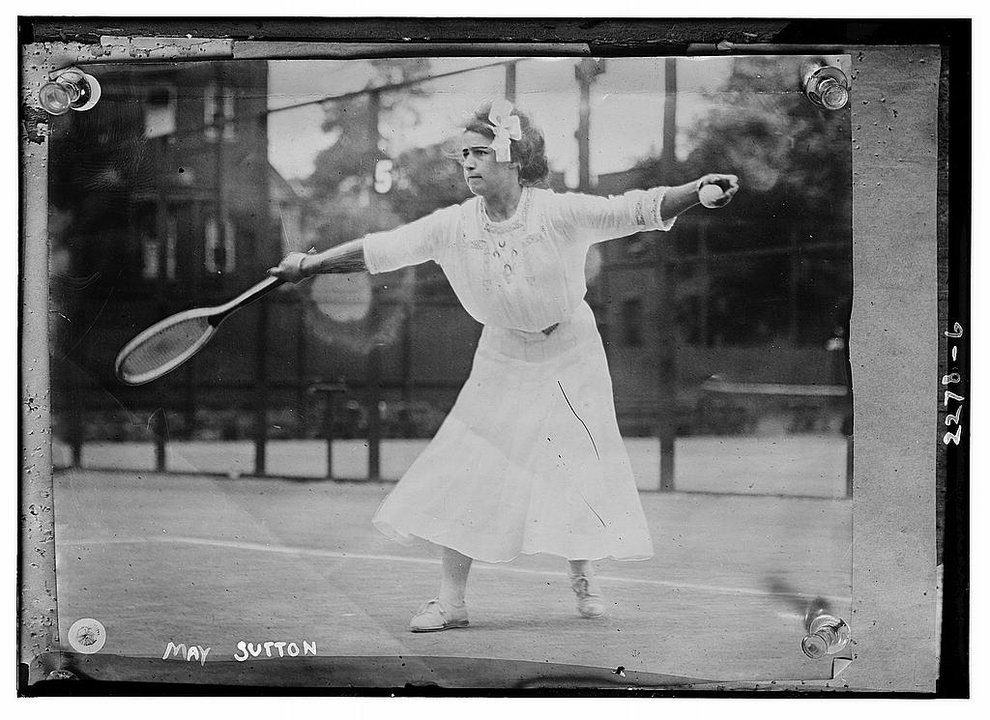
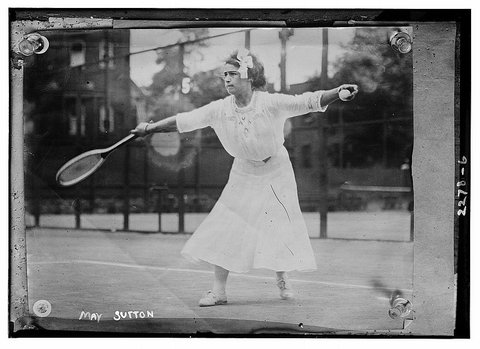
**Cover.** May Sutton [tennis], Bain News Service, negative LC-B2-2278-6, reproduction number LC-DIG-ggbain-09654, Library of Congress Prints and Photographs Division, item 2014689639, no known restrictions on publication, 1024 x 745 px. She is on a court in a long white skirt and a white blouse with the sleeves pushed up, mid-forehand, the ball still in her raised left hand; a wire-mesh backstop runs behind her with houses, a telegraph pole and trees beyond, and a bench inside the fence. The negative is inked MAY SUTTON along the lower edge and 2278-6 down the right edge, which matches the call number. This frame was chosen over two better-resolved portraits because it is the only one of the three that shows her playing. What it does not show is where: the Library dates it only as between about 1910 and about 1915, six or more years after the match this entry is about, and nothing in the frame identifies the ground. It is not a photograph of the Philadelphia championship and is not offered as one. https://www.loc.gov/pictures/item/2014689639/
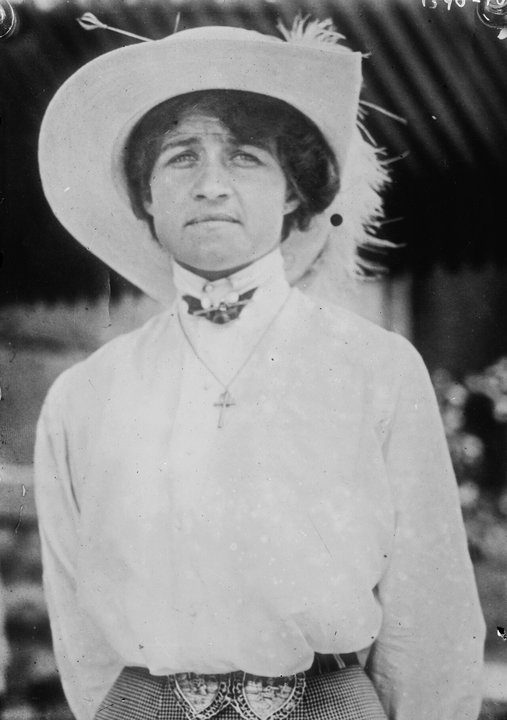
**Second image.** May Sutton, Bain News Service, reproduction number LC-DIG-ggbain-07620, Library of Congress item 2014687612, dated by the Library to 13 July 1912, public domain, 1442 x 2048 px, reached through Wikimedia Commons because the Commons copy is larger than the derivative the Library serves. A close portrait: a wide pale hat with a feather, a high-collared white blouse, a small cross on a chain, a patterned skirt at the lower edge of the frame, an awning behind. It wins on resolution and on being the only one of the three the Library dates at all. It is eight years after the championship, it is not on a court, and it carries no caption or inscription in the frame. A third Bain negative of her exists and was not used, LC-B2-176-5, LC-DIG-ggbain-00998, item 2014680994: a copy negative of a mounted print, inked MAY SUTTON and 176-5, with the glass corner clips of the copy stand visible in the frame. The Library records no date for it.
**Sourcing note.** The quotation above is given because the same wire copy survives in two independent printers' settings and both were read as machine-read text of the scanned pages, which is the raw-text route this platform accepts. Everything else here is attributed paraphrase. The San Francisco Call's sentence about the holder not being required to play through the tournament appears in the Call alone; the New Haven paper's shorter version of the same 24 June dispatch does not carry it, so it has one setting and is paraphrased rather than quoted. The Sun of New York printed a longer descriptive account of the same afternoon on 25 June which is different copy written for that paper, not a second setting of anything, and it is not quoted either.
**Sources.** New-York Tribune, 26 June 1904, page 10: https://www.loc.gov/resource/sn83030214/1904-06-26/ed-1/?sp=10 . Courier-Journal (Louisville), 26 June 1904, section 3, image 19: https://www.loc.gov/resource/sn83045188/1904-06-26/ed-1/?sp=19 . New-York Tribune, 23 June 1904, page 11: https://www.loc.gov/resource/sn83030214/1904-06-23/ed-1/?sp=11 . Evening Star (Washington), 23 June 1904, page 9: https://www.loc.gov/resource/sn83045462/1904-06-23/ed-1/?sp=9 . The San Francisco Call, 25 June 1904, page 11: https://www.loc.gov/resource/sn85066387/1904-06-25/ed-1/?sp=11 . The Daily Morning Journal and Courier (New Haven), 25 June 1904, page 1: https://www.loc.gov/resource/sn84020358/1904-06-25/ed-1/?sp=1 . The Sun (New York), 25 June 1904, page 4: https://www.loc.gov/resource/sn83030272/1904-06-25/ed-1/?sp=4 . Draw structure and dates from the encyclopaedia articles on the 1904 and 1905 United States national championships, the 1905 Championships at Wimbledon, May Sutton and the Philadelphia Cricket Club; where the encyclopaedia and the contemporaneous papers differ, the papers are followed.

changes?
delete this memory?
We detected that you have a Blox in your crypto wallet! We will import the Blox into your account.
Click on done below to complete the import.
Welcome Back!
Sign in to preserve cherished moments
Don't have an account?
Welcome!!
Sign up and start preserving cherished moments
?
?
Choose your payment method
Buy with Metablox Credit
Do you want to mint Blox with Metablox Credit?
Which Crypto would you like to use?
Purchase Confirmed!
Your Blox is being minted on-chain and will appear in your profile shortly.
Log in or sign up to claim your Blox.
How many credits do you want to buy?
$100 USD = 1 Metablox Credit = 1 Blox.
Use Metablox Credit to mint any Blox you want on the map.
 expand_more