Biography | Pancho Gonzales — he signed twenty-five days too early, and the association changed the rule, Madison Square Garden, October 1949
volume_up
Listen
directions
Directions
On 5 September 1949 Richard Gonzales won the United States national men's singles championship at Forest Hills for the second year running, beating Ted Schroeder in five sets. The Evening Star of Washington printed the wirephoto the next afternoon under the caption "NET CHAMPS DISPLAY PRIZES," and recorded the score: Gonzales "took another lease on his crown after losing the longest set in championship history in this country, 16-18. After also dropping the second set he polished off his adversary, 6-1, 6-2, 6-4."
Fifteen days later he stopped being an amateur, and the association that had just crowned him discovered it had a rule that would take his name off its own list.
**What he signed.** The Associated Press report of 21 September is precise about it. Gonzales "hardly had hopped off a plane from his home town yesterday before he signed a one-year contract to play Jack Kramer in close to 100 matches around the country, beginning the night of October 25 at Madison Square Garden." The promoter was Bobby Riggs, himself twice a national amateur champion. The contract "guarantees Gonzales $60,000 within the next year, or an option of 30 per cent of the gate receipts." The paper ran it under the headline "Gonzales, Now a Pro, Starts Earning His $60,000 Oct 25."
**The rule.** The United States Lawn Tennis Association held that no player who turned professional before 15 October could be given a national ranking for that year. Gonzales was sworn in as a professional on 20 September. He was twenty-five days early.
When the ranking committee published its 1949 list in December, it put him at No. 1 anyway, provisionally, and waited. The AP explained the position on 17 December: Gonzales, "in a hurry to cash in on the national championship he had just won at Forest Hills, was sworn in as a money player on September 20," and would "have to wait until next January 21" — the date of the association's annual meeting in New York — to learn whether the list would stand. Behind him were Schroeder, Billy Talbert and Frankie Parker. Parker was on the same professional tour and was in no danger: "he carefully waited until after the deadline to join the union." Had the rule held, Schroeder would have become the No. 1 amateur of 1949 without having won the championship, and everyone below him would have moved up a place.
**And the professional body would not rank him either.** The same column carried the United States Professional Lawn Tennis Association's list for the year. Bobby Riggs was its No. 1. "Jack Kramer, Pancho Gonzales and Frank Parker, none of whom played in a pro tourney this year, were not ranked because of insufficient data." For several weeks at the end of 1949, the reigning national champion was ranked provisionally by the body he had left and not at all by the body he had joined.
**What the association did.** On 21 January 1950, at its annual meeting in New York, the USLTA rescinded the rule. The AP reported it the same day: "Without a dissenting vote, the United States Lawn Tennis Association at its annual meeting decided that Pancho richly deserved the honor and voted to rescind a rule which would have deprived him of the laurels on a technicality." The amended rule required only that a player keep his amateur standing through the national championships. The list stood as printed. The meeting, the reporter noted drily, "went off very quietly. Nobody apparently was mad at anybody else." Lawrence A. Baker of Washington, D.C., was re-elected president.
**Why this is worth pinning rather than admiring.** The interesting thing is not that the association was generous. It is that an amateur ranking was a discretionary document, revisable after the fact by a vote, and that the sport's own records were produced by the same body that decided who was allowed to play for the records. The rule that mattered was untouched: turning professional still barred him from the four championships, and the January amendment did nothing about that. The Associated Press called him twenty-one years old in September 1949. Nineteen years later, when those four tournaments finally admitted professionals, he was forty.
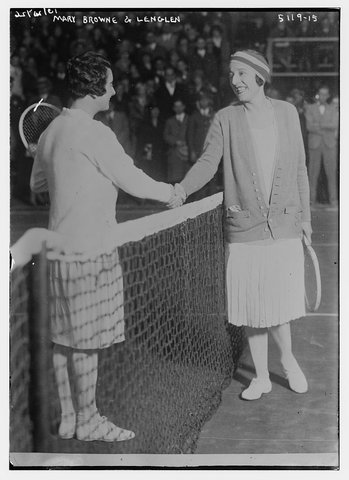
**The money, in the plainest available comparison.** Suzanne Lenglen's 1926 contract with C. C. Pyle, which opened the professional game at this same building, is generally reported at $50,000. Gonzales was guaranteed $60,000 twenty-three years later. Rod Laver's 1963 professional tour, in the memory pinned at College Park, offered a top prize of $35,000 for winning the whole thing. These are not like-for-like figures — a signing guarantee is not a tournament prize — and they are set beside each other here only to indicate the order of magnitude of what a player was weighing against the four championships.
**The opening night, and what is not established about it.** The September announcement gave the Garden date as 25 October 1949. The clearest contemporaneous account of the opening located in this session comes from the Toledo Union Journal of 4 November 1949, a labour weekly previewing the tour's Toledo date: "In the two opening contests this week Kramer defeated Gonzales at Madison Square Garden before 17,000 tennis fans and Pancho evened the series by winning from Kramer at Chicago before 10,000 spectators." The weekly's "this week" does not sit cleanly against the announced 25 October, and no report of the night itself was found in the digitised runs available here. The date given for this memory is the announced one, and the discrepancy is named rather than smoothed over. The crowd figure is worth keeping either way: when professional tennis opened in this building in October 1926, the wire described an arena a third full, more than 7,500 people. Twenty-three years later the same room held 17,000 for the same idea.
**Naming.** He appears in these reports as "Richard (Pancho) Gonzales." Pancho was a nickname, not a given name, and the surname is printed in contemporaneous American copy as both Gonzales and Gonzalez; this memory uses the spelling the cited pages use. The AP of 21 September described him as "the 21-year-old Mexican American from Los Angeles." A widely repeated later account holds that he was kept out of junior competition in Southern California by the officials who controlled entry there. That account could not be traced to any contemporaneous document in this session's searching, and it is therefore not asserted here.
**Sources.** All quoted wording is read from newspaper pages digitised by the Library of Congress, and the optical character recognition of these pages is rough; quotations are given in corrected spelling and the page images carry the wording as printed. The championship result and wirephoto caption: Evening Star, 6 September 1949, page 14 — https://www.loc.gov/resource/sn83045462/1949-09-06/ed-1/?sp=14 . The contract, the terms and the announced Garden date: Evening Star, 21 September 1949, page 44 — https://www.loc.gov/resource/sn83045462/1949-09-21/ed-1/?sp=44 . The 15 October rule, the provisional list and the professional rankings: Evening Star, 18 December 1949, page 44 — https://www.loc.gov/resource/sn83045462/1949-12-18/ed-1/?sp=44 . The rescission: Evening Star, 22 January 1950, page 35 — https://www.loc.gov/resource/sn83045462/1950-01-22/ed-1/?sp=35 . The tour and the Garden crowd, from a second and unrelated title: Toledo Union Journal, 4 November 1949, page 6 — https://www.loc.gov/resource/sn82007637/1949-11-04/ed-1/?sp=6 . One OCR artefact is worth flagging: the January report's tenth-ranked player is rendered "No. 19," which the December list shows should read No. 10.
**Coordinate.** 40.762321, -73.987325, precision radius 200 m. This is the pin already established on this platform for the third Madison Square Garden, the 1925 arena on Eighth Avenue between 49th and 50th Streets, demolished in 1968 — deliberately reused here rather than re-derived, and disclosed as a reuse. Its two independent sources are recorded with that earlier memory: Wikidata's entity for the 1925 arena at 40.7624, -73.9877, and the New York City Department of City Planning geocoder at 40.762243, -73.986951 for 825 Eighth Avenue, the address of the building put up on the site in 1989, about 65 m apart. The radius covers the block frontage. Note what the pin is and is not: the building is where the contract was performed, not where it was signed, and not where the January vote was taken. Neither the signing room nor the association's meeting venue is named in the reports cited above, and neither has been identified.
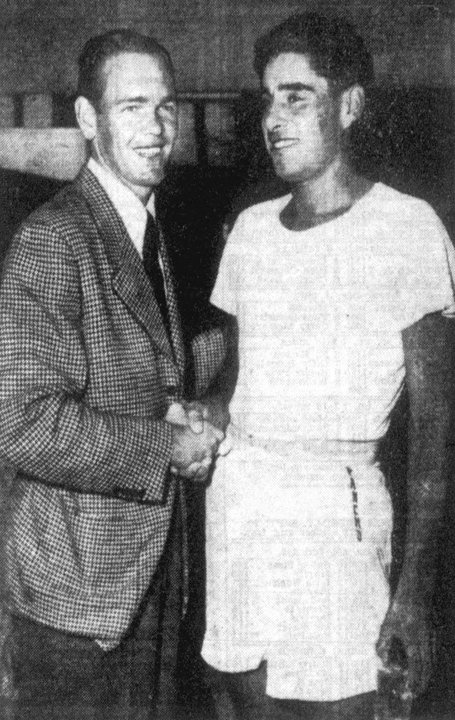
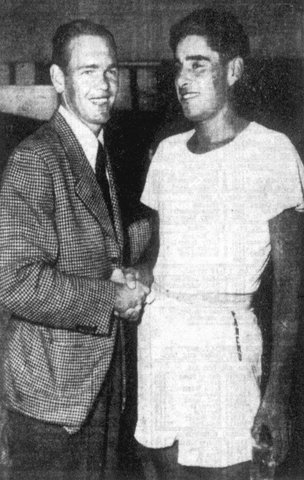
**Cover image.** Jack Kramer, left, in a checked jacket and tie, shaking hands with Gonzales, right, in a white tennis shirt and shorts; both are smiling, indoors, against a dark ground, with Kramer's arm behind Gonzales's shoulder. A newspaper halftone from the Los Angeles Daily News, credited on Wikimedia Commons to that paper's issue of 19 September 1949 — the day before the contract was signed in New York — and hosted there as a public-domain file (File:Jack Kramer and Pancho Gonzales 1949.jpg). The public-domain basis is the one asserted on the file page for the newspaper scan; the printed caption on the original page was not read, and no claim is made here about what the picture was taken to show beyond the two men it identifies.
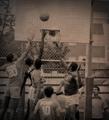
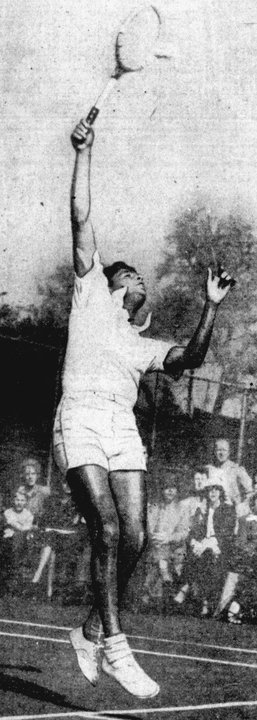
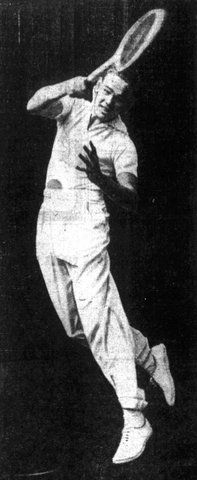
**Second image.** Gonzales airborne on an outdoor court, both feet off the ground, right arm at full extension with the racket above his head at the top of a serve or a smash, a small seated gallery and trees behind him and a chain-link fence at the right of the frame. Also a Los Angeles Daily News halftone, credited to the issue of 31 January 1949 and dated 30 January 1949 on the file page, public domain via Wikimedia Commons (File:Pancho Gonzales 1949.jpg). It is an amateur playing an ordinary winter tournament in Southern California, eight months before the championship and the contract; it is not the Garden and does not show it.





























 expand_more