Biography | Jack Kramer — two years after Wimbledon he won a world championship no record book counts, Wembley, June 1949
volume_up
Listen
directions
Directions
On 4 June 1949 the Associated Press filed a short item from London. Jack Kramer of Los Angeles had beaten Bobby Riggs, also of Los Angeles, and had thereby won what the wire service called "the Wembley version of the world professional tennis championship." (https://www.loc.gov/resource/sn83045462/1949-06-05/ed-1/?sp=45)
The qualifier is the story. There was a Wembley version because there was more than one version, and there was more than one version because the sport had been split in two for a generation. Neither half recognised the other's champions.
Kramer had been the amateur champion. He won the United States National Championships in 1946 and again in 1947, and the Championships at Wimbledon in 1947 — all of them amateur-era titles, won in the years when the four national championships admitted only players who were not paid. (https://www.tennisfame.com/hall-of-famers/inductees/jack-kramer)
Then he was paid, and the four championships closed behind him.
The Evening Star's preview of his professional debut, printed on 26 December 1947, describes the two men who were to play at Madison Square Garden that night as the "national amateur champion recently turned professional" and the "professional champion" — two titles from two separate competitions running at the same time in the same sport. The paper called the match the first in a series to decide the premier player of the world, and noted that Dinny Pails of Australia and Francisco Segura of Ecuador had turned professional to tour with them. The four were booked into Uline Arena in Washington on 22 January. (https://www.loc.gov/resource/sn83045462/1947-12-26/ed-1/?sp=10)
That is what the professional game was in 1949: a touring company with a payroll, a booking sheet, and its own championships.
The Wembley championship was the largest of those championships in Europe. It had been founded in 1934 at the Empire Pool at Wembley Park and had not been staged since 1939; the 1949 edition was its first in a decade. (https://en.wikipedia.org/wiki/Wembley_Championships)
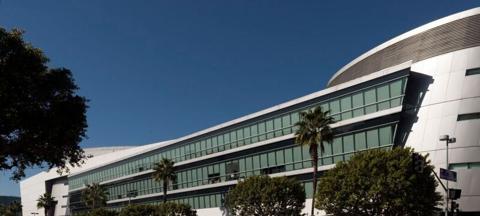
The building had been a swimming pool, and had been one until very recently. The Empire Pool opened on 25 July 1934, engineered by Sir Owen Williams and built under Arthur Elvin for the swimming events of that year's British Empire Games. It was still a working pool the previous summer, when the swimming of the 1948 Olympic Games was held in it. (https://en.wikipedia.org/wiki/Wembley_Arena)
For the first professional championship there, in November 1934, the pool was drained and a temporary wooden floor laid straight onto the ice, painted green, with the court lines marked in white, and seating for more than ten thousand built around it. That is the researcher Ray Bowers's account of the 1934 conversion; no source consulted here describes the 1949 arrangement, though the reference tables record the 1949 surface as indoor wood. (http://www.tennisserver.com/lines/lines_03_03_01.html)
So, in one English summer: grass at Church Road in July, boards over a drained swimming pool at Wembley in June, about fourteen kilometres apart — and only one of the two has ever been counted.
The reason that matters is arithmetic. Lists of major titles do not include Wembley, or the United States Professional Championships, or the French professional championship. They count the four national championships, which for the whole of Kramer's professional career would not let him enter. A figure such as "three major titles" for Jack Kramer is therefore not a measure of how much he won. It is a measure of how long he went unpaid.
This platform already holds the same split seen from other angles — what turning professional actually paid Rod Laver in 1963, why Lew Hoad's amateur record stops in 1957, and the ranking rule the American association revised after Pancho Gonzales signed in October 1949. What this memory adds is the part easiest to overlook: the men who left were not leaving competition. They were leaving one set of tournaments for another set, and the second set is not in the books.
Kramer stopped touring as a player in the early 1950s and became the promoter who ran the professional game, recruiting Gonzales, Frank Sedgman, Segura, Hoad and Ken Rosewall onto his tours. In 1972 the players formed their own association and made the promoter its first executive director. He died on 12 September 2009.
Score note: the Evening Star page's optical text renders the result as "2-5, 6-4, 5-3, 8-4", which contains sets that cannot be won under the rules; the digitisation garbles figures throughout this page. Standard reference tables give 2-6, 6-4, 6-3, 6-4, which is what those digits most plausibly are. That Kramer won in four sets is not in doubt; the individual games are given here in corrected form for that reason.
Sourcing note: only one contemporaneous title was found for this result. A search of the Library of Congress's Chronicling America returns the Evening Star's AP item and nothing else for the match, so the second source for the score is a reference compilation rather than a second newspaper, which is below this vertical's usual standard and is stated rather than smoothed over.
Venue note: the AP report is datelined London and names Wembley, not a building. The championship's home from its foundation was the Empire Pool at Wembley Park, and the pin is the Empire Pool. No source consulted names the building for the 1949 staging.
Coordinate: 51.558067, -0.282806, precision radius 200 metres. Two independent sources: the Office for National Statistics centroid for postcode HA9 0AA at 51.558134, -0.282820, retrieved through postcodes.io and derived from Ordnance Survey addressing; and the OpenStreetMap venue feature for the building, which now trades as the OVO Arena Wembley, at 51.557999, -0.282792. They are about 15 metres apart, which on a single large building reads as agreement between separately maintained datasets rather than one copied from the other. The published pin is their midpoint, and the radius covers the building footprint. The court was inside the hall and no source consulted places it within the room.
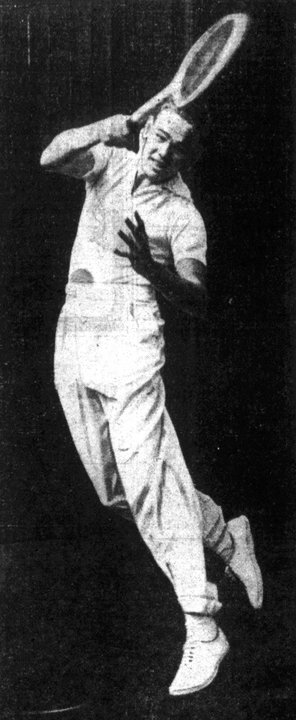
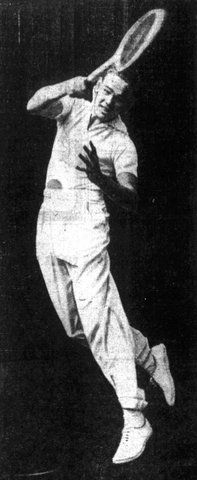
Cover: "Jack Kramer 1946", a press photograph reproduced from a newspaper page — the halftone screen is visible across the whole frame. It shows Kramer airborne on an overhead, racket behind his head, both feet off the ground, in the long white flannel trousers of the amateur era, against a dark background. Public domain; the source is given on Wikimedia Commons as the Los Angeles Daily News, author unknown, and the Commons credit links to that paper's issue of 26 December 1946, which dates the file. That newspaper collection is closed to automated retrieval and the printed caption was not read. This is Kramer three years before the match described here, and as an amateur; the photograph does not show Wembley.
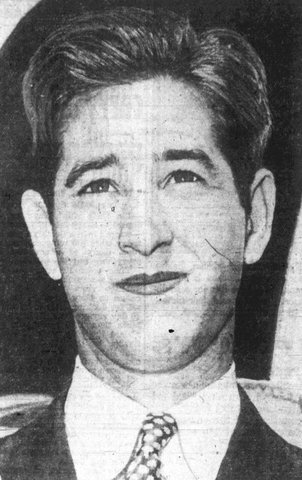
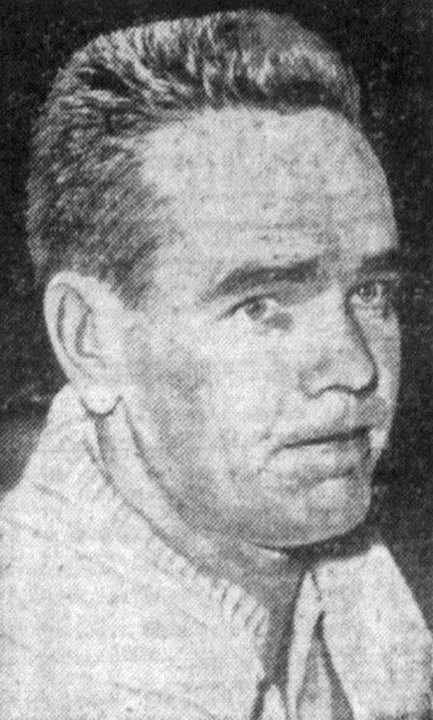
Second image: "Jack Kramer 1954", a head-and-shoulders portrait from the same collection, Los Angeles Daily News, author unknown, public domain; the Commons credit links to the issue of 16 February 1954. By that date Kramer had largely stopped touring as a player and was running the professional game as its promoter. The printed caption was not read.









































 expand_more