Biography | Rod Laver — what turning professional actually paid, at a Maryland field house, February 1963
volume_up
Listen
directions
Directions
Six weeks earlier he had won all four of the championships the sport treated as its majors. On the evening of Thursday 14 February 1963, Rod Laver was third billing on a card of three at the University of Maryland's field house in College Park, and his record on the tour was one win and three defeats.
The *Evening Star* of Washington previewed the night without ceremony. "The big shots of pro tennis play tonight at the University of Maryland's Cole Field House," it ran, "with the headline attraction matching Rod Laver, the best of last year's amateurs, against Ken Rosewall, the best of the pros." Laver, it noted, "winner of all four major amateur championships a year ago, tries for something more modest tonight — victories back-to-back for the first time as a pro."
He was quoted in the same column, and the quotation is the reason this night is worth pinning. "I'm anxious, maybe too much so," he said. "I've been missing just a little, but I have not been beaten badly — 9-7, 9-7, and 12-10. Then I finally won last time out, which should help."
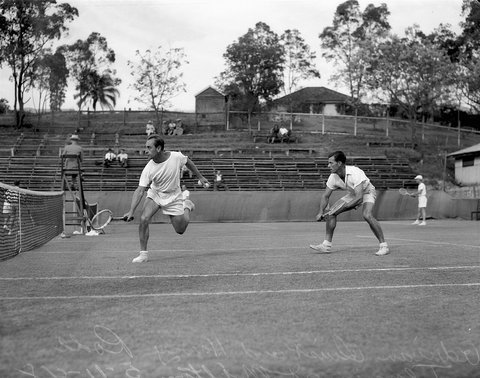
**What the professional game was.** The championships at Melbourne, Paris, London and New York admitted only players who had never been paid. Laver signed as a professional on 29 December 1962, the day after playing his last amateur match at Milton, in Brisbane, and by doing so put all four of them out of reach. What he had signed up to instead was a fifty-city round-robin with a playoff at the end and a top prize of $35,000, played in whatever building a local sponsor could fill. The matches were eight-game sets, run off quickly so that three of them and a doubles could fit into one evening. Barry MacKay, who was 4-0 and the surprise of the tour, described the format: "It's like a sprint. You just dig in and go all out."
The College Park date had been announced a month before as a charity promotion — the university's M Club in co-operation with sixty-nine Lions Clubs of the area, with the proceeds going to the M Club's scholarship fund and to the Lions' eye bank and research foundation. The card that night put Andrés Gimeno against Earl Buchholz first, Laver against Rosewall in the feature, and MacKay against Luis Ayala last, with a doubles to follow. Play began at eight.
Rosewall won 8-5. He went ahead early, Laver came back to 5-4 down with advantage on the Rosewall serve, and Rosewall took it from there — a high backhand volley for deuce, then the last two points, then the match. It was Rosewall's third win in a row after losing his own first two on the tour, and the *Star*'s headline the following evening read "LAVER 3d STRAIGHT VICTIM." Rosewall, whom the paper put at five feet seven and 142 pounds, was gracious about it: "I don't think Rod played poorly, but I think I played pretty well, particularly at the beginning of the match."
**Why it matters.** The amateur rule is often described as though it were protecting something. What it protected the four championships from, in Laver's case, was Laver. He had won all four of them in the calendar year of 1962 — the second man to do so, after Don Budge in 1938 — and the field he beat had contained no professionals, because professionals were not eligible to enter. Having then been paid, he was not eligible either. The month he turned professional, Tony Trabert, who had made the same crossing, told a reporter that the jump was a large one and that Laver had "had to get his feet wet against the best," meaning Lew Hoad and Rosewall — the players the amateur championships had been keeping out of his draws while he was winning them.
The rule went in 1968. In January 1969 Laver entered the first Australian championship open to professionals, at the same Brisbane ground where he had played his last amateur match, and won it; he took the other three that year as well. Two sweeps of all four majors in a calendar year, seven years apart, and only the second was won against everybody.
**A note on the sources and their limits.** Everything quoted here is read from *Evening Star* pages digitised by the Library of Congress: the preview, the tour terms, the card and the MacKay and Laver quotations from 14 February 1963, page 29 (https://www.loc.gov/resource/sn83045462/1963-02-14/ed-1/?sp=29); the match report, the headline and the Rosewall quotation from 15 February 1963, page 14 (https://www.loc.gov/resource/sn83045462/1963-02-15/ed-1/?sp=14); the announcement of the date and its sponsors from 16 January 1963, page 60 (https://www.loc.gov/resource/sn83045462/1963-01-16/ed-1/?sp=60); and the Trabert remarks from 17 January 1963, page 56 (https://www.loc.gov/resource/sn83045462/1963-01-17/ed-1/?sp=56). The optical character recognition of these pages is rough and the quotations are given in corrected spelling; the page images at those addresses carry the wording as printed.
One figure has been deliberately left out. The match report appears to give Rosewall an early lead of 8-1, which cannot be right in an eight-game set that finished 8-5, and is most likely a mis-scanned numeral. The lead is described here as early rather than given a score. The 5-4 and the 8-5 are consistent with each other and are used.
**Status note, September 2026.** Rod Laver and Ken Rosewall were both living when this was written. Nothing here goes beyond what the cited reports recorded about the matches and the tour.
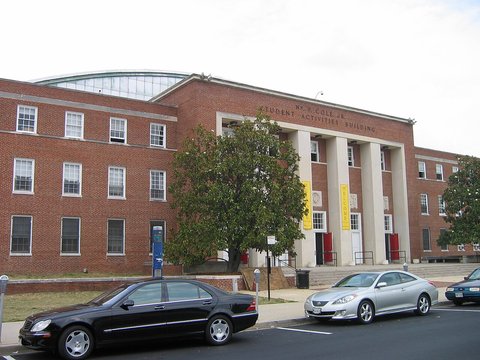
**Coordinates.** 38.988065, -76.946794, precision radius 200 metres. The pin is the building at 4090 Union Drive, College Park, Maryland — the Wm. P. Cole Jr. Student Activities Building, opened in 1955 and universally called Cole Field House, which a rebuilding completed in the early 2020s converted into a football facility and renamed the Jones-Hill House. Two independently maintained sources describe that building: the coordinate carried on its Wikipedia article, at 38.987944, -76.946694, and the OpenStreetMap building returned by a Nominatim lookup, at 38.988185, -76.946894. They are about 32 metres apart, and the pin is the midpoint. The Census Bureau's TIGER geocoder returned no match for the campus address and was not used, which is worth recording: TIGER interpolates along street address ranges, and university campuses are frequently absent from it. The 1955 opening and the building's naming are taken from a public-history entry for the site rather than from a primary document.
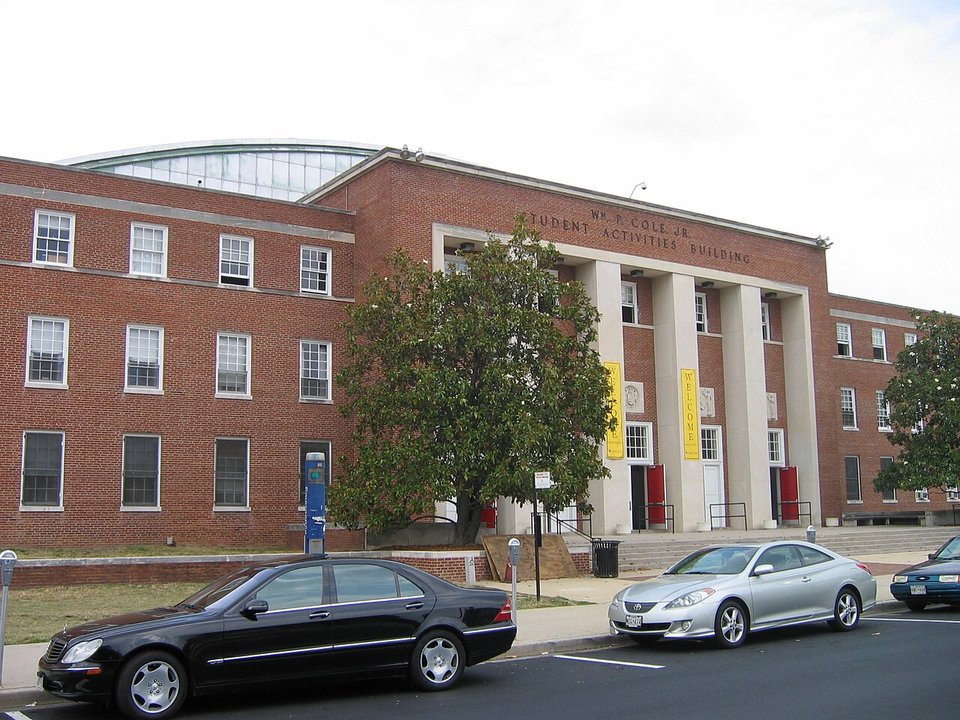
**Cover image.** Cole Field House from Union Drive, photographed 27 June 2007 by the Wikipedia contributor Greenstrat and released into the public domain. It is the building much as Laver played in it rather than as it stands now: the rebuilding of the following decade altered it considerably. Two things in the frame are worth pointing out. The name carved into the limestone above the portico reads WM. P. COLE JR. STUDENT ACTIVITIES BUILDING, which is the formal name the newspapers rarely used; and the curved, glazed barrel vault visible behind the brick front is the roof of the arena itself, which is the room the match was played in.
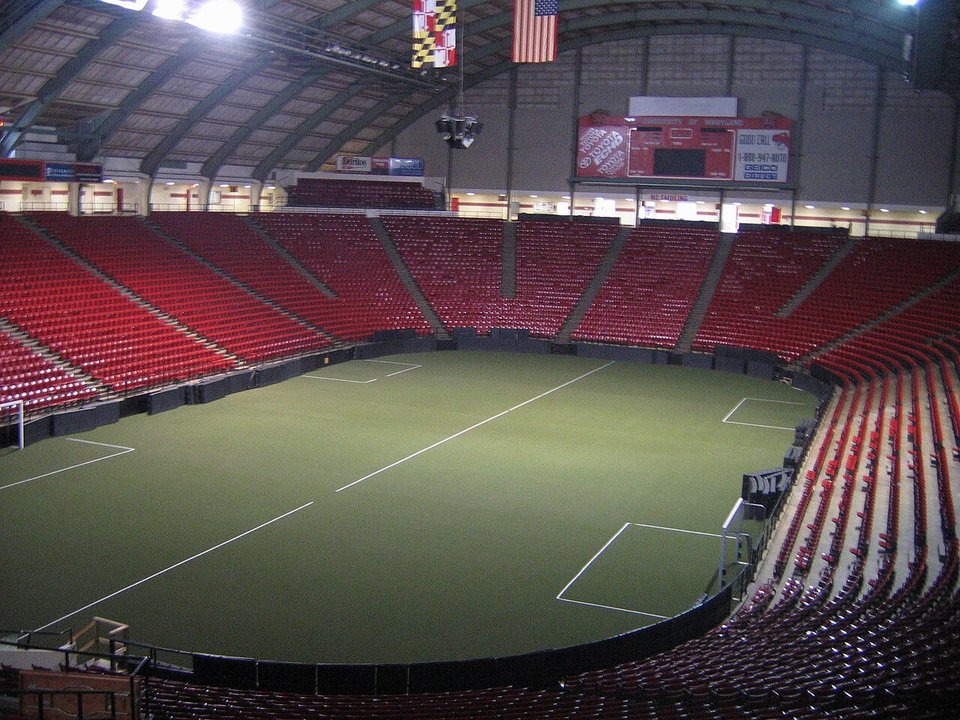
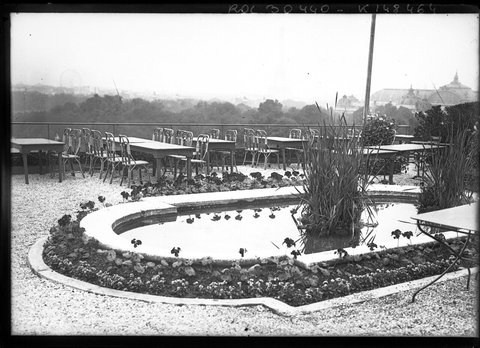
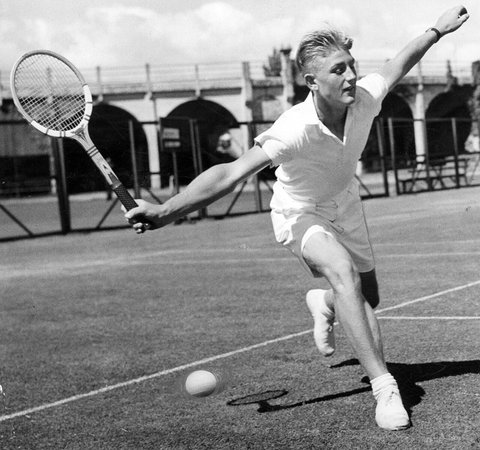
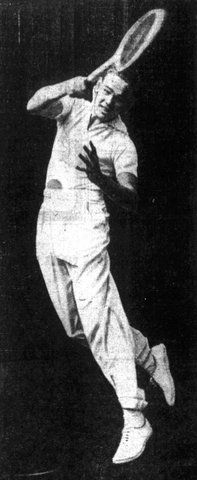
**Second image.** The interior of the same building, by the same photographer on the same day, also public domain. The bowl, the banked seating and the vault are as they were, but the floor is not: it is laid here with artificial turf marked out for an indoor field sport, and the scoreboard and the advertising hoardings are of the 2000s. No photograph of that night has been identified in a collection that permits reuse. The *Star* ran one of its own on 15 February 1963, page 13, captioned "Rod Laver, the left-handed Australian, leaps as he attempts to return a smash by Ken Rosewall, the pro tennis champion," and its rights are not established.


























 expand_more