Biography | Bobby Riggs — three titles in one week, then a bomb and a contract closed the tournament to him, Church Road, July 1939
volume_up
Listen
directions
Directions
On 7 July 1939 the Daily Alaska Empire in Juneau ran four words of headline and one sentence under them. Bobby Riggs, of Chicago, had beaten his roommate and doubles partner Elwood Cooke, of Portland, Oregon, 2-6, 8-6, 3-6, 6-3, 6-2, in what the paper called the all-American final of the All-England championship. (https://www.loc.gov/resource/sn83045499/1939-07-07/ed-1/?sp=5)
Three days later the Tacoma Times printed the rest of the week. American players had won every one of the five titles at stake at Church Road. Alice Marble of San Francisco took the women's singles from Kay Stammers of Great Britain, then the women's doubles with Sarah Palfrey Fabyan of Brookline, Massachusetts, then returned to the court a third time to take the mixed doubles with Riggs. Riggs had the singles, then the men's doubles with Cooke, then the mixed with Marble. (https://www.loc.gov/resource/sn88085187/1939-07-10/ed-1/?sp=9)
Three titles in one week, for a player who was twenty-one. The reference compilations record no other appearance by Riggs at the Championships, before or after.
What he was playing for is the part worth stopping on. On the morning of the final, Le messager, the French-language daily of Lewiston, Maine, told its readers that the title at stake had been won the previous year by Don Budge, who could not defend it because he had turned professional. (https://www.loc.gov/resource/sn83045313/1939-07-07/ed-1/?sp=8) The 1939 champion was therefore champion of a draw the 1938 champion was barred from entering. That is not a slight against Riggs. It is what the four national championships were for the whole of the amateur era: tournaments defined as much by who was ineligible as by who turned up.
Riggs did well out of that year by any measure. He won the United States National Championships in September 1939 and again in 1941, was runner-up at the French Championships in 1939, and won the American mixed title in 1940. He did not enter the Australian championship at all, so the calendar-year sense of the phrase "Grand Slam" — all four national championships won inside one year — never came into it. The sense used here throughout is the other one: the four tournaments themselves.
Then he was paid. Riggs played his first professional match on 26 December 1941. By 31 December the Tacoma Times had him in Philadelphia with the barnstorming professional company at Convention Hall — Fred Perry facing Riggs, Budge meeting Frank Kovacs — the tour having opened at New York the previous Friday, which is that same 26 December. (https://www.loc.gov/resource/sn88085187/1941-12-31/ed-1/?sp=14) He had joined the man whose vacated title he had won thirty months earlier.
It made no difference to his entry either way, because by then there was no tournament. The Championships were not staged from 1940 to 1945. In May 1941 the Wilmington Morning Star described Church Road for American readers: "there are bomb craters on the famous old center court", the stands empty, and no world championships to be held that year or another. (https://www.loc.gov/resource/sn78002169/1941-05-14/ed-1/?sp=6) The same column noted that four professionals would play a round robin at the West Side Tennis Club in New York that June — the paid game filling a summer the amateur game had vacated, which is a pattern this platform has now recorded from several directions.
The Championships resumed in 1946. Riggs was a professional by then, and the Championships did not admit professionals until 1968, a change this platform holds as its own memory. He was fifty years old that year.
So the roll of honour gives Bobby Riggs one line. It is not a measurement of how good he was, and the professional results say so: he won the United States Professional Championships in 1946, 1947 and 1949, and was ranked the world's leading professional in 1946 and 1947. In June 1949 he reached the final of the Wembley professional championship and lost it to Jack Kramer, which is the match this platform records from Kramer's side. Between them the two men are one argument seen from both ends: neither the winner's world title nor the loser's three Wimbledon trophies are counted in the same column as the other.
Riggs was born in Lincoln Heights, Los Angeles, on 25 February 1918, and died at Encinitas, California, on 25 October 1995. In 1973, at fifty-five, he played two promoted exhibition matches against leading women players, beating Margaret Court and losing to Billie Jean King in the Astrodome. That second match is far better remembered than anything described here, and this platform records it at its own pin, as a sold event rather than a sporting one. Nothing in this memory should be read as an account of it.
Hometown note: both American wire items above give Riggs's home as Chicago. He was born and raised in Los Angeles. No source consulted here explains the discrepancy, and it is reported rather than resolved.
Sourcing note: the men's singles score is given here exactly as the wire item printed it, and it agrees with the standard reference tables digit for digit, which is unusual enough for this period to be worth saying. The doubles and mixed results are from the Tacoma Times report, whose optical text garbles the games in both; only the winners and the losing pairs are stated above for that reason. The date of the first professional match, the absence of any other Riggs entry at the Championships, the three professional championships of 1946, 1947 and 1949 and the professional rankings are taken from reference compilations rather than from newspapers read for this memory; the compilations attribute the ranking to a 1972 United States Lawn Tennis Association encyclopaedia, which was not consulted directly. Everything quoted or dated above from a newspaper carries its own link.
Coordinate: 51.435344, -0.214852, precision radius 400 metres. This pin is reused, deliberately and with disclosure. It was established for the All England Club's Church Road ground from Wikidata and the Office for National Statistics postcode centroid, and this platform already carries two memories on it — the club's move to the ground in 1922, and the first open Championships in 1968. The radius covers the grounds. The matches described here were played inside those grounds and this is the club, not the court: no source consulted places the 1939 finals within the site to better than that, and Centre Court is not separately pinned.
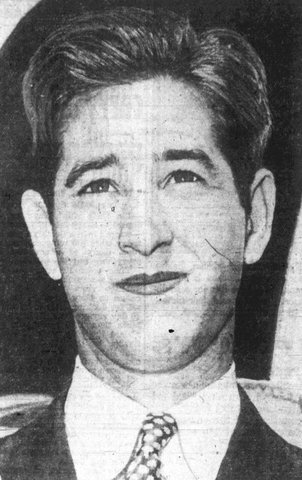
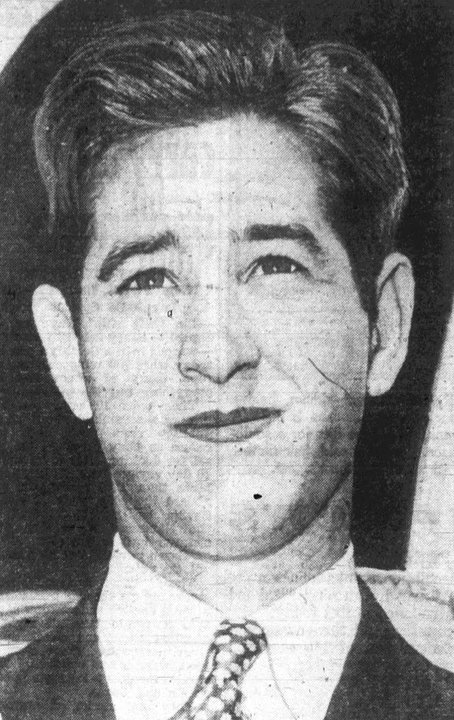
Cover: "Bobby Riggs 1941", a press portrait reproduced from a newspaper page — the halftone screen and the paper's texture are visible across the whole frame. It is a head-and-shoulders view of Riggs in a dark suit, white shirt and patterned tie, looking slightly off camera; there is no racket, no court and no tennis clothing in it. Public domain, author unknown; Wikimedia Commons gives the source as the Los Angeles Daily News and links to that paper's issue of 13 September 1941, which dates the file. That newspaper collection is closed to automated retrieval and the printed caption was not read. This is Riggs two years after the week described here, in the year he turned professional. A photograph captioned as Riggs at the 1939 Championships does exist on Commons, credited to the Polish National Digital Archives, but at 400 by 289 pixels it is below the resolution this vertical will publish, and it was not used.
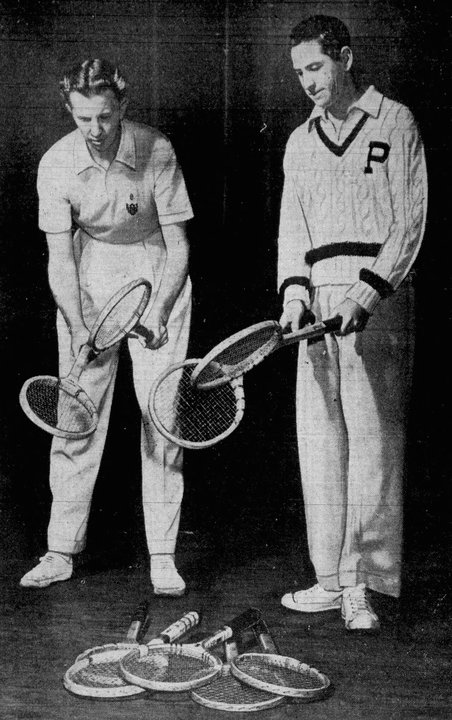
Second image: "Don Budge and Bobby Riggs 1942", from the same collection — Los Angeles Daily News, author unknown, public domain, the Commons credit linking to the issue of 31 March 1942. Two men in tennis whites stand indoors against a black background, each holding a pair of rackets and looking down at them, with six more rackets laid out on the floor at their feet; the taller of the two wears a cable-knit sweater with a large letter P on the chest. The file's description places Budge on the left and Riggs on the right. Nothing available here confirms which man is which independently of that description, and the printed caption was not read. What the picture does show plainly is the arrangement this memory is about: the 1938 champion and the 1939 champion, in the same room, both of them ineligible for the tournament they had won.





































 expand_more