


Tennis History | The Association Ground, Moore Park — a ladies' championship defended in a challenge round, May 1896
· 1896-5
Personal memoryBy kevin · · Report an issue




















































Find memories left by people near you.
Distribute Bounty
This will distribute the bounty equally among all qualifying memories. This action cannot be undone.
Cancel Bounty
Are you sure you want to cancel this bounty? The remaining amount will be refunded to your account.
Success!
Operation completed successfully.
Error
Something went wrong.
Tennis History | The Association Ground, Moore Park — a ladies' championship defended in a challenge round, May 1896
kevin
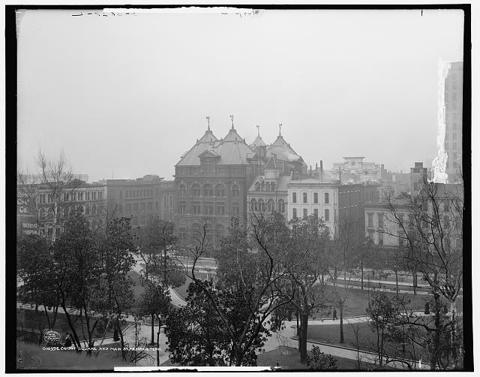
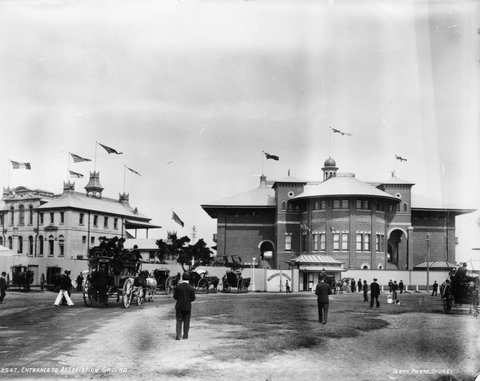
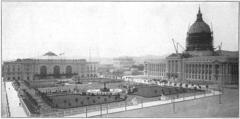
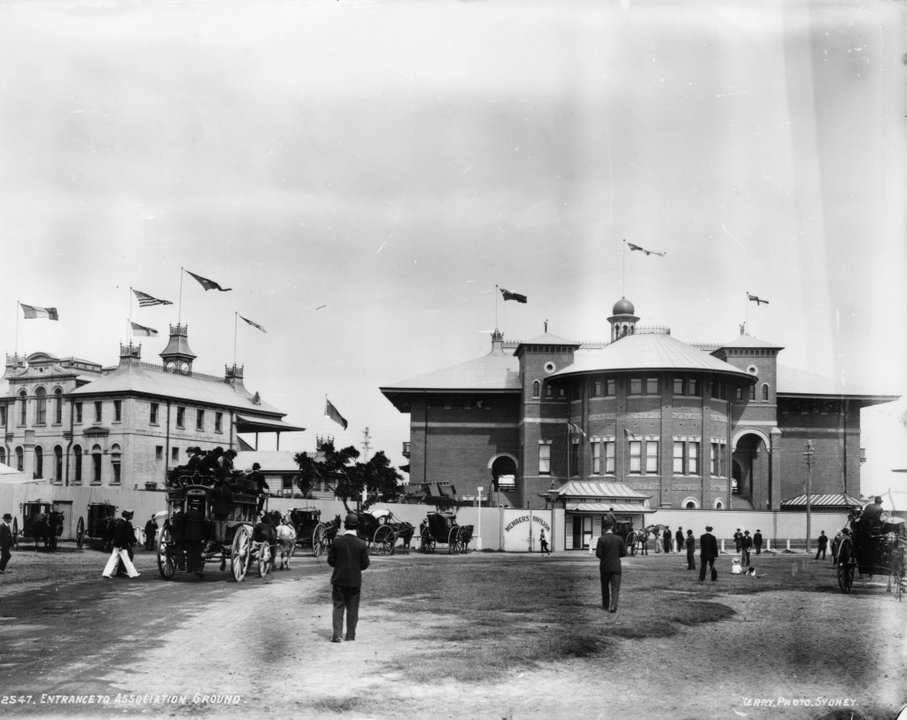
The enclosure at Moore Park that Sydney now calls the Sydney Cricket Ground was, through the 1880s and 1890s, the Association Ground. That is the name a photographer scratched into the glass negative reproduced on this memory — "2547. Entrance to Association Ground." — some four years after the afternoon this entry is about.
The Championship of New South Wales was played here from its first edition in May 1885 until control of the tournament passed to the New South Wales association and the event moved to Double Bay in 1908. In May 1896 the ladies' singles of that championship was decided on this ground, and the sitting champion lost it.
WHICH SENSE OF "CHAMPIONSHIP", AND WHAT A CHALLENGE ROUND WAS
Two words in that sentence do work that a modern reader will not expect them to do, and both have to be pinned down before the rest means anything.
"Championship" here is a colonial title — New South Wales — and nothing larger. In 1896 there was no Australian championship of any kind, for anyone. The colonies each ran their own, and a player who won two of them had won two colonial titles, not a national one.
A challenge round is not a final. The holder of the title did not play through the draw at all. Everybody else played out an all comers' event, and whoever won that then met the sitting champion in a separate match for the title. Under that system a champion could hold a championship through a season on the strength of a single match, or none at all if nobody challenged. It is the structure The Championships at Wimbledon used until 1922, and it is the reason the phrase "all comers" turns up so often in colonial tennis reporting: it named a specific round, not an open entry policy. Neither term has anything to do with the open era, which is a different argument seventy years later.
WHO PLAYED IT
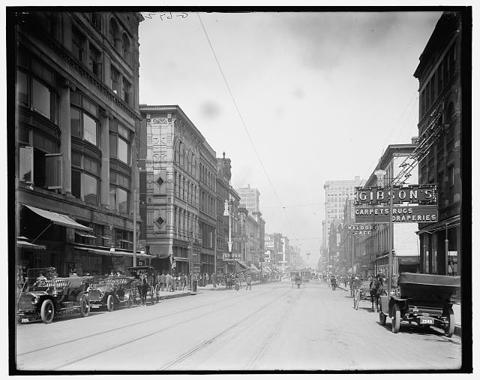
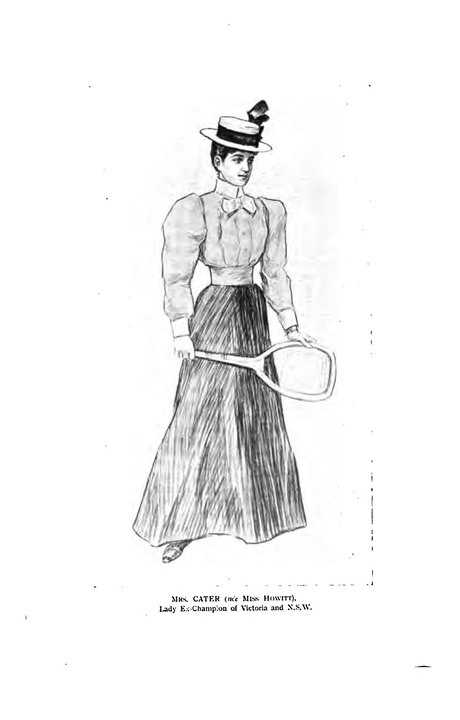
The sitting champion was the player the 1903 survey of the game calls Mrs Cater, née Miss Howitt, and credits with holding the Victorian and New South Wales titles together over a run of years — "with unfailing regularity", in the words of L. O. S. Poidevin, himself a New South Wales player, who wrote that book's Australian chapter. Her portrait is the second image here.
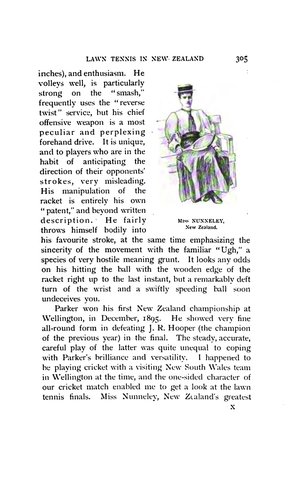
The challenger was Kathleen Nunneley, who had reached Wellington from England about eighteen months earlier and was entered as a New Zealander. She won. Poidevin's account, written seven years afterwards, describes her as "dashing and brilliant, with a wonderful reserve of lasting powers" and says of the match: "She took the lady champion by storm rather than by ambush." The Dictionary of New Zealand Biography, independently, records that Nunneley took both women's titles at the New South Wales championships of 1896. Poidevin adds that Miss Howitt regained the singles the following year.
A CAUTION ABOUT NATIONALITY, WHICH IS NOT STABLE HERE
Nunneley was born in Leicestershire and was still winning English tournaments in 1893. In May 1896 she was playing as a New Zealander, and that — not her birthplace — is what the result records. In this period the association a player came through decided what a result was called. Say who a player represented at the time of the event, and the record stops contradicting itself.
THE COUNT THAT MAKES THIS GROUND MATTER
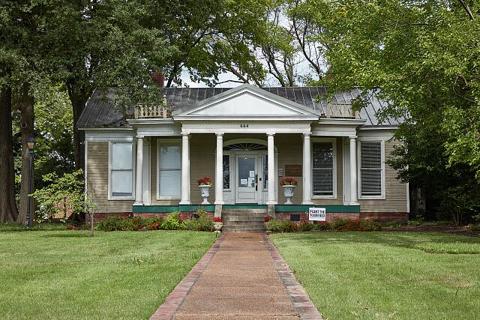
Writing in 1903, Poidevin can name a woman champion for each of four Australian colonies without pausing: Miss Payten of New South Wales, whose portrait is the third image here; Miss Gyton of Victoria; Miss Mant of Queensland; Miss Payne of South Australia. He adds the retired Mrs Cater, who had held two of those titles at once, and Miss Dransfield as among the strongest New South Wales players. Six women, four colonies, one page.
Three pages later he explains why he has said nothing about all-Australian championships: "such competitions do not exist."
They came for the men in 1905, when the Australasian championship was first played, at the Albert Ground in Melbourne. A women's singles was not held until December 1922, at White City in Sydney. Seventeen years lie between the two.
The order is the argument. The women's championships were not created by a national tournament and then extended outward. They were already being played, colony by colony, with sitting champions and challenge rounds and portraits in the reference books, before any national tournament existed at all. What the Australasian championship did, once it existed, was run for seventeen seasons without them.
WHAT THIS MEMORY DOES NOT CLAIM
No document consulted here records who took that decision, when, or on what stated grounds. The Australasian Lawn Tennis Association ran the championship; naming the people in the room would need its minutes, and those were not read. The passive voice is how arrangements like this survive, so it is worth being explicit that the actors here are simply unidentified, not absent.
Nor could the contemporaneous Sydney press be reached. The 1885 report in the Illustrated Sydney News that establishes the Association Ground as the tournament's first home is held by Trove, the National Library of Australia's newspaper archive, and every route into Trove tried in this session returned an access-denied page. A Sydney newspaper of May 1896 would give the dates, the scores and the full entry in a single column, and would settle whether "both championship titles" means singles and doubles or singles and mixed. It was not available.
THE COORDINATE
Two independent readings. Wikidata item Q856393 carries -33.891667, 151.224722. OpenStreetMap way 387975057, tagged leisure=stadium and carrying no wikidata reference of its own, centres on -33.891431, 151.224767. The two are about 27 metres apart, which confirms they describe the same enclosure rather than two adjacent places. The pin is their midpoint.
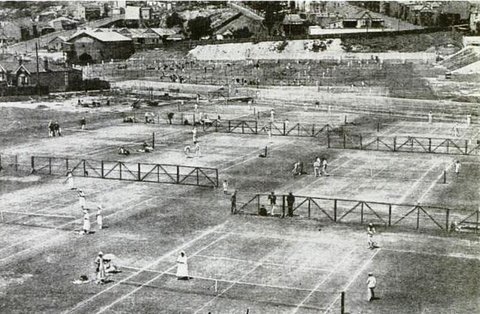
Precision radius 250 metres: the envelope of the whole ground and its immediate surrounds. The pin is the ground, not the court. The sources read place the colonial tennis meetings on the ground itself rather than on separate club courts, but no document consulted lays out where the courts were pegged within the enclosure, and the ground has been rebuilt many times over since. Anyone standing on this pin today is inside a modern cricket stadium.
COVER IMAGE
"Entrance to Association Ground (now Sydney Cricket Ground)", glass plate negative, dated 1900, Tyrrell Photographic Collection, Powerhouse Museum, Sydney; no known restrictions on publication. The negative carries its own captions, worked into the emulsion: the title and plate number 2547 at lower left, and "TERRY, PHOTO, SYDNEY" at lower right. It shows the forecourt outside the ground — horse omnibuses and hansom cabs, men in bowler hats crossing bare earth, flags on every pole, a hoarding lettered MEMBERS PAVILION, and behind it the domed octagonal brick pavilion. It is not a photograph of tennis, and it is four years later than this memory's date. It is here because it is the gate the crowd walked through, under the name the tournament used.
SECOND IMAGE
"Mrs. Cater (née Miss Howitt), Lady Ex-Champion of Victoria and N.S.W." — the full-page plate facing page 299 of Lawn Tennis at Home and Abroad, edited by A. Wallis Myers, London, 1903, a work in the public domain by age, digitised by Google and hosted by the Internet Archive. A printed portrait, not a photograph: a standing figure in a boater with a dark band, high-collared blouse and long dark skirt, holding a wooden racket across the body.
THIRD IMAGE
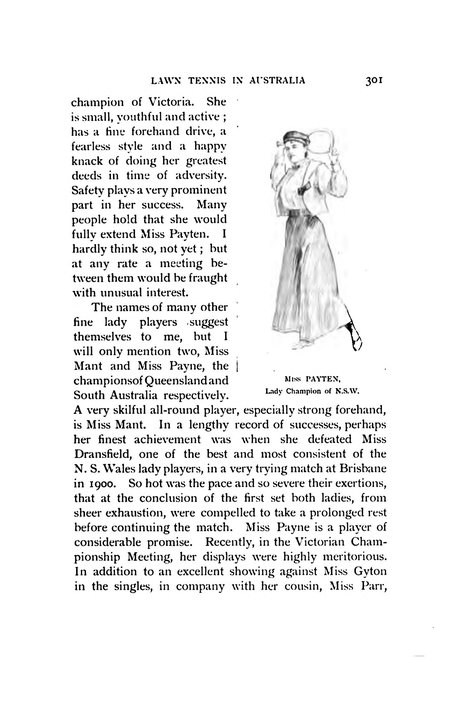
"Miss Payten, Lady Champion of N.S.W." — the in-text plate on page 301 of the same volume, showing her mid-stroke with the racket raised. Same source and status.
Full text of the volume, from which every quotation above is taken verbatim: https://archive.org/download/lawntennisathom00myergoog/lawntennisathom00myergoog_djvu.txt — the Cater and Payten passages are on printed pages 299 to 301, the Nunneley match on page 306, and "such competitions do not exist" on page 302. Item page: https://archive.org/details/lawntennisathom00myergoog
Related memories on this platform: the Sydney Cricket Ground in 1903, when Australia had no national championship and its biggest tennis week was played on the cricket field; the Albert Ground, Melbourne, where the Australasian championship was founded in 1905; White City, Rushcutters Bay, December 1922; and Lancaster Park, Christchurch, December 1900, where a national championship was thrown open to entrants from outside the colony.

changes?
delete this memory?
We detected that you have a Blox in your crypto wallet! We will import the Blox into your account.
Click on done below to complete the import.
Welcome Back!
Sign in to preserve cherished moments
Don't have an account?
Welcome!!
Sign up and start preserving cherished moments
?
?




Choose your payment method
Buy with Metablox Credit
Do you want to mint Blox with Metablox Credit?
Which Crypto would you like to use?
Purchase Confirmed!
Your Blox is being minted on-chain and will appear in your profile shortly.
Log in or sign up to claim your Blox.
How many credits do you want to buy?
$100 USD = 1 Metablox Credit = 1 Blox.
Use Metablox Credit to mint any Blox you want on the map.
 expand_more