


Biography | Bill Johnston — the courts a city built for school boys, and the first bay counties junior title decided on them, Golden Gate Park, November 1910
· 1910-11
Unreviewed contributionBy kevin · · updated · Report an issue






























Find memories left by people near you.
Distribute Bounty
This will distribute the bounty equally among all qualifying memories. This action cannot be undone.
Cancel Bounty
Are you sure you want to cancel this bounty? The remaining amount will be refunded to your account.
Success!
Operation completed successfully.
Error
Something went wrong.
Biography | Bill Johnston — the courts a city built for school boys, and the first bay counties junior title decided on them, Golden Gate Park, November 1910
kevin
In August 1915 Clarence Griffin told a national wire service that the maintenance of municipal tennis courts was responsible for the growth of the American game, and that San Francisco had demonstrated it. That statement is pinned separately on this platform, and that memory says plainly what is missing from it: nothing found there put Griffin himself on a public court. He made the argument. He was not the evidence for it.
His doubles partner was, and the evidence is at this pin.
**Who the courts were built for.**
In 1913 the sporting goods firm Wright and Ditson published a booklet in San Francisco, Growth of Lawn Tennis in California, to mark the twenty-fifth anniversary of the Pacific States Lawn Tennis Association. Writing about the years around 1900, it credits the rising standard of Californian play to two things: the growing number of players and tournaments, and the interest the city authorities took in building courts in Golden Gate Park for the school boys (https://archive.org/details/growthoflawntenn00wrig).
It is a trade publication, produced by a firm that sold rackets into the market it is describing, and that is a reason to read it carefully rather than to discard it. What it supplies is an actor and a purpose: the city authorities built the courts, and the booklet says they built them for school boys. It says so twelve years before Griffin was quoted on the same subject, and it is the earliest document read for this pin.
**The school boy.**
William Marquitz Johnston was born in San Francisco on 2 November 1894, the son of Robert Johnston, an electrical plant mechanic, and Margaret Burns.
Two bodies independently place the start of his tennis on public courts in 1906 and tie it to the earthquake and fire of that April. The International Tennis Hall of Fame says the San Francisco native began playing on public courts in 1906, shortly after the fire and earthquake (https://www.tennisfame.com/hall-of-famers/inductees/bill-johnston/). The English Wikipedia article on him, citing Roger Ohnsorg's book on Robert Lindley Murray at pages 39, 40 and 295 to 298, says he started in early 1906 at the age of eleven on the public asphalt courts in Golden Gate Park, that the schools were closed after the earthquake, and that he spent much of his spare time practising on the courts (https://en.wikipedia.org/wiki/Bill_Johnston_(tennis)).
The two agree on the year, on the public courts and on the earthquake. Only one of them names Golden Gate Park; the Hall of Fame page says public courts and stops there. This pin therefore rests on the narrower of the two sources for the place, and that is stated rather than smoothed over. Both pages were read through a summarising fetch and are reported here as attributed paraphrase.
So the mechanism at this ground is not that a boy discovered tennis. It is that a city had already built courts for school boys, and then an earthquake shut the schools, and one of the school boys had nowhere else to be.
**What the local paper reported, at the time.**
The reference work gives Johnston's first tournament victory as the Bay Counties junior singles of 1910. The San Francisco Call, which the Library of Congress serves as machine-read text of the printed page, carries that event as it was happening, and puts it on these courts.
On 6 November 1910 the Call reported under a headline about the bay counties title being decided on the park courts that the championship tournament, the last of the year, would be completed that day on the Golden Gate Park tennis courts, with the doubles and the senior and junior singles all at the challenge round. It added that because this was the first time a junior event had been held for the bay counties title there would be no challenge match, and that the title would go to the winner of the final, which brought together Fottrell and William Johnston (https://www.loc.gov/resource/sn85066387/1910-11-06/ed-1/?sp=49).
The paper did not report the result on that page. It reported it later, twice, in passing. On 10 September 1911 it described Johnston as the present title holder of the bay counties among the juniors, who would have to be at his best to retain it (https://www.loc.gov/resource/sn85066387/1911-09-10/ed-1/?sp=36). On 8 October 1911, listing the juniors of championship calibre, it named John Strachan, W. Johnston the junior champion, and Fottrell (https://www.loc.gov/resource/sn85066387/1911-10-08/ed-1/?sp=41).
The same 1911 pages settle the venue question directly rather than by inference. The September piece says the bay counties junior tournament would be played on successive Saturdays from nine in the morning until two, at the park. The October piece says the tournament was starting that day on the courts in Golden Gate Park under the auspices of the Golden Gate Tennis Club, that sixty players had entered, and that it was the only championship played on the local courts.
That last clause is worth pausing on, because it corroborates the other memory pinned at this ground from an unexpected direction. The Alice Marble memory here sets out that the San Francisco City Championships was founded in 1901 at the California Tennis Club, a private club, and did not move to these municipal courts until 1930. A San Francisco paper in October 1911 saying that the bay counties event was the only championship played on the local courts is an independent, contemporaneous statement of the same arrangement, made nineteen years before the move.
**The identification, and how far it goes.**
The Call gives a name and no more. The identification of its William Johnston with the player born in 1894 rests on the agreement between the paper and the reference work: the paper puts a William Johnston in the first bay counties junior final in November 1910 and calls him the junior champion in 1911, and the reference work gives the 1910 bay counties junior singles as this player's first tournament victory. He turned sixteen four days before that final. The October 1911 field the Call lists also contains Clarence Griffin, who became Johnston's doubles partner in all three of their national titles, and John Strachan, who partnered Griffin in the 1913 national doubles final. That places the name inside exactly the right circle of San Francisco players. That is strong agreement and it is not a document naming a date of birth, so it is set down as agreement rather than as proof.
**What the courts produced.**
Johnston won the United States National singles championship in 1915, beating Maurice McLoughlin 1-6, 6-0, 7-5, 10-8. That was the first year the championship was played at Forest Hills, having been moved there from Newport by a proxy vote this platform pins at the Waldorf-Astoria on Fifth Avenue. He won it again in 1919, beating Bill Tilden. He won the national doubles with Griffin in 1915, 1916 and 1920, and the national mixed doubles in 1921 with Mary Browne, beating Molla Bjurstedt Mallory and Tilden at the same Forest Hills championship where Suzanne Lenglen's default is pinned on this platform. He won the Wimbledon singles in 1923, beating Frank Hunter 6-0, 6-3, 6-1, and the World Hard Court Championships the same year. He was runner-up at the national championship six times, five of them to Tilden. He was in the United States Davis Cup side that won every year from 1920 to 1926. He stood about five foot eight, which is where Little Bill came from, set against Big Bill Tilden. He retired in 1928 and died in San Francisco on 1 May 1946.
That competitive record is drawn from the same English Wikipedia article, which cites Bud Collins's history of the game and a printed encyclopedia of tennis for it, and is reported as attributed paraphrase.
**Two things this record is not.**
It is not a record from an open sport. Every championship named above was closed to professionals, and it should be read as an amateur-era record on the same footing as the others this platform has pinned.
It is also not another career cut short by that bar. This platform has traced the cost of the amateur rule across seven careers, and Johnston does not extend that count. On the reference work's account of an Associated Press report of June 1928, he turned down an offer to turn professional. Like Griffin, he was not kept out of the championships; he declined the thing that would have kept him out. The distinction is worth holding, because a supply-side memory and a bar memory are different arguments and this is the first kind.
**A disagreement left standing.**
The article on Johnston calls the Golden Gate Park courts public asphalt courts. The English Wikipedia article on the Bay Counties Championships gives that tournament's surface as clay. Neither cites a source at the point of the claim, and the second rests substantially on a subscription records database. They are not necessarily in conflict, since a large municipal complex can hold more than one surface and surfaces are relaid across sixty years, but nothing read here reconciles them and the surface Johnston learned on is not established.
**The image this pin still lacks.**
Two memories are now pinned at these courts and neither carries a photograph of them. Three routes have now been tried and failed. A search of the Library of Congress picture catalogue for Golden Gate Park tennis returns three items and none is this site: two courts at the Presidio of San Francisco in the Letterman Hospital complex, and McKinley Park in Sacramento. A Wikimedia Commons geosearch at 900 m around the pin returns forty files, every one of them the National AIDS Memorial Grove or an event held in it, which sits inside the radius and owns the geotagged record for that part of the park. And the 1913 Wright and Ditson booklet, which was the most promising remaining lead, was read in this session: its plates are portraits of individual champions and it carries no view of the ground. The gap stays open and the route not yet tried is a San Francisco newspaper illustration.
**Coordinate.** 37.770073, -122.459676, precision radius 200 m. This is the Golden Gate Park pin already established on this platform for the Alice Marble memory, reused here deliberately and with disclosure. It was derived from two independent sources: OpenStreetMap, through Nominatim, returns 37.770099, -122.459100 for the tennis centre at 50 Bowling Green Drive, and the United States Census Bureau TIGER geocoder returns 37.770046, -122.460253 for the same street address. The two lie about 101 m apart, well inside the extent of a multi-court facility, and the pin is their midpoint. The radius covers the court complex rather than any individual court.
Two things should not be read into it. Where the courts of 1906 sat within the park is not established, and whether they stood on the ground the present complex occupies is not established either. What stands on the site, as of September 2026, is the Lisa and Douglas Goldman Tennis Center, built in a refurbishment that displaced the city championships to Dolores Park in 2019. The ground is the same ground; nothing standing on it is what Johnston played on.
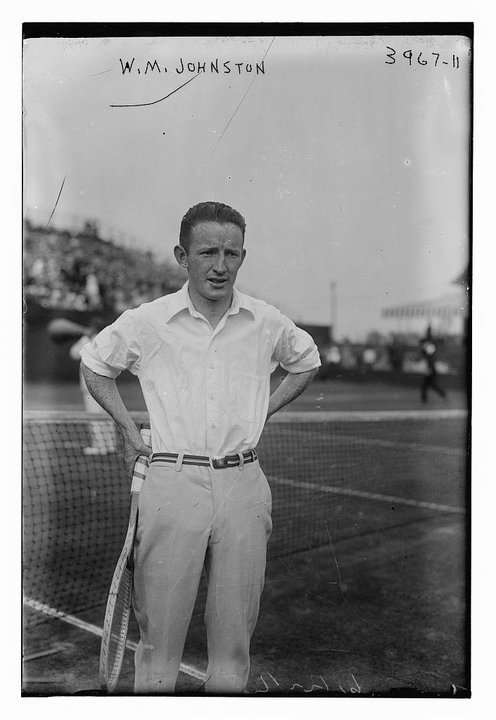
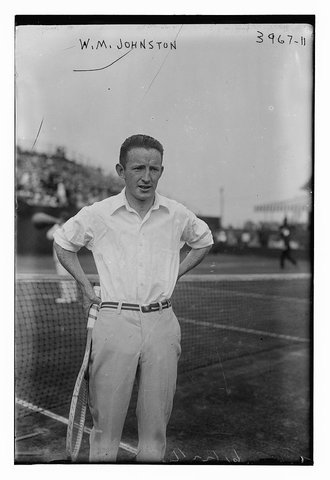
**Cover.** W.M. Johnston, inked on the negative across the top of the frame by the Bain News Service, with the negative number 3967-11, which matches the Library of Congress call number LC-B2-3967-11. A slight young man stands at a net in a white shirt with the sleeves rolled above the elbow, a striped belt and white trousers, hands on hips, a racket hanging from his right hand. Behind him a grandstand is packed with spectators to the left, and to the right, across an open grass court, a pale structure and a flagpole. George Grantham Bain Collection, Library of Congress Prints and Photographs Division, LC-DIG-ggbain-22702, no known restrictions on publication (https://www.loc.gov/pictures/item/2014702652/).
One disclosure. The negative carries the name and nothing else. The Library of Congress catalogue places the photograph at the 1916 United States National Championship at Forest Hills and sources that to a Flickr Commons note of 2014; the place and the date are the catalogue's and are not asserted here. This is not a photograph of Golden Gate Park and shows nothing of this place.
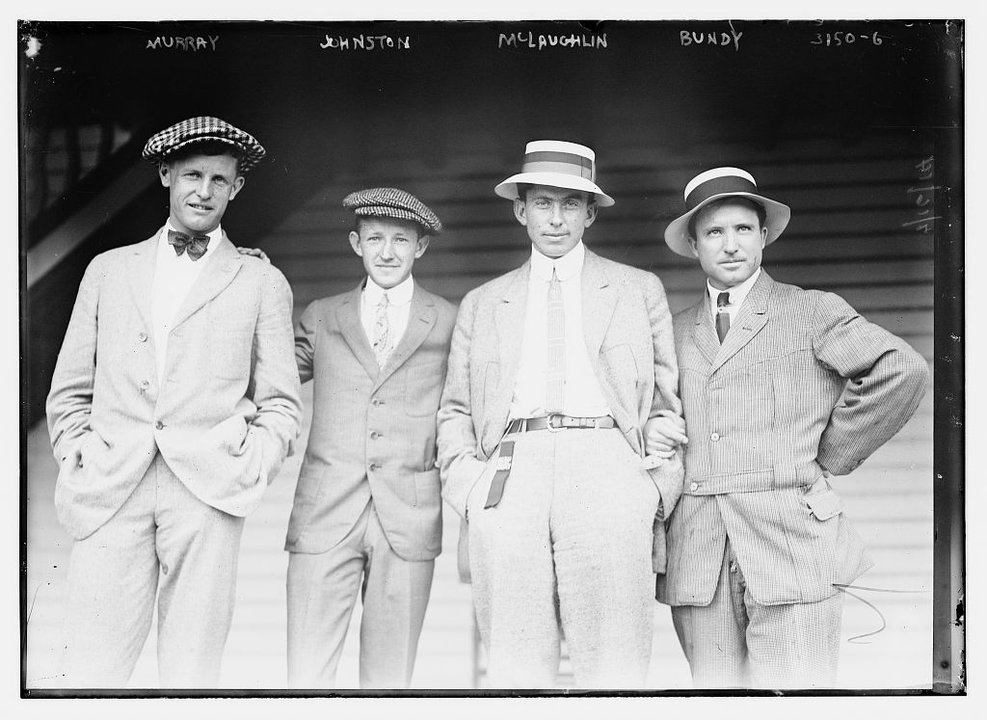
**Second image.** Four men in suits and hats standing on steps, photographed in July 1914. The names are inked across the top of the negative in order, Murray, Johnston, McLaughlin, Bundy, with the negative number 3150-6, matching call number LC-B2-3150-6. Johnston is second from the left, in a checked flat cap and a three-piece suit, and he is visibly the smallest and the youngest of the four; he was nineteen. George Grantham Bain Collection, Library of Congress Prints and Photographs Division, LC-DIG-ggbain-16584, dated on the negative 16 July 1914, no known restrictions on publication (https://www.loc.gov/pictures/item/2014696738/).
Two disclosures here. The Library of Congress corrects the negative's McLaughlin to McLoughlin, and its summary identifies only three of the four men, naming McLoughlin, Johnston and Bundy and not Murray, although the negative inks four names. And this too is a photograph of players rather than of this place.
**Sourcing note.** This memory carries no quotation marks, and that is a decision rather than an accident. Four of its sources were read as machine-read text of the printed page, which is the raw-text route this platform accepts for quotation: the three San Francisco Call pages and the 1913 booklet. But the rule this platform applies is that a machine reading is not the printed page, and a raw-text reading earns quotation marks only where a second independent setting of the same type can be checked against it. Syndicated wire copy can meet that test, as the Griffin memory does. Locally written newspaper copy and a single-edition booklet cannot meet it by construction: there is no second setting to compare. So everything here is paraphrase, attributed, with the page URLs given so the wording can be checked. The Call's optical character recognition on these pages is also poor, which is a second and independent reason not to quote it.

changes?
delete this memory?
We detected that you have a Blox in your crypto wallet! We will import the Blox into your account.
Click on done below to complete the import.
Welcome Back!
Sign in to preserve cherished moments
Don't have an account?
Welcome!!
Sign up and start preserving cherished moments
?
?

Choose your payment method
Buy with Metablox Credit
Do you want to mint Blox with Metablox Credit?
Which Crypto would you like to use?
Purchase Confirmed!
Your Blox is being minted on-chain and will appear in your profile shortly.
Log in or sign up to claim your Blox.
How many credits do you want to buy?
$100 USD = 1 Metablox Credit = 1 Blox.
Use Metablox Credit to mint any Blox you want on the map.
 expand_more