


Biography | Maurice McLoughlin — the first American man in a Wimbledon challenge round, and the Davis Cup taken back on the same grass three weeks later, Worple Road, July 1913
· 1913-7
Unreviewed contributionBy kevin · · updated · Report an issue




































Find memories left by people near you.
Distribute Bounty
This will distribute the bounty equally among all qualifying memories. This action cannot be undone.
Cancel Bounty
Are you sure you want to cancel this bounty? The remaining amount will be refunded to your account.
Success!
Operation completed successfully.
Error
Something went wrong.
Biography | Maurice McLoughlin — the first American man in a Wimbledon challenge round, and the Davis Cup taken back on the same grass three weeks later, Worple Road, July 1913
kevin
The International Tennis Hall of Fame's account of Maurice McLoughlin opens with an argument rather than a birth date. For thirty-one years from its debut in 1881, it says, the United States National men's singles championship was the property of an eastern fraternity of players. That ended in 1912, when McLoughlin, born in Nevada and groomed on the public parks of northern California, became the first westerner to win it, coming from two sets down to beat Wallace Johnson at the Newport Casino, 3-6, 2-6, 6-2, 6-4, 6-2 (https://www.tennisfame.com/hall-of-famers/inductees/maurice-mcloughlin/).
Two memories on this platform are pinned on the municipal courts of Golden Gate Park and argue that a city building courts for school boys is what produced Californian tennis. McLoughlin is the man both of those memories keep naming. He is the player Bill Johnston beat for the 1915 national title. He is among the four names inked on the 1914 negative used as the second image on Johnston's memory. He is half of the pair that Johnston and Clarence Griffin beat for the national doubles title in 1915 and 1916.
This memory is not pinned in California, though, and the reason is that the supply-side argument only matters once it goes somewhere. It is pinned on about four acres of leased meadow between Worple Road and the London and South Western Railway line in south-west London, in the summer of 1913, because that is where the Californian game arrived and what it took away with it.
**The ground.**
The All England Croquet Club leased this field in 1868 and added lawn tennis to its name in 1877. The memory pinned here for July 1877 sets out what that club decided before anyone played a point: a court seventy-eight feet by twenty-seven, a net three feet three inches at the centre, and scoring by fifteen, thirty, forty. The 1913 meeting was the thirty-seventh. The ground held four more, in 1914 and then in 1919, 1920 and 1921, the war having stopped the tournament in the four years between. The club bought land on Church Road in 1920, played its last Championships here in 1921, and opened at the new site in 1922.
The event held here is The Championships, Wimbledon. It has never carried the word Open in its name, and in 1913 it was open in no sense at all: entry ran through a private club and every competitor was an amateur.
**June and July 1913: the first challenge round an American man reached.**
The 1913 Championships ran from 23 June to 4 July, with a men's entry of 116 (https://en.wikipedia.org/wiki/1913_Wimbledon_Championships). The tournament then worked on the challenge round system: the field played out an all-comers competition and the winner earned one match against the previous year's champion, who had not played a point. McLoughlin won the all-comers final against Stanley Doust, who captained the Australasia Davis Cup team, and then lost the challenge round to the holder, Anthony Wilding of New Zealand, 8-6, 6-3, 10-8.
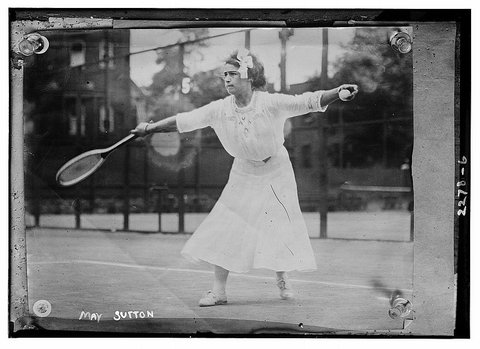
The Hall of Fame calls that result his becoming the first American finalist in history. That claim needs narrowing and this memory narrows it. On this same ground in 1905, May Sutton of the United States had beaten Dorothea Douglass 6-3, 6-4 to win the women's singles outright (https://en.wikipedia.org/wiki/1905_Wimbledon_Championships). An American had therefore not only reached a Wimbledon singles final but won one, eight years before McLoughlin lost his. The defensible claim is the narrow one: McLoughlin was the first American man to play in the Wimbledon singles challenge round.
**Three weeks later, on the same grass.**
The 1913 International Lawn Tennis Challenge, the competition now called the Davis Cup, ran from 3 June to 28 July across eight nations, the largest field it had yet drawn (https://en.wikipedia.org/wiki/1913_International_Lawn_Tennis_Challenge). The United States beat Australasia at the West Side Tennis Club in New York from 6 to 9 June, Germany at Nottingham from 10 to 12 July, and Canada here at Worple Road from 17 to 19 July. That put them into the challenge round against the holders, on this ground, from 25 to 28 July.
The New York newspaper The Sun printed its report on Tuesday 29 July 1913, on image nine of that issue as the Library of Congress serves it, under a special cable despatch datelined Wimbledon, 28 July (https://www.loc.gov/resource/sn83030272/1913-07-29/ed-1/?sp=9). Its account, paraphrased here, is that the cup went back to America after a long absence when McLoughlin of San Francisco beat the English veteran Charles Dixon in straight sets, 8-6, 6-3, 6-2, in the first of the day's singles. That was the fourth of the five rubbers and it settled the tie at three matches to one. James Cecil Parke then beat Richard Norris Williams in the dead fifth rubber, and the tie finished 3-2.
The Sun is worth reading for what it says about the losing side as well as the winning one. It records that Williams had made the capture possible by beating Dixon on the Friday, after Parke had unexpectedly beaten McLoughlin; that ideal weather brought out a record crowd of spectators who gave the players a rousing reception; that the day was very warm and the courts in perfect condition, which it thought favoured the Americans; that Dixon said before play that the English team had had bad luck so far but that he expected to go after McLoughlin; and that when the last stroke was played Dixon went forward and put his arms round the young American's shoulders, and the crowd gave McLoughlin an ovation in spite of its obvious disappointment. It reports the referee, named as Schmidt, attributing the result entirely to McLoughlin's brilliance and holding that Dixon had played to the top of his form and was still no match for him.
**Who the losing team was, and what to call it.**
One page of one newspaper uses two different names for the side that lost the trophy, and it is worth setting them beside each other rather than choosing. The photographic caption on The Sun's page says that if either of Parke's matches, or Dixon in singles, or Dixon and Roper Barrett in doubles, had gone the other way, England would have kept the cup. The year-by-year table printed a few inches away calls the same side the British Isles, in every year from 1900 onward.
The British Isles is the name that fits what the team actually was. James Cecil Parke, who beat both American singles players and was the one man to take two rubbers off them, was born on 26 July 1881 at Clones in County Monaghan, and had already won twenty caps at centre for the Ireland rugby union team (https://en.wikipedia.org/wiki/James_Cecil_Parke). The tie opened on Friday 25 July, the day before his thirty-second birthday, and he beat McLoughlin over five sets, 8-10, 7-5, 6-4, 1-6, 7-5. He was not playing for England, and the trophy he nearly kept was not England's.
**The man crouching at the net.**
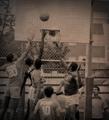
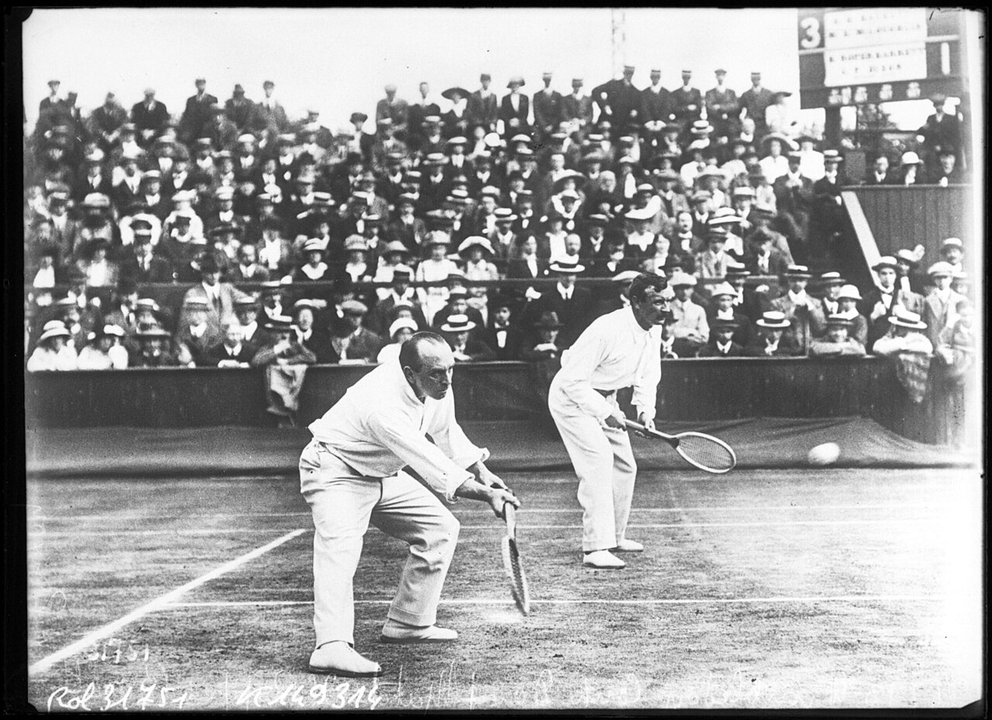
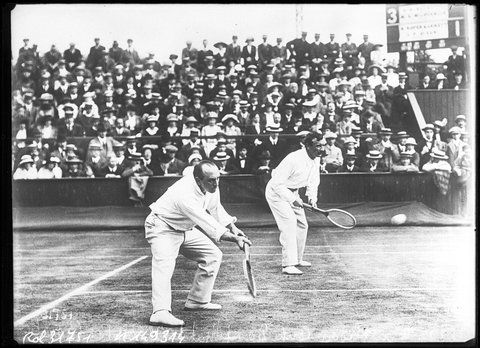
The cover photograph shows the doubles rubber of 26 July. The scoreboard behind the players carries all four names, the Americans above and the British Isles pair below. The two men in frame are the losing pair, Herbert Roper Barrett at the net and Charles Dixon behind him. Neither American is identifiable in the frame.
The Sun's own retrospective on the same page notes something about the older of those two that is worth pinning here, because the other end of it is already on this platform. Roper Barrett was one of the three players sent to Boston in 1900 for the first tie the trophy ever had, alongside A. W. Gore and E. D. Black, against an American side of Malcolm Whitman, Holcombe Ward and Dwight Davis at the Longwood Cricket Club. That ground, Longwood's original one at Pilgrim Road, is pinned separately here. The man crouching at the net in this photograph had played in the competition's first tie thirteen years earlier, and was half of the losing doubles pair when the cup went back to the United States for the first time since 1902.
**Two things this record is not.**
It is not the record of an open sport. Every title named above was closed to professionals, and McLoughlin's two national singles championships, his three national doubles titles with Tom Bundy and his Wimbledon challenge round are amateur-era results, to be read on the same footing as the other amateur-era records pinned on this platform.
It is also not settled in its own details. The Hall of Fame's biography says McLoughlin was a mainstay of the United States Davis Cup team from 1909 to 1913, while its own career-highlights panel, on the same page, lists him as a member in 1909, 1911, 1912, 1913 and 1914. The two halves of one institutional page disagree, and this memory reports both rather than picking one.
**A gap this memory declares.**
The Hall of Fame says McLoughlin was groomed on the public parks of northern California. It names no park, no club and no city. Nothing read for this memory places him on the Golden Gate Park courts, and he is deliberately not pinned there. The two memories at that pin rest on documents naming that ground; this one does not have such a document for McLoughlin, and the difference is the whole reason he is anchored in London instead. Finding one is work for a later session, and the San Francisco Call through the Library of Congress is the route that worked for Johnston.
**Coordinate.** 51.4197, -0.2125, precision radius 250 m. This is the Worple Road pin already established on this platform for the 1877 memory, reused here deliberately and with disclosure. It falls short of the two-independent-source standard used elsewhere in this series, and that shortfall is inherited rather than new: the site is identified from Historic England's photographic record of the commemorative plaque at Wimbledon High School Playing Field, Worple Road, Wimbledon, Merton, and its extent is bracketed by OpenStreetMap's line of Worple Road to the south and the railway to the north, which are the two boundaries the ground actually had. No surveyed coordinate for the courts has been found. The radius covers the whole leased ground rather than any single court. A route that has not been tried is the georeferenced Ordnance Survey county-series mapping of Wimbledon, which would give the ground an extent rather than a bracket.
**Cover.** The doubles rubber of the 1913 Davis Cup challenge round at Wimbledon, 26 July 1913. Herbert Roper Barrett crouches at the net in the foreground with Charles Dixon behind him, both in white; a packed stand runs the width of the frame behind the court, with the back rows standing. The scoreboard at the upper right carries the four names, Hackett and McLoughlin above, Roper Barrett and Dixon below. The negative is inked at the lower left with the agency reference Rol 31751, which matches the reference the archive records for it. Agence Rol, Bibliotheque nationale de France, public domain, 2755 x 2000 px, via Wikimedia Commons. This is a photograph of the ground and of the losing pair.
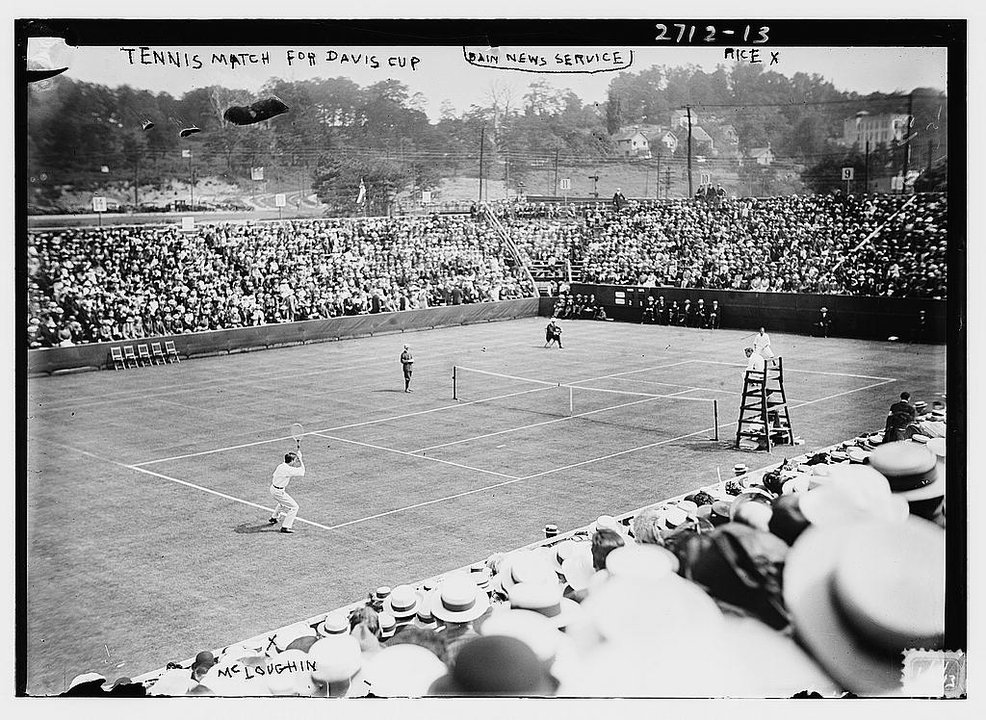
**Second image.** Tennis match for Davis Cup, inked across the top of the negative by the Bain News Service together with the negative number 2712-13, which matches the Library of Congress call number LC-B2-2712-13. A wide view from behind a baseline: McLoughlin, marked with an inked cross and his name at the lower edge, plays a stroke at the near end; Horace Rice of Australasia, also marked with a cross, stands at the far end; the umpire sits on a stepladder chair beside the net; the crowd fills temporary stands on three sides, with a wooded slope, houses and telegraph poles beyond. George Grantham Bain Collection, Library of Congress Prints and Photographs Division, digital id ggbain.13191, no known restrictions on publication (https://www.loc.gov/pictures/item/2014693170/). This is the quarter-final tie of 6 to 9 June 1913, seven weeks before the challenge round and on the other side of the Atlantic. The catalogue places it at the West Side Tennis Club, New York; which of that club's grounds it shows is not established here.
**Sourcing note.** This memory carries no quotation marks. One of its sources, The Sun of 29 July 1913, was read as machine-read text of the printed page, which is the raw-text route this platform accepts for quotation. But the rule applied here is that a machine reading earns quotation marks only where a second independent setting of the same copy can be checked against it, and a special cable despatch written for one newspaper has no second setting by construction. A second paper of the same date, the Birmingham Age-Herald of 29 July 1913, image seven, carries a picture caption saying that McLoughlin's victory of the previous day won the Davis Cup for America and that Hackett was a strong assistant in the doubles (https://www.loc.gov/resource/sn85038485/1913-07-29/ed-1/?sp=7). It corroborates the outcome, but it is different copy, not the same setting. So everything above is paraphrase, attributed, with page URLs given so the wording can be checked.

changes?
delete this memory?
We detected that you have a Blox in your crypto wallet! We will import the Blox into your account.
Click on done below to complete the import.
Welcome Back!
Sign in to preserve cherished moments
Don't have an account?
Welcome!!
Sign up and start preserving cherished moments
?
?
Choose your payment method
Buy with Metablox Credit
Do you want to mint Blox with Metablox Credit?
Which Crypto would you like to use?
Purchase Confirmed!
Your Blox is being minted on-chain and will appear in your profile shortly.
Log in or sign up to claim your Blox.
How many credits do you want to buy?
$100 USD = 1 Metablox Credit = 1 Blox.
Use Metablox Credit to mint any Blox you want on the map.
 expand_more