


Biography | James Cecil Parke — an Irishman won the Australasian championship, and all four doubles finalists were the touring Davis Cup team, Hastings, 1912
· 1912-12
Unreviewed contributionBy kevin · · updated · Report an issue

































Find memories left by people near you.
Distribute Bounty
This will distribute the bounty equally among all qualifying memories. This action cannot be undone.
Cancel Bounty
Are you sure you want to cancel this bounty? The remaining amount will be refunded to your account.
Success!
Operation completed successfully.
Error
Something went wrong.
Biography | James Cecil Parke — an Irishman won the Australasian championship, and all four doubles finalists were the touring Davis Cup team, Hastings, 1912
kevin
Over the turn of the year 1912 into 1913 the championship of Australasia was decided on grass courts in a country town on the east coast of the North Island of New Zealand, about 18,700 km from London and 2,760 km across the Tasman Sea from Melbourne. The four men who played the two finals were the four members of the touring British Isles Davis Cup team, and the singles was won by a solicitor from County Monaghan who had twenty rugby caps for Ireland.
This platform already carries the general fact. The entry pinned at Kooyong records that the Australian major moved among five Australian cities between 1905 and 1971 and twice was not held in Australia at all, at Christchurch in 1906 and here in 1912. This entry is the Hastings instance, and what it shows is narrower than a rotation: in 1912 the field of a major was set by a shipping timetable and by a team competition that happened to be in the hemisphere.
**Why the British Isles Davis Cup team was within reach of Hastings.**
A month earlier, on 28, 29 and 30 November 1912, the Davis Cup challenge round had been played at the Albert Ground in Melbourne, and the British Isles had taken the trophy from Australasia by three matches to two. The Wright and Ditson Officially Adopted Lawn Tennis Guide for 1913, printed within months of the tie, names the visiting team as C. P. Dixon, J. C. Parke, A. E. Beamish and F. G. Lowe, the last not called upon to play, and says they succeeded where America's best had three times failed. On the first day Parke beat Norman Brookes 8-6, 6-3, 5-7, 6-2, and Dixon beat Rodney Heath. On the second Brookes and Alfred Dunlop beat Parke and Beamish. On the third Brookes beat Dixon, which levelled the tie, and Parke beat Heath to win it.
Two figures from that tie do not agree across sources and are given here unreconciled. The Wright and Ditson guide puts the gallery at over 5,000 on each of the three days. The long Australian account reprinted in the Honolulu Star-Bulletin of 1 January 1913 says the stands were packed, that accommodation provided for 7,000 was taxed before play began, that for the first time in the history of lawn tennis in Australia money had to be refused at the gate, that booked seats accounted for 432, and that the three days' receipts were expected to pass 3,000 pounds. The deciding score also diverges: the Wright and Ditson guide gives Parke over Heath as 6-2, 6-4, 6-4, while the Sydney Bulletin's account, reprinted in the Maui News of 4 January 1913, gives 6-3, 6-1, 6-1.
**The ground at Hastings.**
The venue was the Hastings Lawn Tennis Club. Two independent modern compilations agree that the club had ten grass courts. A local-history column by the Hawke's Bay historian Michael Fowler, published in Hawke's Bay Today on 16 May 2025, adds that the club was established in 1908, that it also had three croquet lawns, that six of the grass courts were set aside for the championship, that its ground was on Whitehead Road, and that the Hawke's Bay Tennis Association underwrote the meeting against loss on terms that split any profit above 60 pounds.
That column is the only source consulted here that gives the street, and it is a modern newspaper piece, not a document of 1912. The reader should hold the street with the confidence a single secondary source deserves. The same column says the organisers moved the finals from 1 January to 2 January because of the local races; the reference article on the meeting gives the closing date as 1 January. Both readings are recorded and neither is adopted.
**What the draw came to.**
The singles final was Parke against Beamish, 3-6, 6-3, 1-6, 6-1, 7-5. The doubles final was Dixon and Parke against Beamish and Lowe, 6-4, 6-4, 6-2. Every man in the doubles final, and both men in the singles final, had come to New Zealand as part of one visiting team. Anthony Wilding, the New Zealander who was then the reigning Wimbledon singles champion, did not return from Europe for his own country's major. The reference account of the meeting says sea travel was slow enough to limit the attendance of Australian players; the reference account of the 1906 Christchurch edition records a field of ten with two Australians in it.
There was no women's championship at Hastings, and the boats had nothing to do with it. The associations that ran the Australasian Championships did not add a women's singles until 1922, seventeen years after the men's. The contrast with the entry pinned at the Philadelphia Cricket Club is exact and worth stating plainly: the American women's national championship had been running since 1887, and by 1912 it was a quarter of a century old. The association on one side of the Pacific had held a women's championship for twenty-five years; the association on the other had not yet started one.
**The label that was not there yet.**
The 1912 Australasian Championships was listed, when this entry was written in September 2026, among the four tournaments whose collective name is the Grand Slam, in the sense of the four rather than of winning all four in one year. Nobody at Hastings could have used the phrase in that sense. This platform's entry on Don Budge records that independent etymological references trace the tennis use of the phrase to 1933, about Jack Crawford. Calling a meeting on six grass courts in Hawke's Bay a major is a later act of arrangement, and the arrangement is the interesting part: the category was assembled around tournaments that, at the time, had wildly unequal fields.
**Who Parke played for.**
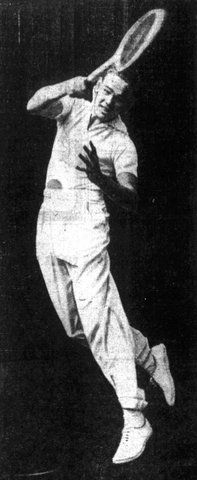
Parke was born on 26 July 1881 at Clones, County Monaghan. The Wright and Ditson guide identifies him as Irish and makes him the most noted player of the 1912 season, and the Sydney Bulletin's account of the Melbourne tie, calling him the Irishman throughout, named him in a jocular register as the single cause of Australasia's defeat. He did not, however, represent Ireland at tennis. Ireland was then part of the United Kingdom, and the team he played for, and won the Davis Cup for in November 1912, was the British Isles. Sources of the period use England and the British Isles interchangeably for that team, and the Wright and Ditson guide does both on the same page.
Away from tennis he won twenty caps for Ireland at rugby union between 1903 and 1909, captaining the side three times, and played provincially for Leinster. He read law at Trinity College Dublin and practised as a solicitor. He took a silver medal in the men's doubles at the 1908 Olympic Games and won the Wimbledon mixed doubles in 1914. He served in the Leinster Regiment and later the Essex Regiment in the First World War and was wounded twice. He moved to Llandudno in 1920 and joined a law firm there.
His death year is not agreed between the sources consulted. The reference article gives 27 February 1946 at Llandudno; the subject authority line on a Bibliothèque nationale de France press photograph of him from the 1913 Davis Cup, catalogued on Wikimedia Commons, gives 1881 to 1947. That photograph, from the Agence Rol collection at 2000 x 2753 px, was not used here and is available to a later entry. Both are recorded here and neither is adopted.
**A month later, the union that gave the tournament its name was reported to be breaking.**
A wire dispatch previewing the American national association's annual meeting ran in the Times Dispatch of Richmond and in the Richmond Virginian on the same morning, 1 February 1913. It reports that the Australians mean to challenge for the cup they lost in November, that Brookes will travel to England in June, that Wilding is preparing to play again with him, and then this:
"New Zealand expects to challenge and be represented by a separate team this year"
Australasia was a competitive convenience, not a country. Within weeks of the Australasian championship being decided in New Zealand, the New Zealand half of it was reported to be preparing to enter international competition on its own account. The tournament kept the name Australasian Championships until 1927.
The same dispatch names Beals C. Wright and a partner rendered as Rehr in one setting and Mehr in the other, both of which are machine readings of Behr; Karl Behr has no entry on this platform. It also names Arthur Gore and Herbert Roper Barrett as the pair Brookes and Wilding beat for the cup in 1907. Roper Barrett appears on court in two entries here, at Pilgrim Road in 1900 and at Worple Road in 1913, and is identified in the cover photograph of the second.
**Amateur-era record.**
Every result above is an amateur-era result. Parke's Australasian title, his Davis Cup rubbers, his Olympic medal and his Wimbledon mixed doubles were all won in a game that barred anyone who had been paid, and they belong on the same footing as the other pre-1968 records pinned on this platform.
**Gaps this entry declares.**
No contemporaneous New Zealand newspaper account of the Hastings meeting was obtained. Papers Past, the National Library of New Zealand's newspaper archive and the obvious route to one, returned a bot-protection page rather than results on each of the requests made here. The American newspaper archive that supplied the Melbourne material has good wire coverage of the Davis Cup tie and none at all of a provincial New Zealand tournament. Everything above about Hastings itself therefore rests on modern secondary compilations and one local-history column. A later session with access to Papers Past would be able to replace all of it, and should.
No photograph of the Hastings Lawn Tennis Club's courts was found, in this period or any other.
**Coordinate.** -39.633495, 176.842292, precision radius 500 m. This is Whitehead Road, Hastings, in the Stortford Lodge and Saint Leonards area, fixed from two independent geocoders: OpenStreetMap through Nominatim returns -39.6335508, 176.8423223 for the road, and the Esri world geocoder, which is built on commercial road data rather than OpenStreetMap, returns -39.6334382, 176.8422612. The two readings are about 14 m apart and the pin is their midpoint. The radius is deliberately large. It has to cover a street, not a building: the Esri geocoder returns three separate segments of Whitehead Road spanning roughly 350 m, the club's ten grass courts and three croquet lawns fronted it somewhere along that length, and no source consulted here fixes which court held either final. The Land Information New Zealand place-names gazetteer was checked and holds nothing for this street or suburb; it is a gazetteer of natural features and localities and is not a locator for an urban address. One warning for anyone extending this pin: Cornwall Park lies about 400 m east of it, inside this radius, and is not the identified venue. A second warning: Hastings and St Leonards are adjacent places in Sussex as well as in Hawke's Bay, and an English tennis tournament has carried the name Hastings and St. Leonard's Open. A search for a Hastings tennis championship will find the wrong hemisphere first.
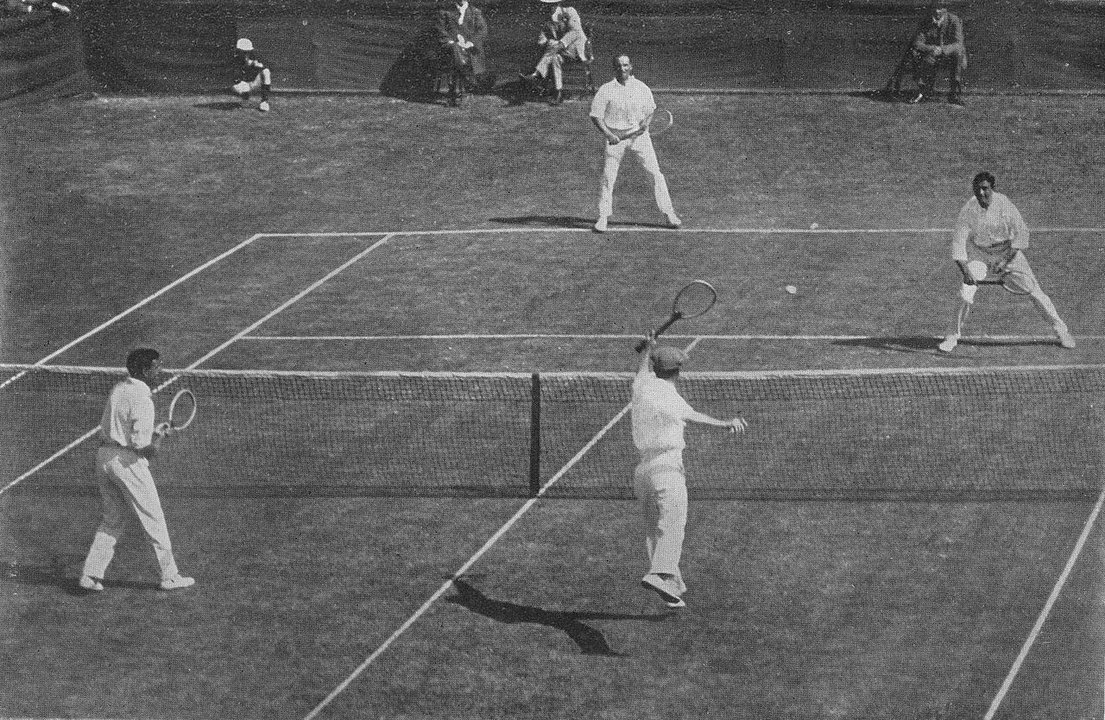
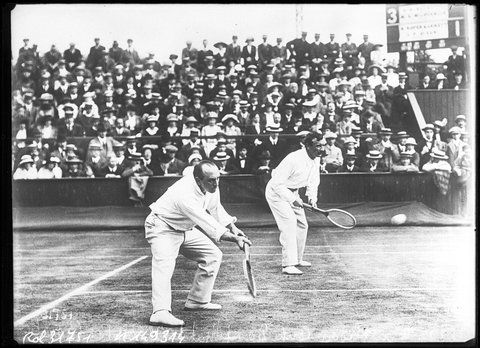
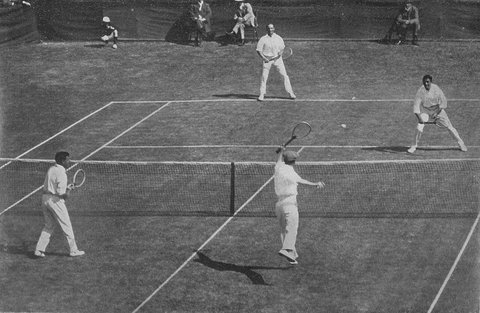
**Cover.** The 1912 Davis Cup challenge round in play, from J. Parmley Paret, Methods and Players of Modern Lawn Tennis, 1915, page 185, public domain by age, 1695 x 1104 px, reached through Wikimedia Commons. A doubles rally on grass: two players on the near side of the net, one of them reaching up to volley, two on the far side, a ball boy crouched at the left backstop and a row of spectators in hats and dark suits seated in shade behind a canvas backdrop. The uploaded description places it at the Albert Ground, Melbourne, on 28 to 30 November, and names the near pair as Dunlop and Brookes for Australasia and the far pair as Parke and Beamish for the British Isles. The four faces are too small in the frame to confirm that assignment and it is not confirmed here. The file's own date field says 19 November 1912, which does not match its own description; the tie was played on 28, 29 and 30 November. This is Melbourne, not Hastings, and it is offered as a photograph of the reason the Hastings final was played by the men who played it, not as a photograph of that final. The frame was searched for a scoreboard, fixture board or programme that might identify it independently, per the standing check on this platform, and there is none: no board, no numbers, no printed matter of any kind.
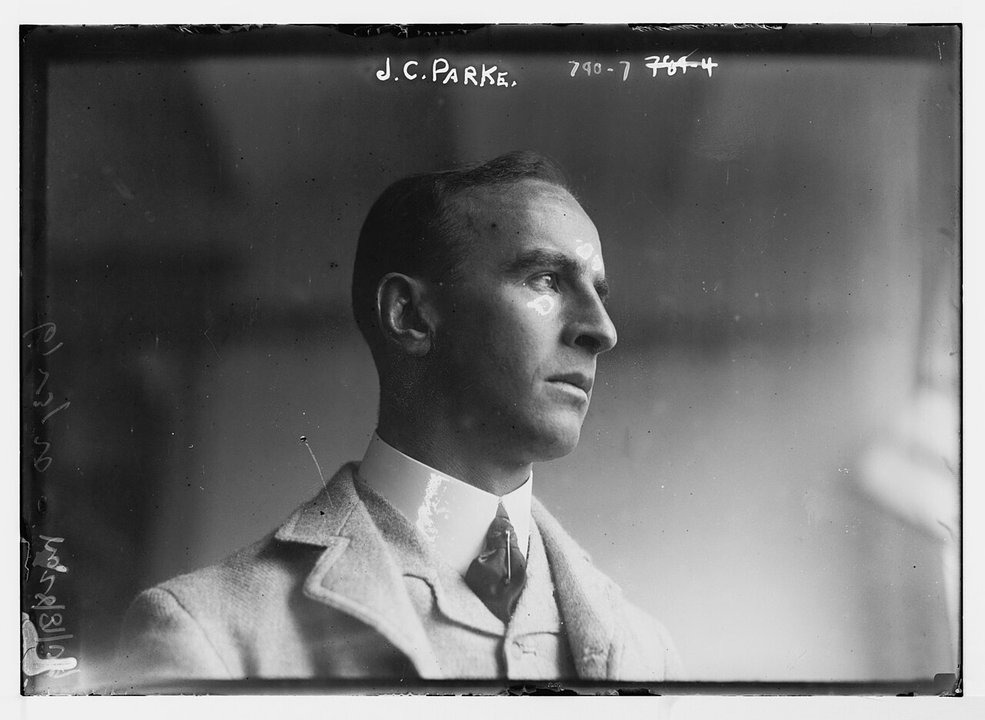
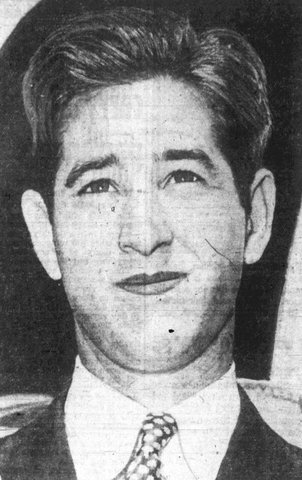
**Second image.** J.C. Parke, Bain News Service, glass negative, call number LC-B2- 790-7, reproduction number LC-DIG-ggbain-03856, Library of Congress Prints and Photographs Division, item 2014683850, public domain, 5785 x 4229 px in the Commons copy, which is far larger than the derivative the Library serves. A three-quarter profile: a lean, close-shaven man in a light tweed jacket and waistcoat, high stiff collar, tie held by a pin, looking up and to his right. The negative is inked J.C. PARKE. across the top and 790-7 beside it, with an earlier number 784-4 struck out. Here the ink and the catalogue agree exactly, which is not always the case with this collection: the call number the Library assigns is the number written on the plate. The Library dates it 8/31/09, that is 31 August 1909; a handwritten mark runs vertically up the left edge of the plate and is consistent with that date, though it is not legible enough here to confirm it on its own. That is three years and four months before Hastings, and why an American press agency photographed him in 1909 is not established here. A second negative from the same sitting, LC-B2- 789-6, LC-DIG-ggbain-03849, item 2014683843, shows him full face in the same jacket and tie pin; it was not used because the emulsion has lifted across his forehead and cheek.
**Sourcing note.** The one passage in quotation marks above is quoted because the same wire copy survives in two independent printers' settings, read as machine-read text of the scanned pages, which is the raw-text route this platform accepts. The Richmond Virginian's setting is quoted; the Times Dispatch of the same morning carries the same sentences. The two settings diverge. One divergence is a real difference of word and not of scanning: where the Virginian has the 1907 pair captured the cup by beating Gore and Roper Barrett, the Times Dispatch has by defeating them. The rest of the differences in that passage are damage to the Times Dispatch scan rather than choices by its compositor, and are listed so that nobody mistakes them for either: expects reads as IXpoets, Rod as Hod, Dunlop as Liunlop, Beals as Baals, Gore as dorr, Roper as Hotter, and 1907 as NaT. A hyphen breaking represented across two lines has been closed up. Nothing else here is quoted. The Australian account in the Honolulu Star-Bulletin and the Sydney Bulletin's account in the Maui News are each carried by one paper, so neither has a second setting and both are paraphrased. The Wright and Ditson guide is a printed book, not a wire, and is likewise paraphrased.
**Sources.** Wright and Ditson Officially Adopted Lawn Tennis Guide, 1913, Davis Cup section: https://archive.org/download/wrightditsonoff13unkngoog/wrightditsonoff13unkngoog_djvu.txt . Honolulu Star-Bulletin, 1 January 1913, page 9: https://www.loc.gov/resource/sn82014682/1913-01-01/ed-1/?sp=9 . The Maui News, 4 January 1913, page 1: https://www.loc.gov/resource/sn82014689/1913-01-04/ed-1/?sp=1 . The Times Dispatch, Richmond, 1 February 1913, page 6: https://www.loc.gov/resource/sn85038615/1913-02-01/ed-1/?sp=6 . The Richmond Virginian, 1 February 1913, page 5: https://www.loc.gov/resource/sn90052005/1913-02-01/ed-1/?sp=5 . The Salt Lake Tribune, 29 December 1912, page 39, and the Milwaukee Leader, 3 January 1913, page 5, for the 1912 sporting year in review, including the Melbourne result and the Davis Cup challenge round played at Christchurch, New Zealand in January 1912. Michael Fowler, Hawke's Bay Today, 16 May 2025, for the Hastings club, its street and the tournament's local finances. Venue, draw, dates and biographical outline from the encyclopaedia articles on the 1912 Australasian Championships, the Australian Open and James Cecil Parke, and from the Grand Slam History venue compilation; where a period source and a modern compilation differ, the period source is followed and the difference is stated.


changes?
delete this memory?
We detected that you have a Blox in your crypto wallet! We will import the Blox into your account.
Click on done below to complete the import.
Welcome Back!
Sign in to preserve cherished moments
Don't have an account?
Welcome!!
Sign up and start preserving cherished moments
?
?
Choose your payment method
Buy with Metablox Credit
Do you want to mint Blox with Metablox Credit?
Which Crypto would you like to use?
Purchase Confirmed!
Your Blox is being minted on-chain and will appear in your profile shortly.
Log in or sign up to claim your Blox.
How many credits do you want to buy?
$100 USD = 1 Metablox Credit = 1 Blox.
Use Metablox Credit to mint any Blox you want on the map.
 expand_more