


Biography | Blanche Bingley Hillyard — eleven at Eastbourne against six at Wimbledon, and a photograph of what the amateur game paid, Devonshire Park, 1905
· 1905
Personal memoryBy kevin · · Report an issue


































Find memories left by people near you.
Distribute Bounty
This will distribute the bounty equally among all qualifying memories. This action cannot be undone.
Cancel Bounty
Are you sure you want to cancel this bounty? The remaining amount will be refunded to your account.
Success!
Operation completed successfully.
Error
Something went wrong.


Biography | Blanche Bingley Hillyard — eleven at Eastbourne against six at Wimbledon, and a photograph of what the amateur game paid, Devonshire Park, 1905
kevin
Blanche Bingley Hillyard won the Championships at Wimbledon six times. She won the South of England Championships at Devonshire Park in Eastbourne eleven times. The second number is the larger one, and it is the one nobody quotes.
That is the argument of this entry, and it is not a complaint about Eastbourne being underrated. It is a point about how an amateur career was actually shaped. The Championships at Wimbledon offered a woman one event a year, and had only done so since 1884. Everything else she played was a provincial open meeting run by a private club for a week in its own season, and that is where a career happened, where it was watched, and where it was photographed. When the standard survey of the sport was published in 1903 and wanted a picture of a women's final, the picture it printed was taken at Eastbourne.
**The ground, and what was played on it first.**
Devonshire Park opened to the public on 1 July 1874, laid out as a cricket ground. The article on the ground states that tennis courts were first marked out on its lawns in 1879; it does not say who marked them out. In 1881 the club staged the first South of England Championships, and the encyclopaedia article on that competition states that the first tournament staged at Devonshire Park was a women's event, in 1881, won by Agnes Noon Watts over E. Hudson by two sets to one.
That date is worth holding next to two other entries on this platform. The All England Club did not add a Ladies' Singles until 1884. This platform's entry on Maud Watson sets out a Birmingham club running a ladies' singles in July 1881, three years earlier; this one records a Sussex club doing the same thing in the same year, and, on the account above, doing it as the first tennis competition its ground ever held. Two provincial clubs, in one year, in different counties. Neither needed permission and neither was following the championship's lead, because there was no lead to follow.
**Eleven.**
Her titles in the South of England ladies' singles, from the published roll: 1885, 1888, 1891, 1892, 1893, 1895, 1896, 1898, 1899, 1900 and 1905. Eleven, over twenty years. She was also beaten in the final in 1886, 1887, 1897 and 1901, so she contested at least fifteen finals at one meeting.
The first was in 1885, against Ada Strapp, 6-1, 6-0. Against her birth date of 3 November 1863 that makes her twenty-one, if the final was played in September, which is the month the meeting usually occupied. The month is an assumption and is flagged here as one rather than buried. The eleventh title was in 1905 against Agnes Morton, 7-5, 4-6, 6-3, which on the same assumption makes her forty-one, and it came five years after the last of her Wimbledon titles.
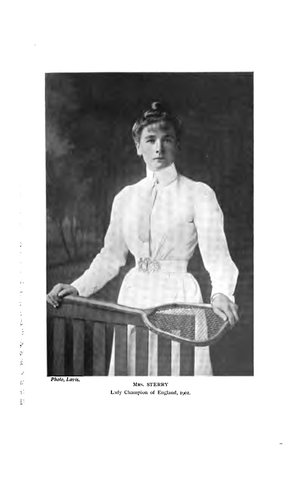
The players who beat her at Eastbourne are the other half of the roll and are worth naming, because a record with no losses in it is a marketing document. Margaret Bracewell took the title in 1886 and 1887. May Langrishe won it in 1889 and 1890 — the same May Langrishe to whom the published Irish roll gives the 1879 title, the championship and the year this platform's Dublin entry is about. Charlotte Cooper, later Mrs. Sterry, won it in 1897 and 1901, both times beating her in the final.
**Where the other titles came from.**
The 1903 survey states her record as of that year: fifty-eight victories in first-class open singles; the Championship of England six times; the South of England Championship ten times; the Northern Championship three times; the Irish Championship three times; the Ladies' Championship on the covered courts on the only occasion she entered it; the Ladies' Doubles Championship five years running, four of them with Miss Steedman; and championships of Wales, of Germany twice, of the South of France and of Monte Carlo.
The South of England figure in that 1903 list is ten. The modern roll gives her eleven, and the eleventh is the 1905 title, which a book printed in 1903 could not have counted. The two sources therefore agree exactly, and that is worth reporting, because most of the time in this series they do not.
Her encyclopaedia article adds tournaments the survey does not itemise: the Middlesex Championships at Chiswick Park in 1884, which it gives as her first success; the London Championships at Stamford Bridge in 1886, 1887 and 1888; the Sussex Championships at Brighton in 1893, 1894, 1895, 1896 and 1900; the Derbyshire Championships at Buxton in 1888, 1893, 1894, 1896, 1901 and 1906; Exmouth in 1887 and 1888; the British Covered Court Championships in 1901; and Bournemouth in 1901.
Counted for this entry, one meeting at a time, the two sources between them name forty-seven separate first-class singles titles. The printed total is fifty-eight. That gap of eleven is not a discrepancy and must not be presented as one: the survey counts to 1903 and the article includes wins in 1905 and 1906, so the two lists are not co-extensive in time and adding them is not a legitimate arithmetic. What can be said is that the total is a number neither source itemises, and that at least eleven titles inside it belong to meetings neither source troubles to name.
**Fifty-eight, printed twice, a hundred and ten years apart.**
There is one thing about that total that this entry can only report. The 1903 survey prints fifty-eight as her figure at that date. Her encyclopaedia article gives fifty-eight as her career singles titles, citing a 2013 biography of her husband. She went on competing until 1913, and won at Eastbourne in 1905 and at Buxton in 1906 after the survey went to press.
So either the career total happens to equal the 1903 total, or a figure has been carried forward. Nothing read for this entry establishes which, because the 2013 book was not consulted. Both readings are printed here and neither is adopted. It is the kind of number that gets copied, and a series that argues about counts across the 1968 line ought to be at least as careful about a count that appears unchanged at both ends of the hundred and ten years between 1903 and 2013.
**What she was paid.**
The survey answers this, and it answers it with a photograph rather than a figure, which is the point. The plate at printed page 169 is captioned THE SPOILS OF WAR: SOME OF MR. AND MRS. HILLYARD'S PRIZES, and it shows a carved oak sideboard loaded with silver.
She was an amateur her whole career, as was every player who entered these events. There was no prize money to report because prize money was the thing that would have disqualified her. What a first-class player accumulated instead was objects: cups, goblets, salvers, ewers, jugs, candlesticks. The caption is careful to say the prizes are his as well as hers, and it says some of, so no part of this photograph can be assigned to any one of her fifty-eight titles. What it does show is the scale of the thing. Two amateur careers, hers much the longer, put enough silver in one household to fill a sideboard twice over and to be worth photographing for a book.
This is what the word amateur meant in practice, and it is why this series writes about amateurism as a rule about class rather than a rule about purity. A woman who could travel to Eastbourne, Buxton, Brighton, Exmouth, Dublin, Hamburg and Monte Carlo, week after week, season after season, for the twenty-nine years between her first Wimbledon in 1884 and her last in 1913, without being paid for any of it, was a woman with an income from somewhere else. Her article records that her father ran a wealthy tailoring business and that she was a member of the Ealing Lawn Tennis and Archery Club. The barrier to a championship roll was not talent alone. It was a railway timetable and the means to follow it.
**The husband, and a pin this platform already has.**
She married Commander George Whiteside Hillyard at Greenford on 13 July 1887, one week after that year's Wimbledon final, according to the 2013 biography of him as cited in her article. He was himself a first-class player on the international circuit between 1886 and 1914, and he is one of the two subjects of the photograph of the prizes.
From 1907 to 1925 he was secretary of the All England Lawn Tennis Club. That span contains the club's move from Worple Road to Church Road, which this platform pins as a separate entry: the ground the club bought because the crowd had outgrown the old one. The 2013 biography's subtitle calls him the man who moved Wimbledon. This entry does not adopt that framing, which is a claim about one man's agency in a committee decision, and the naming trap this series keeps meeting — a thing named after a person is not a thing made by that person — applies to book titles as much as to trophies and tennis centres. What is recorded here is the overlap of dates and that the two entries sit at opposite ends of one household.
Her article also states that he died at Pulborough on 24 March 1943, and marks that statement as lacking a citation. It is repeated here with that flag attached.
**Where the sources contradict themselves and each other.**
Her own encyclopaedia article states her six Wimbledon titles twice and names two different sets of years. Its summary table names 1886, 1889, 1894, 1897, 1899 and 1900. Its opening paragraph names 1886, 1889, 1894, 1897, 1898 and 1900. One document, two readings, one year apart. A third document settles it: the list of Wimbledon ladies' singles champions numbers her titles one to six at 1886, 1889, 1894, 1897, 1899 and 1900, and gives 1898 to another player. The opening paragraph is the error. It is set out here rather than quietly corrected, because a reader who finds 1898 somewhere else should be able to see where it came from.
The article on Devonshire Park says the South of England Championships were played annually for 136 years until 1972. The article on the championships themselves gives the event's span as 1881 to 1973 and its number of editions as 82. From 1881 to 1972 is 91 years. The figure of 136 is not reconcilable with either of the others and no attempt is made here to rescue it.
**A scope question this entry raises and does not answer.**
The article on the South of England Championships describes the meeting as, in her day, a major event. The 1903 survey lists her titles in the English, Irish, Northern and South of England championships in one sentence, without ranking them against one another.
That is the pre-1913 grouping that this platform's Dublin entry set out and expressly declined to adopt, and that its Edgbaston entry raised a second time. This entry raises it a third time and again declines. Ranking these meetings against each other is a decision about the series' frame and is not one to take in passing. What is asserted here is only the count: eleven at one meeting, six at another, in tournaments the sources of the day put side by side.
**Amateur-era record.**
Everything above happened inside competitions closed to anyone who had ever been paid to play, run by private clubs that set their own entry lists and put up their own prizes. Records before and after 1968 are not one series, and nothing here is counted across that line. Where this platform's entries at Forest Hills, Bournemouth and Church Road set out how the amateur rule was enforced and then abolished, those arguments are not repeated here.
**Gaps this entry declares.**
The 2013 biography of George Hillyard was not read; it is cited only as her article cites it, and it is the document that would settle whether fifty-eight is a career total or an inherited one. Nothing read here establishes the date of the photograph used as the cover, the entry numbers in any Eastbourne draw, what the ladies' prize at Eastbourne was in any year, or where or when the photograph of the prizes was taken. No contemporaneous newspaper was read for this entry at all: the tournament reports in the Eastbourne and Sussex press, which would date the cover photograph and give the draws, are the obvious unblocking route and were not attempted. The identity of the near player in the cover photograph is not established and is not asserted. No source read here says who sat on the Devonshire Park committee that put a women's event on in 1881, which is the same question this platform's Edgbaston entry declares open about Birmingham in the same year.
**Coordinate.** 50.763567, 0.283386, precision radius 300 m. The anchor is Devonshire Park, Eastbourne — the tennis ground of the Devonshire Park Lawn Tennis Club, College Road, on which the South of England Championships were played from 1881.
Three readings were taken and sorted by kind before any of them was averaged. Wikidata carries the complex as item Q5267871 with the coordinate 50.763686, 0.283204, which is the same figure the encyclopaedia article's infobox prints, so those two are one reading and not two. The Esri world geocoder, which runs on commercial road and premises data and is genuinely independent of the encyclopaedic sources, returns Devonshire Park at 50.763448, 0.283569. Those two lie 36.9 m apart and the pin is their midpoint, 18.4 m from each. A third reading of a third kind agrees more loosely: the club's own website gives its address as College Road, Eastbourne BN21 4JJ, and the Office for National Statistics centroid for that unit postcode, retrieved through the postcodes.io service, is 50.763122, 0.28212, about 102 m from the pin. A postcode centroid is the centre of a delivery unit and not the position of a building, so it corroborates and does not refine.
One reading was examined and rejected. OpenStreetMap holds an object named Devonshire Park in Eastbourne at 50.7637708, 0.2819410, and it would have been the easy second source. It is way 22745656 and its tag is a car park. Checking what kind of object a geocoder has actually returned is a standing rule in this series and it earned its keep here.
The radius is 300 m and is deliberately not tighter than the agreement between the readings would allow. Devonshire Park is a complex of courts, a theatre and gardens rather than a single structure, its show court now seats eight thousand, and a forty-four million pound upgrade of the site was announced in 2016; nothing read for this entry locates the particular grass court on which any of these finals was played. Tight agreement between geocoders is agreement about where a name sits, not about where a match happened.
The nearest memory of any kind on this platform is a television-locations entry at Friar's Bay, 18.7 km away, and the figure was computed against this platform's own stored coordinates. This is the first pin of this tennis series in Eastbourne and in East Sussex.
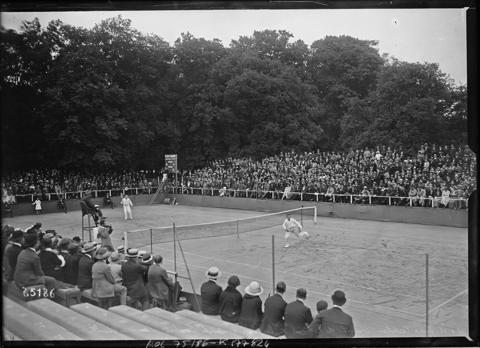
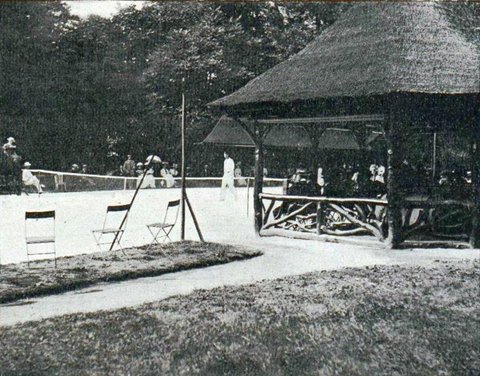
**Cover.** The plate on leaf 149 of the Internet Archive's scan of Arthur Wallis Myers's Lawn Tennis at Home and Abroad, 1903, counting leaves as the archive numbers them rather than as the book paginates itself; it is printed page 128. Digitised from the New York Public Library's copy, sponsored by Google, catalogued there as not in copyright. 3250 x 5084 px, mean brightness 207.8 of 255. It is printed sideways in the book and had to be rotated before it could be read at all. In letterpress at the foot, and at the left, LADIES' FINAL AT EASTBOURNE: MRS. HILLYARD v. MRS. STERRY, and PHOTO, LAVIS.
A woman in a long pale skirt and a pale blouse is bent forward from the waist on the near side of a grass court, turned away from the camera, her racket arm fully extended down and to her left with the racket head close to the turf. A dark shape at the crown of her head reads as either hair or a small dark hat and the two cannot be told apart at this resolution. Her shadow falls to her right. A white court line runs just in front of her feet and others cross the frame behind her; which line is which is not determinable. A small round white spot hangs in the air between her racket and the net. It is most probably the ball and is described here as nothing more than that. Behind the net, a crowd stands three or four deep along a low rail: mostly pale summer clothing and flat straw hats, several parasols up, a few dark-suited men among them. At the left there is a covered stand with a pale awning and more spectators inside it. Behind the crowd is a line of dark trees, and behind those the roofs and gables of large houses. At the right, inside the enclosure, one figure is seated low on the grass and another stands near the rail. Neither is identifiable and no role is assigned to either here.
A pale rectangular panel is raised on a post above the crowd left of centre. Enlarged at full scale it carries no lettering that can be resolved. It may be a scoreboard and this entry does not claim that it is.
The picture cannot be dated from the plate. Charlotte Cooper became Mrs. Sterry on her marriage, so a caption using that name was written in or after 1901, and the book was published in 1903. The two of them met in the Eastbourne final in 1897, 1898, 1899, 1900 and 1901, and the caption may be using the name she held at the time of the match or the name she held when the book was printed. Which of those five finals this is has not been established. It is also not established which of the two women is the player in the frame, and no guess is offered.
**Second image.** The plate on leaf 190 of the same scan, printed page 169, 3250 x 5084 px, mean brightness 214.6 of 255, opened at full size, enlarged in two sections and looked at. In letterpress beneath it: THE SPOILS OF WAR: SOME OF MR. AND MRS. HILLYARD'S PRIZES.
A heavily carved dark oak sideboard with a raised back, foliage carving along the top and three arched recesses. The upper shelf is filled with silver: two-handled cups of several sizes, stemmed goblets, small mugs with handles, a beaker, a lidded piece toward the left. Counted at full enlargement, between fifteen and eighteen separate vessels can be made out on that shelf, and the range is given rather than a figure because they overlap one another and a halftone will not support an exact count.
The lower shelf is denser still and no count of it is attempted here. What can be seen: a large chased urn or vase at the centre with two handles and a decorated body; a substantial ewer at the left with an animal-form handle, standing in front of a large circular salver set on edge; a second circular salver on edge at the right; a candelabrum; several jugs and bowls; small cups at the front edge. At the right of the frame, off the sideboard, hangs a framed picture of a horse.
No lettering, no inscription and no engraved date can be resolved on any object in the photograph. Where the photograph was taken is not stated in the volume and is not asserted here; the same volume carries a separate plate captioned as a group at Thorpe Satchville, which is where the survey says the couple had a court of their own, but nothing connects the two pictures and no private residence is pinned by this entry.
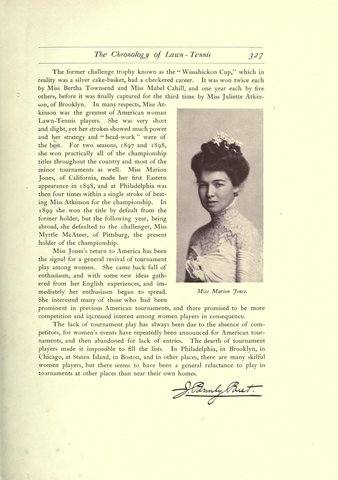
**A cross-reference.** The same volume carries a plate captioned MRS. HILLYARD, EX-CHAMPION OF ENGLAND, AND MISS MARION JONES, EX-CHAMPION OF AMERICA. Marion Jones is the subject of a separate entry on this platform, pinned in California. The two of them are in one 1903 book, and this series pinned them 8,682 km apart, on the same day, without planning it.
**Sourcing note.** No passage in this entry carries quotation marks, and that is deliberate rather than an oversight. The 1903 survey is a book and a book has a single typesetting, which does not meet this series' condition for putting machine-read text inside quotation marks; the encyclopaedia articles and the club's own website are secondary throughout. The plate captions are transcribed in capitals as descriptions of what is printed on the page, not as quotations. No newspaper was read for this entry, and no wire copy, so the second-setting test could not be applied to anything.
**Sources.** Arthur Wallis Myers, editor, Lawn Tennis at Home and Abroad, London and New York, 1903, for the survey's account of her record as at that year, for H. S. Scrivener's chapter on the meetings including his section on Eastbourne, and for both images: https://archive.org/download/lawntennisathom00myergoog/lawntennisathom00myergoog_djvu.txt , with the pages at https://archive.org/download/lawntennisathom00myergoog/page/n149.jpg and https://archive.org/download/lawntennisathom00myergoog/page/n190.jpg . Encyclopaedia article on Blanche Bingley, for her dates and birthplace, her marriage and her husband's career and offices, the six Wimbledon titles and thirteen finals, the eleven South of England titles from 1885 to 1905, the Irish and German titles, the Brighton, Stamford Bridge, Buxton, Exmouth, covered court and Bournemouth titles, the Chiswick Park win of 1884, the fifty-eight singles titles attributed to Bruce Tarran's 2013 biography of George Hillyard, and her father's business and Ealing club membership: https://en.wikipedia.org/wiki/Blanche_Bingley . Encyclopaedia article on the South of England Championships, for the event's run at Devonshire Park from 1881, for the statement that the first tournament staged at the park was a women's event in 1881, and for the full women's singles roll used here including the 1885 and 1905 finals and the Bracewell, Langrishe and Cooper results: https://en.wikipedia.org/wiki/South_of_England_Championships . Encyclopaedia article on the Devonshire Park Lawn Tennis Club, for the ground's opening on 1 July 1874, the marking out of courts in 1879, the 1881 inaugural championships, the 8,000 capacity, the 2016 upgrade scheme and the 136-year statement discussed above: https://en.wikipedia.org/wiki/Devonshire_Park_Lawn_Tennis_Club . List of Wimbledon ladies' singles champions, for the numbered sequence of her six titles that settles the 1898 against 1899 question: https://en.wikipedia.org/wiki/List_of_Wimbledon_ladies%27_singles_champions . Devonshire Park Lawn Tennis Club, club website, for the College Road address and the BN21 4JJ postcode, read on 6 September 2026: https://www.devonshireparkltc.co.uk/ . Wikidata item Q5267871 for the coordinate. The Esri world geocoding service and the postcodes.io service for the other two readings. OpenStreetMap way 22745656 for the rejected reading. Neighbouring-pin distances were computed against this platform's own stored coordinates.


changes?
delete this memory?
We detected that you have a Blox in your crypto wallet! We will import the Blox into your account.
Click on done below to complete the import.
Welcome Back!
Sign in to preserve cherished moments
Don't have an account?
Welcome!!
Sign up and start preserving cherished moments
?
?
Choose your payment method
Buy with Metablox Credit
Do you want to mint Blox with Metablox Credit?
Which Crypto would you like to use?
Purchase Confirmed!
Your Blox is being minted on-chain and will appear in your profile shortly.
Log in or sign up to claim your Blox.
How many credits do you want to buy?
$100 USD = 1 Metablox Credit = 1 Blox.
Use Metablox Credit to mint any Blox you want on the map.
 expand_more