


Biography | Alice Pickering — a 1903 book puts her tennis at a country vicarage and her 1896 Wimbledon win at the All Comers, not the final, Tow Law, 1885
· 1885-7
Personal memoryBy kevin · · Report an issue



















































Find memories left by people near you.
Distribute Bounty
This will distribute the bounty equally among all qualifying memories. This action cannot be undone.
Cancel Bounty
Are you sure you want to cancel this bounty? The remaining amount will be refunded to your account.
Success!
Operation completed successfully.
Error
Something went wrong.
Biography | Alice Pickering — a 1903 book puts her tennis at a country vicarage and her 1896 Wimbledon win at the All Comers, not the final, Tow Law, 1885
kevin
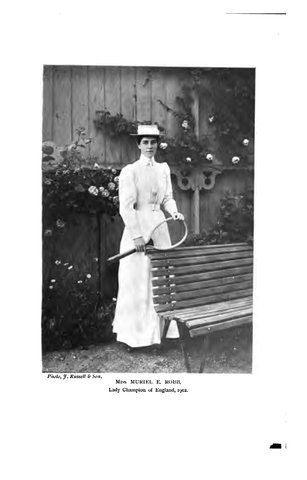
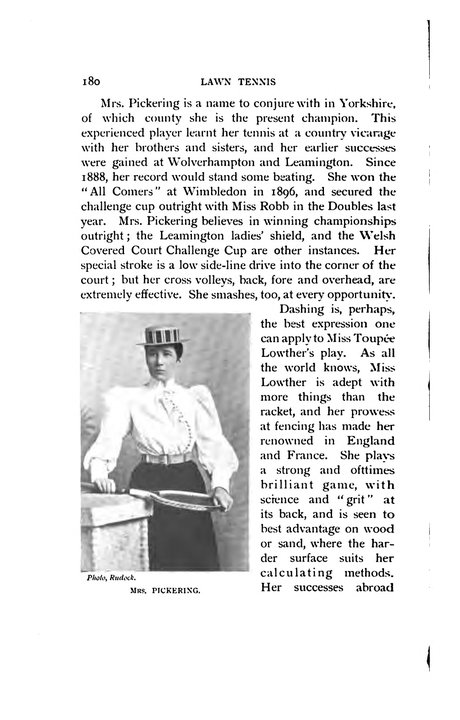
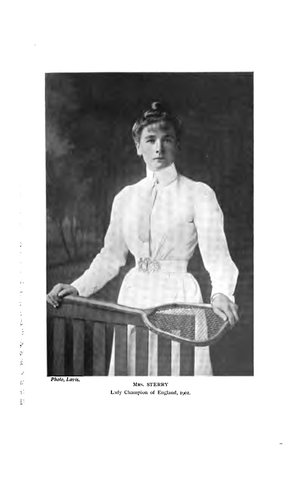
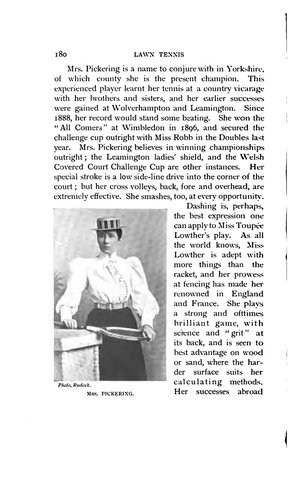
Printed page 180 of a book published in London and New York in 1903 carries a studio photograph of a woman in a straw boater and eleven lines of prose about her. The photograph is credited, in italic type under the frame, “Photo, Rudock.” The caption beneath it reads MRS. PICKERING. The prose above it opens by calling her “a name to conjure with in Yorkshire,” and then says something that no modern account of her repeats: that she “learnt her tennis at a country vicarage with her brothers and sisters.”
The book does not say which vicarage. This entry pins the one the parish record supplies, and says plainly, below, why that join is strong and why it is not closed.
## What the 1903 book actually claims
Arthur Wallis Myers’s Lawn Tennis at Home and Abroad devotes its player notes to short, dry, technical paragraphs. Hers records that her earlier successes came at Wolverhampton and Leamington; that since 1888 her record would stand some beating; that her special stroke was a low side-line drive into the corner of the court; and that she smashed at every opportunity. It also records, in a single clause, the result she is now remembered for: she won “the ‘All Comers’ at Wimbledon in 1896.”
That is not the same sentence as “she reached the Wimbledon final,” and in 1896 the difference was the whole architecture of the tournament.
Under the challenge-round system the holder of the title did not play through the draw. Everyone else played a competition called the All Comers, and the winner of the All Comers then played the holder in a separate match — the challenge round — for the title. So a player could win the All Comers and still lose the championship; and a player could lose the All Comers final and never come within one match of the holder at all. Those are two different results and the modern shorthand “reached the final” covers both.
## 1896 and 1897, which were not the same thing
In 1896 she won the All Comers. The scores below are taken from the Wikipedia articles on the two tournaments, which carry them on Lance Tingay’s 100 Years of Wimbledon (1977) and John Barrett’s Wimbledon: The Official History (2014). Those are compilations, not match reports, and where a score mattered to this entry’s argument it was the shape of the result that mattered and not the digits. That year’s record gives her a 4–6, 6–3, 6–3 win over Edith Austin in the All Comers’ final, and then gives the holder, Charlotte Cooper, a 6–2, 6–3 win over her in the challenge round. She played for the title and lost it.
In 1897 she lost the All Comers’ final, 6–2, 7–5, to Blanche Hillyard, who then went on to beat Cooper in the challenge round and take the title. She did not play the holder. There was no title match for her that year.
Both years are small events by any later standard: the record gives the ladies’ singles draw as six in 1896 and seven in 1897, with the holder standing outside it. That is worth stating flatly rather than either inflating it or using it to diminish her. A six-player draw is what the women’s event was in 1896, and the reason it was that size is a separate story about who was permitted, encouraged and able to enter — one this platform has begun to tell at other grounds and does not pretend to settle here.
## The modern record cannot decide which of those two things happened
The current English-language Wikipedia entry on her states both answers on the same page. Its source text was read directly, as raw wikitext at https://en.wikipedia.org/w/index.php?title=Alice_Pickering&action=raw, rather than through any summarising layer, so the wordings quoted here are the wordings in the article.
Its summary box records her Wimbledon result as “F (1896, 1897)” — a final in each year. Its own section headed “Grand Slam finals” — using that phrase in its four-tournaments sense, not its four-in-one-calendar-year sense — then tabulates exactly one, the 1896 loss to Cooper, and lists 1897 nowhere. The running text of the same article describes 1896 as an All Comers win followed by a challenge-round defeat, and 1897 as an All Comers final defeat, which is correct and is also what the two tournament records say.
So the article is right in its prose, right in its table, and wrong in its summary box, and a reader who takes the box — which is the part that gets copied — comes away with two Wimbledon finals for a player who reached one title match.
This platform has already had to add a correction to another entry over the same distinction, in that case over which of the two matches a player had actually played. It is not a small pedantry. Every women’s Wimbledon record from the years the challenge round was in force runs through this distinction, and any career total that crosses it without saying so is making an argument rather than reporting a number.
The 1903 book, written when the challenge round was still how the tournament worked, gets it right in a single clause because it had no way to get it wrong.
## The vicarage, and what this entry will not claim
Myers says a country vicarage and names no place.
The parish record supplies one. The Reverend Michael Henry Simpson was vicar of Tow Law, in County Durham, from 1862 until 1888. She was born in 1860 at Ledsham in Yorkshire, which is to say two years before her father took this parish, and the household she grew up in — one of a large family of brothers and sisters, which is the detail Myers happens to preserve — was the Tow Law vicarage. She married William Pickering at Tow Law on 28 July 1885 — a date carried, like most of her life away from the court, on the cemetery friends-group page discussed below rather than on a register this entry has seen. It is that dated event at this place that fixes the year on this entry, and the year is therefore only as good as that page.
Nothing read for this entry closes the join. Myers never writes “Tow Law.” The parish and church record never mentions a tennis court, a lawn, or a racket. The two halves sit in different archives and do not refer to each other, and the identification rests on a single coincidence of description — a country vicarage, a clergyman father, brothers and sisters — with a parish the family demonstrably held. That is a strong indication. It is not established, and this entry does not treat it as established.
The entry also does not know where the vicarage building stood. Vicarages move, are sold, are rebuilt and are renamed, and no source consulted places this one relative to the church. The pin is the church; the radius is set by the building this entry cannot find, not by the one it can.
## Two articles on the same woman that disagree with each other
The Wikipedia article on this church (https://en.wikipedia.org/wiki/Church_of_St_Philip_and_St_James,_Tow_Law) calls her the vicar’s youngest daughter. The Wikipedia article on her names a sister born in 1865, five years after her. Both cannot be right, and neither cites a register.
More consequentially: the article on her dates her husband’s death to 12 July 1912. The article on the disaster that killed him dates that disaster to 9 July 1912 and cites The Times of 10 July 1912 for it. Those are three days apart and they are not both true.
This one can be resolved without guessing, because the two sides are not of equal standing. The 12 July date is carried on the footnote of a discussion-forum thread. The 9 July date is carried on a contemporaneous newspaper report published the next morning. A forum thread is not a source under this vertical’s own rules, whatever the care of the person who wrote it, and a newspaper dated the following day is close to the best evidence available for a date. This entry takes 9 July 1912 and says so rather than quietly averaging.
It is worth recording the wider fact plainly: almost everything now published about her life away from the tennis court traces back to two web pages — that forum thread and a cemetery friends-group page — and both Wikipedia articles cite them. The paragraphs below are written accordingly, as what those pages state, not as what this entry has verified.
## What the married name did after 1901
She stopped appearing in tournament results after 1901. The surname the tennis annuals had filed her under then enters the public record twice more, for reasons that have nothing to do with tennis.
William H. Pickering was Chief Government Inspector of Mines for Yorkshire and the North Midlands. On 9 July 1912 an explosion in the south-west workings of Cadeby Main colliery, near Conisbrough in the West Riding, killed thirty-five men in the early morning. Rescue parties went below during the day. A further explosion killed fifty-three of them, and he was among the dead; the colliery manager died of his injuries the following week. Ninety-one men were killed in all. The King and Queen had been visiting mining villages in the district, which is why fewer men than usual were underground, and they went to the pit the next day.
Afterwards, according to the cemetery friends-group page that both Wikipedia articles rely on, she ran the Arnold Auxiliary Hospital in Doncaster during the First World War and was appointed MBE for that work. The article’s own phrasing on the honour is internally muddled — it names both a month and a New Year list — so this entry states the award and declines to state its date. She died at Doncaster in 1939.
None of that is offered as a moral about the amateur game. It is offered because the record of a woman in this period is usually held together by a husband’s surname, and here the surname is the thread that lets the tennis archive and the coalfield archive be recognised as being about the same person.
## What this entry adds to what is already here
Two things, both of which extend entries already published rather than repeat them.
First, the same 1903 volume that prints her portrait on page 180 prints, on page 80 and about a hundred pages earlier, a sentence in a different contributor’s chapter: “Mrs. Pickering was the first holder of the ladies’ cup — instituted in 1896.” That is the ladies’ cup of the Welsh Covered Court Championship, played at Craigside in Llandudno, which this platform pinned separately. Page 180 then records, without reference to page 80, that she kept the Welsh Covered Court Challenge Cup outright. One book holds the beginning and the end of that trophy’s story in two chapters that never look at each other, and the connection is made here for the first time on this platform.
That said, page 80’s “first holder” is not unopposed. The platform’s Craigside entry records a published roll of the women’s event that appears to begin earlier than 1896, and notes that the same 1903 volume dates the cup’s institution to 1896. Both readings are left standing here as they are there; this entry adds the second half of the story and resolves neither.
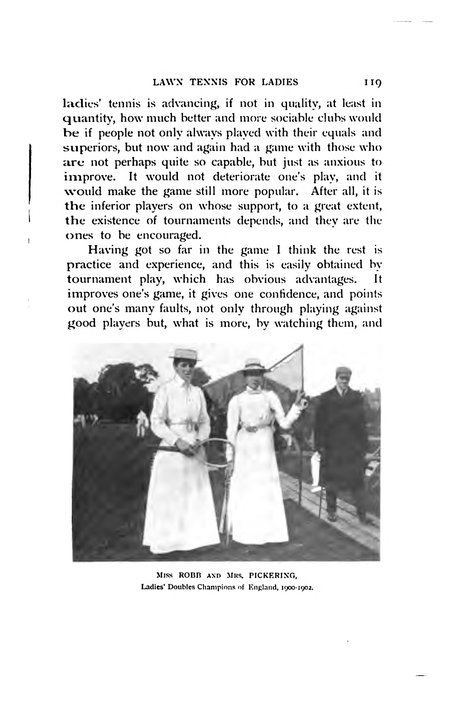
Second, page 180 records that she won a doubles challenge cup outright with Miss Robb, and page 119 shows the two of them. That plate is discussed under the images below, because its caption is where a modern description of it goes wrong.
Names appearing in the 1896 and 1897 records who have no entry here — Edith Austin, Lottie Paterson, Ruth Durlacher, Muriel Robb — are noted for future work rather than absorbed into this one.
## The tournament’s name
The event is The Championships, Wimbledon. It has never had “Open” in its name, and it was not open in either 1896 or 1897: entry was confined to amateurs, and amateurism in this period was a rule about who could afford to travel and compete without being paid before it was a rule about sport. A contributor to the ladies’ chapter of the same book is candid about the cost, remarking on page 119 that tournament play may involve travelling about a great deal and naturally means a good deal of expense — which is a statement about who could afford to be an amateur, written by someone who could.
## Coordinate
The pin is the Church of St Philip and St James, Church Lane, Tow Law, County Durham — the church of the parish held by her father, built to a design by Charles Hodgson Fowler and completed in 1869, and listed at Grade II on 5 June 1987.
Two independent readings were used.
1. A ten-figure Ordnance Survey National Grid reference for the church, NZ 12328 38941, converted from OSGB36 (EPSG:27700) to WGS84 (EPSG:4326). This yields 54.745281, −1.810019, and is the pin.
2. The OpenStreetMap record for the church building, which returns 54.7452967, −1.8100552.
The two fall 2.9 m apart. A third reading, the Office for National Statistics centroid for postcode DL13 4HE, gives 54.745507, −1.811022, 69.2 m from the pin; that is a postcode centroid rather than a building and the offset is expected, so it is reported as corroboration and not averaged in.
The grid conversion was itself checked rather than trusted to one library, by running the same transformation on the ONS record’s own published easting/northing pair for this postcode and comparing the result with the ONS record’s own published latitude and longitude. The two agreed to 1.14 m, which is the accuracy of the conversion at this location.
A Historic England list-entry page for the church was requested as a fourth, separately maintained source and returned HTTP 403 to this session. It is logged as unread rather than counted.
The precision radius is 250 m. It is not set by the 2.9 m scatter, which describes the church only. It is set by the vicarage, which is the building this entry is actually about and which no source consulted places. A 250 m circle from the church covers Church Lane and the ground immediately around it, and is an honest statement that the house where, on the 1903 book’s account, she learnt the game is somewhere in this parish and has not been located. No dwelling is pinned and no present occupier is named or implied.
County Durham has carried no tennis entry on this platform before this one. The nearest published entry in this vertical is 123.3 km away, at Moffat; the nearest published entry of any kind is 28.7 km away, on Tyneside. Both distances were queried, not recalled.
## Cover image
Page 180 of Arthur Wallis Myers, Lawn Tennis at Home and Abroad (London and New York, 1903), from the Internet Archive scan, public domain by age. The whole page is used rather than a crop, because the argument of this entry is the page: the portrait and the eleven lines about the vicarage and the All Comers sit on it together.
The photograph is a three-quarter-length studio portrait against a plain painted backdrop. She wears a straw boater with a wide vertically striped band, a white blouse with full upper sleeves and a line of small buttons running down the bodice, a broad belt with a rectangular buckle, and a dark skirt. Her left hand rests on a low plinth at the left edge of the frame.
There is one racket, and the count was made on a crop enlarged to more than twice the page scale before it was written down. It lies roughly horizontally across the front of her body; the strung head is an open oval right of centre with the stringing visible as a diamond mesh, and the shaft runs left towards the plinth. Her right hand meets the frame at the far side of the head. The plate does not show which hand holds the handle and this entry does not say.
The credit line reads, in italic, “Photo, Rudock.” That is the spelling on the plate, read at three times magnification: one d. Whether the studio is the same as any similarly spelled firm of the period is not something this entry has established, and the printed form is given as printed.
## Second image
Page 119 of the same volume. The printed caption reads, on two lines: MISS ROBB AND MRS. PICKERING, / “Ladies’ Doubles Champions of England, 1900-1902.”
The photograph shows two women outdoors on grass, both in long white dresses and wide-brimmed hats, in front of an awning and a plain banner on a pole, with a man in a dark suit and flat cap at the right of the frame and small figures further back at the left. One racket is legible, held in both hands by the figure on the left. A second long light shaft stands in front of the figure on the right and cannot be resolved as a racket at this scale; it is not counted as one. The caption names the two women in an order and does not say which is which, and this entry does not assign them.
A note on that caption, because it matters. A copy of this same photograph circulating on a media repository is described there as showing the Wimbledon doubles champions of 1900 to 1902. The printed caption says Champions of England and names no venue, and the book’s own running text says the same thing in prose — that Miss Robb secured the Doubles Championship of England with Mrs. Pickering, and subsequently won it outright. The repository description adds a tournament the plate does not claim. Anyone citing the image should cite the printed caption.
## Sources and date of checking
Arthur Wallis Myers, Lawn Tennis at Home and Abroad (1903), pages 80, 119 and 180, read as page images in the Internet Archive scan of the volume rather than through any summarising layer:
https://archive.org/details/lawntennisathom00myergoog/page/n101 (printed 80)
https://archive.org/details/lawntennisathom00myergoog/page/n140 (printed 119)
https://archive.org/details/lawntennisathom00myergoog/page/n201 (printed 180)
Wikipedia articles on the player, on the church, on the 1896 and 1897 Wimbledon women’s singles and on the Cadeby Main pit disaster were consulted, in each case as raw wikitext, for the parish dates, the draws and the newspaper citation. The 9 July 1912 date and the casualty figures are carried there on The Times of 10 July 1912, issue 39947, page 8, which this entry has not itself read. Where they are quoted or characterised above they are named as the source of the claim, not treated as establishing it.
All online material was checked on 7 September 2026.
changes?
delete this memory?
We detected that you have a Blox in your crypto wallet! We will import the Blox into your account.
Click on done below to complete the import.
Welcome Back!
Sign in to preserve cherished moments
Don't have an account?
Welcome!!
Sign up and start preserving cherished moments
?
?

Choose your payment method
Buy with Metablox Credit
Do you want to mint Blox with Metablox Credit?
Which Crypto would you like to use?
Purchase Confirmed!
Your Blox is being minted on-chain and will appear in your profile shortly.
Log in or sign up to claim your Blox.
How many credits do you want to buy?
$100 USD = 1 Metablox Credit = 1 Blox.
Use Metablox Credit to mint any Blox you want on the map.
 expand_more