


Biography | Myrtle McAteer — a Cincinnati final the papers called a championship, and the national title she took in 1900 when the holder never appeared
· 1899-9
Unreviewed contributionBy kevin · · Report an issue













































Find memories left by people near you.
Distribute Bounty
This will distribute the bounty equally among all qualifying memories. This action cannot be undone.
Cancel Bounty
Are you sure you want to cancel this bounty? The remaining amount will be refunded to your account.
Success!
Operation completed successfully.
Error
Something went wrong.


Biography | Myrtle McAteer — a Cincinnati final the papers called a championship, and the national title she took in 1900 when the holder never appeared
kevin
On the afternoon of Friday 22 September 1899, on the grounds of the Avondale Athletic Club in Cincinnati, Myrtle McAteer beat Juliette Atkinson 7-5, 6-1, 4-6, 8-6 in the final of the ladies' singles. The Indianapolis Journal headed its report of the match with a line calling her the tennis champion.
She was not. The championship of the United States for 1899 had already been decided earlier that year in Philadelphia, and it had gone to Marion Jones, who did not have to play for it. Atkinson, the holder, defaulted.
That is what this entry is about. In American lawn tennis at the end of the century the word championship was doing at least two jobs, and the one that counted could change hands without a ball being struck.
**Two printers, one dispatch.**
The result went out from Cincinnati on the evening of 22 September and was printed on Sunday 24 September in at least two papers that set the same copy: the Indianapolis Journal on page six and the Saint Paul Globe on page eight. Both carry the Cincinnati dateline. Both describe the crowd in the same words, and three short stretches are rendered identically in the two settings and are quoted here on that ground.
Of Atkinson, the wire's claim is that she
"had never lost a championship game since"
the American title it credits her with, which the next section shows to be wrong twice over. Of the crowd, it says the play was greeted with cheers and
"the clang of tin horns"
and that when the match ended,
"When the decisive play was made there was no bound to the enthusiasm."
The Saint Paul scan damages the opening two words of that last sentence, which are legible in the Indianapolis setting; nothing else in the quoted stretches differs between them.
Outside those stretches the two settings do differ, and the differences are worth setting down because they show two compositors at work rather than one. Indianapolis has the plays were greeted with cheers and the clang of tin horns; Saint Paul drops the definite article and reads plays were greeted with cheers, and the clang of tin horns, adding a comma. Saint Paul also sets a comma after three years ago where Indianapolis sets none. Saint Paul alone carries a results table, and it is from that table that the four-set score above is taken.
**What the wire got wrong, and it is the interesting part.**
The dispatch says Atkinson won the American championship three years ago, which from September 1899 means 1896. The roll of champions printed in the 1904 volume described below, and reproduced as this entry's second image, gives 1896 to Elizabeth H. Moore and gives Atkinson 1895, 1897 and 1898; the association's own annual for 1899, read for this platform's entry on the 1898 championship, prints the same three years against her. The wire is wrong, and it was wrong in two cities on the same morning.
The dispatch also enters Atkinson as Miss Atkinson, of Buffalo. This platform's entry for the 1898 championship enters her, from a different wire, as of the Ladies' Club of the Staten Island Athletic Club; the 1904 chronology quoted below calls her of Brooklyn; the encyclopaedia article on her gives the family's origin as New Jersey. Four statements, four places, and no attempt is made here to reconcile them. What a period source records is where a newspaper or a draw sheet said a player came from, which is not the same question as where she lived.
**The title that passed twice without a match.**
The fullest period account of how the women's championship was actually decided in these years is in The Book of Sport, published in New York by J. F. Taylor and Company in 1904. It is a commercial volume and not an association publication, and the distinction matters here. The chapter on the chronology of lawn tennis is signed at its foot with the engraved autograph of J. Parmly Paret.
Paret was not a detached observer. The record page reproduced as this entry's second image, printed in his own volume on the leaf immediately following his signature, lists him as the winner of the all-comers' tournament in the men's championship of 1899, the man who played through the field that year and then lost the challenge round to Malcolm Whitman. What follows is therefore a competitor's account of the competition, published in a book that also printed the results.
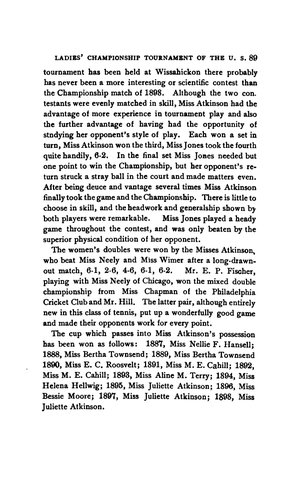
Paret writes that the former challenge trophy known as the Wissahickon Cup, which in reality was a silver cake-basket, had a checkered career; that it was won twice each by Bertha Townsend and Mabel Cahill, and one year each by five others, before it was finally captured for the third time by Juliette Atkinson. Of Marion Jones he writes that in 1899 she won the title by default from the former holder, and that the following year, being abroad, she defaulted to the challenger, Myrtle McAteer.
So McAteer's national championship, the one the 1904 roll reproduced here lists against 1900, was not won in a championship match. She won the all-comers' tournament, which entitled her to challenge, and the holder did not come home to meet her. A year earlier the title had reached Jones the same way. Two championships of the United States in succession turned on a holder not appearing.
**Why the entry was thin, in the chronicler's own account.**
Paret is direct about the cause and it is not a matter of merit. He writes that the lack of tournament play has always been due to the absence of competitors, that women's events had repeatedly been announced for American tournaments and then abandoned for lack of entries, and that although there were many skilful women players in Philadelphia, Brooklyn, Chicago, Staten Island, Boston and elsewhere, there seemed to be a general reluctance to play in tournaments at other places than near their own homes.
He also records, on the preceding page, that the women's championship tournaments had always been held in Philadelphia. That is the structural fact underneath the defaults. The United States National Lawn Tennis Association fixed its women's championship at one club in one city and kept it there. Nothing read here says why Philadelphia, or who decided it. A woman who lived in Pittsburgh, as McAteer did, or in California, as Jones did, could only defend a national title by travelling to Philadelphia; and if she did not, the challenge round decided itself.
This entry does not claim that anybody intended that outcome. It claims that the association's arrangements produced it twice running, and that the period's standard illustrated account wrote down the reason.
**What she did when the holder did turn up.**
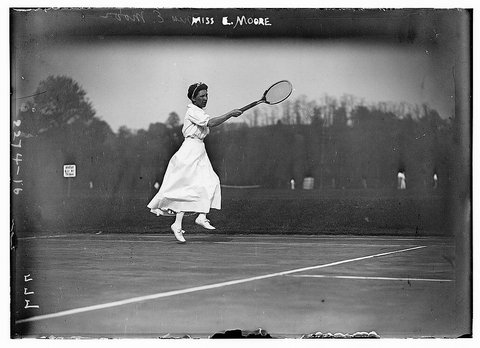
On 29 June 1901, on the Philadelphia Cricket Club's grass, McAteer defended the championship against Elisabeth Moore and lost it in five sets, 6-4, 3-6, 7-5, 2-6, 6-2. The New-York Tribune of the following morning reported that both players were exhausted at the end of the match and that Moore then forfeited the doubles. This platform's entry for that match is written from Moore's side and counts the games the two women played; it is the companion to this one.
**The encyclopaedia's account, given as the encyclopaedia's.**
The encyclopaedia article on McAteer gives her dates as 12 June 1878 to 26 October 1952 and says she died in Los Angeles. It credits her with the United States singles title in 1900 and the doubles in 1899 and 1901, and with a long record at the Cincinnati tournament, including its first women's singles title in 1899 and further singles titles in 1900 and 1904. None of that was checked here against a contemporaneous source except the 1899 Cincinnati final and the 1901 championship, which are documented above. The article also calls the Cincinnati event storied; that is not a finding and is not adopted. Nothing read in this session establishes when the Cincinnati tournament was first held, and no claim about its founding is made here.
**Amateur-era note.**
Every title named above belongs to a competition closed to anyone who had been paid to play, which is the footing all pre-1968 material on this platform sits on. It bears on this entry in a particular way. An amateur champion earned nothing from the title and paid her own fare to defend it, and the record of these two years shows what that cost when the only tournament that mattered was always in the same city and home was Pittsburgh or California.
**Scope note.** This is a biography anchored at a place in its subject's life, on the same footing as this platform's other player entries pinned at home grounds and public courts. It is not the opening of an arc about the Cincinnati tournament, which would be a separate decision.
**Gaps this entry declares.**
The date of the 1900 championship at which Jones defaulted is not established here; only the year is, from the 1904 roll and from Paret's narrative. Nothing read here gives McAteer's own club in Pittsburgh, and the anchor is therefore the ground where she played the match documented above rather than a home court. The Avondale Athletic Club's street address was not found in any period source read in this session, and the coordinate below is consequently below this platform's usual standard and says so. No photograph of the Avondale grounds is offered: the one period view located, a 1907 commercial postcard, is held by a university archive under an undetermined copyright status and an assertion of fair use only, which is not a licence this platform can rely on.
**Coordinate.** 39.149100, -84.479400, precision radius 500 m. This pin is below the two-independent-source standard used elsewhere on this platform and is published with that disclosure.
Only one source consulted here purports to locate the Avondale Athletic Club at all. Xavier University's archive, cataloguing two period images of the club, states that the club's building became the Union Building on the university's Cincinnati campus, and attaches coordinates to both items: 39.1491, -84.4791 to a 1907 postcard of the grounds and 39.1491, -84.4797 to a 1911 photograph of the building. Those two readings are 52 m apart, but they are two records in one catalogue and are treated here as a single reading of a single kind, not as agreement. The pin is set at their midpoint.
The other readings available are about a different thing and were not averaged in. OpenStreetMap's surveyed boundary for Xavier University as a whole has its centre 779 m east-north-east of this pin, and a commercial road-network geocoder returns three candidates for the university at 143 m, 413 m and 417 m from it. A modern university campus is not a nineteenth-century athletic club's grounds, and the divergence is reported rather than resolved.
The radius is 500 m for two reasons. The first is that the pin locates a club's grounds and not a court: the tournament ran several events at once over a week and nothing read here says where on the grounds the final was played. The second is the weakness above. The route that would fix this properly, and which was not attempted in this session, is the Sanborn fire insurance mapping of Avondale and the Cincinnati city directories of the 1890s, either of which would give the club a street.
The identification of the site with Xavier's campus rests on one institution's catalogue notes, and those notes are not internally consistent: one says the club had closed by 1903 while carrying a postcard of it postmarked 1907, and the other records that the building was purchased by F. Heiermann in the autumn of 1911. No account of the club's end is asserted here.
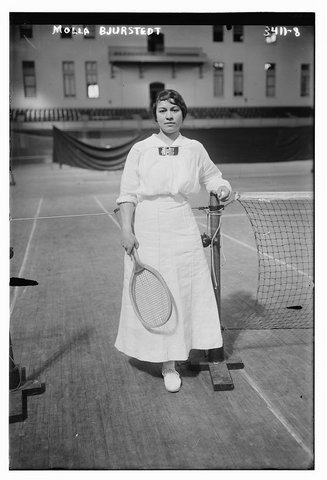
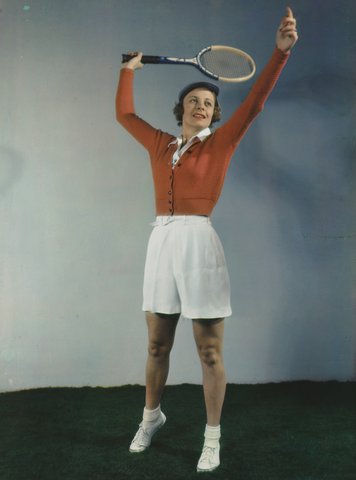
**Cover.** The full-page portrait plate captioned Miss Myrtle McAteer, from The Book of Sport, published by J. F. Taylor and Company, New York, 1904; digitised from the University of Toronto's copy and served by the Internet Archive, which catalogues the item as not in copyright. The page image is 2748 x 3900 px. It was opened and read at full size. The plate is a halftone of a standing studio photograph, three-quarter length, of a young woman facing the camera against a dark ground: dark hair worn up, a white high-necked blouse with a wide collar, full sleeves and a dark tie at the throat, a belted white skirt, and a lawn-tennis racket held loosely across the front of the skirt in one hand. The caption is set in italic letterpress beneath the image and there is nothing else on the leaf.
Two things about the plate are worth recording. The book's copyright page states that most of the portraits were made especially for the publishers and that their reproduction is strictly forbidden; that prohibition was printed in 1904 and has long since lapsed, which is why the plate can be published here. And the negative itself carries a studio credit that the book's list of illustrations does not: nothing on this leaf, but on the Juliette Atkinson portrait two leaves further on the photographer's name is scratched into the negative down the right edge and reads SCHLOSS N.Y.
**Second image.** The opening leaf of The Championship Record in the same volume, 2748 x 3900 px, likewise opened and read. It prints the men's singles from 1881 to 1900 with the winner of the all-comers' and the runner-up in separate columns, the men's doubles, and then the women's singles as a bare list of years and names from 1887 to 1900, ending 1900 . . . Miss Myrtle McAteer. It is included because it is the document that makes this a championship at all, and because the asymmetry on the page is itself the argument: the men's record is printed in three columns because the men's championship had a structure worth recording, and the women's in one because it did not. The list also gives 1887 to Miss Alice Hansell, where the player is usually recorded as Ellen Hansell, and 1896 to Miss Elizabeth H. Moore, where this platform's entry for her uses Elisabeth. Both spellings are the volume's own and neither is corrected here.
**Sourcing note.** Three passages above are in quotation marks. All three are from one wire dispatch of 22 September 1899 as set independently by two printers, the Indianapolis Journal of 24 September 1899 and the Saint Paul Globe of the same morning, read as machine-read page text rather than through any summarising layer, which is this platform's condition for quotation marks. Each quoted stretch was checked word for word against both settings and cut back to what the two render identically; the divergences outside them are given in the body rather than hidden here. Everything else on this page is attributed paraphrase, including every passage from The Book of Sport, the New-York Tribune report of 1901, and the encyclopaedia article.
**Sources.** Indianapolis Journal, 24 September 1899, page 6, for the Cincinnati final and the headline: https://www.loc.gov/resource/sn82015679/1899-09-24/ed-1/?sp=6 . The Saint Paul Globe, 24 September 1899, page 8, for the second setting and the score: https://www.loc.gov/resource/sn90059523/1899-09-24/ed-1/?sp=8 . The Sun, New York, 21 September 1899, page 5, for the tournament being played at the Avondale Athletic Club grounds and for the earlier rounds: https://www.loc.gov/resource/sn83030272/1899-09-21/ed-1/?sp=5 . New-York Tribune, 30 June 1901, page 9, for the 1901 championship match: https://www.loc.gov/resource/sn83030214/1901-06-30/ed-1/?sp=9 . The Book of Sport, New York, 1904, for Paret's chronology, the roll of champions, the copyright page and both images: https://archive.org/details/bookofsport00newyuoft , text at https://archive.org/download/bookofsport00newyuoft/bookofsport00newyuoft_djvu.txt , cover image at https://archive.org/download/bookofsport00newyuoft/page/n347.jpg and second image at https://archive.org/download/bookofsport00newyuoft/page/n351.jpg . Biographical dates and the list of titles from the encyclopaedia article on Myrtle McAteer: https://en.wikipedia.org/wiki/Myrtle_McAteer . The coordinate and the identification of the site, with the reservations stated above, from Xavier University's archive items for the Avondale Athletic Club grounds and the old Avondale Athletic Club: https://www.exhibit.xavier.edu/xu_campus/13/ and https://www.exhibit.xavier.edu/xu_campus/14/ .



changes?
delete this memory?
We detected that you have a Blox in your crypto wallet! We will import the Blox into your account.
Click on done below to complete the import.
Welcome Back!
Sign in to preserve cherished moments
Don't have an account?
Welcome!!
Sign up and start preserving cherished moments
?
?
Choose your payment method
Buy with Metablox Credit
Do you want to mint Blox with Metablox Credit?
Which Crypto would you like to use?
Purchase Confirmed!
Your Blox is being minted on-chain and will appear in your profile shortly.
Log in or sign up to claim your Blox.
How many credits do you want to buy?
$100 USD = 1 Metablox Credit = 1 Blox.
Use Metablox Credit to mint any Blox you want on the map.
 expand_more