Finance History | Eurotower, 5 June 2014 — The ECB Moved the Deposit Rate Below Zero
volume_up
Listen
directions
Directions
On 5 June 2014, the European Central Bank's Governing Council met in Frankfurt and cut the interest rate on its deposit facility to negative 0.10 percent, effective 11 June.
The same package lowered the main refinancing rate to 0.15 percent and the marginal lending rate to 0.40 percent. It also applied the negative rate to banks' excess reserve holdings and several other deposits held within the Eurosystem.
A negative deposit rate changes the price of the safest overnight placement available to a bank. Instead of receiving interest for leaving excess funds at the central bank, an institution paid a small charge on the balance.
The banking system as a whole could not eliminate reserves simply by lending or transferring them, because a payment moved reserves from one bank to another. Individual banks could still try to avoid the charge by buying securities, lowering money-market offers, or changing the price and volume of customer business.
That competition was part of the policy channel. Lower money-market rates could feed into bond yields, bank funding costs, exchange rates, and eventually credit conditions, while the direct cost to banks created concern about compressed margins and the treatment of depositors.
The decision responded to weak inflation and the danger that a prolonged period of low price growth would pull expectations downward. ECB President Mario Draghi presented it alongside targeted longer-term refinancing operations and preparation for purchases of private-sector securities.
Negative rates were therefore one piece of a broader package, not a stand-alone attempt to make banks lend. The ECB later cut the deposit rate further, and in 2015 it added large-scale public-sector bond purchases as inflation remained too low.
The measure also crossed an important operational boundary. Textbook descriptions often treated zero as the floor because cash pays a nominal return of zero, yet storing, insuring, and moving large quantities of banknotes is costly.
Eurotower was still the ECB's policy home when the boundary moved. The decision showed that central-bank administered rates could pass modestly below zero, while also revealing that the practical lower limit depended on bank behavior, cash alternatives, and financial-system structure.
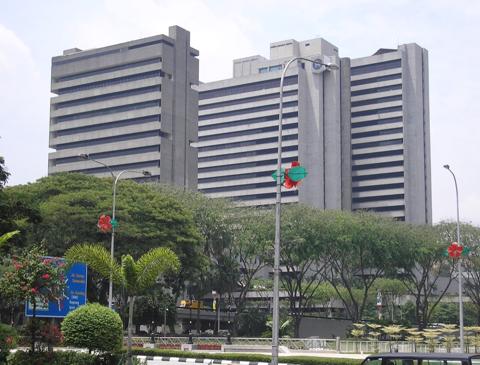
The accompanying photograph is by Tilman AB and dedicated to the public domain under CC0 via Wikimedia Commons.




































 expand_more