Finance History | Oberwallstraße, 15 November 1923 — Berlin Queued for the Rentenmark
volume_up
Listen
directions
Directions
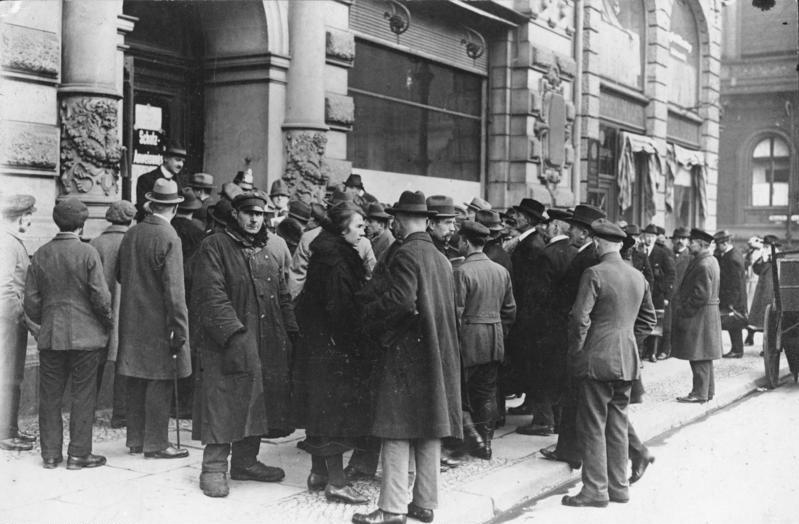
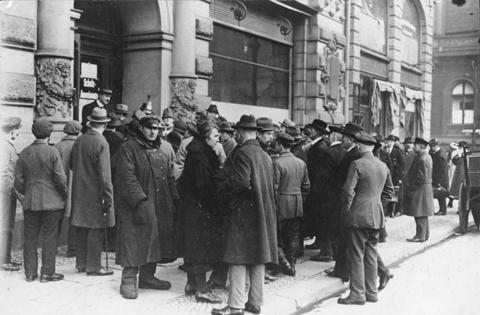
On 15 November 1923, Berliners queued at an issuing office on Oberwallstraße for the first Rentenmark notes. The line recorded by Germany's Federal Archives stood at the point where monetary stabilization became something people could hold.
The old paper mark had ceased to perform the ordinary work of money. Prices changed within hours, wages were paid more frequently, and notes with enormous denominations could lose meaningful purchasing power before they were spent.
The immediate crisis had several roots: wartime borrowing, postwar fiscal weakness, reparations conflict, and the government's financing of passive resistance after French and Belgian forces occupied the Ruhr. By late 1923, printing money covered nearly all regular public spending.
Germany lacked the gold reserves for a conventional new gold currency. The Deutsche Rentenbank instead issued a transitional unit backed indirectly by mortgage claims imposed on agricultural, industrial, and commercial property.
One Rentenmark was set equal to one trillion paper marks, while the exchange relationship of 4.20 Rentenmark to one United States dollar echoed the prewar gold parity. The arithmetic removed twelve zeros, but the decisive mechanism was a change in fiscal and monetary behavior.
The Reichsbank stopped discounting government Treasury bills on the day issuance began, closing the main channel through which public deficits had been monetized. The permitted Rentenmark issue was also limited, and government spending faced severe cuts and new tax demands.
The Rentenmark was not itself redeemable in gold, and the property backing could not be turned into cash on demand by every noteholder. Its success therefore depended on scarcity, credible policy restraint, and a public willingness to coordinate on a new unit.
Stabilization did not restore the savings already destroyed by inflation. Debtors and owners of real assets had often benefited, while wage earners, pensioners, and holders of cash or fixed claims bore losses that shaped German politics long after prices steadied.
The later Reichsmark completed the formal currency reconstruction in 1924, but the Rentenmark remained in circulation. Its rapid acceptance became known as a monetary miracle, although the institutional break behind it was more concrete than the phrase suggests.
Oberwallstraße makes that break visible. People did not queue for an abstract theory of backing; they queued for notes they expected the next shopkeeper, employer, tax office, and creditor to accept tomorrow.
The accompanying Federal Archives photograph is by an unknown author, licensed CC BY-SA 3.0 Germany via Wikimedia Commons.


























 expand_more