Finance History | Knickerbocker Trust Company, Fifth Avenue at 34th Street, New York, 22 October 1907 — Three Hours and Eight Million Dollars
volume_up
Listen
directions
Directions
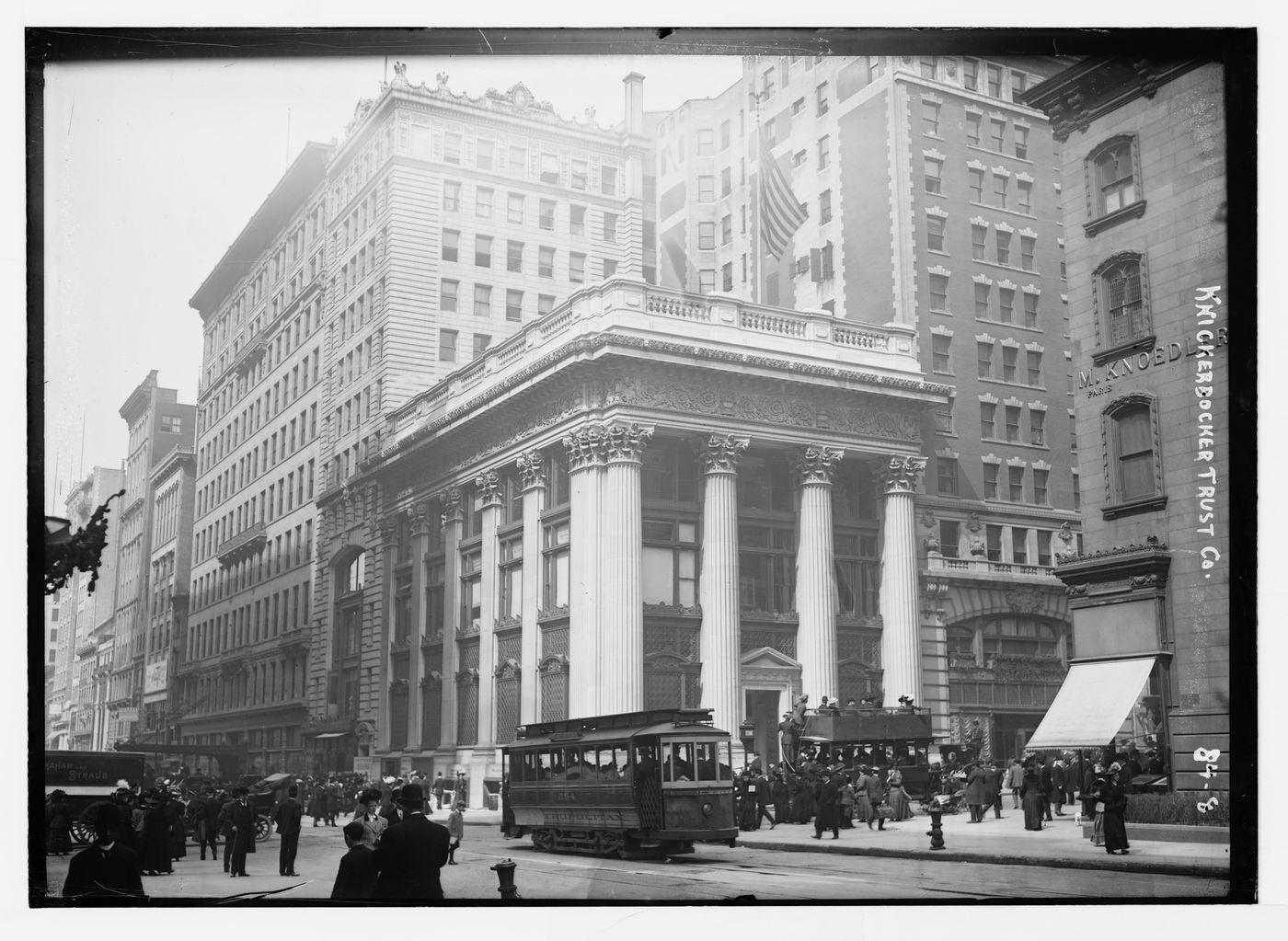
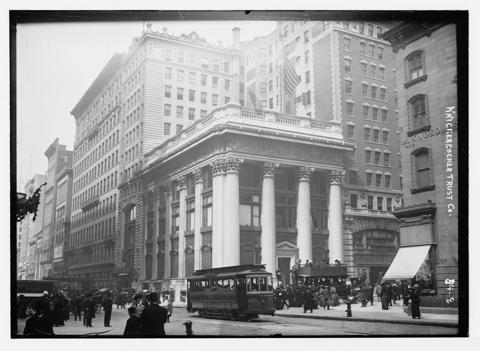
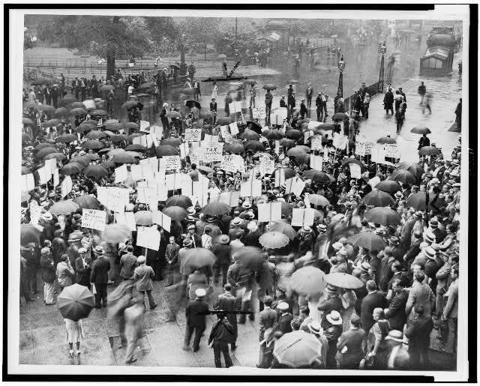
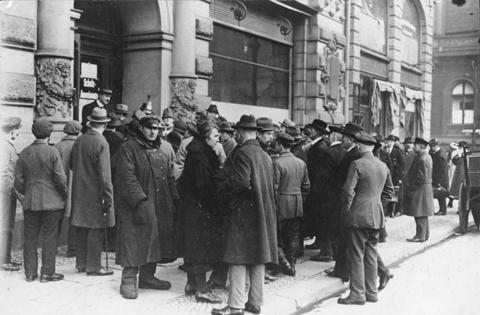
The queue outside this colonnade on the morning of 22 October 1907 ran around the block. In roughly three hours depositors carried out about $8 million in cash, and just after noon the Knickerbocker Trust Company stopped paying.
It was the third largest trust company in New York, chartered in 1884, holding something near $62 million of deposits.
What broke it was not a loss on its books. It was the withdrawal of a service.
Trust companies were not members of the New York Clearing House, so they settled their cheques through member banks. On Monday 21 October the National Bank of Commerce, which had been clearing for Knickerbocker and lending it money to meet withdrawals, announced it would clear for it no longer.
That announcement cut the trust off from the payment system and was read by everyone as a verdict on whether it was good for the money.
The Clearing House had already refused a loan that day, on the ground that its resources were for its own members. Knickerbocker was not one.
Worth correcting, because almost every retelling gets it wrong: Charles Barney, the president, was not part of the copper corner. He had invested in United Copper and was reported on 18 October to be an associate of Charles W. Morse, but the attempt to corner the stock on 16 October was the Heinze brothers' operation.
The distinction meant nothing to a depositor standing in line, which is the whole lesson of the week.
J. P. Morgan sent Benjamin Strong to go through the books overnight. Strong could not establish in the hours available whether the trust was solvent, so Morgan declined to help, and the next day, faced with the same question at the Trust Company of America, he answered it differently.
Runs spread across the city's trusts. Two days after Knickerbocker suspended, Morgan assembled $23 million to keep the New York Stock Exchange open.
Barney resigned and died by suicide the following month.
Six years later the country had a central bank, and the argument that produced it began here, with a solvent-looking institution destroyed in a morning because no lender of last resort existed to answer the question Strong could not answer in a night.
McKim, Mead & White finished this building in 1904, a marble temple with a Corinthian colonnade, designed so that offices could be piled on top of it later. They were, in 1921, and the front was remade completely in 1958.
The structure is still there, at 358 Fifth Avenue, and nothing about it now would tell you what it was. The photograph is the only place the temple survives.
Photo: Bain News Service, Library of Congress, public domain.







 expand_more