Tennis History | Ellis Park, Johannesburg — a government decided who could enter, November 1973
volume_up
Listen
directions
Directions
The South African Open had been played at Ellis Park in Johannesburg since 1931. In November 1973 Arthur Ashe played in it, recorded as the first Black competitor in the tournament's draw, and the decision that let him into the country was not the tournament's to make.
Arthur Ashe applied for a visa to play the 1969 South African Open and the South African government refused it. It refused him again, and again. Accounts of the period describe three consecutive years of refusal before the application of 1973 was granted. The body that decided was the National Party government of South Africa, not the tournament committee and not the national tennis association, and that is the fact worth holding onto: entry to a tennis tournament was a question for a ministry of the interior.
Ashe set terms. He declined to enter under the "honorary white" designation that had been extended to visiting Black sportsmen — a category that let an individual pass through facilities reserved for whites without disturbing the law that reserved them — and asked that the segregated seating at Ellis Park be desegregated for the duration of his matches. The first condition he got. The second he did not: contemporary and later accounts agree the stands were not integrated in any general sense, whatever was done in particular sections. (https://www.tennis.com/news/articles/1973-arthur-ashe-breaks-sporting-color-barrier-in-south-africa)
The tournament ran from 14 to 27 November 1973 on outdoor hard courts. Ashe reached the singles final and lost it to Jimmy Connors, 6-4, 7-6, 6-3. He won the doubles with Tom Okker, beating Lew Hoad and Robert Maud 6-2, 4-6, 6-2, 6-4. He returned in 1974 and lost the singles final to Connors again.
The year is not a coincidence, though the causation should not be overstated. South Africa had been banned from the Davis Cup on 23 March 1970 over its apartheid sports policy, and was briefly readmitted in 1973 — the same year the visa came through — before being banned again in 1978. A government that wanted its teams back in international competition had a reason to let one American in. Whether that reasoning was decisive is not something the available documents settle.
The visit was contested at the time and Ashe himself did not settle it later. Black South African critics called him an Uncle Tom for coming at all; others objected that he stayed in a white-owned house rather than in Soweto. Reporting on the trip records Ashe expressing some regret about the South African visits when he testified before a United Nations committee in the 1980s. (https://www.dailymaverick.co.za/article/2023-11-12-arthur-ashe-caused-a-storm-by-playing-in-apartheid-sa/) Both the argument for going and the argument against it were made by people with more at stake than a tennis result, and neither is improved by being tidied up.
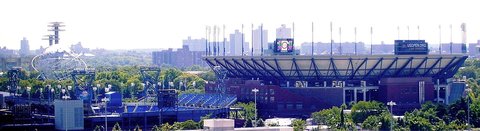
Coordinate. The coordinate standard for this vertical was not met here and the shortfall is disclosed rather than papered over. The pin is the Ellis Park sports precinct in Doornfontein, Johannesburg, taken as the midpoint between the Wikidata entities for Ellis Park Stadium (Q182081, 26.19750 S, 28.060833 E) and the arena on the same precinct now called Ellis Park Arena, formerly Standard Bank Arena (Q7598176, 26.19610 S, 28.06500 E), which lie 444 m apart. That is a precinct centre, not a court. No independent second source was found for the outdoor tennis stadium itself: OpenStreetMap carries no named tennis venue in the precinct, its position for Ellis Park Stadium sits 7 m from the Wikidata point and is therefore plainly derived from the same origin rather than confirming it, and a Wikimedia Commons geosearch at 900 m returned no photograph of the tennis courts. Precision radius 500 m, which covers the precinct. Anyone able to supply a surveyed position for the tennis stadium would improve this pin.
Cover image: "ABN-wereldtennistoernooi in Rotterdam, Arthur Ashe in actie", Rob Bogaerts for Anefo, 1 March 1975, Nationaal Archief of the Netherlands, CC0, via Wikimedia Commons. It is Ashe indoors at a tournament in Rotterdam roughly fifteen months after Johannesburg. It is not South Africa and does not show Ellis Park; no free-licensed photograph of the 1973 South African Open has been located.
Second image: "Arthur Ashe 1964", Art Rogers, Los Angeles Times, 16 March 1964, CC BY 4.0, from the UCLA Library digital collections via Wikimedia Commons. The catalogue describes it as Ashe, then a UCLA player, hitting a backhand volley against Dennis Ralston at the Southern California Intercollegiates — five years before the first visa refusal, and nine years before Johannesburg.































 expand_more