


NFL History | TCF Bank Stadium, Minneapolis — A Roof of Air and Two Borrowed Buildings
· 2010-12
Personal memoryBy kevin · · Report an issue







































Find memories left by people near you.
Distribute Bounty
This will distribute the bounty equally among all qualifying memories. This action cannot be undone.
Cancel Bounty
Are you sure you want to cancel this bounty? The remaining amount will be refunded to your account.
Success!
Operation completed successfully.
Error
Something went wrong.
NFL History | TCF Bank Stadium, Minneapolis — A Roof of Air and Two Borrowed Buildings
kevin
An air-supported roof does not stand up. It is held up, and the thing holding it up is a difference in air pressure maintained by machinery that has to keep running.
The Hubert H. Humphrey Metrodome had one of those. MNopedia, the Minnesota Historical Society's encyclopedia, in an article by Linda A. Cameron published on 23 September 2016 and last revised on 14 April 2025, describes the roof as ten acres of woven fiberglass fabric in two layers separated by a cushion of air, coated in Teflon, designed by Geiger Berger Associates and first inflated on 2 October 1981 by twenty fans of ninety horsepower each. The same article records that the roof came down four times over the building's life, the first of them about six weeks after it was finished.
The building was not the club's. Cameron's article gives the landlord as the Metropolitan Sports Facilities Commission, a seven-member body appointed by Governor Rudy Perpich, and puts construction at about 55 million dollars, begun in December 1979 and financed through bond sales and hospitality taxes. A tenant in a building like that does not get to decide what the roof is made of, and does not get to decide what happens when it fails.
It failed again just after five o'clock on the morning of Sunday 12 December 2010. The account here is the club's own: a long retrospective published on the Vikings' website on 12 December 2020 by Craig Peters and Lindsey Young, which puts roughly seventeen inches of snow over the preceding forty-eight hours, with the heaviest of it overnight. That figure is the club's, not a meteorological record. An attempt to reach the National Weather Service's Twin Cities event archive for this storm returned nothing usable, and no official snowfall total is printed here in its place.
What followed is the part worth keeping. In eight days a club with a stadium problem played in two buildings that belonged to other people.
The game scheduled for that Sunday was moved to Ford Field in Detroit and played on the Monday night. The club's retrospective records that the doors were opened to the public at no charge and that the building was still largely empty, and that neither side's colours dominated the stands.
The following week's game, on Monday 20 December, went to TCF Bank Stadium, the University of Minnesota's football ground on the east bank of the Mississippi, about three kilometres from the dome. It had opened in 2009 and it had no roof at all.
Getting a game onto it was work. The club's retrospective describes four feet of snow on the playing surface, cleared by crews and plows; then a process of bubbling the field, running hot air under tarpaulins to bring the surface up; then a turf temperature of forty-five degrees Fahrenheit in the fibres before the tarpaulins came off early for warm-ups. It records that the footing was still uneven, with icy patches, and that the facility had been winterised for the occasion. None of that is what a home ground is supposed to require.
The game itself is in the record plainly enough. Pro-Football-Reference's box score gives TCF Bank Stadium, Monday 20 December 2010, a kick-off at 8:40 in the evening, an attendance of 40,504, and Chicago 40, Minnesota 14. The quarters run Chicago 10, 7, 20, 3 and Minnesota 7, 0, 7, 0. The starting quarterbacks were Jay Cutler and Brett Favre. No capacity figure for the stadium was reached from a source good enough to print, so none appears here and no proportion of the ground is claimed to have been filled.
The borrowing did not turn out to be a one-week arrangement. Pro-Football-Reference's page for the stadium records eighteen professional games there between 2010 and 2015, with the Vikings resident for the 2014 and 2015 seasons while their own replacement was built, and a last game on 10 January 2016. A university ground that took an emergency fixture in December 2010 ended up carrying a professional club for two full seasons.
That is the thread this entry belongs to. Professional football in this country has spent most of its history in buildings it did not own, and university grounds have taken the overflow more than once. Another entry in this series covers a season the Carolina club spent at Clemson's Memorial Stadium under an arrangement with the town, and others cover the league's first game in the surviving grandstand of a Boston ballpark on a university campus, and its first championship on a Houston school district's field. The landlords change. The arrangement does not.
There is one coincidence in the dates, and it is offered as a coincidence. Pro-Football-Reference's 1981 season page shows that the club's last home game of that year was on 20 December 1981, against Kansas City, at Metropolitan Stadium, an open ground. The game at TCF Bank Stadium was on 20 December 2010. The two fall on the same calendar date. This entry does not claim that nothing was played outdoors in between, because the intervening seasons were not checked here, and it makes no record or first-of-its-kind claim of any sort.
Nor does it explain the roof. MNopedia records that it failed four times and that the building was demolished in 2014 to make room for U.S. Bank Stadium, but no engineering finding on the December 2010 failure was reached for this entry, and none is invented. The snow is what the club's own history says was on it. Why ten acres of fabric let go that morning and not on some other morning is not answered here.
Nothing in this entry concerns any player's health or injury, and no such material was sought.
Status note, September 2026: this entry describes the buildings, the decision and the game as its sources record them - MNopedia's article last revised in April 2025, a club retrospective of December 2020, and Pro-Football-Reference's box score, stadium page and 1981 season page. Nothing in it establishes what the university's stadium is called today, who holds its naming rights now, or what stands on the Metrodome site beyond the successor building MNopedia names. Those are live and should be checked before they are relied on.
Coordinate: 44.975544, -93.226513. One method only, and the body should say so. A United States Census TIGER geocode of 2009 University Avenue SE, Minneapolis, run on 6 September 2026, matched that address string exactly, in the same quadrant and the same ZIP code that was asked for. A second TIGER probe on 2100 University Avenue SE returned a point about thirty-six metres to the east and slightly south, which is what confirms the first result is a point interpolated along University Avenue rather than a fix on the building: the address numbers run eastward and the returned points move eastward with them. A probe intended as a geometry check on 2100 4th Street SE was discarded, because the geocoder answered with 2100 S 4th Street, a different street about 1.25 kilometres west, and the returned string is what caught it. The Historical Marker Database returned no entries for either name of this stadium, and no municipal address-point layer was reached for Minneapolis. The published point therefore sits on University Avenue along the ground's northern edge rather than at the centre of the bowl, and the radius below is sized from the stadium's footprint, not from the decimal places in the geocode. Precision: plus or minus 250 metres.
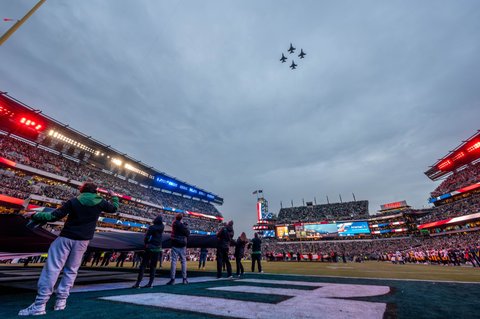
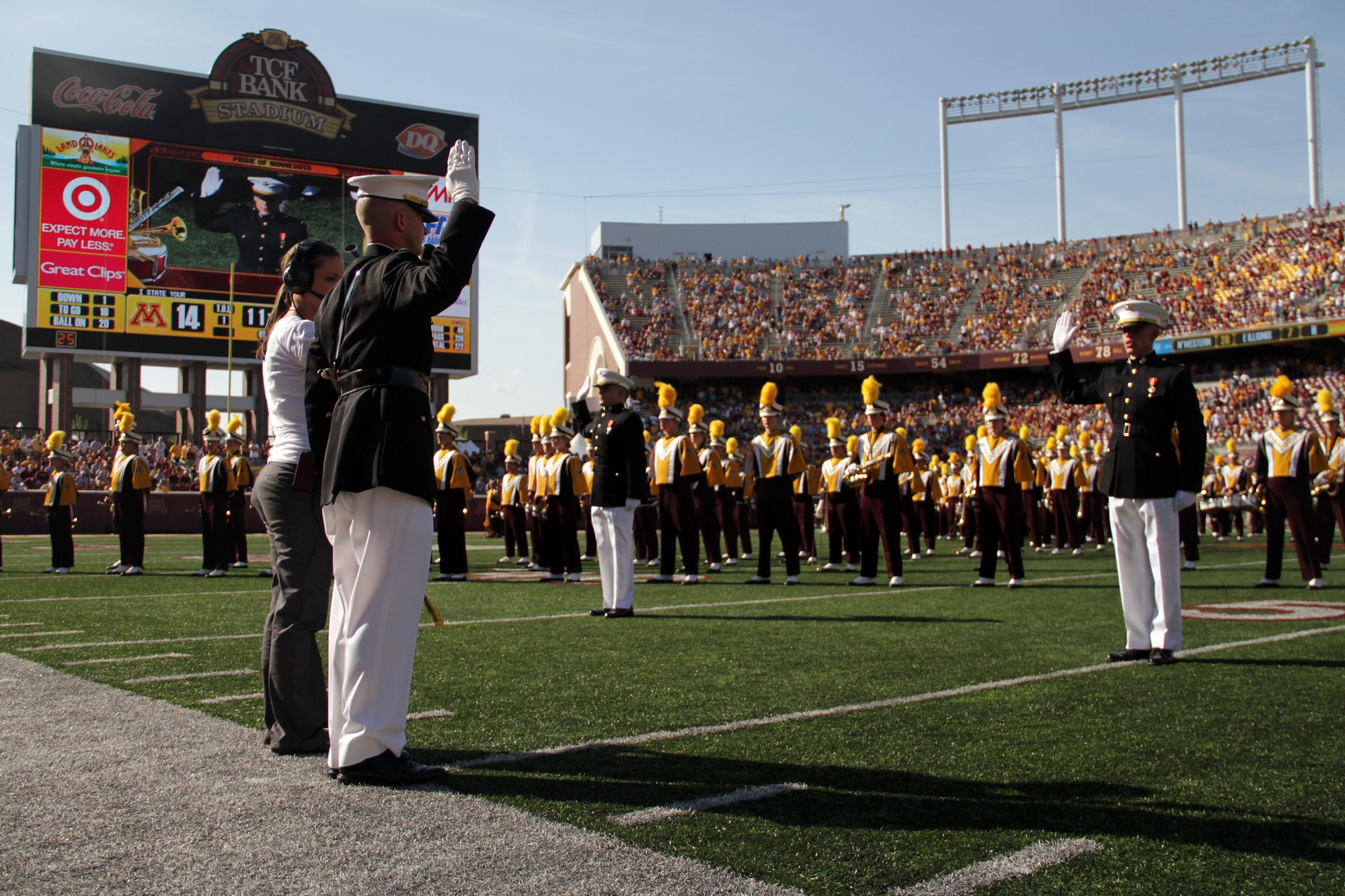
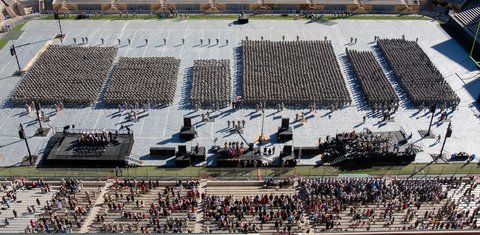
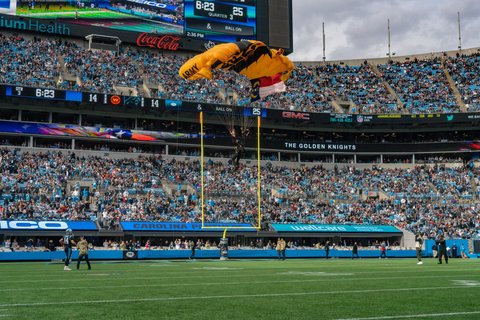
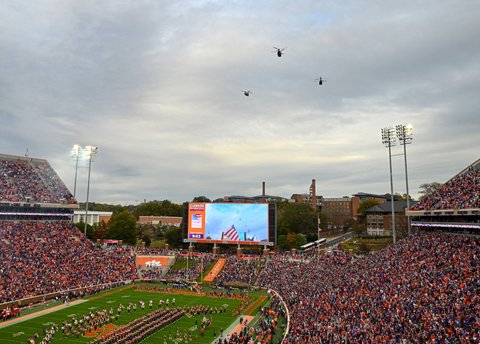
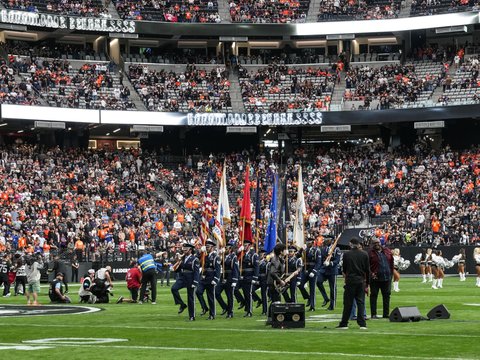
Cover image: a United States Marine Corps photograph taken at TCF Bank Stadium on 10 September 2011, released through DVIDS as image 479692, public domain. The record disagrees with itself about who took it: the listed photographer is Lance Cpl. Kris Daberkoe and the caption credit reads Staff Sgt. Clinton Firstbrook. The VIRIN is a generic placeholder and cannot settle it, so both names are given. The picture shows a commissioning ceremony on the field before a college football game, with the university's marching band on the grass and the stadium's name legible on the scoreboard. It is not a photograph of the game this entry is about, and no photograph of 20 December 2010 is used here. It is included because it shows the thing that matters: an open bowl with the sky in it.
No second image is published. The two candidate photographs found of the Metrodome interior are both close portraits of people, with the crowd behind them and no roof in frame, and a picture of an air-supported roof is precisely what this entry would have needed.


changes?
delete this memory?
We detected that you have a Blox in your crypto wallet! We will import the Blox into your account.
Click on done below to complete the import.
Welcome Back!
Sign in to preserve cherished moments
Don't have an account?
Welcome!!
Sign up and start preserving cherished moments
?
?


Choose your payment method
Buy with Metablox Credit
Do you want to mint Blox with Metablox Credit?
Which Crypto would you like to use?
Purchase Confirmed!
Your Blox is being minted on-chain and will appear in your profile shortly.
Log in or sign up to claim your Blox.
How many credits do you want to buy?
$100 USD = 1 Metablox Credit = 1 Blox.
Use Metablox Credit to mint any Blox you want on the map.
 expand_more