Tennis History | Philadelphia Cricket Club, St. Martin's — the American championship asked which club you belonged to, not which country, June 1915
volume_up
Listen
directions
Directions
For thirty-four years the phrase "the United States national championship" covered two tournaments on separate grounds, and only the men's half is remembered by address. The men played at the Newport Casino and, from 1915, at Forest Hills. The women played here, on the grass of the Philadelphia Cricket Club at St. Martin's, from the first women's national singles in September 1887 until 1920. In June 1915 the ground gave the American game a result its own governing body had never had to think about.
On Saturday 12 June 1915, Molla Bjurstedt of Norway won the women's national lawn tennis championship at St. Martin's, beating Mrs. George Wightman — Hazel Hotchkiss of Pasadena before her marriage, and the champion of 1909, 1910 and 1911 — after losing the first set. Wightman took the opening two games to love and the set 6–4; the Philadelphia Evening Public Ledger counted the points in that set at 38 to 35 and put the crowd above two thousand. Bjurstedt took the last two sets, the third to love.
The two contemporaneous reports do not agree on the middle set. The Ledger's headline score reads 4–6, 6–3, 6–0, while its own narrative in the same column says Bjurstedt took the second set by six games to two. The Daily Kennebec Journal of Augusta, Maine, printed 4–6, 6–2, 6–0 and set out the second set game by game, arriving at six games to two. Two of the three renderings say 6–2. This entry does not resolve the discrepancy; it reports it.
Both papers called the result a first. The Kennebec Journal wrote that the victory "marks the first time in the history of the championship that the title has gone to a foreign player." The Ledger said the same thing and then miscounted its own premise, describing the event as having been held for twenty years; the women's championship had been played since 1887, which made 1915 the twenty-ninth. The narrower claim the papers were reaching for is the sound one: no player representing a country other than the United States had previously won the American women's singles title.
What made that possible was not an act of principle. It was a membership rule. The United States National Lawn Tennis Association ran a championship entered through affiliated clubs, and Bjurstedt had joined one. The Kennebec Journal put the consequence plainly, and a little defensively: "In the tournament Miss Bjurstedt represented the West Side Tennis Club of New York, therefore the Wissahickon cup at least does not leave the United States." A Norwegian could win the American championship because an American club had taken her in, and the trophy was recorded against the club, not the player's passport.
That is worth setting beside what the French were doing at the same moment. The French national championship of the period was closed to players who were not members of French clubs — the same instrument, club membership, used to produce the opposite result. Both associations decided who could enter by asking which club you belonged to. One set of clubs admitted a foreigner and one set did not.
Nothing protected the holder here either. Mary Browne of California had won the title in 1914 and, as the Kennebec Journal noted, did not come East to defend it. Bjurstedt entered a championship whose reigning champion had simply stayed home.
She had arrived in the United States earlier that year and had already won the national indoor title. Her form on grass was not taken for granted: eight days before the final, the Ledger ran a column arguing that she depended almost wholly on ground strokes and that her inexperience on turf, after a career on clay and concrete, was a real handicap. She had forfeited a singles match at a Philadelphia tournament that week with an injured ankle. On the same afternoon she won the singles she lost the mixed doubles final, partnered with Irving C. Wright of Boston, to Wightman and Harry C. Johnson, 6–0, 6–1.
She played for Norway that day. She competed in the United States for years afterwards and the Library of Congress catalogues her later negatives under the married name Mallory. This entry describes her as Norwegian because that is what she was at the time of the match; a title list that carries her through under one nationality is flattening a change that happened partway along. Her own entry on Metablox is pinned at Forest Hills, in August 1921.
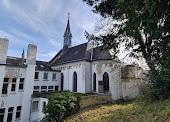
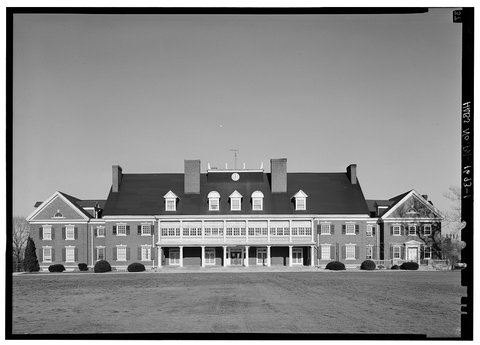
The women's championship left St. Martin's after 1920 and moved to Forest Hills in 1921. The Philadelphia Cricket Club is still at St. Martin's and still has grass courts.
**Correction, added after publication.** An earlier version of this entry called 1921 "the first year the two halves of the American championship were played on one ground, thirty-four years after the women's event began." That is wrong, and it is withdrawn. The men's championship moved out of Forest Hills in the same season the women's moved in: it was played at the Germantown Cricket Club in Philadelphia in September 1921, reported independently by the Evening Public Ledger of 2 September 1921 (https://www.loc.gov/resource/sn83045211/1921-09-02/ed-1/?sp=17) and New York's Evening World of 7 September 1921 (https://www.loc.gov/resource/sn83030193/1921-09-07/ed-1/?sp=14). 1921 was the year the two halves of the American championship swapped grounds, not the year they came together. The Germantown entry on Metablox carries the detail.
**Coordinate.** 40.063473, -75.210644, precision radius 300 m. Two independent sources for 415 West Willow Grove Avenue, the St. Martin's clubhouse address: the City of Philadelphia's OPA property records, served through the city's own ArcGIS feature service, return 40.063570, -75.210829, and OpenStreetMap's building outline for the same address returns 40.063376, -75.210459 — about 38 m apart. The pin is the midpoint. Disclosure: the U.S. Census TIGER geocoder, this vertical's usual first source for American addresses, returns 40.064552, -75.207084 for the same address, roughly 338 m to the northeast; that is a street-line interpolation across a long block and it is the weaker reading for a large-parcel address, so it was not used in the pair. The radius is set to cover the club's St. Martin's grounds rather than the clubhouse door, because the 1915 championship was played on the club's grass courts and no source consulted here fixes which court held the final.
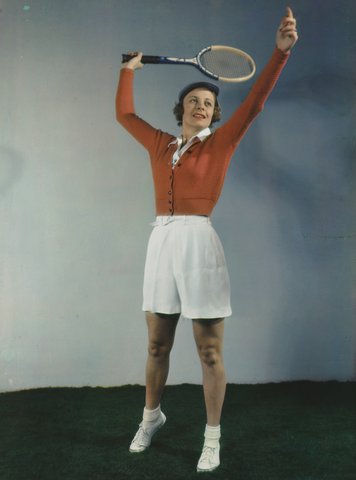
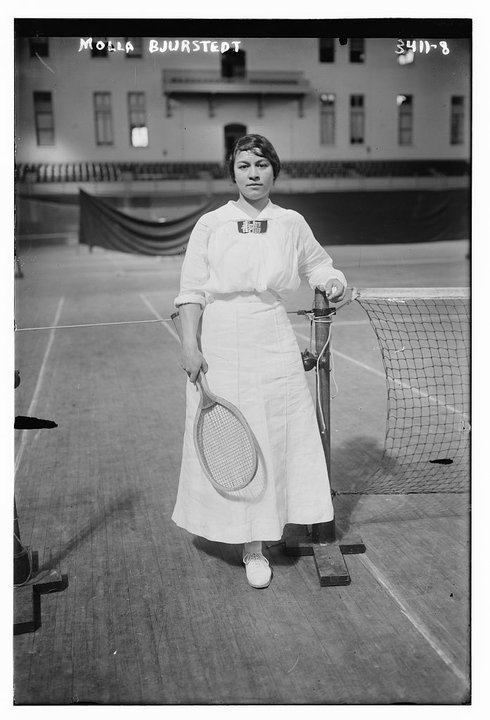
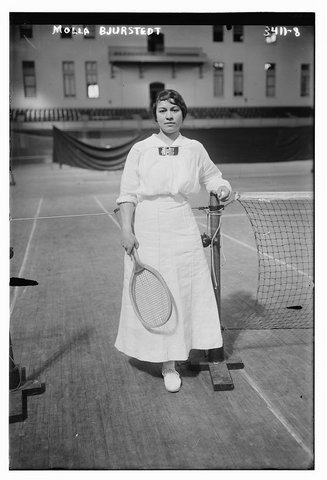
**Cover image.** "Molla Bjurstedt" — Bain News Service, negative LC-B2-3411-8, Library of Congress, item 2014697295, dated [1915], "No known restrictions on publication." The negative carries the photographer's handwritten caption MOLLA BJURSTEDT across the top. Note what it actually shows: she is standing at the net on a wooden indoor court in front of empty tiered seating, not on the Philadelphia grass. Bjurstedt won the United States national indoor championship earlier in 1915, and an indoor court is the likelier setting. It is used here as the best-dated rights-clean portrait of the subject in the year of the match, not as a picture of the match. https://tile.loc.gov/storage-services/service/pnp/ggbain/18600/18641v.jpg
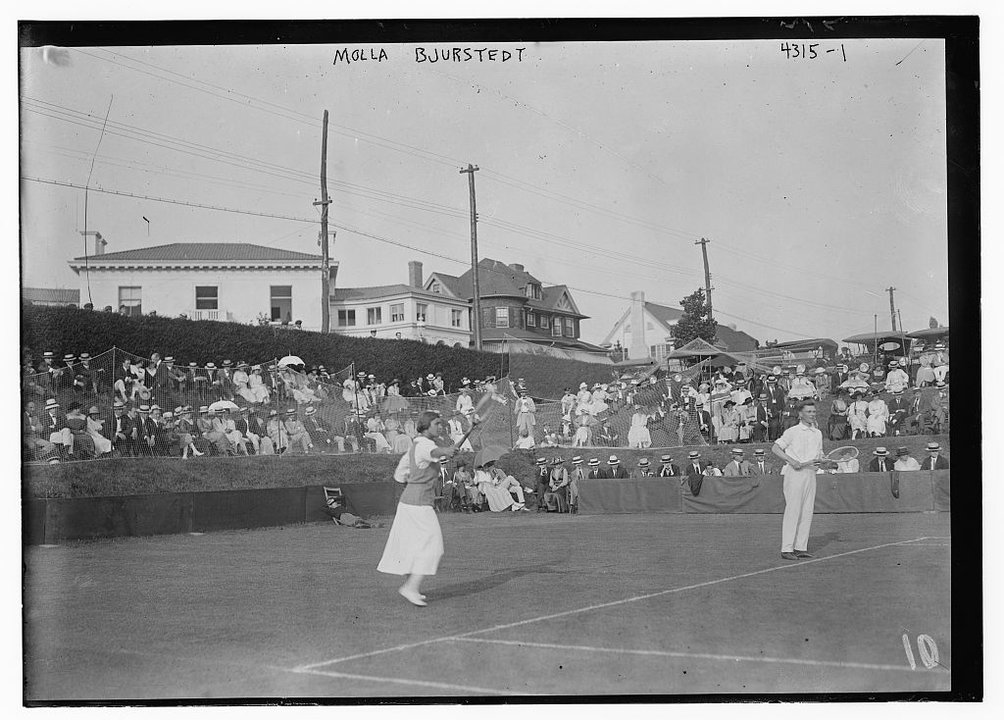
**Second image.** "Molla Bjurstedt" — Bain News Service, negative LC-B2-4315-1, Library of Congress, item 2014705368, "No known restrictions on publication." A grass court in play, with a banked gallery in straw hats and houses on a rise behind. The Library dates it only as between about 1915 and about 1926 and does not identify the ground; it is not evidence of the Philadelphia Cricket Club and is not offered as such. It is here for the scale and shape of a women's championship gallery in the period. https://tile.loc.gov/storage-services/service/pnp/ggbain/25100/25186v.jpg
**Sources.** Evening Public Ledger (Philadelphia), 12 June 1915, page 29, via the Library of Congress: https://www.loc.gov/resource/sn83045211/1915-06-12/ed-1/?sp=29 — and 4 June 1915, page 12: https://www.loc.gov/resource/sn83045211/1915-06-04/ed-1/?sp=12 · Daily Kennebec Journal (Augusta, Maine), 14 June 1915, page 10: https://www.loc.gov/resource/sn82014248/1915-06-14/ed-1/?sp=10. All three were read from the Library of Congress OCR text of the scanned pages. The OCR of these broadsheets garbles proper names and figures systematically; the quotations above are given in corrected orthography, and the page URLs are provided so the wording can be checked against the scans.










































 expand_more