


Tennis History | 24-25 Upper Pembroke Street, Dublin — the women's championship was moved off the public square to keep it private, June 1879
· 1879-6
Personal memoryBy kevin · · Report an issue







2.JPG?width=1280)





























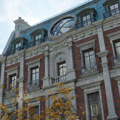












Find memories left by people near you.
Distribute Bounty
This will distribute the bounty equally among all qualifying memories. This action cannot be undone.
Cancel Bounty
Are you sure you want to cancel this bounty? The remaining amount will be refunded to your account.
Success!
Operation completed successfully.
Error
Something went wrong.


Tennis History | 24-25 Upper Pembroke Street, Dublin — the women's championship was moved off the public square to keep it private, June 1879
kevin
On Monday 9 and Tuesday 10 June 1879 the Fitzwilliam Lawn Tennis Club of Dublin held a national championship for women. It did not hold it where it held the men's. The men played for the Irish Championships on Fitzwilliam Square, an open city square with a garden at its centre, in front of whatever crowd turned up. The women played on the club's own courts behind 24 and 25 Upper Pembroke Street, a terrace in the next street, and the reason given at the time was that the matches should be kept as private as possible.
That is the whole of it, and it is why this entry exists. Two draws of one championship, run by one committee, in one city, in one week, put in two different places according to who was playing. The distance is a short walk. It was long enough to do the job.
**What the club did, and where.**
The Fitzwilliam Lawn Tennis Club was founded in November 1877 by ten men, on premises in Upper Pembroke Street leased to them by Sir Francis Brady. Dublin City Council's commemorations project, which put a plaque on the building and had the Lord Mayor unveil it on 10 June 2023, gives the club's first home as 24-25 Upper Pembroke Street and records that the club outgrew it and moved to Wilton Place in 1880.
The championships and the club premises are two different things, and the sources keep them apart, which is worth saying plainly because they are easy to run together. The encyclopaedia article on the club has the Irish Championships staged at Fitzwilliam Square from 1879 and remaining there until 1903, when the meeting moved to Wilton Place; the club itself had taken a house and gardens at Wilton Place in 1880. So for twenty-three years the club's address and its championship ground were not the same address.
In 1879 the women's event was at neither of the places the meeting is remembered by. It was on the courts at Upper Pembroke Street.
**The reason, and who reported it.**
The encyclopaedia article on the club states that the ladies' event was held at Upper Pembroke Street rather than at Fitzwilliam Square in order to keep the matches as private as possible, and attributes that reason to a report in The Field. The Field was not read for this entry, no wording from it is quoted here, and nothing is asserted about the paper beyond the article's citation of it. What is reported here is that an encyclopaedia article cites a period magazine for the reason, and that Dublin City Council's own account of the tournament, written independently of that article, gives no reason at all.
The distinction matters, because the reason is the whole argument and it rests on one citation. If the report is right, the club recorded its own motive, and the motive was not that the women could not enter. They could enter. It was that they should not be watched entering.
Note the grammar of it as well. A club committee decided; a magazine reported the decision; and the shape the language takes ever afterwards is the passive one, in which matches were kept private and nobody kept them. This entry names the club, because the club is who did it.
**What the record says happened.**
The published roll of the women's singles gives the 1879 title to May Langrishe, who beat a player entered as D. Meldon by 6-2, 0-6, 8-6. Meldon took the title the following year. The event was not held in 1881. The same roll gives May Langrishe the title again in 1883, over Beatrice Langrishe, and again in 1886.
That roll should be read with one caution, which is its own. It marks repeat winners with a bracketed number, and the numbering does not run consistently: Meldon is marked as a repeat winner in 1880 having been only the runner-up in 1879, and May Langrishe is marked the same way in 1886 after two earlier wins. The years are used here; the bracketed counts are not.
She is not a name invented by later compilers. Writing in 1903, H. S. Scrivener, an English player of the period who knew May Langrishe well enough to partner her in private mixed doubles, listed the famous Irish women players of the earlier days as Miss Stanuell, who had been champion once, and the Misses May and B. Langrishe, and said of the first of the two sisters that she was Irish champion as far back as 1879 and again in 1886. He names two of the roll's three years and does not mention 1883. A published roll and a man who played with her agree on the first year and on the person, and that is the support this entry rests on.
**Five years, and a silver basket.**
The Championships, Wimbledon began in 1877 and were for men. The All England club added a Ladies' Singles competition in 1884, and the first prize, awarded to Maud Watson, was a silver flower-basket valued at twenty guineas. Dublin's women's championship therefore came five years before Wimbledon's, and Dublin City Council says so in those terms.
The two events then met almost at once. Maud Watson also won the Irish women's title in 1884, beating May Langrishe in the final, and won it again in 1885. Which of her two 1884 titles fell first in the calendar is not established here. A later writer, describing the season of 1896 rather than 1884, puts the Irish Championship at Dublin late in May and the English Championship at Wimbledon in July, but a calendar for one season is not a calendar for another and it is not used as one.
Both Dublin City Council and the encyclopaedia article call the 1879 event the first national championship for women in the world. That is an unnarrowed claim of the kind this series does not adopt, and it is repeated here as those two sources' claim and nothing more. What would settle it is an enumeration of the women's competitions held anywhere before June 1879 together with a working definition of what makes one national, and neither was attempted here. The narrower statement, which both sources also make and which can be checked against the two rolls, is the one this entry uses: Dublin's women's championship is five years older than Wimbledon's.
**Why a Dublin street is in a series about the four majors.**
Because for a long time there were four majors, and these were not the four. The encyclopaedia article on the tournament states that before the International Lawn Tennis Federation was created and its world championship events established in 1913, players and historians counted the Irish Championships as one of the four most important tournaments to win, the others being Wimbledon, the United States National Championships and the Northern Championships. Scrivener, who played in it, records that the Northern meeting was held alternately at Liverpool and Manchester. Paris and Melbourne are not in that list. Dublin and Manchester are.
Period writing supports the standing of the Irish title even where it does not endorse that particular list of four. The 1904 volume Lawn Tennis, published in New York by The Macmillan Company in October of that year as part of Caspar Whitney's American Sportsman's Library, describes the British team that came to America in 1897 and notes that H. S. Mahony had just given up the English championship while Dr. W. V. Eaves had just taken the Irish one, concluding that these two at least were at the top of the lawn tennis ladder at home. The Irish title is being used there as a measure of rank, not as a provincial souvenir. That book's copyright page was read for this entry; its title page was not, and its authorship is not established here beyond the credit J. P. Paret printed under one of its photographs.
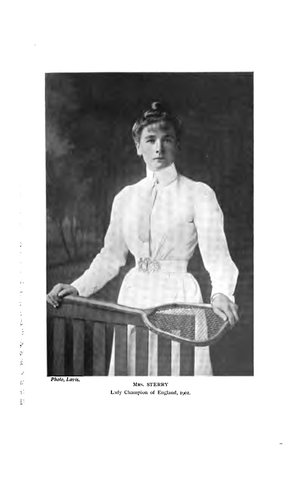
Scrivener, in a separate 1903 volume, remembered the Fitzwilliam meeting as about the best-managed of the year, said that Fitzwilliam week ran a good second to Horse Show week in the affections of Dublin society, and recorded more than three thousand spectators present on the second afternoon of the week in 1889. Mrs. Sterry, who won the Wimbledon singles five times and whose own entry on this platform is pinned at Worple Road, wrote in her chapter of that same book that she could confidently recommend the Fitzwilliam to any lady wanting an enjoyable tennis week, and complained only that it fell a little early in the season for an International Championship. She calls it an International Championship without qualifying the phrase.
This entry does not open an arc on the Irish Championships or on any tournament outside the four modern majors. It is anchored here on the narrow ground that Wimbledon's women's championship followed this one by five years, and that the meeting the modern four displaced is part of how the modern four came to look inevitable. Whether this series should go further into the older four is a scope question left open rather than answered.
**The surface, and a word that has changed meaning.**
The tournament record gives the Irish Championships' surface as hard for 1879 and 1880 and grass from 1881. Nothing read here establishes what the Upper Pembroke Street courts were made of, and the word should not be read forward: hard court in British and Irish usage of that period did not describe the material a modern hard court is made of. This entry does not resolve what was meant and builds nothing on it.
**Amateur-era record.**
Everything above belongs to competitions closed to anyone who had been paid to play, run by private clubs that controlled their own entry lists. The pre-1968 and post-1968 records are not one series and nothing here is counted across that line. This platform's entries at Worple Road, at St. Martin's in Philadelphia and on the Ile de Puteaux set out how club membership, the challenge round and a retrospectively assembled record each shaped what the roll of a championship looks like afterwards, and those arguments are not repeated here.
**Gaps this entry declares.**
The Field of June 1879 was not read, and it is the single document that would either confirm or remove the privacy reason on which this entry turns. No Irish newspaper of June 1879 was reached. The machine-searchable American newspaper corpus used elsewhere in this series was searched on three strings, for Irish lawn tennis championship Dublin, for Langrishe tennis and for Fitzwilliam lawn tennis, and returned nothing from 1879 at all; that is a statement about those three strings in that corpus and not about the press of 1879. The plaque's own inscription was not read: the Dublin City Council page describing it, read for this entry on 6 September 2026, does not reproduce the wording, and no photograph of the plaque was obtained, so nothing is asserted here about what it says. Nothing was established about the number, size or position of the courts behind the terrace, about how many women entered in 1879, or about who else sat on the committee that made the decision. May Langrishe's age in 1879 is not given, because no source read here gave her a date of birth.
**Coordinate.** 53.334897, -6.254307, precision radius 150 m. The anchor is the building at 24-25 Upper Pembroke Street, Dublin 2: the club's first premises, and the site of the Dublin City Council plaque. Two independent sources of different kinds were used and they agree closely. The Esri World Geocoding Service, working from commercial address and road data, returns 53.334826, -6.254260 for number 24 and 53.334873, -6.254142 for number 25, both at a match score of 99.3 out of 100. OpenStreetMap separately holds a mapped building polygon, way 250304306, labelled 24-25 Pembroke Street Upper, whose centre is reported at 53.334944, -6.254413. Taking the two Esri address points as one reading and the building polygon as a second of a different kind, the pin is the midpoint of the two kinds and lies about 9 m from each.
The radius is far wider than that agreement, because the agreement is about a doorway and the tournament was not played in a doorway. A club is not a court. The courts stood on the leased premises, and no source read here locates them, counts them or gives their dimensions; this entry does not assume how far back from the street they lay. The radius is set to cover the two house plots and their ground together with the spread between the readings.
For orientation, and because the whole argument is a distance: Fitzwilliam Square, where the men played, lies about 163 m from this pin, computed from this coordinate and the OpenStreetMap centre of the square's garden at 53.335403, -6.252002. That is a figure derived from two mapped centres rather than a measurement between two courts, and it should be read as an order of magnitude. This is the first anchor in this tennis series in Ireland. The nearest pin to it anywhere on this platform belongs to a different subject entirely: a finance-history entry at Government Buildings, 487 m north.
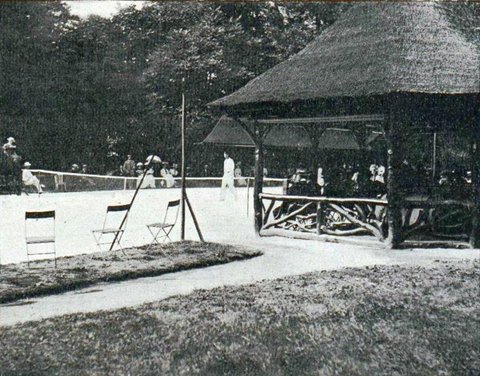
**Cover.** The illustration on leaf 35 of the Internet Archive's scan of Arthur Wallis Myers's Lawn Tennis at Home and Abroad of 1903, counting leaves as the archive numbers them rather than as the book paginates itself; digitised from the New York Public Library's copy, sponsored by Google, catalogued there as not in copyright. The page measures 3250 x 5084 px and was opened at full size, measured and enlarged before being described. In letterpress beneath it: H. S. BARLOW PLAYING AT DUBLIN, 1890.
It is a halftone action photograph rather than a full-page plate, and body text runs beneath it on the same page. A man in a white shirt and pale trousers, with a dark band at the waist and pale shoes, stands with one arm raised and the hand closed and the other arm extended low and away from him, holding a racket with its head near the ground. Behind him, and close behind him, stand spectators: a figure in a dark bowler hat, a taller dark figure beside a long straight object that may be a stick or a furled umbrella, several people in pale clothing, and at the right a woman in a broad pale hat. Upper left there is a large pale angular shape, most probably an awning or a marquee, though the halftone does not resolve it into anything certain. No net, no court marking and no lettering of any kind can be resolved inside the picture, and the lower part of the frame is too dark to read.
This shows the men's meeting, eleven years after the women's championship this entry is about, and it is the cover for that reason rather than in spite of it. It is what the Irish Championships looked like when they were played in public: the spectators stand in the same frame as the player, and no barrier between them can be made out. That is the thing the women's draw of 1879 was moved away from.
**Second image.** The full-page plate on leaf 198 of the same scan, likewise 3250 x 5084 px, opened, measured and looked at. In letterpress at the foot, at the left, the photographer's credit, which the scan renders as Pholo, Werner; and centred beneath it, in two lines, MISS MARTIN, Lady Champion of Ireland, 1902.
A studio portrait, three-quarter length, against a painted backdrop of foliage with what reads as a distant hill. A woman in a dark tailored jacket over a white collar, with a dark bow at the throat and a pale straw boater with a dark band, stands behind a heavy carved wooden rail with both hands resting on it, her head turned down and to one side. A small dark long-bodied dog with short legs and long ears stands on the ledge below the rail. She holds no racket, and there is nothing in the frame to say she plays anything.
Louisa Martin is the title's later half. The same roll has her as runner-up in 1885 and 1886 and as champion from 1889, and Scrivener wrote in 1903 that her record in the Irish championship was very nearly a counterpart of Mrs. Hillyard's in the English. The championship begun on a screened ground in 1879 was, twenty-three years later, producing a champion whose portrait a widely circulated survey of the game printed at full page and captioned with a country. It is the same distance travelled, in the other direction.
**Sourcing note.** No passage in this entry carries quotation marks, and that is deliberate. Two of the three substantial sources are books, and a book has one typesetting, which does not meet this series' condition for putting machine-read text inside quotation marks; everything taken from Wallis Myers's 1903 volume, including Scrivener's chapter and Mrs. Sterry's, and everything taken from the 1904 Macmillan volume, is attributed paraphrase. The wording said to come from The Field is at one remove inside a secondary source, and is paraphrased for that reason as well. The Dublin City Council page and the encyclopaedia articles are secondary throughout and are named wherever they are the only support for a statement.
**Sources.** Dublin City Council, Plaques of Dublin, Fitzwilliam Lawn Tennis Club, for the founding in November 1877, the lease from Sir Francis Brady, the address 24-25 Upper Pembroke Street, the moves to Wilton Place in 1880 and to Appian Way in 1972, the dates 9 and 10 June 1879, the tournament's location on the Upper Pembroke Street courts, the five-year interval before Wimbledon and the unveiling of the plaque by the Lord Mayor on 10 June 2023: http://plaquesofdublin.ie/list/fitzwilliam-lawn-tennis-club/ . Encyclopaedia article on the Fitzwilliam Lawn Tennis Club, for the championships at Fitzwilliam Square from 1879 to 1903 and for The Field's reported reason: https://en.wikipedia.org/wiki/Fitzwilliam_Lawn_Tennis_Club . Encyclopaedia article on the Irish Championships, for the 1879 founding, the venue, the surface record, the women's singles roll including the 1879 result and Maud Watson's 1884 and 1885 titles, and for the pre-1913 grouping of four major tournaments: https://en.wikipedia.org/wiki/Irish_Championships . Encyclopaedia article on the Wimbledon Championships, for the addition of the Ladies' Singles in 1884 and Maud Watson's twenty-guinea silver flower-basket: https://en.wikipedia.org/wiki/Wimbledon_Championships . Arthur Wallis Myers, Lawn Tennis at Home and Abroad, 1903, for H. S. Scrivener's chapter on the Irish Championships and the Langrishes, for Mrs. Sterry's chapter, for Louisa Martin, and for both images: https://archive.org/download/lawntennisathom00myergoog/lawntennisathom00myergoog_djvu.txt , with the pages at https://archive.org/download/lawntennisathom00myergoog/page/n35.jpg and https://archive.org/download/lawntennisathom00myergoog/page/n198.jpg . Lawn Tennis, The American Sportsman's Library, The Macmillan Company, October 1904, for Mahony, Eaves and the lawn tennis ladder and for the 1896 season's calendar: https://archive.org/download/lawntennisitspa00maddgoog/lawntennisitspa00maddgoog_djvu.txt . Coordinates from the Esri World Geocoding Service and from the OpenStreetMap building polygon way 250304306 via Nominatim; the neighbouring-pin distance computed against this platform's own stored coordinates.



changes?
delete this memory?
We detected that you have a Blox in your crypto wallet! We will import the Blox into your account.
Click on done below to complete the import.
Welcome Back!
Sign in to preserve cherished moments
Don't have an account?
Welcome!!
Sign up and start preserving cherished moments
?
?

Choose your payment method
Buy with Metablox Credit
Do you want to mint Blox with Metablox Credit?
Which Crypto would you like to use?
Purchase Confirmed!
Your Blox is being minted on-chain and will appear in your profile shortly.
Log in or sign up to claim your Blox.
How many credits do you want to buy?
$100 USD = 1 Metablox Credit = 1 Blox.
Use Metablox Credit to mint any Blox you want on the map.
 expand_more