Tennis History | West Side Tennis Club, Forest Hills — the colour line was an invitation list, August 1950
volume_up
Listen
directions
Directions
Althea Gibson was not the first Black player to enter a United States Lawn Tennis Association event. Reginald Weir had done that at the National Indoor Championships in New York in March 1948, and Gibson played the indoor championships herself in 1949 and again in 1950.
The obstacle at Forest Hills was not a rule. It was an invitation list.
Entry to the US National Championships turned on a player's record across the summer grass-court season, and those tournaments were invitational events run by private clubs. The clubs chose whom to invite.
Nothing in the association's regulations had to mention race for the result to be the same every year, which is precisely why the USLTA could point to by-laws that forbade discrimination while the outcome never changed.
Alice Marble, four times the US singles champion, set that mechanism out in print.
Her editorial in the 1 July 1950 issue of American Lawn Tennis argued that the association's own rules prohibited exclusion, that Gibson was being kept out by the entry system rather than by any assessment of her tennis, and that if she was a genuine threat to the leading players they ought to meet her on court. She added that she would be ashamed of the game if that did not happen.
The wording here is paraphrase; the editorial is quoted at second hand in every account consulted and no scan of the issue was located.
The association accepted Gibson's entry on 21 August 1950, after a New Jersey grass-court tournament invited her in and gave her the record the Nationals required.
A news-agency caption filed on 30 July, a month before she played, shows how the system actually worked. It reported that she had been practising on the club's courts, "which is generally tantamount to confirming an invitation to the Nationals" (New York World-Telegram and Sun caption, Library of Congress, loc.gov/pictures/item/2013650114/).
She won her first-round match on Court 14 on 28 August 1950, beating Barbara Knapp 6-2, 6-2.
In the second round she took Louise Brough, the reigning Wimbledon champion, to 7-6 in the deciding set before a thunderstorm stopped play and a lightning strike knocked one of the stone eagles off the stadium. Play resumed the following day and Brough won 6-1, 3-6, 9-7.
The precise claim is the one worth making. Gibson was the first Black player to compete in the US National Championships, and on the accepted record the first in any of the four major championships.
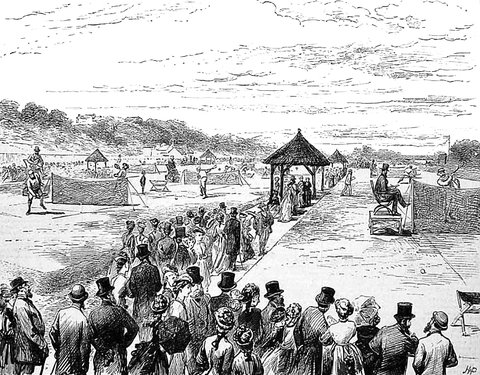
The women's title had been contested since 1887 and played at this club since 1921.
Coordinate: 40.71975, -73.84680, precision radius 250 m. Two independent sources agree: the US Census Bureau TIGER geocoder for 1 Tennis Place returns 40.71990, -73.84669, and the GPS tag on the cover photograph gives 40.71959, -73.84692, about 40 m apart.
Wikidata's point for the club sits roughly 150 m north-west, apparently aimed at the stadium rather than the clubhouse.
The pin is the club grounds, not a court: Court 14 and the grandstand court where the two matches were played are inside this radius, but their exact positions in the 1950 layout were not established.
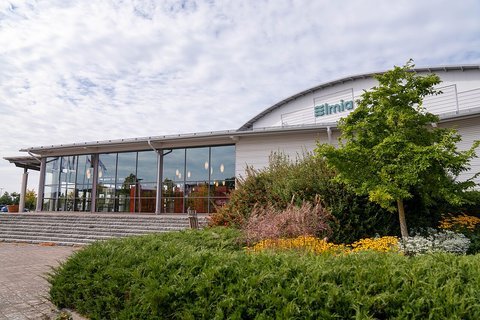
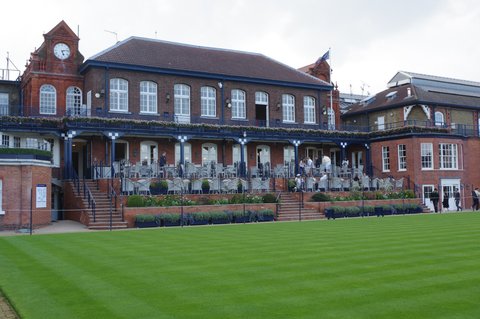
Cover: The West Side Tennis Club entrance, photographed by Peter Dutton on 2 September 2007, CC BY 2.0 via Wikimedia Commons.
The picture is modern and taken from the public side of the gate, looking through it at the clubhouse. It shows neither the courts nor anything of 1950.


















































 expand_more