


Tennis History | Île de Puteaux, Paris — the first French championship, and the 1900 week whose amateur events were called Olympic long afterwards
· 1900-7
Unreviewed contributionBy kevin · · Report an issue










































Find memories left by people near you.
Distribute Bounty
This will distribute the bounty equally among all qualifying memories. This action cannot be undone.
Cancel Bounty
Are you sure you want to cancel this bounty? The remaining amount will be refunded to your account.
Success!
Operation completed successfully.
Error
Something went wrong.


Tennis History | Île de Puteaux, Paris — the first French championship, and the 1900 week whose amateur events were called Olympic long afterwards
kevin
Between 6 and 11 July 1900, on an island in the Seine between Puteaux and the Bois de Boulogne, a club with ten courts held a week of tennis tournaments. Some of the matches played that week are now listed as Olympic events with medallists attached to them. Others played at the same club in the same week are not. Nothing on the ground separated them at the time, and the line that separates them now was drawn later, by people this entry cannot name.
That is what this entry is about, and the island is the right place to argue it, because the same ten courts had already held the first French championship nine years earlier.
**The ground.**
The Île de Puteaux is a long island in the Seine, downstream of Paris, lying between the town of Puteaux on one bank and the Bois de Boulogne on the other. The club that occupied it is named in at least five ways in the sources read for this entry, and the variation is worth setting down rather than tidying away. An English-language account of the French championship calls it the Société de Sport de l'Île de Puteaux. An English-language account of the 1900 tournaments calls it the Cercle des Sports de l'Île de Puteaux. The New-York Tribune of 15 July 1900 calls it the Puteaux Tennis Club. A syndicated Paris letter printed in Montana that month calls it, without naming it at all, the most exclusive outing club on the Isle de Puteaux. The Henri Gervex painting in the Musée Carnavalet is titled Le Cercle de l'île de Puteaux. No form is adopted here as correct.
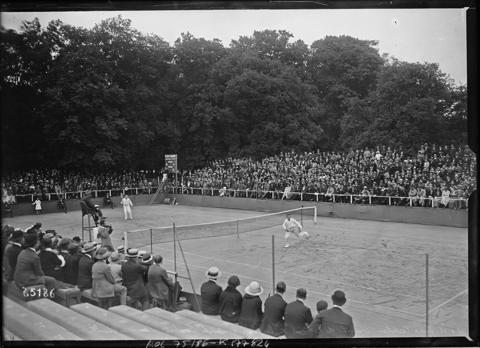
The surface is described twice and the two descriptions are not the same. The account of the French championship venues says the club played on ten sand grounds laid out on a bed of rubble. The tournament record for 1900 is indexed under clay. Both readings are printed here and neither is adopted. What can be said from the photographs, and only from the photographs, is that the court in both images is a pale, evenly graded, level surface marked with painted lines, plainly not the grass that is growing in the foreground of the first one.
**The first French championship was played here.**
The Championnat de France began in 1891, and the island held that first edition. It held the men's singles again in 1893, 1894, 1895 and 1907; the women's singles in 1897, 1902, 1905 and 1907; and the mixed doubles in 1902, 1905 and 1907. The rest of those years the championship was at the Croix-Catelan of the Racing Club de France, which this platform pins separately, or at the Tennis Club de Paris in Auteuil, or once at Bordeaux.
Two things about that first championship bear on everything below. The first is that it was not an open competition in any sense. It was closed to anyone who was not a member of a French club, a restriction that lasted until 1925, when the event was opened to amateurs internationally and became the major tournament this platform writes about elsewhere. Its first winner was a Briton resident in Paris who held membership of a French club. The rule was about club membership, not about nationality, and a man from London could satisfy it by joining.
The second is the scale. The French-language encyclopaedia article on the island quotes an account saying that the final of the first official French championship, in 1891, drew barely more than fifteen spectators, and describing the play as an occasion for society conversation with rubber balls that bounced unpredictably. The underlying source of that quoted passage was not identified in this session and it is reported here as the encyclopaedia's, not as established fact. It is set down because the photograph used as this entry's cover, taken nine years later at what its own caption calls the finals, shows empty folding chairs at the side of the court.
**What the club looked like from outside, a fortnight before.**
The best period description of the place found for this entry is not a sports report. It is a women's fashion letter datelined Paris, 20 June 1900, sixteen days before the tournaments began, printed in the Daily Inter Mountain of Butte, Montana on 7 July, the second day of them.
It says that Burke, whom it calls the celebrated English tennis player, had been called over to Paris by the exclusive outing club on the island, and that from early morning until evening he was on the tennis court giving pointers on the game to his many pupils. It reports a new amendment to the club rules allowing the children of club members to use the courts until four o'clock in the afternoon, and it describes young women arriving at the grounds in the charge of a chaperon to take their practice before their elders came.
The letter does not say whether Burke was paid, and no claim that he was is made here. What it does establish, from outside the sport entirely, is the character of the ground on the eve of the tournaments: a private club whose rules governed who could be on the courts and at what hour, with an imported English expert giving instruction to its members.
Four days after the tournaments ended, the same club appears in the New-York Tribune of 15 July 1900, and again not as a sports venue. It is listed in a satirical Paris column, among the Polo Club in the Bois de Boulogne, the Racing Club and the Automobile Club, as one of the places where Parisian and Anglo-American society took its luncheons and receptions. The column does not mention that a tournament had just finished there.
A search of the Chronicling America newspaper corpus for this club's name in 1900 returns those two pages and no others. Neither reports the tennis. That is a statement about one searchable corpus and one spelling, not a claim that no American paper covered the tournaments.
**The week itself.**
The account of the 1900 tournaments used here is an encyclopaedic one resting on a published Olympic results database, and it is reported as such. It says the organisation was uncertain and that no venue was guaranteed until five days before play began, when the ten-court island club agreed to take the events. Five of the ten courts were used, with one of them, numbered five, as the principal court.
Twenty-six players from four nations entered, more than half of them French. All four of the events now counted as Olympic were won by British players. In the men's singles Laurence Doherty won after his brother Reginald withdrew rather than play him in the semi-final. The two then won the men's doubles together. Charlotte Cooper won the women's singles from a field of six players from four nations, and won the mixed doubles with Reginald Doherty.
And in the same week, at the same club, there were other tournaments: handicap events, and a round-robin singles tournament for professionals. Those are not Olympic events and have no medallists. The distinction between them and the four that do is the amateur line, which is the line this platform's pre-1968 material sits on throughout. It is worth saying plainly what that means here. A man could have played on court five that week, in front of the same spectators, and be absent from the record entirely, because of the terms on which he was allowed to enter.
**A record assembled afterwards.**
The word Olympic is doing something in this entry that needs stating. These events were held as part of the international competitions attached to the Paris Exposition of 1900. The designation of four of that week's tournaments as Olympic events, with gold, silver and bronze attached to named players, is a later act of classification. The tables that carry it are modern compilations.
Two features of those tables show the seams. The first is that in the mixed doubles three of the four medals are credited not to a country but to a mixed team, an entity that existed on no entry form, because the pairs had been made across national lines and a table with a country column had to put something in it. Marion Jones of the United States took one of those bronze medals playing with Laurence Doherty of Britain. The second is that the women's singles awarded two bronzes and the mixed doubles awarded two bronzes, which is a structure imposed on a small draw rather than one the competitors played to.
Charlotte Cooper is commonly described as the first woman to become an Olympic champion. The claim needs its narrowing said out loud, and the encyclopaedic account read here supplies it: she is given as the first female individual Olympic champion, the qualification being necessary because a woman had already been part of a winning crew in the sailing earlier that year. A bare first would be wrong. The narrowed one is what the sources support.
**The American in the draw, and what it cost her at home.**
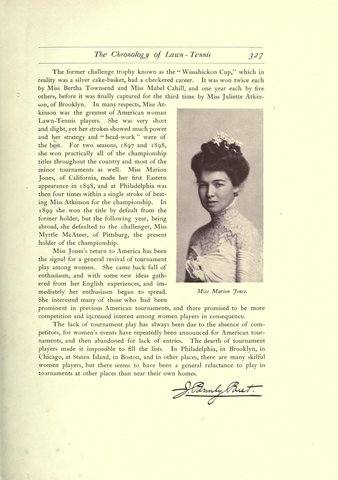
Marion Jones of the United States took a bronze medal in the women's singles here and another in the mixed doubles. This platform's entry on Jones is pinned at San Rafael in California and argues that the challenge round was a rule about travel: the holder of a title played one match, at one fixed ground, and a holder who was elsewhere lost the title without playing.
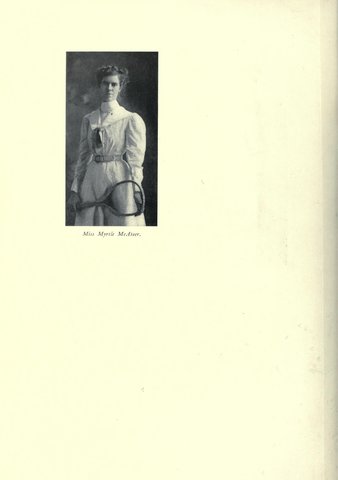
The island is where she was. In 1900 Jones held the championship of the United States and did not defend it, and the reason given by the period chronicler is that she was abroad. The two entries are the same fact seen from two continents. The tennis she was playing instead is the tennis now listed in the Olympic tables, and at the time it cost her a national championship that passed to Myrtle McAteer without a championship match being played. This platform's entry on McAteer carries the other half.
**Amateur-era note.**
Every result named above belongs to competitions closed to anyone who had been paid to play, except the professionals' round-robin, which is precisely the one that did not become an Olympic event. The reader should not take the medal tables as a ranking of who was best at tennis in July 1900. They are a ranking of who was best among those the entry rules admitted, sorted later into a record that did not exist while they were playing.
**Scope note.** This entry is anchored at a ground of the French championship, which is why it sits in this platform's tennis history rather than opening an arc about the Olympic Games. The 1900 tournaments enter as the instrument that shows how a record gets assembled; a broader Olympic tennis arc would be a separate decision and is not taken here.
**Gaps this entry declares.**
No source read here locates the club's ten courts on the island, which is the central weakness of the coordinate below.
Nothing read here establishes who decided that four of that week's tournaments were Olympic events, when that decision was taken, or on what basis. This entry says only that the classification came later than the play and that the compilations carrying it are modern. Naming the body and the date is the obvious next piece of work, and the route not taken here is the published account of how the results of the 1900 competitions were determined and by whom. Until that is done, this entry deliberately leaves the actor unnamed rather than guessing at one.
Nothing read here establishes the dates of individual matches within the week, only the span the encyclopaedic account gives; the date carried by this entry is 11 July 1900, the last of those days. Nothing read here identifies the Burke of the Paris letter, and no relationship to any of the known professional coaching families of that name is asserted. Nothing read here states what became of the club, or when the ten courts ceased to be used, or whether the modern municipal tennis courts on the south-western part of the island stand on any part of its ground; the last of those was specifically not assumed. No period plan of the club was consulted. No photograph of the 1891 championship was found.
**Coordinate.** 48.876865, 2.243660, precision radius 800 m. The two-independent-source standard is met for the island and is not met for the courts, and the radius is set by the second failure rather than the first.
Two readings of different kinds were used. The first is the coordinate held for the island in the structured-data repository, 48.878300, 2.245700. The second is a commercial road-network geocoder queried on the island's name, 48.875430, 2.241620. They are 437 m apart and the pin is their midpoint, 219 m from each. A third available reading was deliberately excluded rather than averaged in: the OpenStreetMap polygon for the island carries the structured repository's own identifier in its tags, which makes it a second expression of the first reading and not an independent one.
The radius is 800 m because the pin locates an island and not a tennis court. The island's mapped outline spans about 2,009 m north to south and about 2,584 m corner to corner, and no source read here says where on it the ten courts lay. A radius of 800 m covers the central and south-western part of the island, where the modern sports grounds are, and does not claim to cover the whole of it. The modern municipal tennis centre on the island lies 701 m from this pin; that distance is given so a reader can judge the pin, not because any source connects the two grounds.
The route that would fix this, and which was not attempted in this session, is the French national mapping agency's historic cadastral and topographic cover of the island, or the Hauts-de-Seine departmental postcard collection, whose catalogue holds period cards of the club and may carry locations.
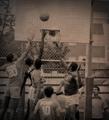
**Cover.** A halftone photograph captioned as the court of the Île de Puteaux during the tennis finals at the 1900 Olympic Games, published in Le Sport universel illustré of 21 July 1900 at page 460, ten days after the week described above. The file is 840 x 658 px, which is at this platform's lower limit for a cover, and it was opened and examined at full size. It is in the public domain by age.
It shows a level, pale court surface with a net strung across it and a white boundary line, quite distinct from the rough grass in the foreground. At the right stands an open pavilion with a deep thatched roof carried on posts, its balustrade made of rustic branch-work, with a number of figures seated under it and further figures standing behind. A man in white stands on the court. Several folding chairs stand empty on the grass in front of the court, and a gravel path curves across the foreground. Behind the court is a line of tall trees. Nothing legible is printed within the photograph itself.
The scarcity of spectators is visible and is left to speak for itself. This entry does not infer an attendance figure from it, and no attendance figure for 1900 was found. Nor does it count the figures under the pavilion, which the halftone screen does not resolve reliably at this size.
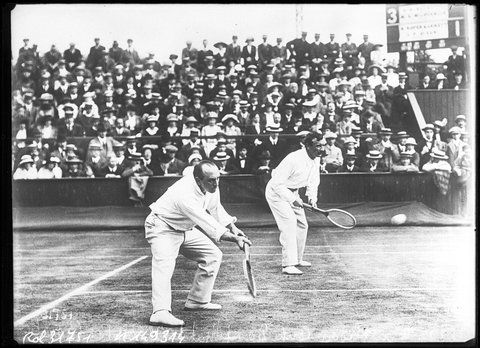
**Second image.** A press negative of a man playing a forehand on a court at the Île de Puteaux, 5,974 x 4,447 px, from the Agence Rol collection held by the Bibliothèque nationale de France and in the public domain. It was opened and examined at full size. The library's catalogue gives the subject as Arthur William Gore, 1868 to 1928, dates the coverage to 10 July 1904, and assigns the reference K260905. That identification of the player is the catalogue's and is not something this entry can confirm from the picture.
It is included because it shows the courts themselves at high resolution, and it is not the 1900 tournament: it is four years later, and the memory says so rather than letting the picture imply otherwise. What it shows is a light, smooth, apparently unbroken surface with painted lines, a dark canvas surround stretched at the back of the court, and spectators seated immediately behind that surround in ordinary clothes, several of the women in large hats and one under a parasol. There are no stands. Trees rise behind the netting.
The frame carries a document the catalogue also holds: the reference K260905 is written in white in the top right corner of the plate itself, matching the reference in the library's record, and a further short inscription is scratched at the right edge which is not resolvable here. A companion plate of Max Decugis on the same courts, catalogued to the same date, carries K260903, so the two come from a single assignment two numbers apart.
**Sourcing note.** There are no quotation marks anywhere in this entry, and that is deliberate. This platform's condition for quoting is machine-read raw text from a source set independently by more than one printer. The Paris letter of 20 June 1900 was found in a single setting, and a search of the newspaper corpus for its distinctive phrasing returned no second one; the New-York Tribune column is that paper's own Paris correspondence, which by construction has no second setting. Both are therefore given as attributed paraphrase, as is every statement above taken from the encyclopaedic accounts and the tournament records.
**Sources.** Daily Inter Mountain, Butte, Montana, 7 July 1900, page 10, for the Paris letter of 20 June describing the club, Burke and the rule on members' children: https://www.loc.gov/resource/sn85053057/1900-07-07/ed-1/?sp=10 . New-York Tribune, 15 July 1900, page 13, for the Puteaux Tennis Club named among the society resorts of the Exposition season: https://www.loc.gov/resource/sn83030214/1900-07-15/ed-1/?sp=13 . For the French championship's venues, the club's ten sand grounds on a bed of rubble, the 1891 first edition, the closure to non-members of French clubs and the 1925 opening: https://en.wikipedia.org/wiki/French_Open . For the 1900 tournaments, the uncertain organisation and five-day venue decision, the five courts used, the twenty-six players from four nations, the handicap events and the professionals' round-robin: https://en.wikipedia.org/wiki/Tennis_at_the_1900_Summer_Olympics . For the women's singles field and the narrowed first-female-individual-champion claim: https://en.wikipedia.org/wiki/Tennis_at_the_1900_Summer_Olympics_%E2%80%93_Women%27s_singles . For the mixed doubles, the six teams and the three medals credited to mixed teams: https://en.wikipedia.org/wiki/Tennis_at_the_1900_Summer_Olympics_%E2%80%93_Mixed_doubles . For the island, the Gervex painting and the quoted account of the 1891 final's fifteen spectators: https://fr.wikipedia.org/wiki/%C3%8Ele_de_Puteaux . Cover image, Le Sport universel illustré, 21 July 1900, page 460, via Wikimedia Commons: https://commons.wikimedia.org/wiki/File:Le_cours_de_l%27%C3%AEle_de_Puteaux,_lors_des_finales_du_tennis_aux_JO_de_1900.jpg . Second image, Agence Rol, Bibliothèque nationale de France, reference K260905: https://commons.wikimedia.org/wiki/File:Gore_(jouant_au_tennis_sur_l%27%C3%AEle_de_Puteaux,_10_juillet_1904)_-_btv1b53216840t.jpg . Island coordinate from the structured-data repository item for the island: https://www.wikidata.org/wiki/Q1889758 , and the island's mapped outline from OpenStreetMap way 35602833: https://www.openstreetmap.org/way/35602833 .



changes?
delete this memory?
We detected that you have a Blox in your crypto wallet! We will import the Blox into your account.
Click on done below to complete the import.
Welcome Back!
Sign in to preserve cherished moments
Don't have an account?
Welcome!!
Sign up and start preserving cherished moments
?
?

Choose your payment method
Buy with Metablox Credit
Do you want to mint Blox with Metablox Credit?
Which Crypto would you like to use?
Purchase Confirmed!
Your Blox is being minted on-chain and will appear in your profile shortly.
Log in or sign up to claim your Blox.
How many credits do you want to buy?
$100 USD = 1 Metablox Credit = 1 Blox.
Use Metablox Credit to mint any Blox you want on the map.
 expand_more