Tennis History | Croix-Catelan, Bois de Boulogne — a national championship closed to foreigners, June 1922
volume_up
Listen
directions
Directions
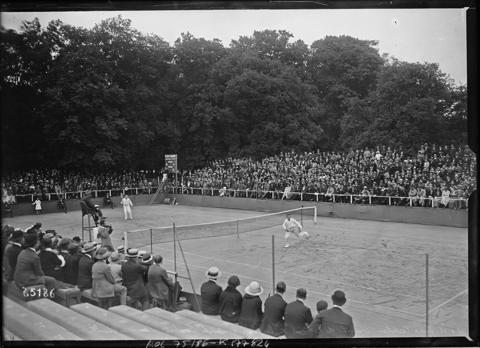
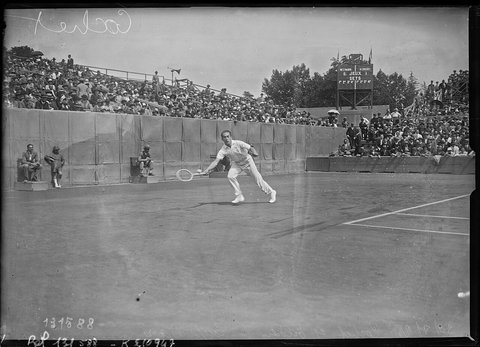
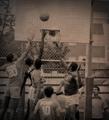
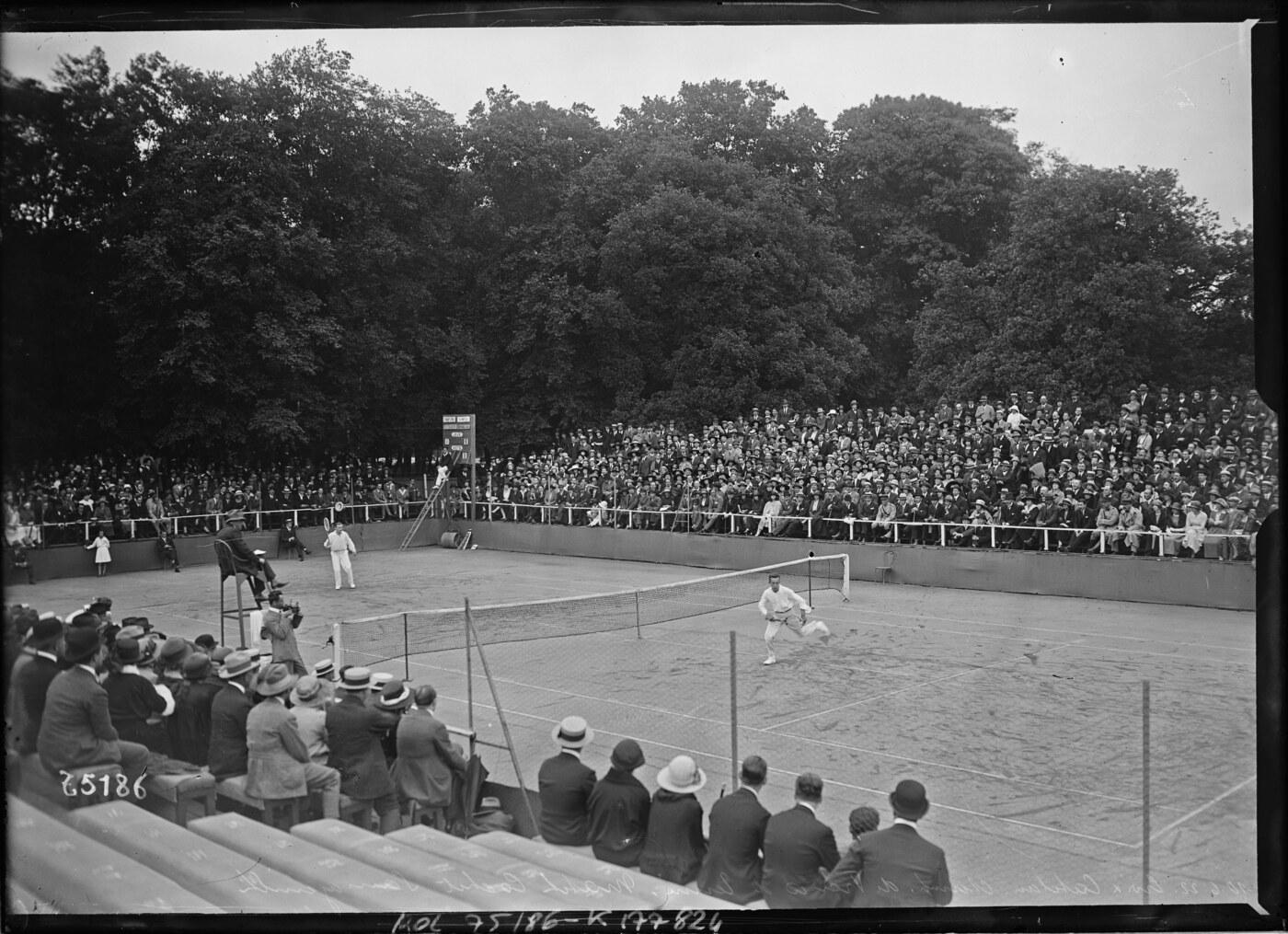
On 10 June 1922 a photographer for the Agence Rol climbed onto a temporary wooden stand in the Bois de Boulogne and photographed the final of the French championship. The court is clay. The boundary is a low painted hoarding. The umpire sits in a chair that is essentially a stepladder, the press photographers work from the front row of the stand, and the trees of the Bois close the picture off at the back. There is no stadium here. There would not be one in Paris for another six years.
The more interesting fact is who was not on the court. From its beginning in 1891 through 1924, the Championnat de France — the tournament that later became Roland-Garros — was open only to players who were members of French clubs. It was a national championship in the strict sense: a closed competition, entered through club membership, in a period when club membership in Paris was itself a filter of income and social standing. The title lists of those thirty-four years record what French clubs could produce. They do not record who was best.
France ran a separate tournament for everyone else. The World Hard Court Championships, sanctioned by the International Lawn Tennis Federation and held from 1912 to 1914 and 1920 to 1923, admitted amateurs of any nationality; it was played on the clay of the Stade Français at Saint-Cloud, except in 1922, when it went to Brussels. So in the summer this plate was exposed, the open championship in the French orbit was in Belgium and the closed one was here in the Bois.
The federation ended the arrangement from outside. In 1923 the ILTF issued its Rules of Tennis and created a category of Official Championship covering events in Great Britain, France, the United States and Australia. In 1925 the French Championships opened to all amateurs internationally and took their place among the four. The World Hard Court Championships was not held after 1923 — Paris hosted the 1924 Olympic Games and the Olympic tournament stood in its place — and it is on that basis that some historians treat it, rather than the closed Championnat, as the true ancestor of the modern French Open.
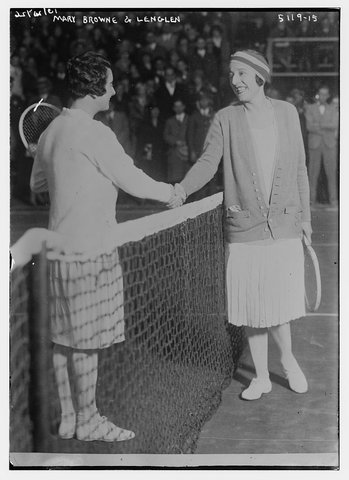
Two disputes in the record, left standing rather than resolved. First, the venue years. The tournament moved between the Île de Puteaux, the Racing Club de France's ground at the Croix-Catelan, the Tennis Club de Paris at Auteuil and, in 1909, the Villa Primrose in Bordeaux, and the published venue-by-year tables do not agree with each other: one gives the Croix-Catelan the even years from 1892 and 1910-1914, 1920-1924 and 1926, another assigns 1896-1906 to Auteuil and gives a different set of early years to Puteaux. Anyone printing a clean list is choosing one of them. Second, the 1922 result. The French-language record has Henri Cochet beating Jean Borotra 6-3, 7-5, 6-2, and also records that the holder still entered directly at a challenge round, as Suzanne Lenglen did in the women's event; the Rol plates of 10 June are captioned as the final and show Cochet against Jean-Pierre Samazeuilh, who had won the title in 1921. A challenge round played on 10 June against the previous year's champion would reconcile the two, but that is an inference, not a document, and it is offered here as one.
The men in these photographs matter for what came next. Cochet, Borotra and Jacques Brugnon, all photographed at the Croix-Catelan in June 1922, became three of the four players who took the Davis Cup from the United States in 1927 — the win that obliged France to build a ground capable of defending it, which is how the Stade Roland-Garros came to exist in 1928. The closed national tournament of the Bois de Boulogne produced the players whose success made the closed tournament's home obsolete.
Coordinate. The pin is the Racing Club de France's Croix-Catelan grounds in the Bois de Boulogne, 16th arrondissement, Paris, taken as the midpoint of two independently maintained sources: the Wikidata entity for the Croix-Catelan sports ground (Q3003238, 48.864221 N, 2.256666 E) and the IGN Géoplateforme national address base for the Chemin de la Croix Catelan, 75016 Paris (48.865696 N, 2.254962 E). The two lie 206 m apart on a sports complex of roughly twenty hectares, which is scale rather than disagreement; IGN's nearest higher-scoring feature, the Carrefour de la Croix Catelan, sits 321 m from the Wikidata point. Precision radius 350 m. This is the ground, not the court: the courts were relaid and rebuilt repeatedly across the twentieth century and no surveyed position for the 1922 championship court has been located.
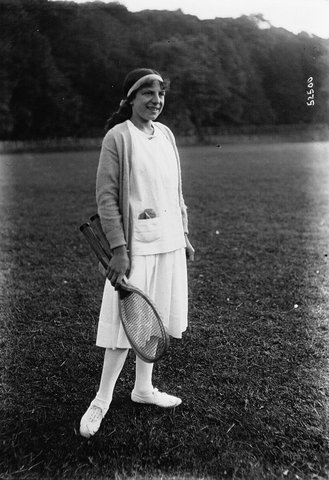
Cover image: "10-6-22, Croix-Catelan, championnat de France de tennis, match Cochet-Samazeuilh", Agence Rol, 10 June 1922, glass negative held by the Bibliothèque nationale de France (btv1b53080577m), public domain, via Wikimedia Commons. The handwritten caption along the lower edge reads in mirror, having been written on the reverse of the plate; the printed reference ROL 75186 - K 177824 reads normally.
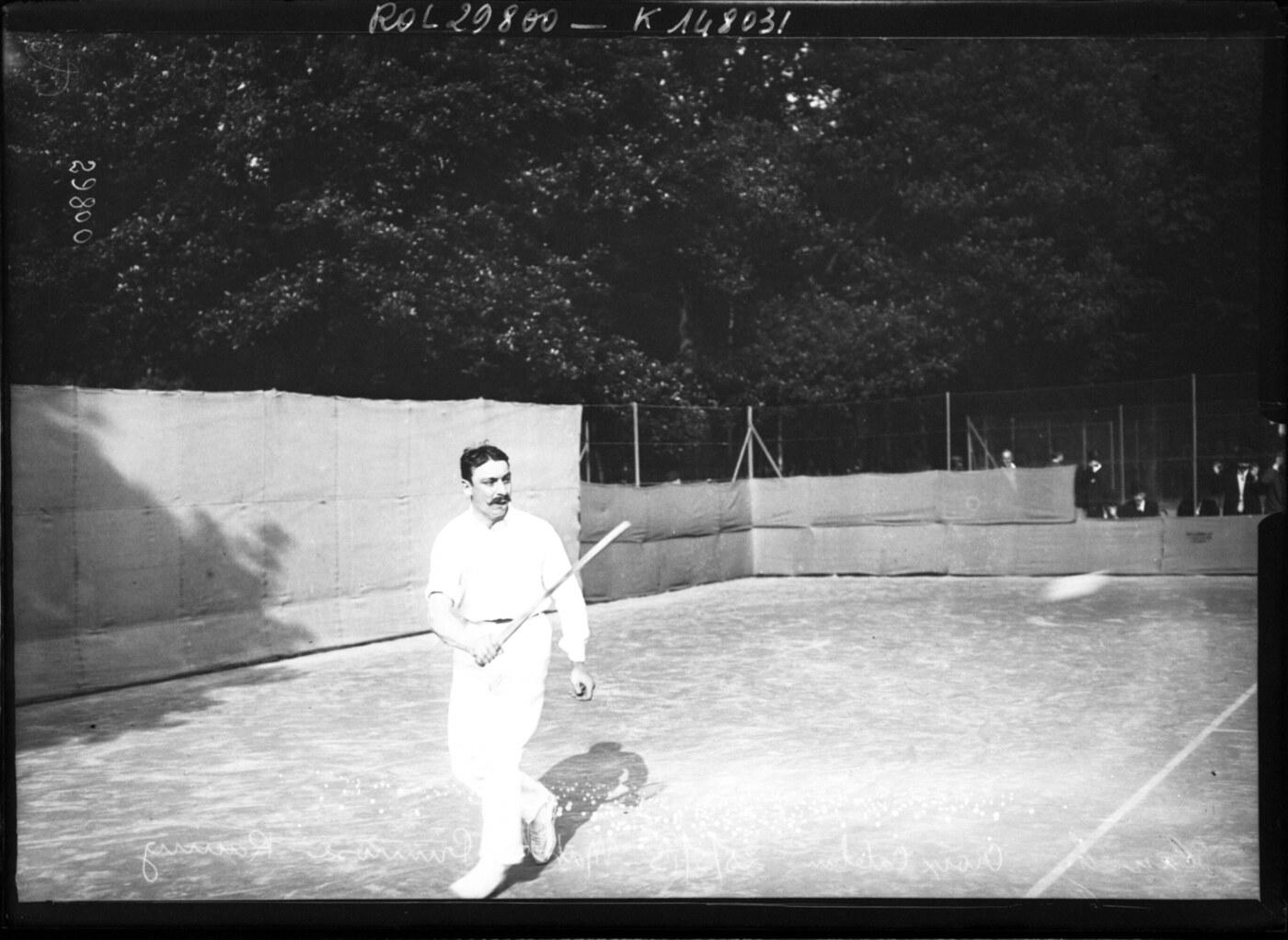
Second image: "25-5-13, Croix-Catelan, match (Villa) Primrose-Racing, Blanchy (tennis)", Agence Rol, 25 May 1913, BnF (btv1b6925297z), public domain, via Wikimedia Commons. It shows the same ground nine years earlier — canvas windbreaks instead of stands, and perhaps a dozen spectators standing at the far fence. It is a club match, not the championship. Its handwritten caption is likewise mirrored.
Press-agency plates carry the filing date rather than, necessarily, the date of play; both captions here are internally dated and consistent with the events described.















































 expand_more