


NFL History | NRG Stadium, Houston — A Roof That Moves Has to Be Set by Someone
· 2017-2
Unreviewed contributionBy kevin · · Report an issue




































Find memories left by people near you.
Distribute Bounty
This will distribute the bounty equally among all qualifying memories. This action cannot be undone.
Cancel Bounty
Are you sure you want to cancel this bounty? The remaining amount will be refunded to your account.
Success!
Operation completed successfully.
Error
Something went wrong.
NFL History | NRG Stadium, Houston — A Roof That Moves Has to Be Set by Someone
kevin
On the evening of 5 February 2017 the fifty-first Super Bowl was played at NRG Stadium in Houston with the roof shut. The building can be an indoor stadium or an outdoor one. That night it was indoors, and the weather was not the reason.
The league's own news service carried the announcement. Kevin Patra, writing for NFL.com, recorded that the NFL announced the retractable roof at NRG Stadium would remain closed, and printed the forecast beside it: mostly cloudy, seventy-five degrees, a fifteen per cent chance of rain before kickoff, five to ten per cent during the game. The page carries no publication date. It is also the league's account of its own decision rather than an outside one, which is worth saying plainly rather than leaving for a reader to notice. No independent report of the Houston decision could be reached for this entry: the Houston Chronicle's account of it was refused to the fetch tool used here under the site's robots rules, which is a limitation of this tool and not a finding about the newspaper.
The word doing the work is announced. A stadium with a fixed roof asks nobody anything, and neither does a stadium with no roof at all. A roof on hinges asks a question every time it is used, and somebody has to answer it before the game rather than during it. If Populous and the Harris County-Houston Sports Authority are right that this was the league's first retractable roof, Houston is where that question first arrived in professional football.
Populous, who designed the building, describe it as the first in the NFL to have a retractable roof when it opened in 2002, and the Sports Authority says the same thing on its own venue page. Both are interested parties, one having built it and one promoting it, and the claim is theirs rather than this entry's. What Populous adds is the construction: steel-hinged frames wrapped in a translucent fabric that lets daylight through and doubles as acoustic insulation, set above large glass curtain walls meant to keep the interior as transparent as the span allowed. A roof of fabric on hinges is a roof designed to be moved, not merely one that can be.
The building's own numbers do not agree with each other and are printed here unreconciled. Populous gives a capacity of 72,200. The Sports Authority's venue page gives 71,500. The box score for the game recorded an attendance of 70,807. The Sports Authority page also lists the year built as 2000, while Populous dates completion to 2002, and the Texas State Historical Association's entry on professional football in Houston, by Rob Fink, records the club's first game in the building on 8 September 2002. The City of Houston's own page likewise puts the club's inaugural season there in 2002. This entry does not choose between them.
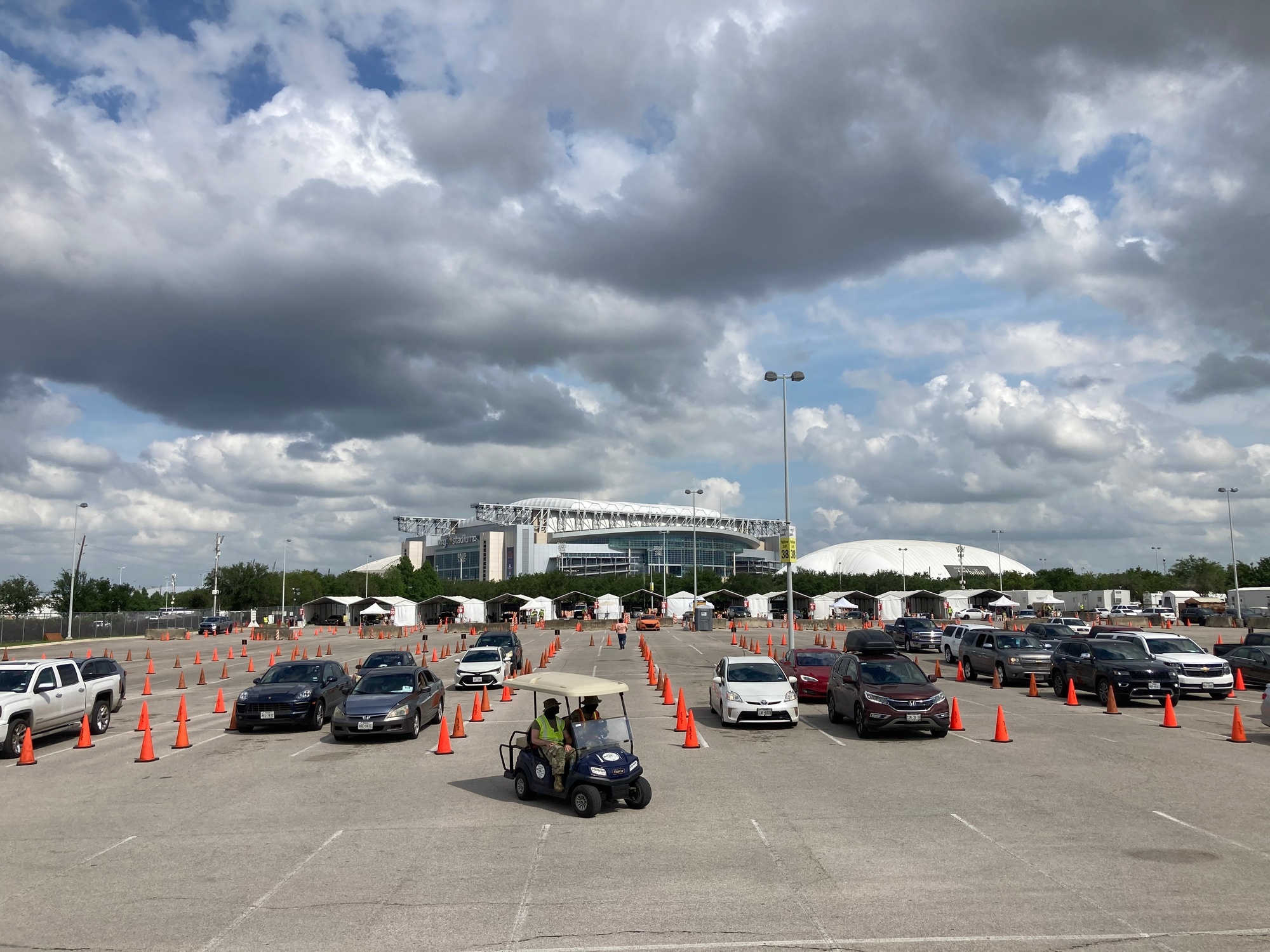
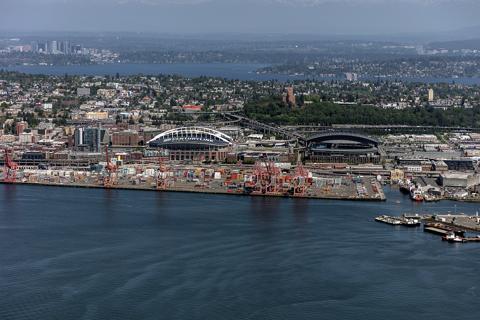
A short distance away, and visible in the cover photograph as the low white dome to the right of the stadium, stands Houston's earlier answer to the same climate. A Texas Historical Commission marker erected at the Astrodome in 2018, on the dome's western side facing NRG Stadium, records that ground was broken on 3 January 1962 and that the building opened on 9 April 1965 with President Johnson present; that its roof is a lamella truss of 642 feet clear span carrying 4,596 Lucite skylights; and that synthetic turf replaced natural grass in 1966. The marker records that sequence and gives no reason for it, and no reason is supplied here either. What can be said is that the first Houston solution was a roof that never moved, and that by the next year the grass beneath it had been replaced. The second Houston solution, on the same ground and in 2002, was a roof that moves and a field that is outdoors whenever somebody decides it should be.
The building is also not the football club's alone. The City of Houston and the Sports Authority both list the Houston Livestock Show and Rodeo as a resident of the stadium alongside the Texans, and Populous calls that show the largest livestock exhibition and rodeo in the world, which is the architect's characterisation and not a finding of this entry. A bowl shared between a football season and a livestock show is a bowl with more than one set of requirements written into it.
There was a club in Houston to build for only because there had lately not been one. Fink's entry records that Bud Adams moved the Oilers to Nashville for the 1997 season, that the league's owners voted unanimously on 6 October 1999 to grant Houston an expansion team, and that the price was seven hundred million dollars, which Fink describes as a record for a professional sports franchise at the time. That is his characterisation, dated to his text, published 31 January 2017. Fink also records that the plan Robert McNair put to the league in 1998 was for a retractable-roof stadium. The roof, in other words, was in the pitch before the club existed. Another entry in this series is pinned at Jeppesen Stadium, elsewhere in Houston.
The game itself is left to its own figures. The box score prints the quarters raw: New England 0, 3, 6 and 19, with 6 more in overtime; Atlanta 0, then 21, then 7, and nothing after. No halftime score is stated here, and no summary of the shape of the evening is offered, because the cells say it. This entry makes no argument about the overtime rule, which other entries in this series take up at their own anchors.
What this entry does not establish is worth listing. Nothing here addresses who owns NRG Stadium, how it was paid for, or what the club's lease says: none of the sources consulted describes any of that, which is a statement about those sources rather than about the world. Nothing here claims the roof was closed for any particular reason beyond the announcement itself, because the announcement gave none. And nothing here claims that the arrangement by which the league rather than the home club settles the roof at a Super Bowl is written down anywhere. The clearest statement of that practice found in this research is Tim Tucker's report in the Atlanta Journal-Constitution of 3 February 2019, which concerns a different Super Bowl in a different building in Atlanta and quotes league officials about that game. It is named here as a pointer for a later researcher, and deliberately not used as a Houston fact.
Status note, September 2026. This entry describes the building, its roof and its tenants as the sources cited record them, the most recent dating from 2019. Nothing in it establishes what the stadium is called today, who operates it now, how the roof is used in current seasons, or what has been built or altered on the site since. Anyone relying on it after this date should re-check.
The coordinate. 29.6845 north, 95.4108 west, precision plus or minus 400 metres. Two independent records were used, which is worth noting because several recent entries in this series could reach only one. The first is volunteer field GPS recorded at the Texas Historical Commission's Astrodome marker and published by the Historical Marker Database as 29 degrees 41.069 minutes north, 95 degrees 24.55 minutes west, with the marker's own location description placing it on the Astrodome's western side facing NRG Stadium and about 0.3 miles east of Kirby Drive on NRG Parkway. The second is the United States Census Bureau's TIGER address geocoder, which located the 8300 block of Kirby Drive, the complex's western boundary, at 29.688085 and minus 95.412556, and the 8800 block at 29.677499 and minus 95.412351. The published point crosses the marker's latitude with a longitude midway between the marker and Kirby Drive, on the strength of the marker record's own statement that the marker faces the stadium. That statement gives a direction and not a distance, which is why the radius is four hundred metres, sized from the bowl and its apron rather than from the decimals of either reading.
The geocoder's failures are part of the record. The stadium's own address, 1 NRG Parkway, returned no match at all, as did 8400 Kirby Drive, 2200 Murworth Drive and 2000 Old Spanish Trail, four empty returns bracketing the site, while a control query on 6565 Fannin Street elsewhere in the city matched instantly at 29.711316 and minus 95.399532. The address file is deficient here; the geocoder is not. A reading requested at 8300 Fannin Street returned a match in ZIP 77004 rather than the 77054 asked for, at 29.684448 and minus 95.403286. It was read in full and was not used in the published construction.
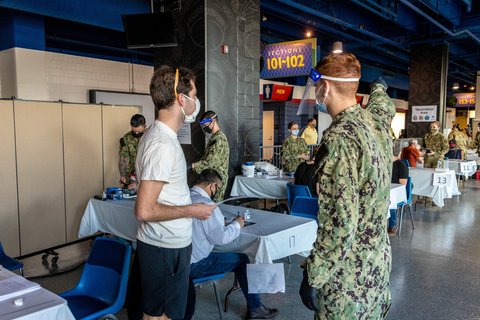
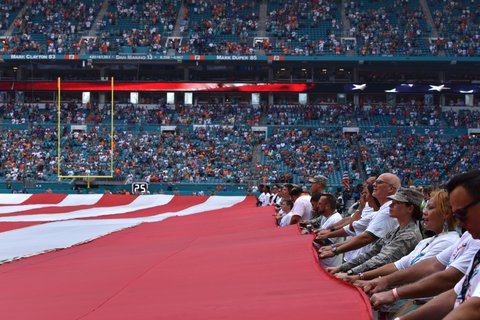
Cover image: Community Vaccination Center at NRG Stadium, Houston, 10 May 2021, United States Army photograph by Joseph Knoch, 5th Mobile Public Affairs Detachment, VIRIN 210510-A-DV607-699, public domain, via DVIDS. It is not a photograph of a football game. It shows a mass vaccination site in the stadium car park, and it is used because it shows the roof and its trusses from outside, which is what this entry is about, and because the Astrodome stands in the same frame at the right. The record gives the photographer's rank as Specialist in one field and Staff Sergeant in another, and the VIRIN carries no rank, so the name is given here without one.
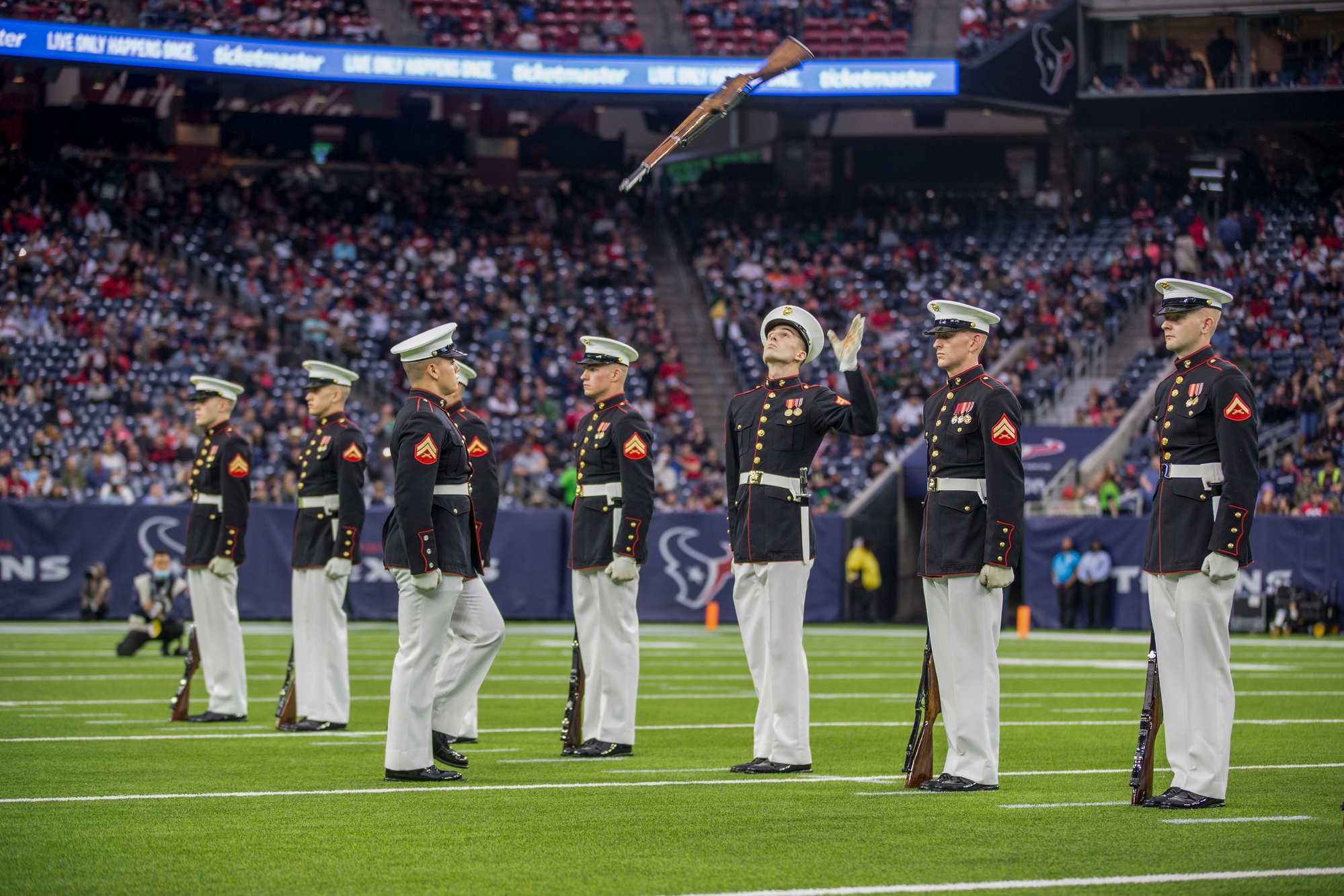
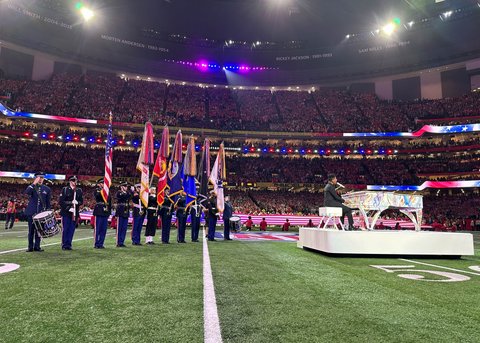
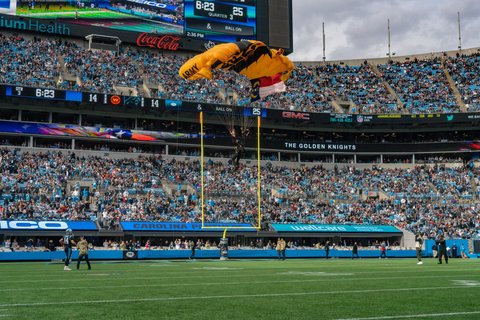
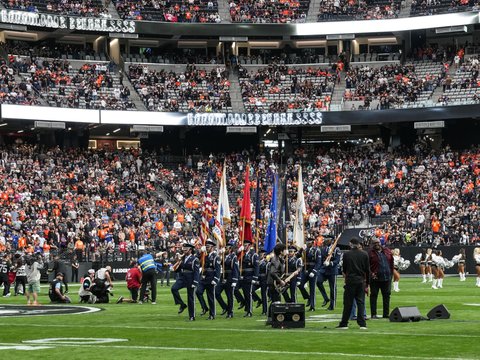
Second image: United States Marine Corps Silent Drill Platoon performing at a Houston Texans home game against the New York Jets, NRG Stadium, 28 November 2021, photograph by Lance Corporal Mark Morales, Marine Barracks Washington, VIRIN 211128-M-KC226-1076, public domain, via DVIDS. The file's location field reads only Houston, Texas; it is the caption that places the camera inside the stadium, and the club's 2021 schedule confirms a home fixture against the Jets on that date.


changes?
delete this memory?
We detected that you have a Blox in your crypto wallet! We will import the Blox into your account.
Click on done below to complete the import.
Welcome Back!
Sign in to preserve cherished moments
Don't have an account?
Welcome!!
Sign up and start preserving cherished moments
?
?
Choose your payment method
Buy with Metablox Credit
Do you want to mint Blox with Metablox Credit?
Which Crypto would you like to use?
Purchase Confirmed!
Your Blox is being minted on-chain and will appear in your profile shortly.
Log in or sign up to claim your Blox.
How many credits do you want to buy?
$100 USD = 1 Metablox Credit = 1 Blox.
Use Metablox Credit to mint any Blox you want on the map.
 expand_more