


Military History | Birdoswald Granaries — The Timber Building on the Robbed Walls
· 1987
Unreviewed contributionBy kevin · · Report an issue














































Find memories left by people near you.
Distribute Bounty
This will distribute the bounty equally among all qualifying memories. This action cannot be undone.
Cancel Bounty
Are you sure you want to cancel this bounty? The remaining amount will be refunded to your account.
Success!
Operation completed successfully.
Error
Something went wrong.


Military History | Birdoswald Granaries — The Timber Building on the Robbed Walls
kevin
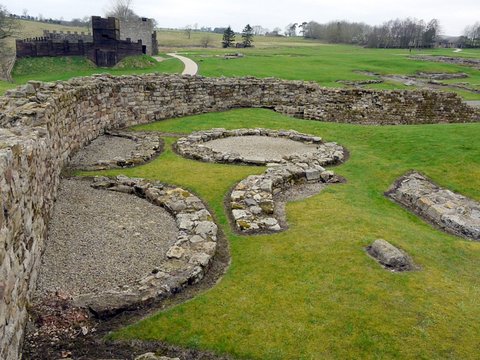
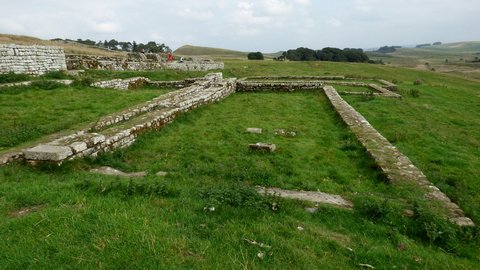
The 1987 season at Birdoswald opened the ground in front of the farmhouse and found the fort's two granaries, standing side by side along the via principalis. Historic England's research record gives each as 26.8 by 10.4 metres and dates them to about AD 205-8. They were built as granaries are built, stone floors carried on sleeper walls with air moving underneath, to keep grain dry for a cohort a thousand strong, the cohors I Aelia Dacorum.
What the excavation found was what became of them after the grain stopped arriving. In the late fourth or early fifth century the south granary was put to another use and a hearth was set at its western end; high-quality finds and a Theodosian coin lay around it. The north granary's roof came down and its walls were robbed for stone. Postholes were then cut into those robbed walls and a timber building was raised on them, with its stone floor relaid. A second timber building followed, set partly across the street so that it stood facing the west gate.
What to call them is not settled. The excavator's report says timber building; English Heritage says hall-type buildings; the scheduling text says early medieval hall. English Heritage reads the occupants as a garrison that "perhaps became more akin to a war band, possibly even a small local chiefdom", and puts the end of the sequence no later than about 520, hedged at every step. All of it rests on one excavator's report, Tony Wilmott's, which English Heritage's account, the scheduling text and Historic England's research record each cite rather than corroborate.
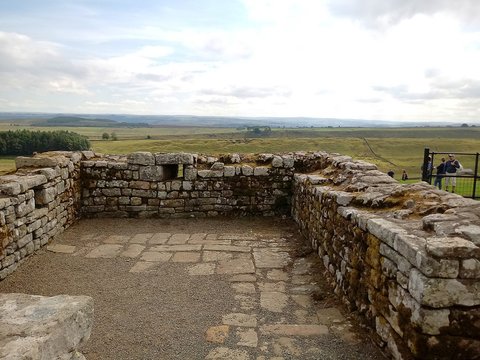
The granary walls stand consolidated and open today. Modern timber posts mark where the posts of the vanished building stood.
📸 Cover: the two granary blocks with the alley between them, the modern marker posts at left standing on the site of the later timber building; photograph by Michael Garlick, 12 August 2024, CC BY-SA 2.0 via Geograph Britain and Ireland and Wikimedia Commons. Second image, the granary sleeper walls and ventilation channels with the marker posts among them; same photographer, same day, same licence.


changes?
delete this memory?
We detected that you have a Blox in your crypto wallet! We will import the Blox into your account.
Click on done below to complete the import.
Welcome Back!
Sign in to preserve cherished moments
Don't have an account?
Welcome!!
Sign up and start preserving cherished moments
?
?


Choose your payment method
Buy with Metablox Credit
Do you want to mint Blox with Metablox Credit?
Which Crypto would you like to use?
Purchase Confirmed!
Your Blox is being minted on-chain and will appear in your profile shortly.
Log in or sign up to claim your Blox.
How many credits do you want to buy?
$100 USD = 1 Metablox Credit = 1 Blox.
Use Metablox Credit to mint any Blox you want on the map.
 expand_more