


NFL History | Texas Stadium, Irving — A City Built It and the Fans Paid First
· 1971-10
Personal memoryBy kevin · · Report an issue


































Find memories left by people near you.
Distribute Bounty
This will distribute the bounty equally among all qualifying memories. This action cannot be undone.
Cancel Bounty
Are you sure you want to cancel this bounty? The remaining amount will be refunded to your account.
Success!
Operation completed successfully.
Error
Something went wrong.
NFL History | Texas Stadium, Irving — A City Built It and the Fans Paid First
kevin
Texas Stadium is remembered for the hole in its roof, and the hole is worth explaining, but it is not what the building was for. The more durable fact about the place is who paid for it, and in what order the money arrived.
The stadium opened on 24 October 1971, and the Dallas Cowboys beat the New England Patriots 44-21 in the first game played in it. The Pro Football Reference box score for that date records the same result the Dallas Morning News does, along with a line score of 10, 24, 0 and 10 for Dallas against 7, 0, 0 and 14 for New England, and a two o'clock start. Both sets of quarters sum correctly to the final figures.
The club did not build it. The City of Irving did, through revenue bonds, and the Austin Chronicle's survey of professional venues and the University of North Texas Libraries' Southwest Metroplex material agree on both the owner and the instrument. The Chronicle gives the cost as thirty-five million dollars and names the City of Irving as the venue owner. UNT's account says simply that Irving financed the stadium through revenue bonds.
Alongside the municipal issue there was a second, stranger transaction, and it is the one that makes this building an ancestor rather than an ordinary piece of civic infrastructure. The Dallas Morning News describes fans buying bonds to pay for construction, and calls Texas Stadium the first stadium in the country funded that way, adding that the arrangement is now known as a personal seat licence. Both halves of that need narrowing before they are repeated. The claim is not that this was the first stadium the public helped pay for, which would be false many times over; it is the narrower claim that this was the first whose construction was funded by selling the public bonds that carried an entitlement to buy season tickets. And the equation with the personal seat licence is the newspaper's, not this entry's.
There is a real gap here that no source read for this entry closes. The city's revenue bonds and the fans' seat bonds may have been one instrument or two. UNT and the Austin Chronicle describe municipal revenue bonds; the Dallas Morning News describes fans buying bonds. Whether Irving sold its revenue bonds directly to the public with a ticket entitlement attached, or ran a separate seat-option issue beside them, is not established by anything consulted. The tidy sentence that merges the two would be the wrong one, so it is not written.
The ownership split is worth stating plainly because it explains a common confusion. Irving held title; the Cowboys kept the stadium's revenues and paid the city an annual fee, which the Austin Chronicle puts at nearly one and a half million dollars in 1995. The Irving Convention and Visitors Bureau describes the stadium as owned by the Dallas Cowboys, and it is easy to see why: the club controlled the money the building generated for its entire life. Control of the gate is what the public remembers as ownership.
Read backward, this is one long story about a sport that could not build for itself. The Green Bay club passed a hat at an unfenced park because it had no gate to sell. The Bears rented a baseball club's outfield for fifty seasons. The first American Football League game was played in the leftovers of a dead ballpark, and the first AFL championship on a school district's field, under the school district's rules. By 1971 the arrangement had not ended; it had acquired a bond issue. Renting went to the capital markets.
Two later buildings on this platform run the idea forward. Ericsson Stadium in Charlotte was paid for by selling the right to buy a ticket, and Joe Robbie Stadium was sold by the seat and guaranteed by its owner. Texas Stadium is an ancestor of that idea and should be read as one, but the instruments are not the same and the difference matters: a bond is repaid to the person who bought it, and a personal seat licence is not.
The roof has two published explanations and this entry names both rather than choosing. The Dallas Morning News describes the opening as the result of abandoned plans for a retractable roof. UNT's account says the roof was designed to retract but the structure could not carry the weight. The second explanation is the more specific one and it is also the one that rests on a single source.
Capacity comes in two figures from two moments. A Fort Worth Star-Telegram caption dated 31 May 1970, written while the building was going up, gives sixty-five thousand. UNT gives 65,675 as the final figure. Those are a projection and a completed count, not a contradiction, and they are printed here as what they are.
The club's record in the building is genuinely unreconciled between sources. Pro Football Reference's stadium page gives 313 games, a regular-season record of 197-94 and a post-season record of 16-6, across 1971 to 2008. The Dallas Morning News gives 219-99 and sixteen post-season games. Adding Pro Football Reference's two lines produces 213-100, which matches neither the newspaper's figure nor a rounding of it, and nothing read here explains the gap. The span is also counted two ways: 1971 through 2008 inclusive is thirty-eight seasons, while the elapsed distance between those years is thirty-seven, which is the number the newspaper prints. Both counts describe the same building.
One line about the roof has attached itself to the stadium and it should be handled carefully. The Dallas Morning News attributes to the linebacker D.D. Lewis the observation that the hole exists so that God can watch his favourite team, and the newspaper itself hedges the attribution, printing that he is said to have famously quipped it. It is repeated here as a paraphrase with the hedge intact, because a line that reaches us through that many hands is not a quotation.
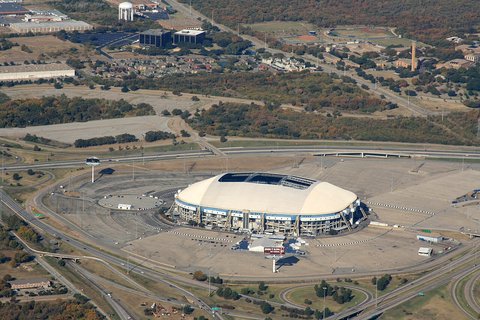
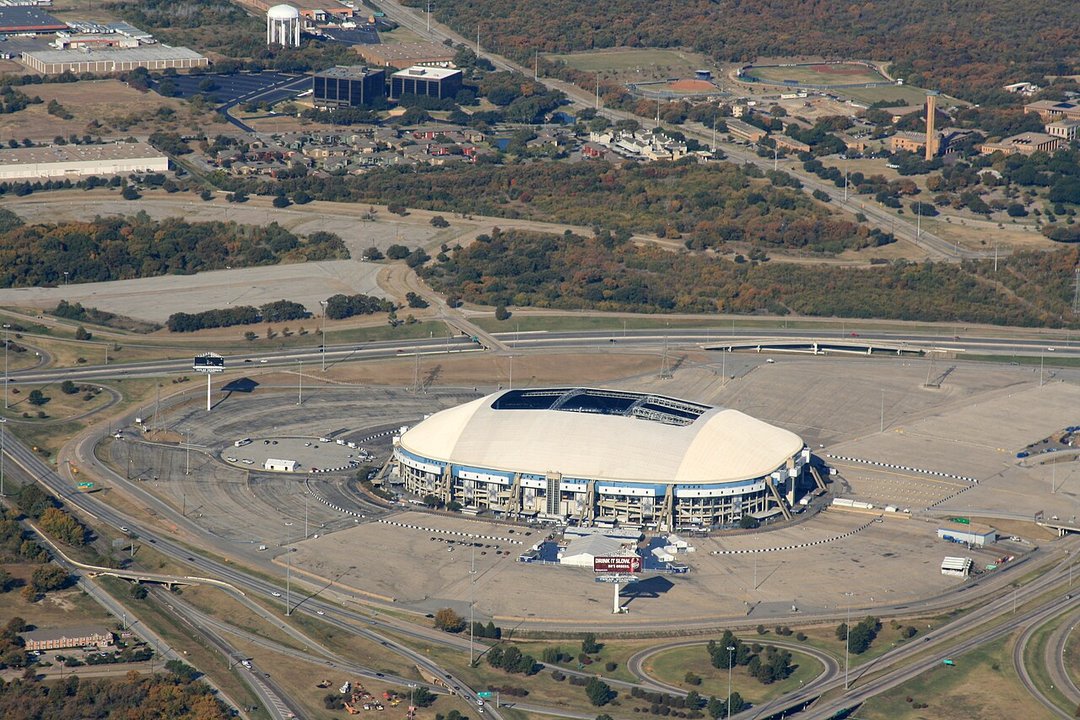
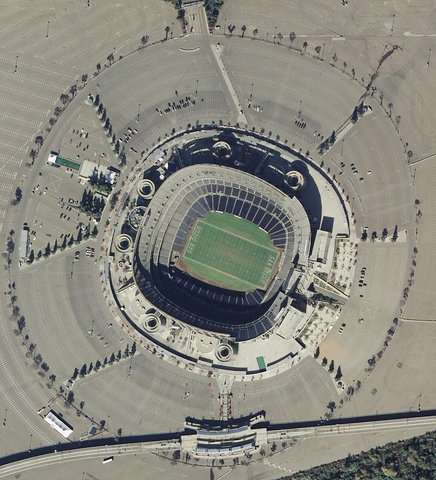
Texas Stadium was demolished in 2010. The site sits inside a freeway interchange, and what is most striking in an aerial view of the building's last years is not the roof at all but the parking, which occupies several times the footprint of the stadium it served.
Coordinate. The pin is at 32.83977 north, 96.91091 west, with a precision radius of 120 metres. Two independent methods agree. The published gazetteer value for the stadium gives 32.839769, -96.910911. Photographer GPS tags from two separate Wikimedia contributors give 32.839861, -96.911172 and 32.84051, -96.91143, about seventy metres apart from each other, which is what makes them genuine per-photograph tags rather than one published number copied twice; the nearer of them sits about twenty-six metres from the gazetteer value. The United States Census TIGER geocoder was tried and is disclosed here as a failure rather than folded into the average: asked three separate ways for 2401 East Airport Freeway it returned 2401 West Airport Freeway every time, an error of about 6.2 kilometres, and 2401 Texas Stadium Circle returned no match at all. The 120-metre radius is sized from the footprint of a stadium of this size, not from the number of decimal places available.
Cover image: an aerial photograph of Texas Stadium by the Wikimedia contributor Allspamme, own work, dated 11 February 2008, licensed CC BY-SA 4.0. The opening in the roof is the subject of the frame, and the surrounding parking apron and the freeway interchange around it are both visible.
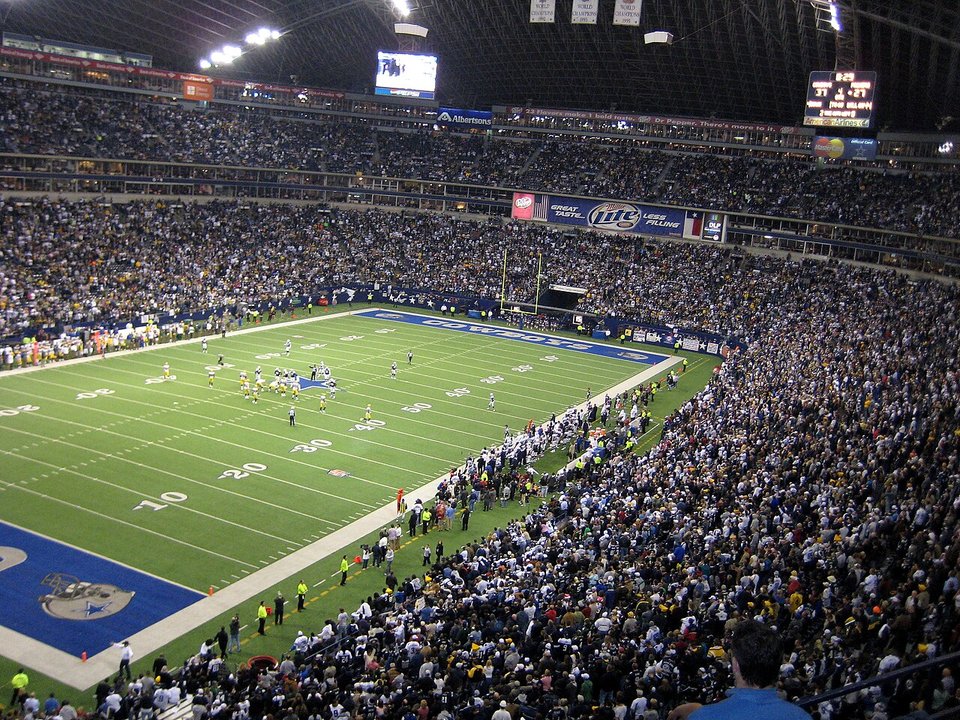
Second image: a photograph of a Cowboys game against the Green Bay Packers by the Wikimedia contributor grantlairdjr, licensed CC BY 2.0. It shows live play under the roof, with the interior of the opening and the club's championship banners along its edge. The image also independently confirms its own result, since the scoreboard in frame reads 37-27. Its date is unsettled: the file's embedded camera metadata gives 29 November 2007 and the Wikimedia description gives 30 November 2007, and neither is preferred here.

changes?
delete this memory?
We detected that you have a Blox in your crypto wallet! We will import the Blox into your account.
Click on done below to complete the import.
Welcome Back!
Sign in to preserve cherished moments
Don't have an account?
Welcome!!
Sign up and start preserving cherished moments
?
?
Choose your payment method
Buy with Metablox Credit
Do you want to mint Blox with Metablox Credit?
Which Crypto would you like to use?
Purchase Confirmed!
Your Blox is being minted on-chain and will appear in your profile shortly.
Log in or sign up to claim your Blox.
How many credits do you want to buy?
$100 USD = 1 Metablox Credit = 1 Blox.
Use Metablox Credit to mint any Blox you want on the map.
 expand_more