NFL History | Municipal Stadium Site, Kansas City — The Referendum That Moved a Club Before the Rule Existed
volume_up
Listen
directions
Directions
The league's own explanation for why clubs left their old grounds is a rule. After the 1970 merger it required a home stadium seating at least fifty thousand, and that clause is why Wrigley Field, War Memorial Stadium and Metropolitan Stadium stopped hosting professional football. Kansas City is the place where that explanation does not work.
Jackson County voters had already decided. On 27 June 1967 — three years before the merger, and before the rule existed — they approved a $102 million general-obligation package. The sports-complex proposal took 69 per cent against a 66.7 per cent supermajority requirement and carried all twenty-five wards, one of them by 1,326 votes to 1,312. The complex was priced at $43 million on 384 acres in the Leeds district, eight miles east of downtown, with Kivett & Myers as architects. A rolling roof to cover both stadiums, costed at roughly $8 million more, was never built.
What the county chose is the part worth noticing. The era's default was one multipurpose bowl shared by a baseball club and a football club. Jackson County built two single-sport stadiums instead. Arrowhead opened on 12 August 1972 and Royals Stadium the following year. That is the opposite of the shared-ground tenancy that runs through most of this series, and it was settled at a ballot box, not by a league clause.
So the last professional football game at Municipal Stadium was played by a club that already knew it was leaving, and knew because its neighbours had voted.
That game was on 25 December 1971, an AFC divisional playoff. Miami won 27–24 after 82 minutes and 40 seconds of elapsed playing time, the longest game in league history. Garo Yepremian's winning field goal came 7 minutes 40 seconds into the second overtime — the sixth quarter. Ed Podolak gained 350 all-purpose yards, which remains the playoff record, and returned a kickoff 78 yards after Miami tied the game with about a minute left in regulation. It was around 60°F.
Two details of the kicking are reported inconsistently and are left that way here. KCUR gives Yepremian's winning kick as 30 yards; the club's own account states no distance. Kansas City Magazine describes Jan Stenerud's missed fourth-quarter attempt as a 22-yarder; KCUR calls it a 32-yard attempt that went wide right. Those are not descriptions of the same kick, and neither source is contemporaneous.
The club did not host another home playoff game until 1991.
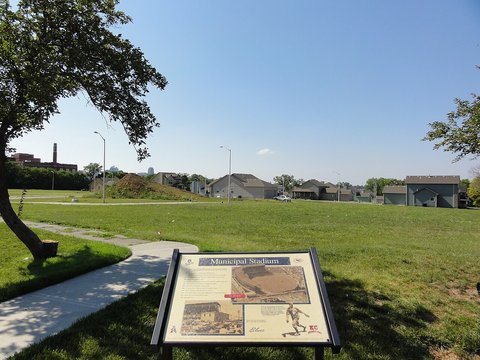
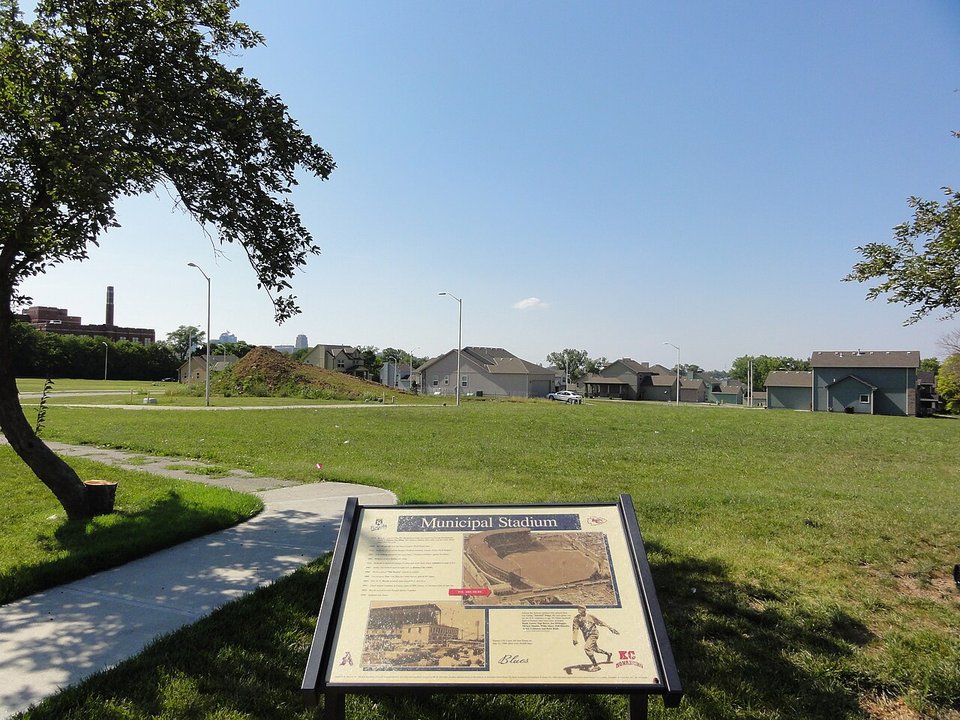
Coordinates 39.085792, -94.556863, precision ±120 m. Two legs: the geotag carried by a 2012 own-work photograph of the site on Wikimedia Commons, and the US Census TIGER geocoder on 2123 Brooklyn Avenue, which returns 39.086575, -94.556574 — 91 metres apart, consistent with the mailing-address-versus-footprint offset that recurs across this series. The published pin covers both legs and the interpretive marker at 22nd and Brooklyn, where home plate stood. Note for anyone re-deriving it: TIGER also returns a decoy match 21 km south, in ZIP 64146; the correct row is 64127.
Cover: *Kansas City Municipal Stadium site, 2012* by Delaywaves, CC BY 3.0, via Wikimedia Commons, photographed 14 June 2012. It shows the site as it is now — mown grass, a paved path and a low interpretive marker — not the stadium and not the game.
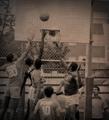
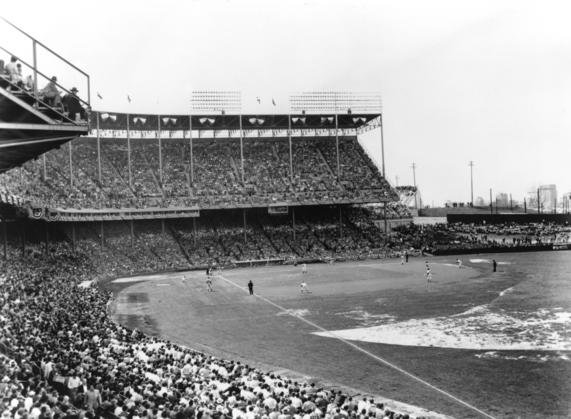
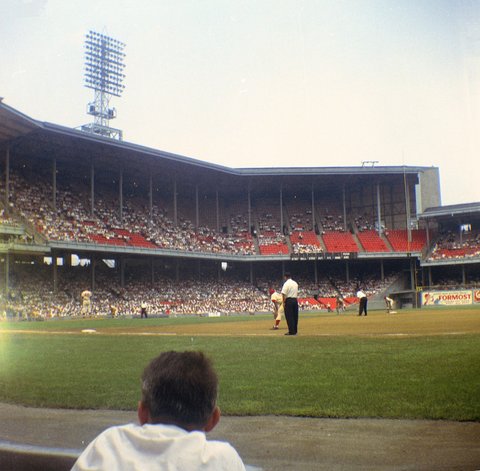
Second image: *Kansas City Municipal Stadium 1955* by Harry Barth, Harry S. Truman Library and Museum, public domain, 12 April 1955. It shows a baseball game, the Athletics' first in Kansas City, sixteen years before the football game described here.





















































 expand_more