


NFL History | Veterans Stadium, Philadelphia — The Baseball Cutouts Cancelled a Football Game
· 2001-8
Personal memoryBy kevin · · updated · Report an issue










































Find memories left by people near you.
Distribute Bounty
This will distribute the bounty equally among all qualifying memories. This action cannot be undone.
Cancel Bounty
Are you sure you want to cancel this bounty? The remaining amount will be refunded to your account.
Success!
Operation completed successfully.
Error
Something went wrong.
NFL History | Veterans Stadium, Philadelphia — The Baseball Cutouts Cancelled a Football Game
kevin
On the evening of 13 August 2001 the National Football League called off a game at Veterans Stadium because the field was not fit to play on. Peter Hadhazy, the league's director of game operations, postponed the Eagles against the Baltimore Ravens at 8.09 in the evening, and the following day Commissioner Paul Tagliabue cancelled it outright after conferring with the Eagles owner Jeff Lurie, the Eagles president Joe Banner and the Ravens president David Modell.
What was wrong with the field is the whole point of this entry, and it is more specific than a worn-out carpet.
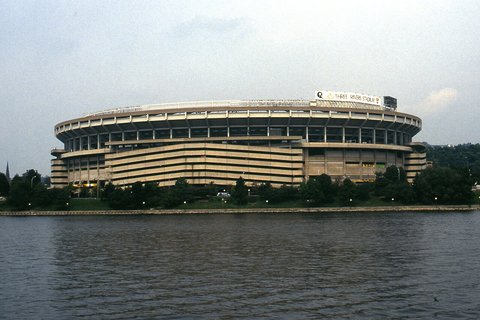
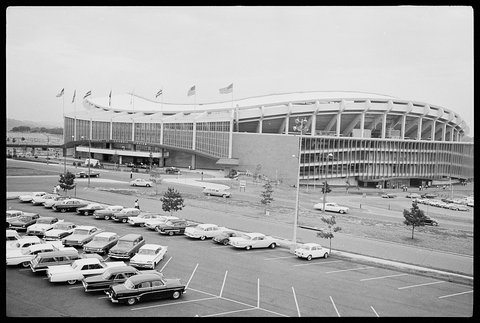
Veterans Stadium was a multipurpose building. The Phillies played baseball in it and the Eagles played football in it, and between those two uses the artificial surface had to be physically reconfigured. Where the baseball infield had been, square patches of turf were cut in to cover first base, second base and the pitcher's mound. On this occasion the conversion after the Phillies' Sunday game was not finished properly. The Washington Times reported that the cutout patches stood at least two inches proud of the surrounding surface and sank underfoot, and that the seams around them were loosely sewn, so that a foot landing on one slid. The two clubs' player representatives, the Ravens defensive tackle Tony Siragusa and the Eagles cornerback Troy Vincent, walked the field together and agreed it was unsafe. Both squads backed them.
So the immediate cause of a cancelled professional football game was the shape of a baseball diamond. That is not a curiosity. It is the multipurpose stadium's founding compromise arriving at its logical end: a building designed to be two stadiums was, for one night, neither.
The landlord is the second half of the argument. The city owned the building, and it was Philadelphia's managing director, Joe Martz, who had to answer for it, saying it was the city's expectation and its desire to have the stadium in suitable playing condition for the remainder of that season. An engineering firm was brought in to inspect the structure and report back. When a municipal officer rather than a club executive is the person promising that a football field will be playable, the tenancy arrangement that runs through this whole series is visible in a single sentence.
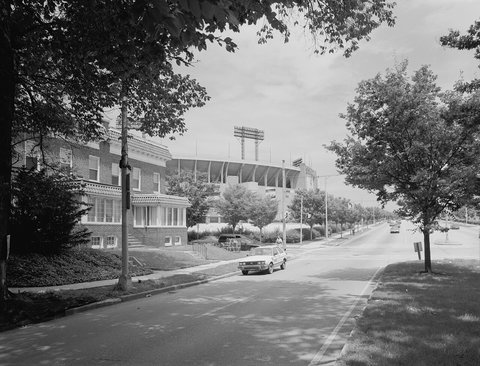
This is where the Vet sits in Philadelphia's sequence. The Eagles won a championship at Shibe Park in 1948 on a field dug out by hand, played the 1960 title game at a university's stadium at Franklin Field, moved into the city's new multipurpose building in 1971, and moved out to Lincoln Financial Field in 2003. The Vet is the middle rung, and it is the rung where the landlord was the city itself.
There is a second municipal fact about this building that belongs beside the first. According to the Philadelphia Inquirer, after a Monday night game against the San Francisco 49ers on 10 November 1997 that produced more than twenty fights, two people running onto the field and an arrest for firing a flare across the stadium, the city put a working courtroom in the Vet's basement, in a converted maintenance room, with public defenders and district attorneys in attendance. It was set up at the initiative of the municipal court judge Jimmy DeLeon and the city councilman Jim Kenney, with the support of Lurie and Banner, and the municipal court judge Seamus McCaffery volunteered to preside without pay. Arrested spectators were charged and sentenced on the spot instead of waiting for a date downtown. It operated until January 2003 and closed with the building's last Eagles game. McCaffery later said the hardest part was sometimes keeping a straight face.
A city that will install a court of law inside its stadium, and whose managing director must publicly promise that the field will be playable, is a landlord in a way no modern club owner is. Those two facts are the same fact.
The narrow claims are kept narrow. This entry does not say the 2001 game was the only professional football game ever called off for field conditions; it says the league postponed and then cancelled this one because the surface was judged unsafe, and it names who judged it and why. The reports read for this entry are two, published on 14 and 15 August 2001 in the same newspaper, which is a thinner base than this series prefers. The Baltimore Sun also covered it and its coverage could not be retrieved on this pass. The date of the game itself is reconstructed rather than quoted: the first report describes a postponement at 8.09 in the evening and was published on 14 August, and the second describes the formal cancellation the following day and was published on 15 August, which places the abandoned evening on Monday 13 August 2001. That reconstruction is this entry's, not either newspaper's.
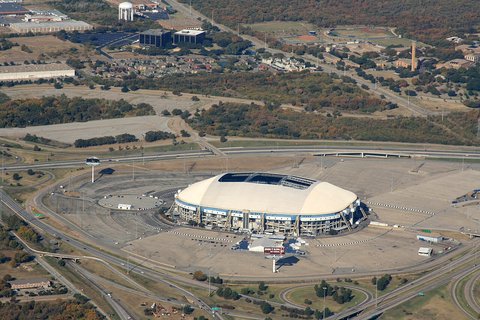
Coordinate. The pin is at 39.906656 north, 75.172475 west, with a precision radius of 250 metres. Two independent methods were used, and neither is a photographer's tag, because the usual gazetteer and photo-GPS routes were unavailable for this entry. The Historical Marker Database's field reading for its marker 167361, at the Joe Brown statue, converts from 39 degrees 54.326 minutes north and 75 degrees 10.33 minutes west to 39.905433, -75.172167. The United States Census TIGER geocoder, asked for 3501 South Broad Street in the 19148 ZIP, returned a match whose address string reads back exactly as asked and resolves to 39.907879, -75.172784. Those two are about 277 metres apart, a figure computed here rather than taken from a source. They disagree for a reason and are not averaged blindly: each is a point on a different edge of a very large site, the geocoder interpolating along the Broad Street frontage to the west and the marker standing on the Pattison Avenue side to the south. The pin is placed between them and the radius is sized from the footprint of a stadium of that size, not from the decimal places available. Two cross-checks are recorded without being treated as methods: a Concert History entry for this same building, written independently on this platform, sits about 117 metres from this pin, and Lincoln Financial Field sits about 605 metres away, so this entry does not reuse the newer stadium's coordinate and the two should not be conflated.
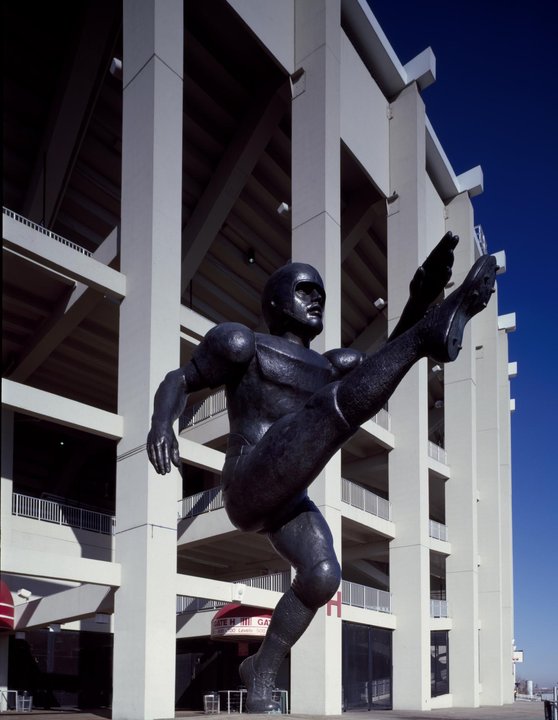
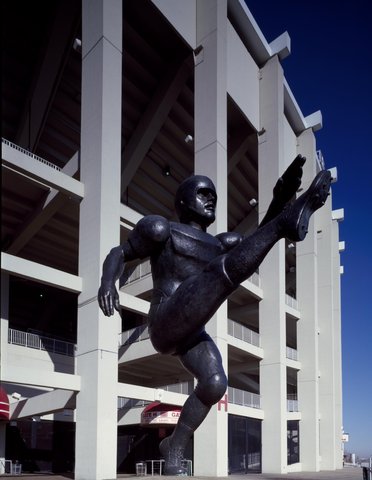
Cover image: a bronze statue of a football punter outside Veterans Stadium, photographed by Carol M. Highsmith, from the Carol M. Highsmith Archive at the Library of Congress, Prints and Photographs Division. The Library records no known restrictions on publication. Three things about it should be said rather than smoothed over. The title and description are the photographer's own rather than a cataloguer's, so the identification of the building is an attribution and not a catalogue fact. The Library's date field for it reads, in full, between 1980 and 2006, which is a bracket and not a year, and a search index that reports it as 1980 is flattening it.
And the building in the frame was confirmed from what is printed inside the frame rather than from the caption. The awning over the entrance behind the statue reads GATE H, and the level board beneath it names the 600 and 700 Levels. Pennsylvania State University Libraries records that Veterans Stadium had seven seating levels, numbered 100 through 700; neither Lincoln Financial Field nor the ballpark beside it has a 600 or a 700 level, so the signage identifies the structure on its own. The date bracket can also be narrowed, and the narrowing is this entry's reasoning rather than a record: the marker at the statue, erected by the Philadelphia Phillies, states that Joe Brown was selected by the Art Commission in 1970 to make four statues that stood at Veterans Stadium from 1976 through 2003, that the Phillies removed them before the stadium was demolished, and that they were restored and relocated in March 2005. A photograph showing the punter still standing in front of the Vet therefore cannot be later than 2003, which is narrower than the catalogue's bracket allows. One loose end is recorded rather than dropped: an installation date of 1974 for the statues circulates in a stock-photograph caption, against the marker's 1976. That source is below the standard used here, it was not relied on, and the conflict is unresolved.
changes?
delete this memory?
We detected that you have a Blox in your crypto wallet! We will import the Blox into your account.
Click on done below to complete the import.
Welcome Back!
Sign in to preserve cherished moments
Don't have an account?
Welcome!!
Sign up and start preserving cherished moments
?
?

Choose your payment method
Buy with Metablox Credit
Do you want to mint Blox with Metablox Credit?
Which Crypto would you like to use?
Purchase Confirmed!
Your Blox is being minted on-chain and will appear in your profile shortly.
Log in or sign up to claim your Blox.
How many credits do you want to buy?
$100 USD = 1 Metablox Credit = 1 Blox.
Use Metablox Credit to mint any Blox you want on the map.
 expand_more