


NFL History | Riverfront Stadium Site, Cincinnati — The Record Is Held in a Unit the Weather Service Retired
· 1982-1
Personal memoryBy kevin · · updated · Report an issue




























































Find memories left by people near you.
Distribute Bounty
This will distribute the bounty equally among all qualifying memories. This action cannot be undone.
Cancel Bounty
Are you sure you want to cancel this bounty? The remaining amount will be refunded to your account.
Success!
Operation completed successfully.
Error
Something went wrong.
NFL History | Riverfront Stadium Site, Cincinnati — The Record Is Held in a Unit the Weather Service Retired
kevin
On 10 January 1982 the Cincinnati Bengals beat the San Diego Chargers 27-7 at Riverfront Stadium and reached their first Super Bowl. Kickoff was at one in the afternoon. The score is the least interesting thing about the day. What the afternoon is remembered for is a single number, a wind chill of fifty-nine degrees below zero, and that number was produced by an index the National Weather Service took out of service in 2001. The record is written in a unit that was retired.
Two of the quantities involved were measured, and are still measured the same way. The air temperature at kickoff was nine degrees below zero Fahrenheit; every source consulted for this entry gives that figure and none of them disagrees. The wind is a different matter. Ohio History Connection, in an account by Todd Jones dated 9 January 2019, says it gusted from twenty to thirty-five miles an hour. Ohio Magazine, in a January 2017 article by Vince Guerrieri, says it was estimated at between twenty-five and thirty. History.com, in a piece by Christopher Klein first published in 2021 and updated in 2025, prints thirty-five-mile-an-hour gusts. Those are three descriptions of one afternoon and this entry does not reconcile them.
The third quantity was never measured at all. Wind chill is computed from the other two, and what the arithmetic is has changed. The National Weather Service put a new wind chill index into service on 1 November 2001, announced in Service Change Notice 01-49, issued in amended form on 2 October 2001, and again in Service Change Notice 01-58, issued on 31 October. Both notices are public documents. The new index was developed by the Meteorological Service of Canada, which had implemented it on 3 October 2001. The notices list what changed: wind speed is now calculated at five feet, the height of a human face, rather than at the standard thirty-three-foot anemometer height; the calculation is built on a model of a human face and on modern heat transfer theory; the calm-wind threshold drops from four miles an hour to three; skin tissue resistance is held to a consistent standard; and solar input is excluded. The notices describe the replacement. They do not name what was replaced, and neither does this entry.
How much difference the change makes to this particular afternoon rests, in the sources consulted, on one line in one article. Ohio Magazine reports that under the post-2001 standard the wind chill at Riverfront Stadium that day was thirty-eight below rather than fifty-nine. That is a single source and it is flagged as one. No recalculation has been performed here.
The consequence shows up as a plain disagreement between two of the better sources on this game. Ohio History Connection calls it still officially the coldest NFL game in history. The Bengals' own account, written by the club's senior writer Geoff Hobson, calls it the second coldest game in NFL history. Neither is careless. They are ranking by different quantities. By air temperature the 1967 title game at Lambeau Field was colder, and Ohio History Connection gives thirteen below for it; that afternoon has its own entry in this series. By wind chill as the index stood in 1982, Cincinnati. The two rankings answer two different questions, and a record book has room for only one answer at a time.
The football, briefly. Jim Breech kicked a thirty-one-yard field goal and Ken Anderson threw eight yards to M.L. Harris in the first quarter; Dan Fouts threw thirty-three yards to Kellen Winslow and Pete Johnson ran in from the one in the second; Breech added a thirty-eight-yarder in the third and Anderson threw three yards to Don Bass in the fourth. Those plays are from the Pro Football Reference box score, and the quarter figures are left as that page prints them. Anderson completed fourteen of twenty-two passes for 161 yards, two touchdowns and no interceptions, a line on which Ohio History Connection and the club agree; Ohio History Connection adds thirty-nine yards rushing, and the club says he played without gloves. Fouts, per the club, completed fifteen of twenty-eight for 185 yards, one touchdown and two interceptions. History.com's account has the Chargers arriving from an overtime win in Miami a week earlier, in eighty-four degrees. On the same day the National Football Conference title was decided at Candlestick Park, which is another entry in this series.
How many people sat through it is also unsettled. Ohio History Connection gives 46,302. Ohio Magazine gives about forty-five thousand. History.com approaches it from the other side and reports that thirteen thousand stayed away from a sixty-thousand-seat stadium. Three shapes, three sources, and no total is computed here.
Status note, September 2026: the coldest-game claim is a live one, and the sources above were read this month. The most recently updated of them was revised in 2025. Nothing here establishes what any league record book prints today.
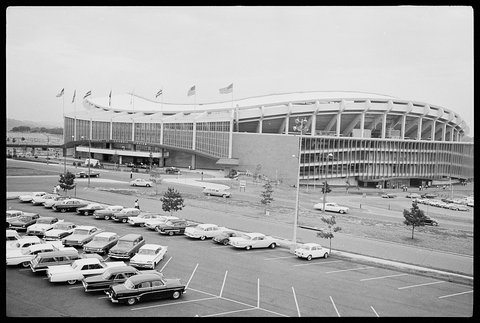
COORDINATE. 39.096583, -84.508704, precision plus or minus 200 metres. Two independent records place the site. The first is a marker at the ground itself, catalogued by the Historical Marker Database as m247804, recording the original location of Riverfront Stadium's home plate; its field reading is 39 degrees 5.795 minutes north, 84 degrees 30.522 minutes west, and the database places it on the first level of the Reds parking garage at the west entrance, listed against 124 East Mehring Way. That is one volunteer-submitted record and is treated as such. The second is the United States Census Bureau's TIGER geocoder, which returns 39.096122, minus 84.508276 for 100 Joe Nuxhall Way, Cincinnati, Ohio 45202. The two lie about sixty metres apart. The same geocoder returns no match at all for 200 Joe Nuxhall Way, which indicates the first result is an address point rather than a position interpolated along a street centreline. The radius is drawn from the building rather than from the marker's decimals, for a specific reason: the marker fixes a baseball home plate, and no source consulted establishes where the football field was laid out inside the same bowl. Two hundred metres is drawn to cover the footprint of the demolished building rather than to assert a precision these two records do not support.
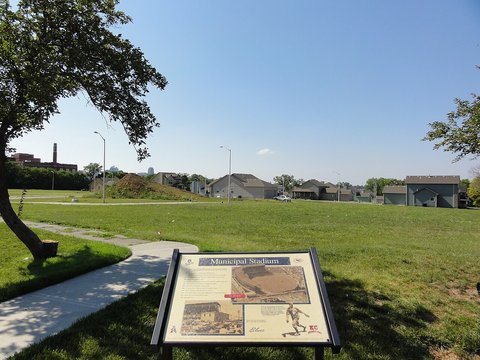
The marker is worth one more sentence. Its inscription names the Cincinnati Reds' tenancy from 1970 through 2002 and lists National League pennants in 1970 and 1972 and World Series titles in 1975, 1976 and 1990. It does not mention football. The physical record left at this spot is a baseball record, in a car park.
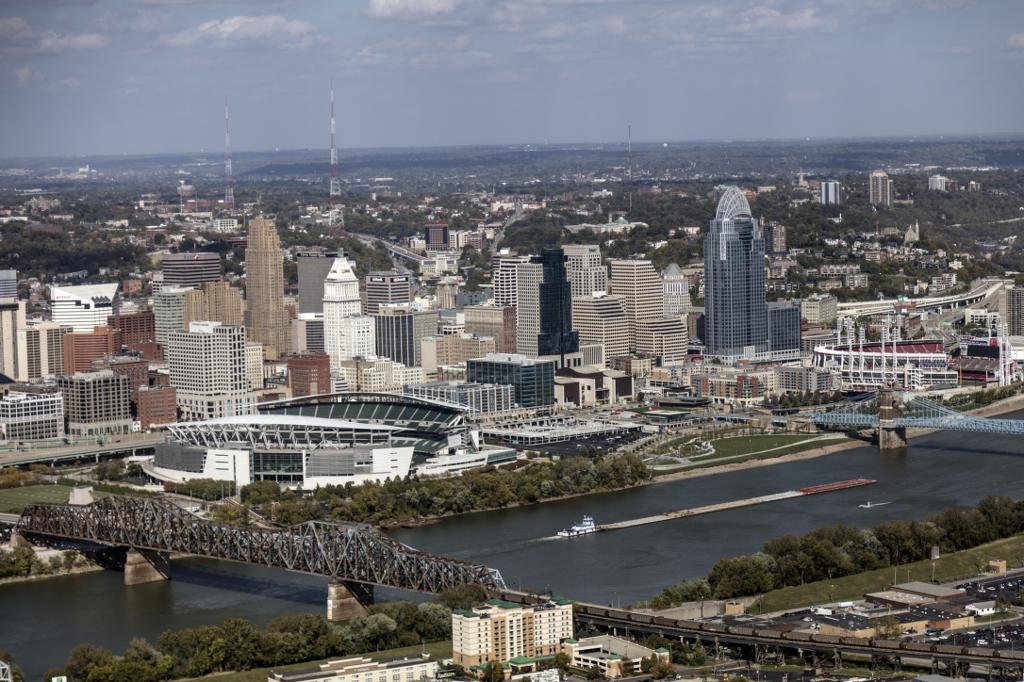
COVER IMAGE. Aerial view of Cincinnati, Ohio, with a focus on the city's professional sports stadiums along the Ohio River, photographed by Carol M. Highsmith on 17 October 2016. Library of Congress, Carol M. Highsmith Archive, Prints and Photographs Division, LC-DIG-highsm-42000, item 2016632818; rights advisory, no known restrictions on publication. It shows the modern football stadium at left with its field visible, the baseball park at right, the Ohio River and its bridges below. Riverfront Stadium is not in the picture. The ground this entry is pinned to lies between the two buildings. The marker records baseball played on it through 2002; the photograph is from 2016.
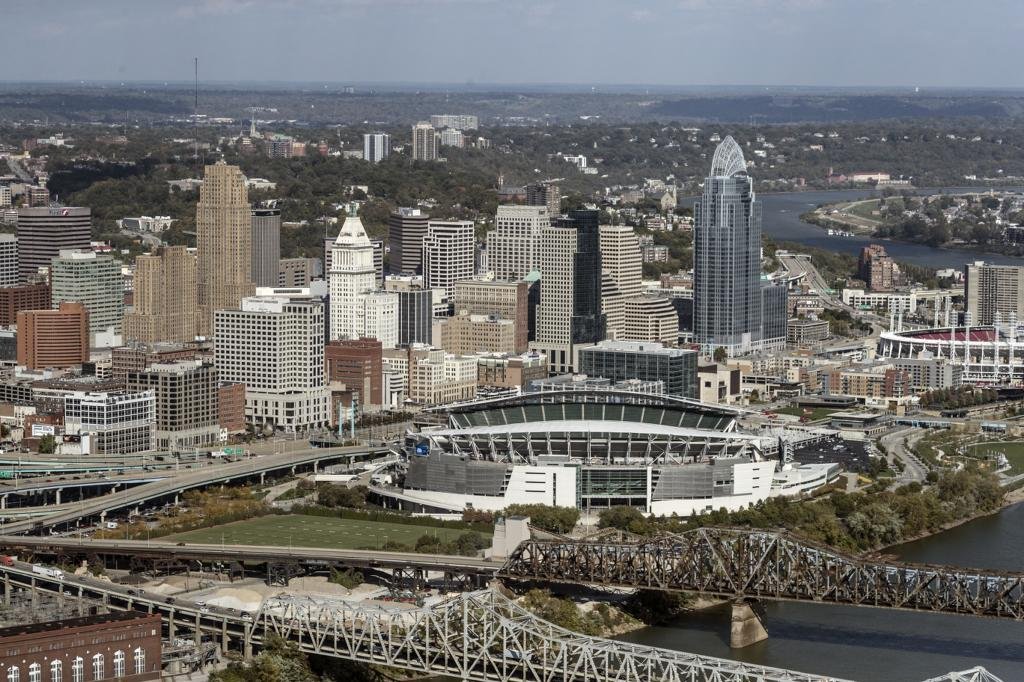
SECOND IMAGE. Aerial view of downtown Cincinnati, Ohio, photographed by Carol M. Highsmith on 17 October 2016. Library of Congress, Carol M. Highsmith Archive, Prints and Photographs Division, LC-DIG-highsm-42060, item 2016632878; rights advisory, no known restrictions on publication. A closer view along the same riverfront, with the football stadium centre and the ball park at right. It is a photograph of the site as it now stands and of nothing that happened in 1982.



changes?
delete this memory?
We detected that you have a Blox in your crypto wallet! We will import the Blox into your account.
Click on done below to complete the import.
Welcome Back!
Sign in to preserve cherished moments
Don't have an account?
Welcome!!
Sign up and start preserving cherished moments
?
?







Choose your payment method
Buy with Metablox Credit
Do you want to mint Blox with Metablox Credit?
Which Crypto would you like to use?
Purchase Confirmed!
Your Blox is being minted on-chain and will appear in your profile shortly.
Log in or sign up to claim your Blox.
How many credits do you want to buy?
$100 USD = 1 Metablox Credit = 1 Blox.
Use Metablox Credit to mint any Blox you want on the map.
 expand_more