
NFL History | Candlestick Park Site, San Francisco — A Ballpark Was Closed In to Make Room for Football
· 1982-1
Unreviewed contributionBy kevin · · Report an issue































Find memories left by people near you.
Distribute Bounty
This will distribute the bounty equally among all qualifying memories. This action cannot be undone.
Cancel Bounty
Are you sure you want to cancel this bounty? The remaining amount will be refunded to your account.
Success!
Operation completed successfully.
Error
Something went wrong.
NFL History | Candlestick Park Site, San Francisco — A Ballpark Was Closed In to Make Room for Football
kevin
On 10 January 1982 the San Francisco 49ers beat the Dallas Cowboys 28-27 on this ground in the National Football Conference Championship Game. Pro-Football-Reference's box score names the venue as Candlestick Park, gives a 4:30pm start, and records the last score of the afternoon as a six-yard touchdown pass from Joe Montana to Dwight Clark in the fourth quarter, with Ray Wersching's conversion. That box score prints no attendance and no weather note, and none is claimed here. The club had finished the regular season 13-3 and first in the NFC West, per its 1981 season page.
The building they won it in was not built for them. It had been altered to hold them, and the alteration is the reason this entry is here.
The Pacific Coast Architecture Database, maintained by the University of Washington Libraries, records Candlestick Park as constructed between 1958 and 1960 to designs by John S. Bolles and Associates, with Chin and Hensolt as structural engineers and Charles Harney as contractor. Its entry gives an original cost of 15 million dollars and an original capacity of 43,765, describes the stadium as originally open on one side, and records the building as owned by the City of San Francisco. The same entry says extensive renovations and additions were carried out in the winter of 1971-1972, that the open side was closed to house the 49ers, and that capacity rose to 58,000 in the expansion. CBS San Francisco, reporting in March 2011, gave the same shape: built in 1960 open-sided for baseball, fully enclosed in 1971-72 for football.
The club's schedule does not sit flat against those dates, and the difference is left standing here rather than smoothed. Pro-Football-Reference's 1970 season page puts every 49ers home game at Kezar Stadium, including the conference championship they lost to Dallas there on 3 January 1971. Its 1971 page puts every home date at Candlestick, from 10 October 1971 onward, and a playoff win on this ground that December. Football was therefore being played here before the winter both accounts of the enclosure point to. No source consulted for this entry says whether the club's first season at Candlestick was played in the open building or the closed one.
What the alteration is said to have done to the site is the part worth keeping. The Pacific Coast Architecture Database's entry states that closing the open side made the wind worse rather than better, describing air swirling inside the bowl; its account of that effect is written around baseball games. Taken at its word, that describes a made condition rather than a natural one: the air moving through this bowl was the weather at Candlestick Point and a wall, and the wall was raised to make room for professional football.
The city was the landlord, and in the building's late years that cost it money. CBS San Francisco reported on 16 March 2011, in a piece carrying reporting by Barbara Taylor, that the Board of Supervisors had unanimously settled a dispute with the club over roughly 60 million dollars in maintenance costs. Under that settlement, as the outlet described it, the club took on repairs and improvements in exchange for a rent reduction and funding from the city, receiving 6.5 million dollars for repairs not previously completed along with further rent credits, under a lease running through at least the 2014 season. Supervisor David Chiu was reported summarising it in the same terms.
Pro-Football-Reference's 2013 season page records the club's last home game here on 23 December 2013, a 34-24 win over Atlanta; all three of that season's playoff games were played away. KQED reported on 30 June 2015, under Lisa Pickoff-White's byline, that demolition had begun in February 2015, that as of 26 June one section was still standing, and that officials had changed their demolition method that January after neighbouring residents objected a planned implosion would spread potentially hazardous dust.
Three results from one source, in one round, are worth setting side by side. Pro-Football-Reference has the 49ers losing the conference championship to Dallas at Kezar on 3 January 1971, losing it to Dallas at Dallas on 2 January 1972, and winning it against Dallas here on 10 January 1982. Another entry in this series is pinned at Kezar Stadium.
A note on currency. This entry describes the site as of its sources. The most recent of them dates from June 2015 and reports a demolition then still in progress; the architecture database entry is written at a still earlier moment, listing the 49ers as current tenants and the ground under a corporate name it later lost. Nothing here states what stands on the site today.
Coordinate. The pin is at 37.71332, -122.38510, the address point the City and County of San Francisco's Enterprise Addressing System records for 490 Jamestown Avenue, tied to assessor's block 5000, lot 002, in a file current to 4 September 2026 when it was read. The United States Census Bureau's geocoder returns 37.714354, -122.388484 for the same address, about 320 metres to the north-west. These are two separately maintained government records answering the same question, and they disagree: the federal file interpolates along a street's address range and returns a point on the roadway, while the city file is tied to a parcel. This entry takes the city's parcel point and states a precision of plus or minus 350 metres, wide enough to contain the federal record as well. No plan of the demolished building was consulted, so that radius is a statement of uncertainty and not a measurement. The site also carries an entry from this platform's baseball vertical, pinned separately.
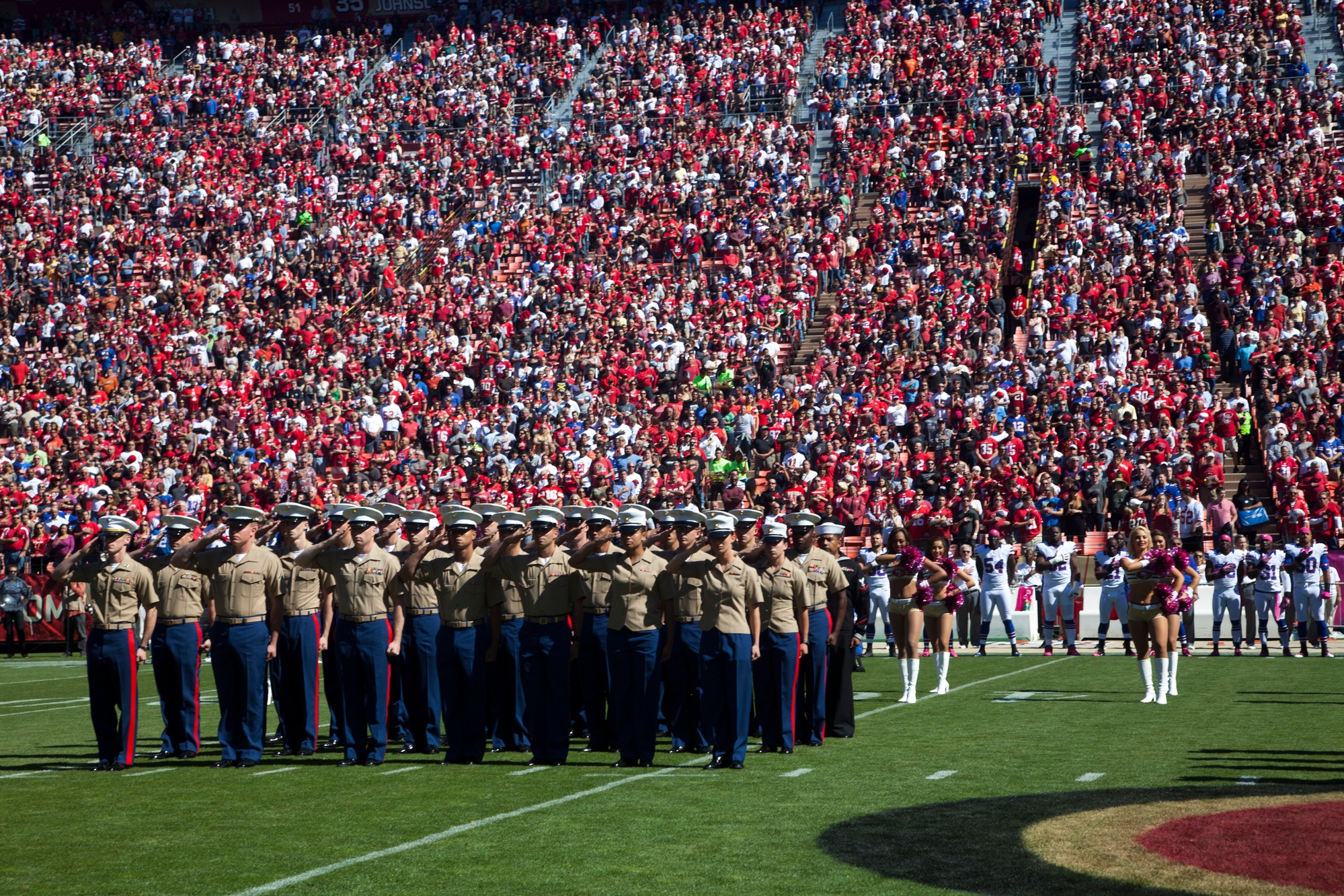
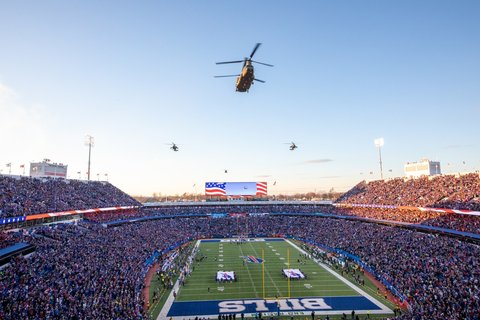
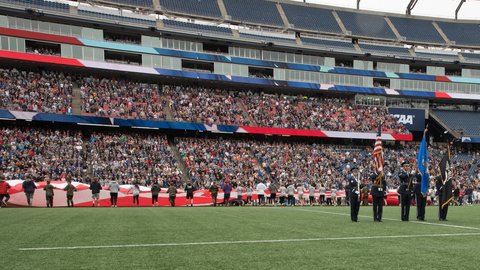
Cover image: US Marines with the 13th Marine Expeditionary Unit stand for the pre-game show at a San Francisco 49ers regular-season game against the Buffalo Bills at Candlestick Park during San Francisco Fleet Week, 7 October 2012. Photograph by Lance Cpl. Catie D. Edwards, 13th Marine Expeditionary Unit, I Marine Expeditionary Brigade; VIRIN 121007-M-BE386-227, via DVIDS. The picture is from a regular-season game more than thirty years after the championship this entry describes, and is used because it shows the seating bowl in the building's last seasons.
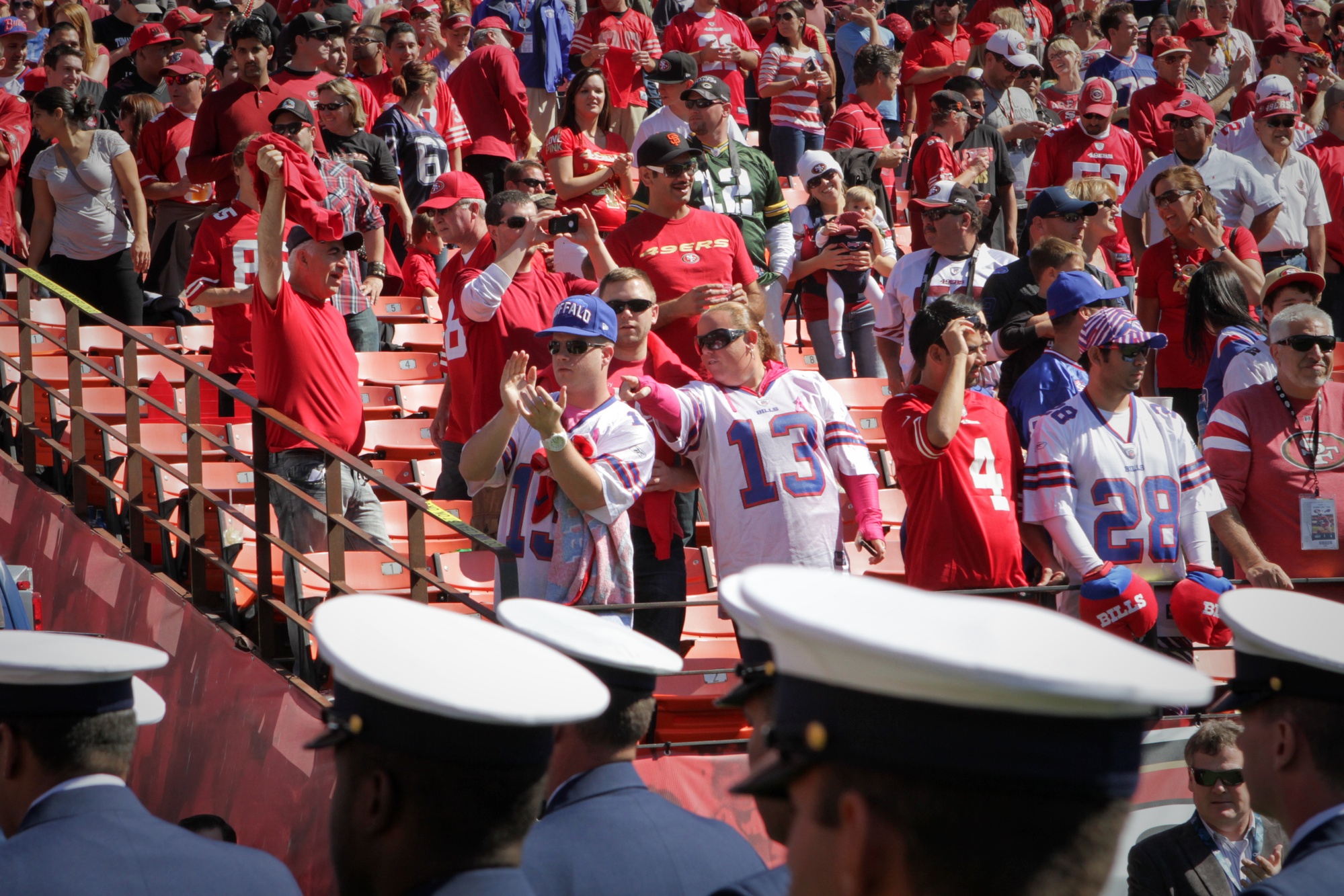
Second image: spectators at the same 7 October 2012 game as the service members leave the field after the pre-game show. Photograph by Sgt. Michael Cifuentes, 1st Marine Expeditionary Brigade; VIRIN 121007-M-XZ164-504, via DVIDS.


changes?
delete this memory?
We detected that you have a Blox in your crypto wallet! We will import the Blox into your account.
Click on done below to complete the import.
Welcome Back!
Sign in to preserve cherished moments
Don't have an account?
Welcome!!
Sign up and start preserving cherished moments
?
?

Choose your payment method
Buy with Metablox Credit
Do you want to mint Blox with Metablox Credit?
Which Crypto would you like to use?
Purchase Confirmed!
Your Blox is being minted on-chain and will appear in your profile shortly.
Log in or sign up to claim your Blox.
How many credits do you want to buy?
$100 USD = 1 Metablox Credit = 1 Blox.
Use Metablox Credit to mint any Blox you want on the map.
 expand_more