NFL History | San Diego Stadium Site, Mission Valley — The Fumble the Rulebook Answered
volume_up
Listen
directions
Directions
Eleven weeks before the Meadowlands, the same season produced the other kind of accident — the kind the rulebook answers. On 10 September 1978 the Oakland Raiders trailed San Diego 20–14 with the game in its last seconds. Ken Stabler, hit as he turned, put the ball on the ground ahead of him; Pete Banaszak moved it further forward; Dave Casper kicked it into the end zone and fell on it as time expired. Errol Mann's extra point made it 21–20. The box score's language is the league's own: an offensive fumble recovery in the end zone.
The Raiders have never much denied the design. Their own account of the play describes Stabler flipping the ball forward, and *Football Zebras*, a publication written by game officials, records Stabler admitting the fumble was deliberate, and the referee Jerry Markbreit saying later that with a better view he would have ruled it an incomplete forward pass.
In the off-season the league legislated. On fourth down, or inside the last two minutes of either half, only the player who fumbled may recover the ball and advance it; a teammate's recovery stands, but the ball returns to the spot of the fumble. The provision has outlived nearly everyone involved in the play that caused it.
Set the two 1978 games beside each other and this vertical's least obvious point appears. Two freak endings, eleven weeks apart, both decided by a ball on the ground. One was answered with a rule, because a club had exploited a gap deliberately. The other was answered with a habit, because no rule can require a quarterback to be sensible. The league legislates against cleverness and trains against carelessness, and only one of those leaves a paper trail.
One small correction to the record-keepers. The club's own retelling places the game at Jack Murphy Stadium. In September 1978 the ground was San Diego Stadium; Jack Murphy's name was not added until 1981, and Qualcomm's not until 1997.
Coordinates 32.783056, −117.119444, precision ±150 m. Wikidata P625 for San Diego Stadium (Q956072) agrees with a cluster of photographs geotagged inside the bowl at a 2012 college game, 63–75 m away — but those images are one photographer on one afternoon and are counted here as a leg and a half, not two. The postal address is not usable at this site: the US Census geocoder puts 9449 Friars Road about 410 m north-west, out on the road frontage. Snapdragon Stadium, opened on the same site in 2022, sits at 32.784242, −117.122390 in OpenStreetMap — roughly 300 m north-west of the old bowl, so pinning today's stadium does not land on the 1978 ground.
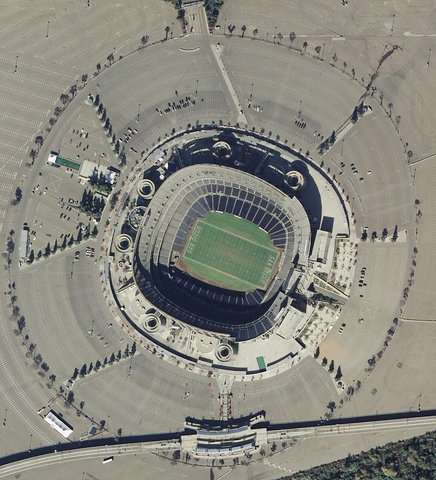
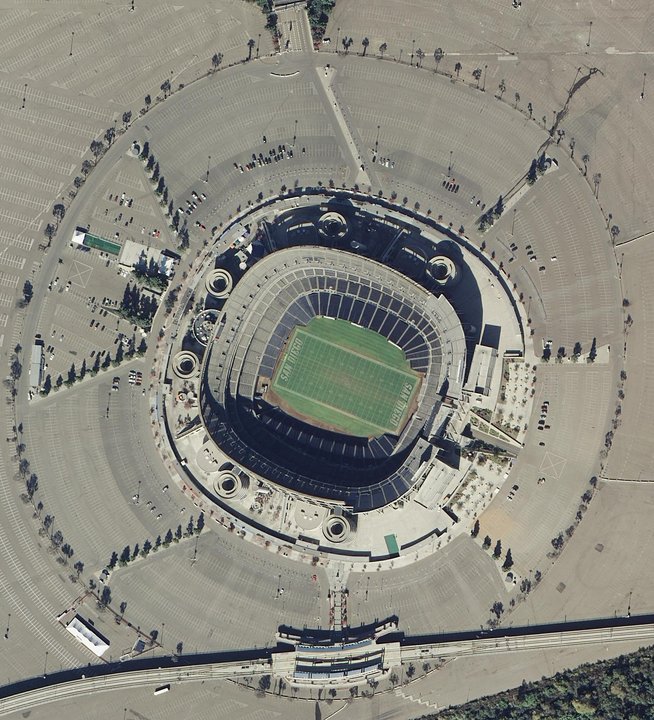
Cover: *Qualcomm Stadium-football* by the United States Geological Survey, public domain, via Wikimedia Commons, November 2003. A vertical aerial of the enclosed bowl in its football configuration, ringed by the parking lot that was the point of building in Mission Valley — twenty-five years after the game described here, and under the stadium's third name.
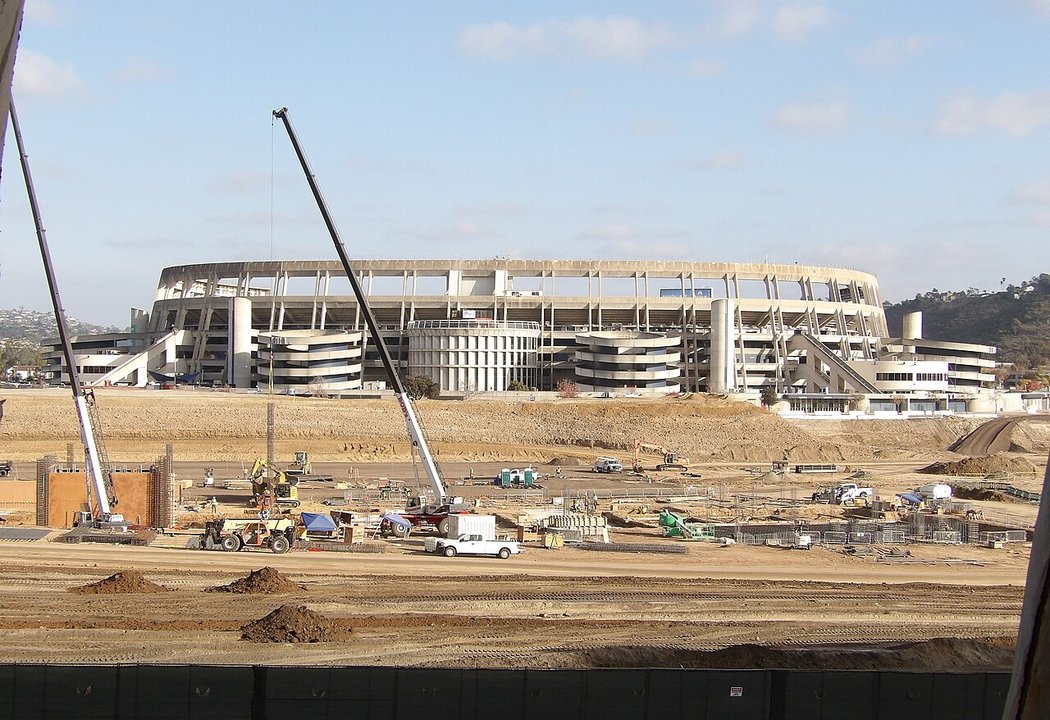
Second image: *Sdccu stadium demolition* by Ruff tuff cream puff, CC0, via Wikimedia Commons, 10 December 2020. The file name says demolition; the photograph shows the building still standing, stripped, with the parking lot already excavated for its replacement. Demolition followed in 2021.



























































 expand_more