


NFL History | Foxboro Stadium Site, Foxborough — The Building Was Bought Six Years Before the Team
· 2002-1
Unreviewed contributionBy kevin · · Report an issue





































Find memories left by people near you.
Distribute Bounty
This will distribute the bounty equally among all qualifying memories. This action cannot be undone.
Cancel Bounty
Are you sure you want to cancel this bounty? The remaining amount will be refunded to your account.
Success!
Operation completed successfully.
Error
Something went wrong.
NFL History | Foxboro Stadium Site, Foxborough — The Building Was Bought Six Years Before the Team
kevin
On 19 January 2002 the New England Patriots beat the Oakland Raiders 16-13 in overtime on this ground, in the last game played at Foxboro Stadium. Pro-Football-Reference records the venue and the sequence: Tom Brady ran six yards for a touchdown with 7:52 left in the fourth quarter, Adam Vinatieri kicked a 45-yard field goal with 27 seconds left to tie the game, and Vinatieri kicked again from 23 yards 6:31 into overtime to win it. The same record gives the attendance as 60,292, which is also the figure Stadiums of Pro Football gives as the building's seating capacity. The two numbers being identical is noted here rather than resolved.
The game is usually remembered for a replay reversal rather than for a kick. The league's own report of the rule's later repeal describes the play plainly: Brady appeared to fumble late in the game, the play was ruled an incomplete pass, and New England went on to win in overtime. The wording of the rule is not reproduced here. At the annual meeting in Phoenix in March 2013 the clubs voted to rescind it, twenty-nine in favour, Pittsburgh against, New England and Washington abstaining; the league's report of the vote does not give the day. Two other memories in this vertical turn on a single play that changed the rulebook - 9304 at Giants Stadium and 9305 at San Diego Stadium - and this is a third, except that here the rule outlived the play by eleven years.
The building's other history is a property history, and by the club's own account it is the reason there was still a team in Massachusetts to argue about.
Stadiums of Pro Football records construction commencing on 23 September 1970 and the stadium opening on 15 August 1971 with a preseason game against the New York Giants; the Clio entry for the building says it went up in 327 days. It held more than sixty thousand seats, of which, according to a Boston.com retrospective published on 1 June 2017, about seven thousand had backs. The rest were aluminium benches. The names changed with the money: Schaefer Stadium from 1971, then Sullivan Stadium, then Foxboro Stadium. The end dates disagree - Pro-Football-Reference gives Sullivan Stadium 1983 to 1988 and Foxboro Stadium 1989 to 2001, Stadiums of Pro Football gives Sullivan 1983 to 1989 and Foxboro 1989 to 2002 - and the Clio entry's account of the second renaming does not match either source and is not used here.
The transfer that matters was not a sale of a football team. A United Press International report of 23 November 1988 covers it directly. A United States Bankruptcy Court judge, Chief Justice James Gabriel, awarded the stadium to K-Corp., a company headed by Robert Kraft and Steven Karp, for twenty-five million dollars in cash. The losing bid, of 19.85 million dollars in cash, came from Victor Kiam, who had bought the football team weeks earlier. The team's own owner tried to buy the building his team played in and was outbid by a man who did not own a team. The report puts the debt accumulated under the previous owner, Chuck Sullivan, at more than fifty-three million dollars.
The same report sets out the terms, which are the whole point. The club had to play at least ten games a year in the building, exhibitions included, for the twelve years remaining on the lease. Rent ran between 650,000 and 1.3 million dollars a year. The stadium's owners took all of the concession and parking revenue. The report records the judge observing that a valid lease was in place, and the buyer saying he had not spent that money in order to watch the team move out. Both are paraphrased here rather than quoted.
What that lease was worth became clear six years later. The club's own history records that Kraft had bought an option on land around the stadium in 1985; that James Orthwein took controlling interest in the team in 1992; that a St Louis group offered Kraft seventy-five million dollars to release the lease and let the team go; and that he refused, and instead bought the team outright on 21 January 1994 for more than 172 million dollars. The club describes that price as more than anyone had until then paid for an American professional sports franchise, which is the club's characterisation and not a ranking offered here. The arithmetic is the argument. The building cost twenty-five million dollars in 1988. Six years later a release from the lease on it was worth three times that on its own, without the building attached. Kraft's explanation, paraphrased from the club's account, is that the lease was the thing that both kept the team in Massachusetts and put it within his reach. He bought the landlord's position first and the tenant six years afterwards.
There is a coda that runs against this vertical's usual direction. Five memories here turn on public money paying for a stadium - 6891 at Baltimore, 6893 at RFK, 9513 in Erie County, 9530 in Nashville and 9540 in Tampa. Foxborough is the case where public money was offered and declined. Connecticut Public reports Governor John Rowland announcing on 18 November 1998 that the state would finance a 68,000-seat stadium in downtown Hartford for the club, and saying the team would play its first home game there in the autumn of 2001. The club announced on 30 April 1999 that it was terminating the agreement, exercising a contractual right ahead of a 2 May deadline, on the ground that the building could not be open for the 2002 season. The reason given was a schedule, not a principle. Stadiums of Pro Football gives the replacement built in Foxborough instead, Gillette Stadium, at 325 million dollars, privately financed, with no public financing.
Stadiums of Pro Football and StadiumDB agree that construction on that replacement began on 24 March 2000. The last game in the old building was on 19 January 2002. For nearly two years the club played its home games alongside its own building site.
Accounts of when the old stadium came down do not agree, and none of the sources consulted is a record-keeper. The Clio entry says late January 2002. Stadiums of Pro Football says spring 2002. The Boston.com retrospective says demolition was completed on 1 June 2002. Stadiums of Pro Football gives the replacement opening on 9 September 2002 at about 65,000 seats; StadiumDB gives 65,878 for professional football.
Status note, 4 September 2026. The club's own front-office page lists Robert Kraft as its chairman and chief executive, describes him as the owner, and dates his ownership from 21 January 1994. Gillette Stadium is the club's home ground. Those are live facts and were current on the date given.
Coordinate: 42.0929, -71.2686. Precision plus or minus 600 m. This coordinate does not meet this vertical's two-source standard, and the shortfall is disclosed rather than concealed. No gazetteer entry or published coordinate for Foxboro Stadium was found. The United States Geological Survey's domestic names service at edits.nationalmap.gov returned a 503 on 4 September 2026, as it had on the two preceding days. The United States Census TIGER geocoder cannot resolve the complex at all: run on 4 September 2026, One Patriot Place returns 1 Patriot Circle at 42.094503, -71.251947, a residential street about two kilometres east, and Patriot Place is not carried in TIGER as a street. This is a third distinct failure mode from the two this vertical has already recorded - not a bad read of the right building, and not a good read of the wrong building, but a silent substitution of a different street with a similar name. The pin is therefore constructed and not sourced. Pro-Football-Reference and the Clio entry both give the stadium's address as Washington Street, Route 1. TIGER resolves 1 Washington Street to 42.100813, -71.260808 and 60 Washington Street to 42.084891, -71.276437; the stadium fronted that road somewhere between them, and the pin is the midpoint of those two geocodes. The midpoint of a stretch of road nearly two kilometres long locates a frontage, not a footprint, and the radius is set wide to say so.
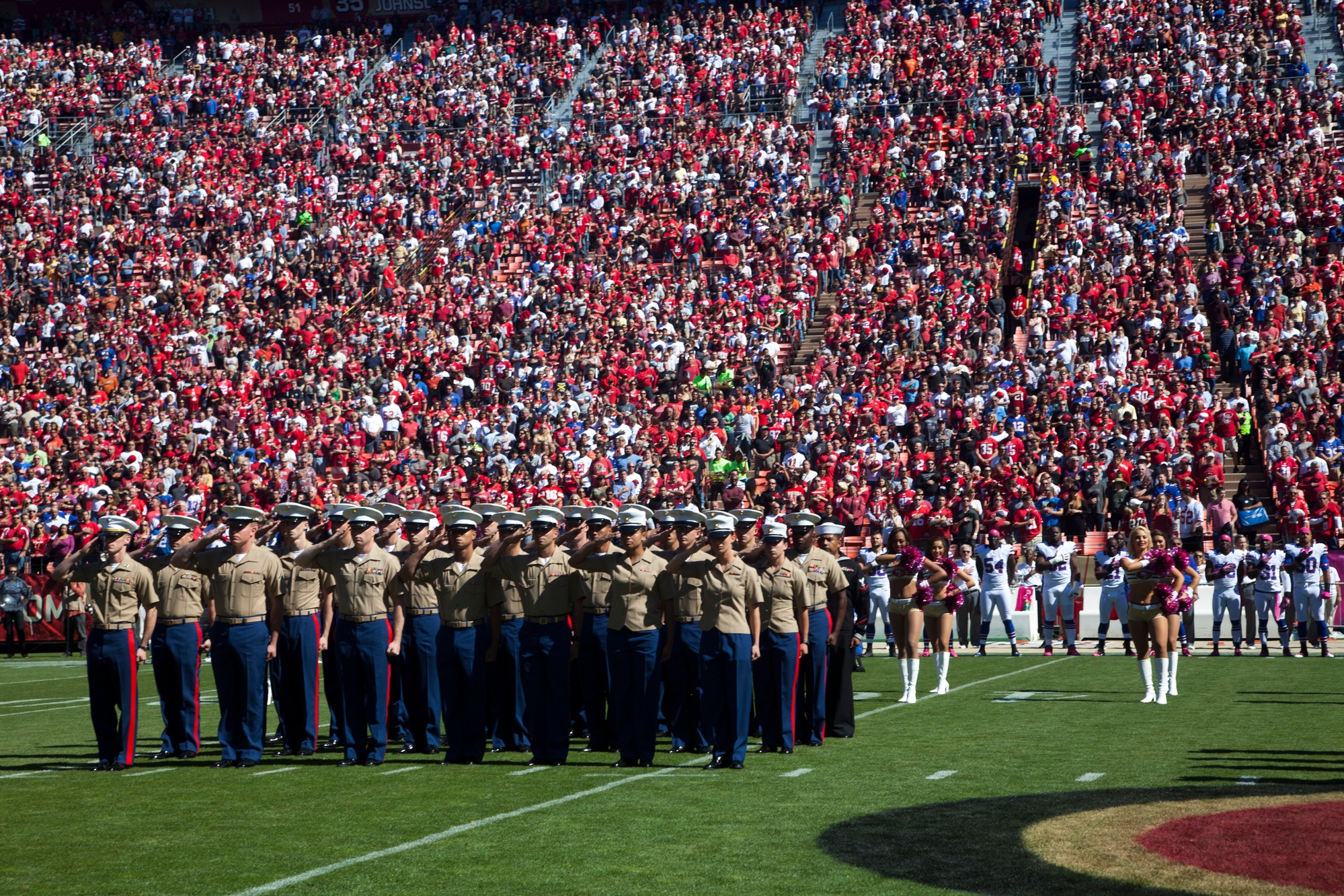
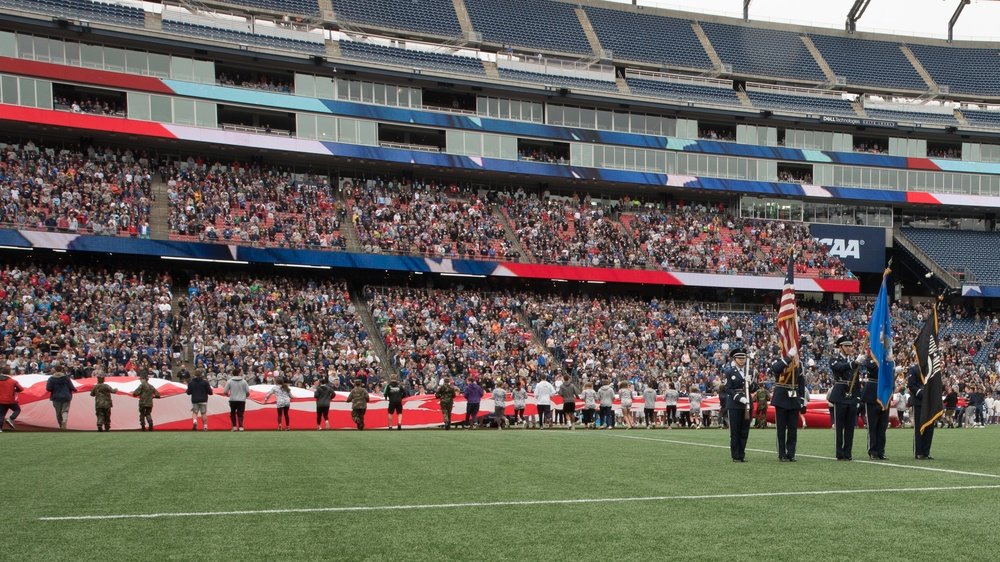
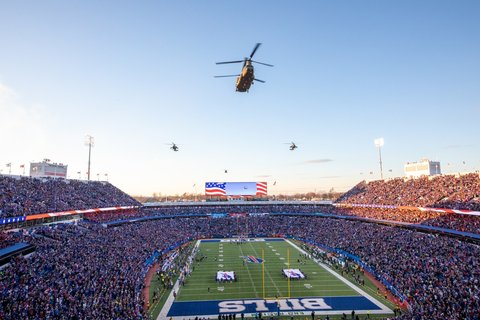
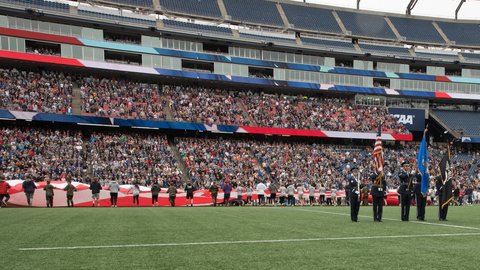
Cover: the honour guard of the 102nd Intelligence Wing posting the colours before the Division I NCAA men's lacrosse championship at Gillette Stadium, Foxborough, on Memorial Day, 28 May 2018, with a flag held flat across the field in front of a full lower bowl. Photograph by Timothy Sandland, 102nd Intelligence Wing, distributed through DVIDS; a work of the United States Government, in the public domain. The DVIDS record gives no rank for the photographer. The building shown is Gillette Stadium, the replacement described above, photographed sixteen years after the game this memory is about. It is not Foxboro Stadium, and it is not a photograph of a professional football game.


changes?
delete this memory?
We detected that you have a Blox in your crypto wallet! We will import the Blox into your account.
Click on done below to complete the import.
Welcome Back!
Sign in to preserve cherished moments
Don't have an account?
Welcome!!
Sign up and start preserving cherished moments
?
?
Choose your payment method
Buy with Metablox Credit
Do you want to mint Blox with Metablox Credit?
Which Crypto would you like to use?
Purchase Confirmed!
Your Blox is being minted on-chain and will appear in your profile shortly.
Log in or sign up to claim your Blox.
How many credits do you want to buy?
$100 USD = 1 Metablox Credit = 1 Blox.
Use Metablox Credit to mint any Blox you want on the map.
 expand_more