NFL History | Polo Grounds Site, Manhattan — A Tenant Cannot Fix the Field
volume_up
Listen
directions
Directions
On 9 December 1934 the Giants beat the Chicago Bears 30–13 here for the National Football League title, before a crowd of 35,059. Chicago had gone 13–0 in the regular season and were the defending champions; New York had finished 8–5 and had lost to them twice. Freezing rain the night before had turned the field to ice, and the temperature at kick-off is reported at nine degrees Fahrenheit.
The game is remembered for basketball shoes, and the sources do not agree on how they arrived. The Pro Football Hall of Fame's account has the club's treasurer, John Mara, walking the turf hours beforehand and alerting coach Steve Owen and captain Ray Flaherty, with Flaherty recalling a Gonzaga game won on the same trick; other accounts have Flaherty simply putting it to Owen during the game. Abe Cohen is variously a tailor who helped on the sideline, a locker-room attendant and the equipment manager. The pairs borrowed from Manhattan College are counted as eight or as nine. They are said to have arrived at half-time, or in the third quarter, or to have been waiting in the dressing room all along because the trainer Gus Mauch, who also worked at Manhattan College, had arranged the loan in advance. The Hall of Fame says plainly that the lore grew in the retelling — the version with a door broken down and a dash back through the streets is the embellished one. What is not in dispute: Chicago led 10–3 at half-time, a field goal made it 13–3, and New York then scored 27 unanswered points in the fourth quarter.
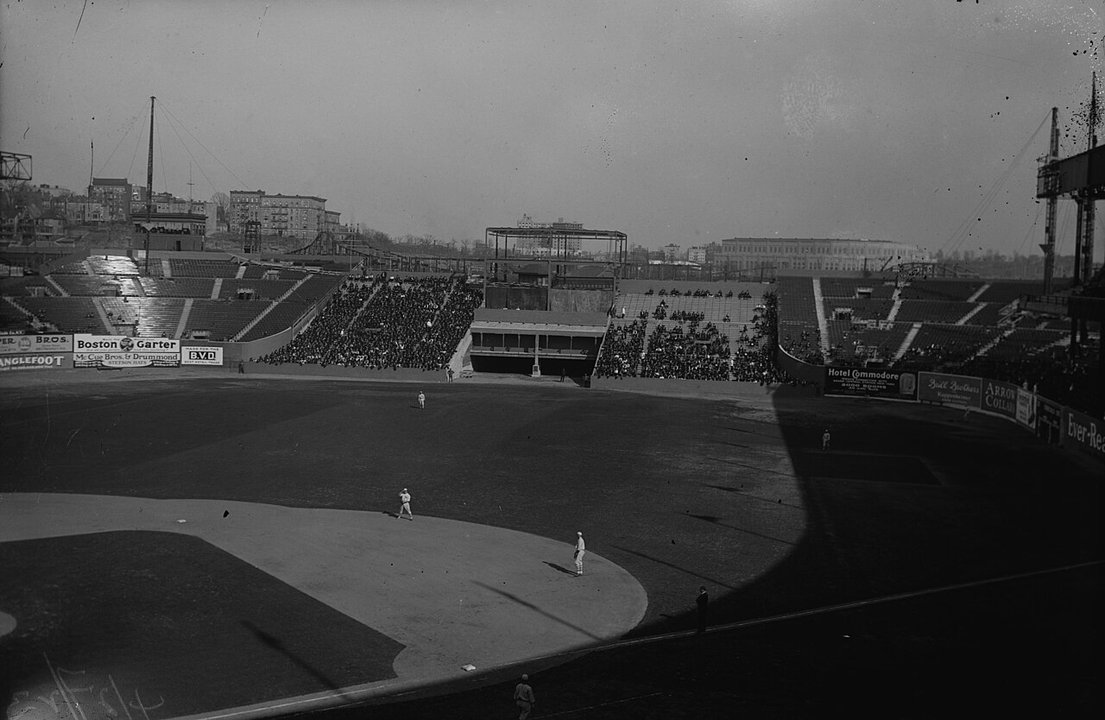
The mechanism is underneath all of that, and it is the reason the shoes were the only remedy available. The football club did not own this ground. The Polo Grounds was a baseball park — rebuilt in 1911 into the long bathtub whose centre field ran away into the distance — and the Giants were tenants in it from 1925. A tenant does not choose the drainage, or the tarpaulin, or the grounds staff, or the date in December on which the league schedules its title game. The whole of the club's power over the surface that afternoon was the footwear it could borrow from a college two miles away. The same helplessness produced the handshake at Wrigley Field (memory 6687), the surplus university grandstand in Boston (6704) and the school board's lease in Houston (6705). This is what the professional game looked like before it could build.
The ground kept taking football tenants. Pro-Football-Reference lists the New York Brickley Giants here in 1921, the Giants from 1925 to 1955, the New York Bulldogs in 1949, and the Titans of the American Football League from 1960, renamed the Jets in 1963. The Giants moved to Yankee Stadium in 1956, which is where memory 6776 picks the story up in 1958. So when the new league needed a New York ground in 1960 it took the one the old league had just vacated, and the two rival-league experiments in the city, thirty-five years apart, were staged on the same grass.
The Polo Grounds was demolished on 10 April 1964. There is a discrepancy worth flagging in the records of its ending: baseball sources describe the Mets' game of 18 September 1963 as the last game ever played here, while football records have the Jets playing on into December of that year. Both are reporting accurately within their own sport, and the phrase "last game ever" is doing the damage.
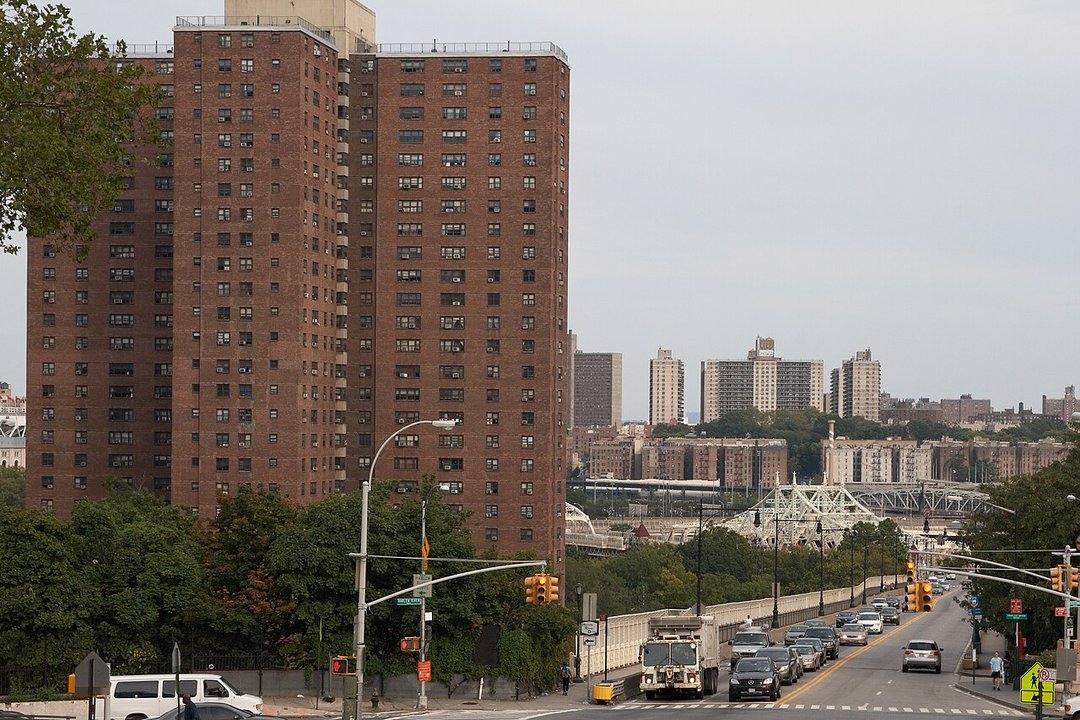
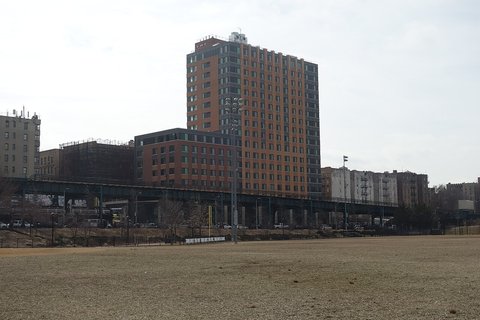
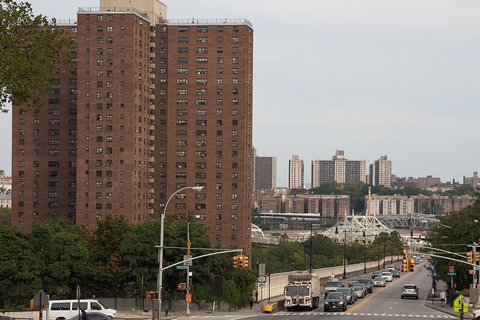
Polo Grounds Towers, a city housing development, stands on the site, and a plaque is set where home plate was. The John T. Brush Stairway, which brought spectators down Coogan's Bluff to the gates, still survives above the site at roughly 40.83241, -73.93942.
Coordinate: 40.830833, -73.937500, from Wikidata's P625 for the ballpark. OpenStreetMap's entry for Polo Grounds Towers gives 40.830989, -73.937773, about 28 m away, and the two are independently maintained. The Census TIGER address point for 2971 Eighth Avenue sits roughly 120 m south-east, on the street frontage rather than the footprint — the offset this vertical now expects. Precision ±150 m, which is the scale of the ballpark itself.
Cover: Polo Grounds Towers seen from West 155th Street, photographed by Magnus Bäck in August 2012, CC BY 3.0 via Wikimedia Commons. The towers stand over the site; the bridge at the right of the frame crosses the Harlem River.
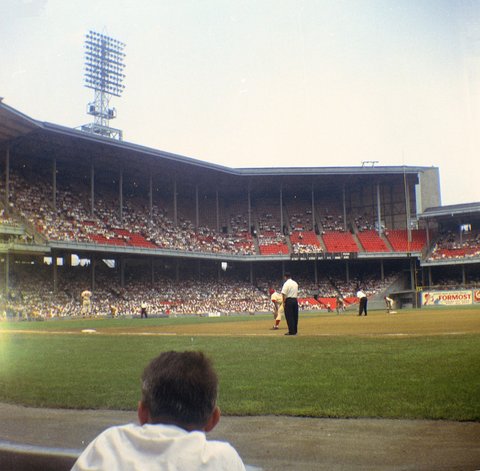
Second image: the Polo Grounds on 26 April 1923, Bain News Service, public domain via the Library of Congress and Wikimedia Commons. This is a baseball crowd, not a football one, and it is included for the shape of the place — the deep, narrow bowl that football had to fit itself into. The Commons record identifies the pale structure on the horizon at the right as the newly built Yankee Stadium across the river.








 expand_more