NFL History | Baltimore Memorial Stadium Site — The Ground That Lost a Franchise and Received One
volume_up
Listen
directions
Directions
The vans did not load here. They loaded at the Colts' training complex at Owings Mills, some twenty kilometres north-west, on the night of 28–29 March 1984. But this is the ground the club was leaving, and the argument the club had been making for fifteen years was about this building.
The federal court record sets the sequence out plainly (Mayor and City Council of Baltimore v. Baltimore Football Club, 624 F. Supp. 278, D. Md.). On 27 March 1984 the Maryland Senate passed emergency legislation extending the city's power of eminent domain to professional sports franchises, by 38 votes to 4. On the morning of 28 March Robert Irsay learned of the vote from a Chicago newspaper, agreed terms with Indianapolis that afternoon, and instructed his general counsel to move everything out of Owings Mills immediately. Movers worked through the night; by the morning of 29 March the vans were on the road. That same day the city offered $40 million for the club, an offer that expired unaccepted at noon the following day, and then began condemnation proceedings. The case was dismissed — the property was no longer in Maryland to condemn.
Details differ between accounts and are worth keeping separate. Fourteen or fifteen vans, depending on the source. The arrival is put at nine in the evening, at ten, and at two in the morning. The weather is remembered as snow and as sleet. The court's own recital dates the enactment of the eminent-domain bill to Friday 30 March, two days after the vans left, while press retrospectives commonly date the governor's signature to 29 March.
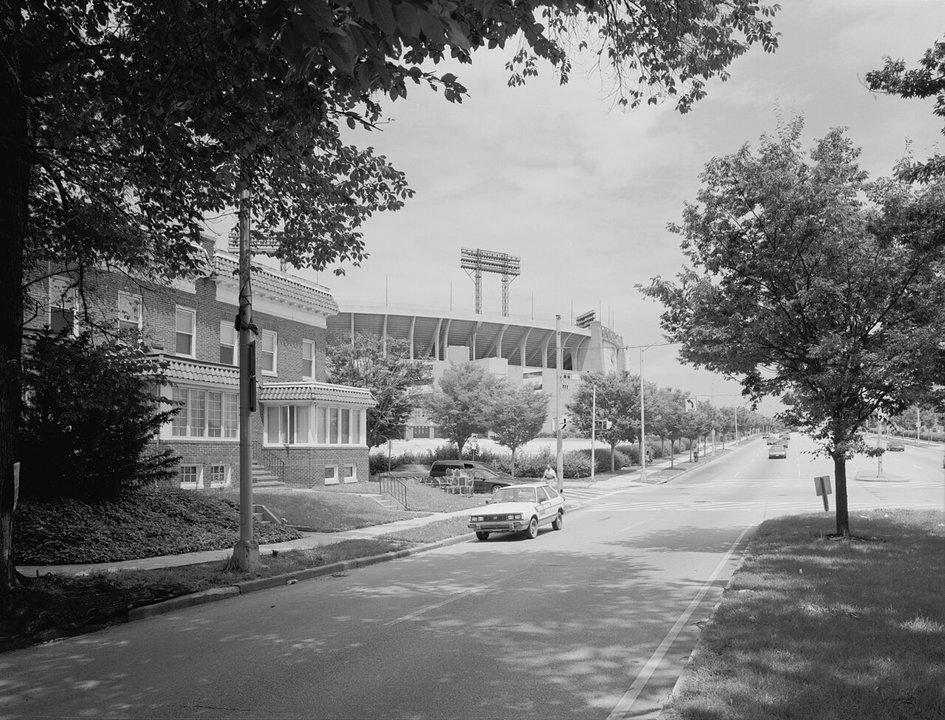
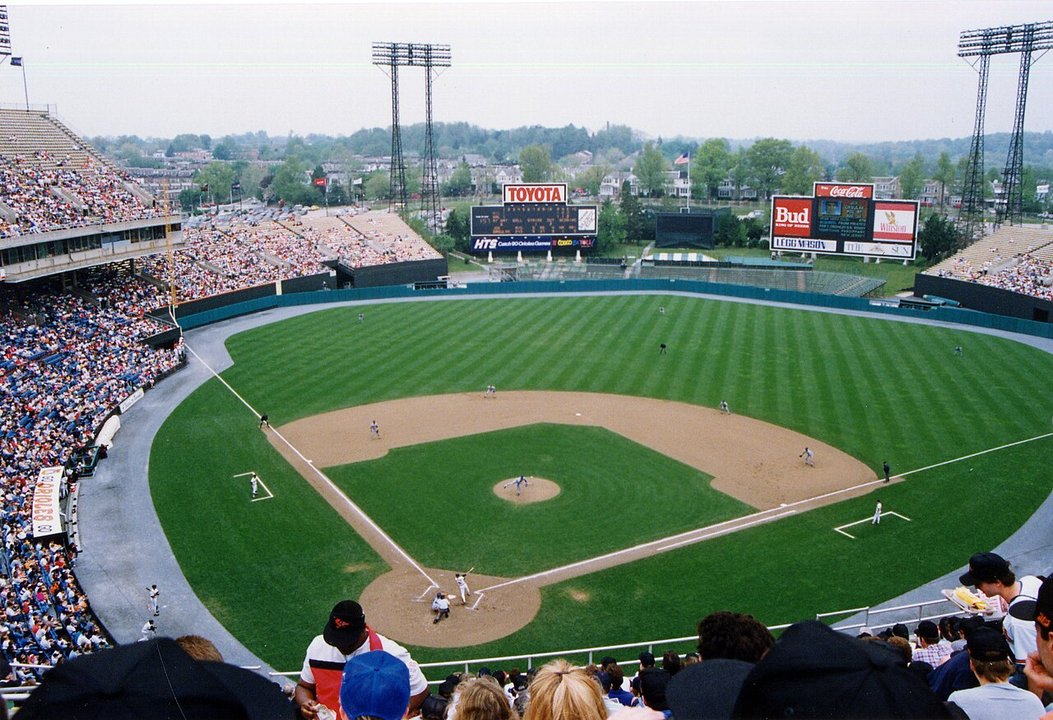
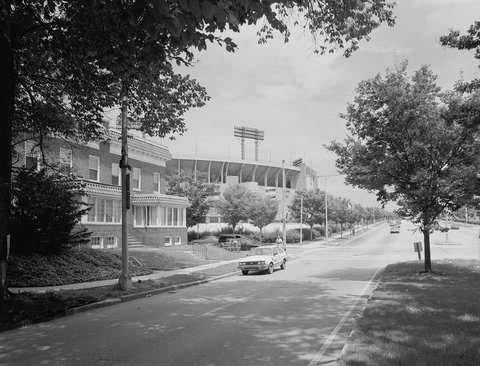
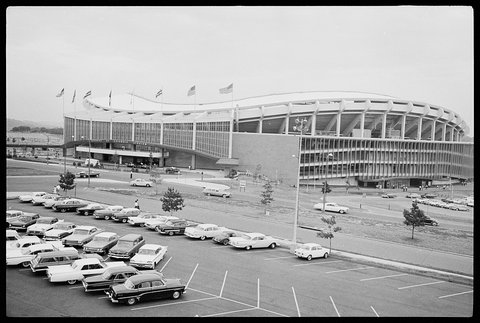
What the Colts were leaving was a municipal stadium of 1950, built over the 1922 municipal stadium in Venable Park and dedicated as a war memorial as well as a ballpark. It seated somewhere above fifty thousand by the 1980s and had no luxury boxes at all, which by then was the whole of the commercial argument. The photographs make the other half of the case: a two-deck concrete horseshoe wedged into a grid of rowhouses, 33rd Street running along its southern edge. An earlier and unrelated Baltimore Colts, an All-America Football Conference club, had played on this site from 1947 until it folded in 1950; the franchise that left in 1984 arrived in 1953.
Then the same ground took a team the same way it had lost one. Baltimore first filled the hole with the Canadian Football League's Stallions, who played here in 1994 and 1995 and won the Grey Cup in their second season. In 1996 the Cleveland Browns became the Baltimore Ravens and played two seasons on 33rd Street while their new stadium went up at Camden Yards, opening before a crowd of more than sixty-four thousand on 1 September 1996. Memory 6676, at the site of Cleveland Municipal Stadium, is the other end of that same transaction.
Salvage began in 2000 and demolition ran through 2001; accounts date the start to November 2000, to February 2001 and to April 2001, and the memorial wall at the front, which preservationists briefly succeeded in holding back while the city argued over saving part of the structure, came down in February 2002. The site now carries Stadium Place, a senior housing development and one of Maryland's largest YMCA facilities.
Coordinate: 39.329444, -76.601389, the value carried by Wikidata's P625 for the stadium and by the GPS attached to Commons photographs of it. Those two agree to six decimal places, which indicates a single published value passed between records rather than independent observation, so this coordinate does not meet the two-source standard and is stated as such. The Census TIGER geocoder for the 33rd Street addresses (both 900 and 1000 East 33rd Street are printed by different sources) returns a point about 130 m south of it, consistent with a street frontage against a bowl set back inside a block that ran north to 36th Street. Precision ±150 m, which is roughly the footprint.
Cover: Baltimore Memorial Stadium seen from the street after abandonment, Historic American Buildings Survey / Historic American Engineering Record, public domain via the Library of Congress and Wikimedia Commons. The Commons record dates the survey photograph to circa 2000; the cars in frame look older than that, so treat the year as unestablished. What the frame shows exactly is the argument of this memory — the upper deck rising directly behind a residential block.
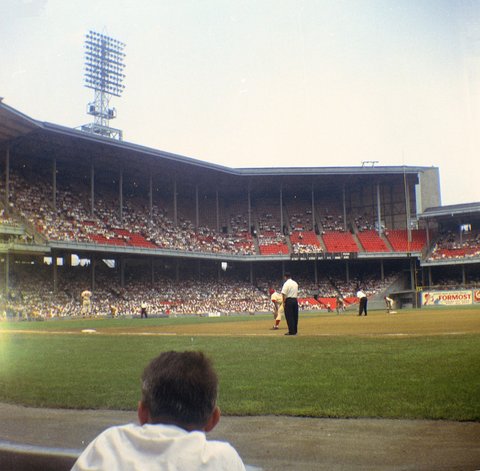
Second image: the bowl in use in 1991, photographed by Paul-W, CC BY-SA 2.0 via Wikimedia Commons. This is a baseball crowd, not a football one — the Orioles' last season here — and it is included because it shows the seating geometry and the rowhouses beyond the outfield.





_thumbnail.jpg)
 expand_more