NFL History | RFK Stadium Site, Washington — The Replacement Season and the Road to Court
volume_up
Listen
directions
Directions
On Sunday 4 October 1987 the Washington club beat the St Louis Cardinals here 28–21 with a roster assembled in about a fortnight. The quarterback, Ed Rubbert, completed 14 of 24 passes for 334 yards and three touchdowns. All three went to Anthony Allen, who caught seven passes for 255 yards, the longest an 88-yard score. The club's own account records those 255 yards as a single-game franchise receiving record that still stands. None of the men who did it had been in the building a month earlier.
The National Football League Players Association had struck on 22 September, after the second week of the season, over free agency above all. The owners cancelled the third week and then played weeks four to six with replacement players — forty-two games that counted in the standings. By the union's own figures roughly 85 per cent of about 1,585 players stayed out. Attendance collapsed, in some cities to a few thousand. The strike ended on 15 October, after twenty-four days, with none of the union's demands met.
Washington's part in it is the part that gets remembered, and it needs care. The replacements won all three games, the club finished 11–4, took the division and won Super Bowl XXII. Sources disagree on whether it was the only club whose veterans all held the line or one of two, with Philadelphia; both versions are in print and neither has been resolved here. The replacements received playoff shares but no championship rings at the time, the regulars having objected; the club reversed that in 2018 and gave them rings thirty-one years late. Who counts as having played was still being negotiated three decades on.
The mechanism runs from this field to a courtroom. The strike failed, so the union stopped being a union: the NFLPA decertified in 1989, and the fight over free agency moved into antitrust litigation, arriving at a Minneapolis jury in 1992 and at free agency in the 1993 collective bargaining agreement. That is the same door Radovich opened in 1957 (memory 6738). The picket line lost and the lawsuit won, and the players learned which of the two the law would actually hear.
The club played under a name it retired in 2022 and is now the Washington Commanders. That name is not used here.
Status as of 22 August 2026, and worth re-checking before anyone relies on it. There is nothing to visit. Events DC states that structural demolition of RFK Stadium was completed in May 2026 and that removal of the remaining foundation walls and columns is ongoing, with the project due to close out by October 2026; the District's own site anticipates complete demolition in the autumn of 2026. Roughly 95 per cent of the demolition waste is being recycled, much of it crushed and reused as backfill on site. A new stadium for the Commanders is planned on the same ground.
Coordinate: 38.889722, -76.971667, the stadium bowl. Wikidata's P625 gives 38.89, -76.971944, about thirty metres away; the GPS attached to Commons photographs taken at the stadium repeats the first value exactly across several contributors, which makes it a published figure rather than independent observation, so this does not fully meet the two-source standard. The Census TIGER address point for 2400 East Capitol Street falls about 400 m west, at the street frontage of a campus that ran to 174 acres. Precision ±150 m.
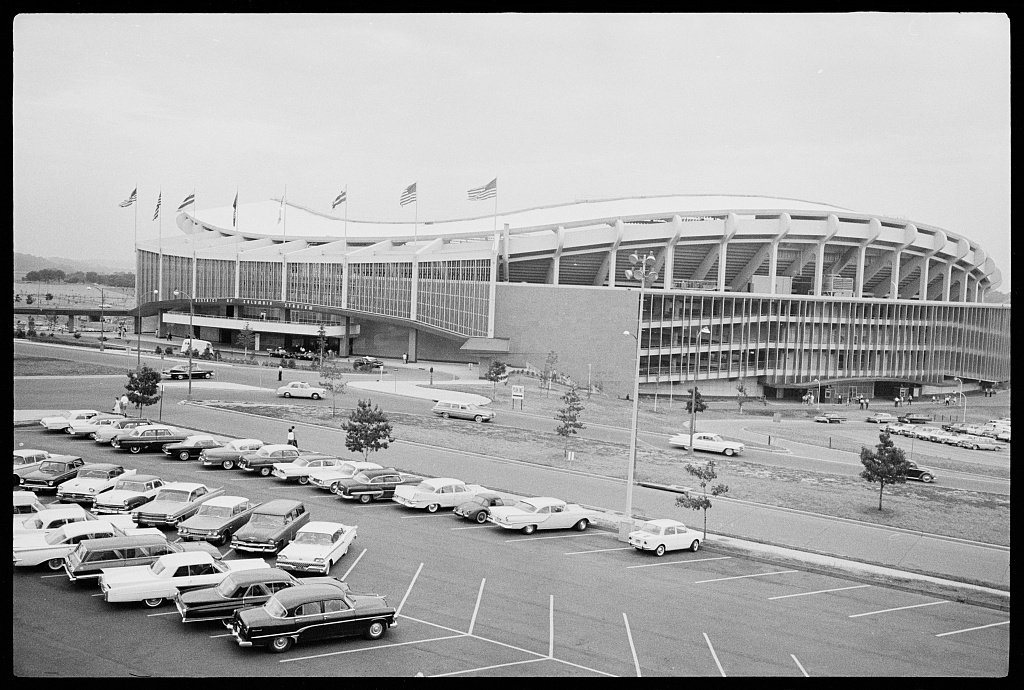
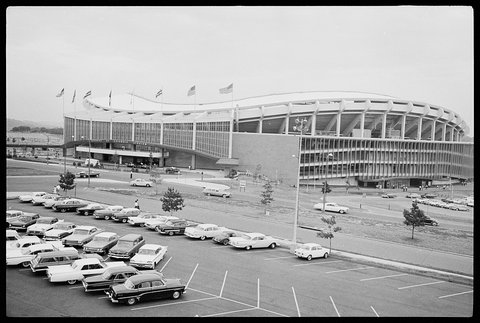
Cover: the exterior of D.C. Stadium with cars in the parking lot, photographed by Marion S. Trikosko on 29 July 1963, public domain via the Library of Congress and Wikimedia Commons. This is the building as new and under its original name — it became RFK Stadium in 1969 — and the frame is included because the surface parking is half the story of what the site later became.
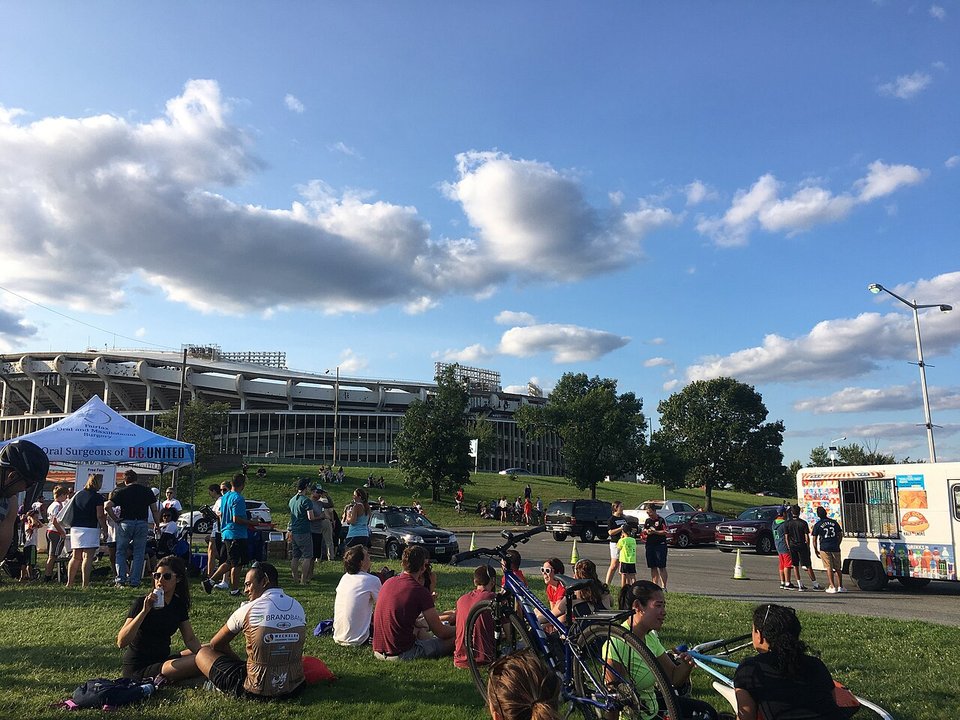
Second image: the stadium in August 2017, photographed by Eric T. Gunther, CC BY 3.0 via Wikimedia Commons. The crowd on the grass is a D.C. United gathering, not a football one; 2017 was the last season the stadium was regularly used.



_thumbnail.jpg)
 expand_more