


NFL History | Shea Stadium Site, Queens — The Baseball Season Set the Football Schedule
· 1968-12
Personal memoryBy kevin · · updated · Report an issue




















































Find memories left by people near you.
Distribute Bounty
This will distribute the bounty equally among all qualifying memories. This action cannot be undone.
Cancel Bounty
Are you sure you want to cancel this bounty? The remaining amount will be refunded to your account.
Success!
Operation completed successfully.
Error
Something went wrong.
NFL History | Shea Stadium Site, Queens — The Baseball Season Set the Football Schedule
kevin
On 29 December 1968 the New York Jets beat the Oakland Raiders at Shea Stadium in Queens. Pro-Football-Reference's box score prints the quarters raw — Oakland 0, 10, 3, 10; New York 10, 3, 7, 7 — for a final of 27 to 23. The page prints no attendance figure, and none is claimed here. The same site's 1968 season page records that the Jets went on to beat Baltimore 16 to 7 on 12 January.
The date is the argument. In the last week of December a football club could have Shea Stadium to itself. For a good part of the season it could not, and the reason was written into the building's paperwork before the football club had any claim on it at all.
Shea Stadium was built and owned by the City of New York. The Society for American Baseball Research's park entry, written by Rory Costello and published on 11 April 2013, records that the city budgeted $15 million and that the finished cost reached $28.5 million, and that the New York Mets signed a thirty-year lease on 6 October 1961. The ground opened on 17 April 1964.
What that meant for football shows up in the schedule tables without anyone having to interpret them. Pro-Football-Reference's 1968 Jets season page lists the club's first three games — 15, 22 and 29 September — as away games, with the home opener on 5 October. Its 1969 page lists five straight away games: 14, 21 and 28 September, then 5 and 12 October, with the first home date on 20 October. The same site's 1968 season page records that these Jets had won the previous season's championship game, and its 1969 table numbers the weeks: the first home date fell in week six.
Costello's entry attributes that pattern to the arrangement rather than to the schedule-maker's whim. It describes the Jets as the lesser of the building's two tenants, pushed into early-season road games, and it names 1969 and 1973 — the two years the Mets reached the World Series — as the seasons when the effect was worst. That characterisation is his, and it is the only sourced account of the mechanism found for this entry.
The building did convert itself, at some cost. Costello records motor-operated stands that travelled on underground tracks between the baseball and football arrangements, a system he attributes to the project engineer Robert Schoenfeld, and he notes that the tracks left strips of dead grass across the field that showed late in the year. He also records that the football field took in the skinned infield of the baseball diamond. Whatever else the Jets had at Shea, they had a surface laid out for another game.
They were not the only football tenant. Pro-Football-Reference's page for the ground records 150 professional football games there between 1964 and 1983; a Jets regular-season record of 69-68-3 and a postseason record of 1-2; a first game on Saturday 12 September 1964, Jets 30 and Denver 6; and a last on Saturday 10 December 1983, Pittsburgh 34 and the Jets 7. It also records that the New York Giants played a single season at Shea, in 1975, going 3-5-0. Costello states the Jets' tenure record as 70 wins, 70 losses and 3 ties. The two sources state the record differently and this entry does not reconcile them. Costello attributes the club's departure for the Meadowlands to the favouritism it perceived and to the condition of the building.
One comparison this entry deliberately does not make. Costello gives Shea a baseball capacity of 55,000-plus and gives no football capacity, and no source consulted here supplies one. Any comparison between this ground and a stadium-size threshold would therefore rest on a figure that does not exist in the sources read, and none is attempted. Other entries in this series follow the same landlord problem at Wrigley Field, at Comiskey Park and at the Polo Grounds.
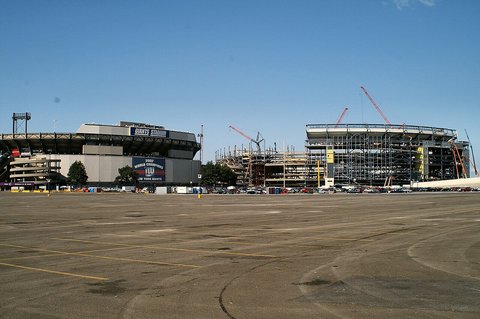
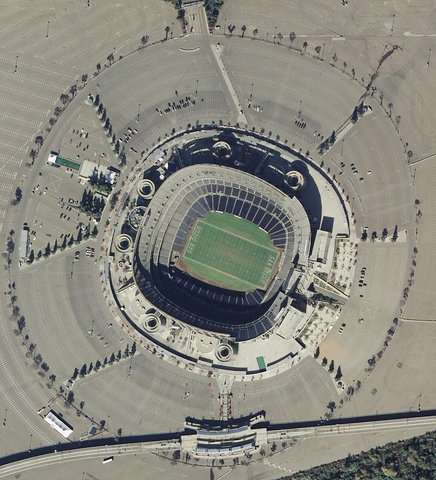
The ground is a car park now. The Historical Marker Database's record of the Shea Stadium Home Plate marker places it in Citi Field parking Lot D, reached from Shea Road north of Roosevelt Avenue, and reports it as erected by the New York Mets in 2009 to mark the site of home plate for the years 1964 to 2008. Four companion markers — first, second and third base and the pitcher's plate — stand a few steps away. A second marker, recorded by the same database as the William A. Shea Municipal Stadium marker erected by the City of New York in 1964 at 123-01 Roosevelt Avenue, is logged there as missing since 2008. Costello records that demolition began on 14 October 2008 and finished on 18 February 2009.
Status note, September 2026: the paragraph above describes the site as the records consulted describe it, the most recent of them a photograph made in 2018. Nothing in this entry establishes what stands on that ground today beyond what those records say.
Coordinate. The pin is the field GPS reading published by the Historical Marker Database for the Shea Stadium Home Plate marker, 40 degrees 45.339 minutes north and 73 degrees 50.902 minutes west, a marker inside the stadium's own footprint. A second and independent record was obtained from the United States Census Bureau's TIGER geocoder, which matched the stadium's postal address, 123-01 ROOSEVELT AVE, CORONA, NY, 11368, at 40.753038 and -73.851152. The two disagree, and the disagreement is explainable rather than troubling: they answer slightly different questions. The marker records where home plate stood inside the bowl; the federal address file records a postal address on Roosevelt Avenue, at the site's southern edge, and it interpolates along the street rather than locating a building. A second query on the same avenue, 126-01 Roosevelt Avenue, returned 40.755414 and -73.843200 — a different latitude and a different longitude, which is what a road point on a curving avenue looks like and not what a building point looks like. The marker's pin is published. The precision radius is set at 250 metres, and it is sized from the building rather than from the decimal places of the GPS reading: home plate was a point at one corner of a stadium bowl, and no source consulted here gives that bowl a dimension. The radius covers the ground the stadium stood on, not the accuracy of the marker.
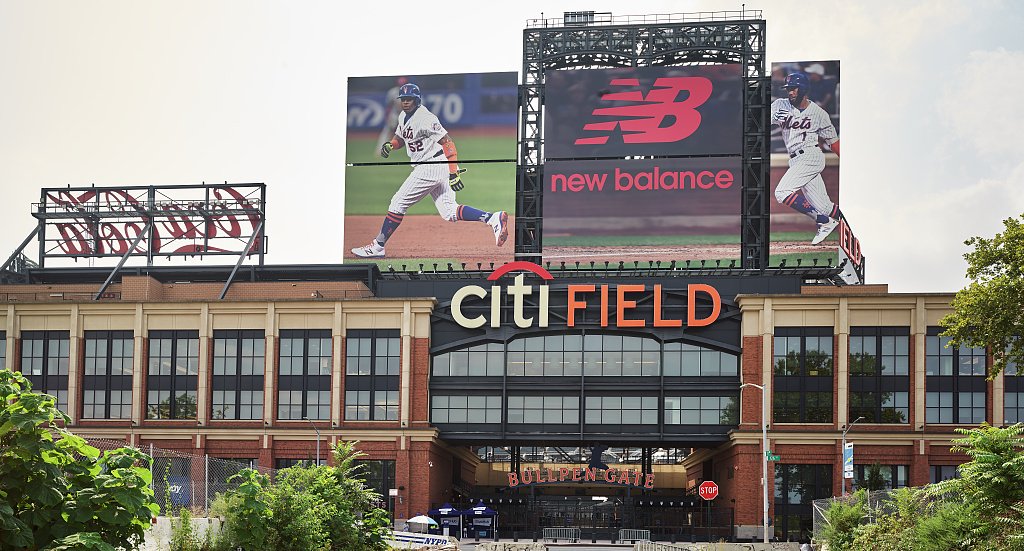
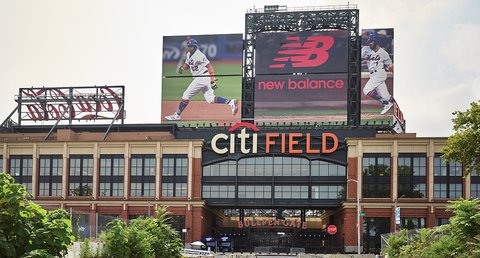
Cover image: Citi Field, Queens, photographed on 27 August 2018 by Carol M. Highsmith, Carol M. Highsmith Archive, Library of Congress Prints and Photographs Division, no known restrictions on publication. It is not a photograph of Shea Stadium and not a photograph of football. It shows the ballpark that replaced Shea and now occupies the ground beside it; the Shea footprint, and the base markers described above, are in this building's car park. A search of the Library of Congress photographic collections for a Jets game at Shea returned nothing.
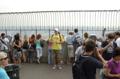
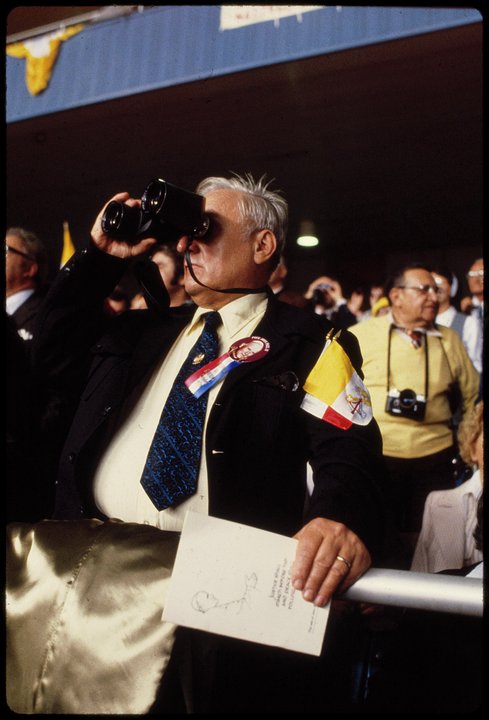
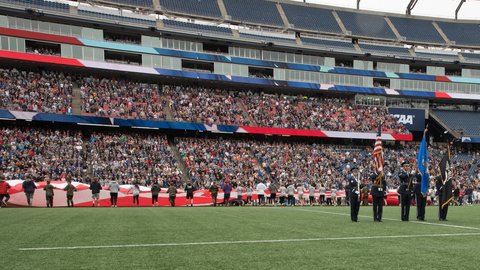
Second image: spectators at Shea Stadium during the visit of Pope John Paul II in 1979, photographed by Bernard Gotfryd, Bernard Gotfryd photograph collection, Library of Congress Prints and Photographs Division, no known restrictions on publication. It is not a football photograph. It was made inside the years of the Jets' tenancy and shows the stands and the blue panelling of the ballpark's upper deck, which is the closest look at the building itself that the public-domain collections searched for this entry could provide.



changes?
delete this memory?
We detected that you have a Blox in your crypto wallet! We will import the Blox into your account.
Click on done below to complete the import.
Welcome Back!
Sign in to preserve cherished moments
Don't have an account?
Welcome!!
Sign up and start preserving cherished moments
?
?

Choose your payment method
Buy with Metablox Credit
Do you want to mint Blox with Metablox Credit?
Which Crypto would you like to use?
Purchase Confirmed!
Your Blox is being minted on-chain and will appear in your profile shortly.
Log in or sign up to claim your Blox.
How many credits do you want to buy?
$100 USD = 1 Metablox Credit = 1 Blox.
Use Metablox Credit to mint any Blox you want on the map.
 expand_more