NFL History | Shibe Park Site, Philadelphia — The Championship That Was Dug Out by Hand
volume_up
Listen
directions
Directions
On 19 December 1948 the Philadelphia Eagles beat the Chicago Cardinals 7–0 here for the National Football League title, in a snowstorm that had dropped close to a foot on the city that morning. Kick-off was held about half an hour while the field was cleared. The grounds staff could not shift the tarpaulin, which had become too heavy with snow to drag, so players from both teams took hold of it and pulled it off themselves. The commissioner, Bert Bell, weighed postponing; the players wanted to play.
What followed was a championship run on improvisation. The yard lines were invisible almost at once, so the officials laid ropes to mark the sidelines and judged first downs by eye. Snow banked up around the perimeter. Spectators who turned up carrying shovels were admitted free and put to work on the field. The scoring came early in the fourth quarter, after Chicago fumbled in its own half: a short Steve Van Buren run, and then more shovelling before the extra point could be attempted. The attendance is recorded two ways, 36,309 paid against 28,864 actually present, and the gap between those numbers is the weather. History.com's account has Van Buren assuming the game must be off, staying home, then making his way in by bus, trolley and train and walking the last blocks to arrive shortly before kick-off.
Here is the mechanism, and it is a matter of timing. This was the first NFL championship game carried on television — ABC, with Harry Wismer and Red Grange calling it. Keep that first narrow: it is a claim about the title game, not about the league's earliest appearance on television at all. The point is what the two halves of the afternoon say together. The sport reached the broadcast era on a day when its championship was being staged by volunteer labour, a length of rope and a referee's judgement. Television arrived thirteen years before the statute that let the league sell its games as a single package (memory 6790), and the money that statute unlocked is the reason no championship has been run like this since. In 1948 the audience was national and the infrastructure was a snow shovel.
The Eagles were tenants, and the sources cannot even agree on the lease. Wikipedia and football.ballparks.com give 1940, then 1942 to 1957. Clem's Baseball gives 1940, 1942, then 1944 to 1957. The Society for American Baseball Research describes it as a continuous tenancy from 1940 through 1957. The war years are where the accounts diverge, and no attempt is made here to resolve them. In 1958 the club moved to Franklin Field, the University of Pennsylvania's ground — from one landlord to another, which is the whole of Thread B in a sentence. One ballpark site states the move as 1958 in a way that reads as the final season here; the last Eagles season at this address was 1957.
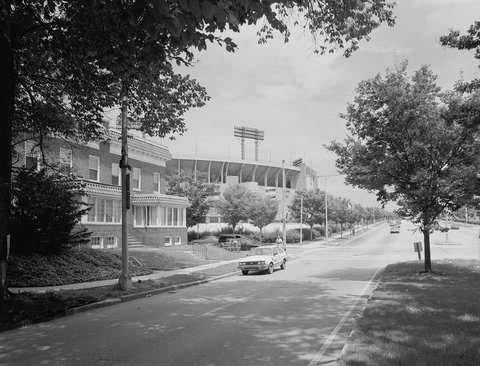
The park opened in 1909 on the block bounded by Lehigh Avenue, North Twentieth Street, Somerset Street and North Twenty-first, and was renamed for Connie Mack in 1953. The Philadelphia Stars of the Negro National League played here in 1943. Baseball ended on 1 October 1970; a fire set by boys who got into the empty structure gutted much of it in August 1971; a judge ordered demolition in October 1975; and by SABR's account the corner tower with its domed cupola, where Mack had kept his office, was the last section to come down, on 13 July 1976. One published timeline dates the final demolition to 1974, which does not survive contact with the others. Deliverance Evangelistic Church built on the site in 1991.
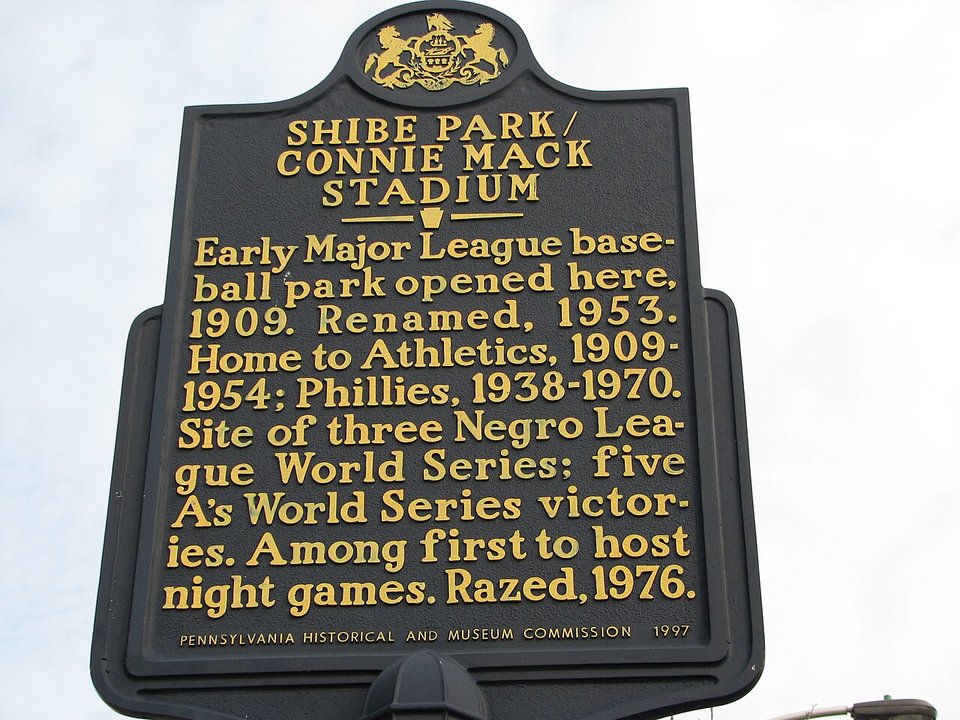
One more thing about tenancy, and it is the reason this memory ends where it does. The state marker standing at the corner records an early major league ballpark, the Athletics and the Phillies, three Negro League World Series, five Athletics championships, early night baseball, and the year it was razed. It does not mention the Eagles, or the 1948 title game, or football at all. The tenant is as invisible in the commemoration as it was on the lease. Note also that the marker settles a small dispute in the sources: it is the Pennsylvania Historical and Museum Commission's, dated 1997, where SABR credits the Philadelphia Historical Commission and gives 9 November while another record gives 1 November. The body is now established; the day is not.
Coordinate: 39.996111, -75.165000, from Wikidata's P625 for the ballpark. The Census TIGER point for the corner of North Twenty-first and West Lehigh falls about 110 m to the south-west, which is consistent with a corner against a footprint filling the block, and the GPS attached to the Commons photographs used here sits on Lehigh Avenue because those are camera positions rather than the subject. Independent confirmation is therefore weaker than it looks and is stated as such. Precision ±150 m, the scale of the block.
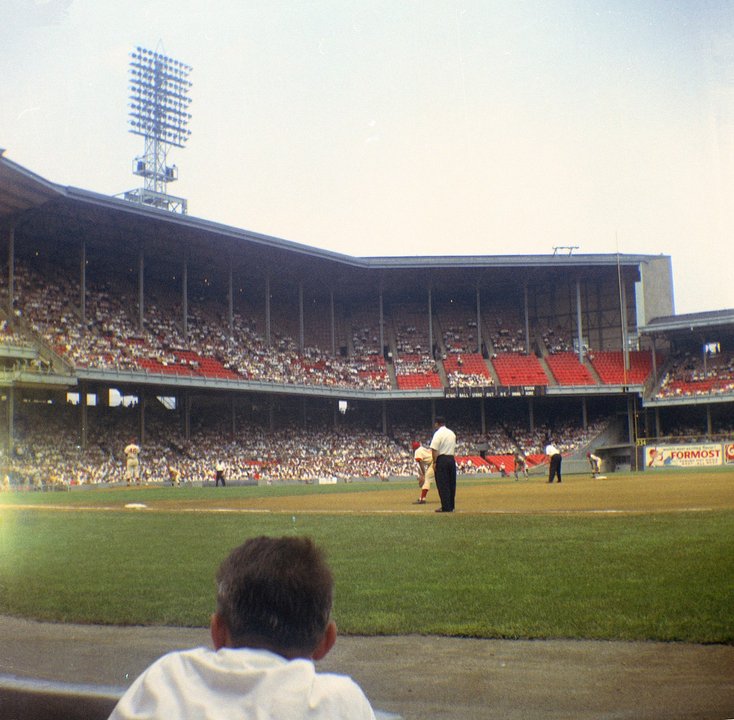
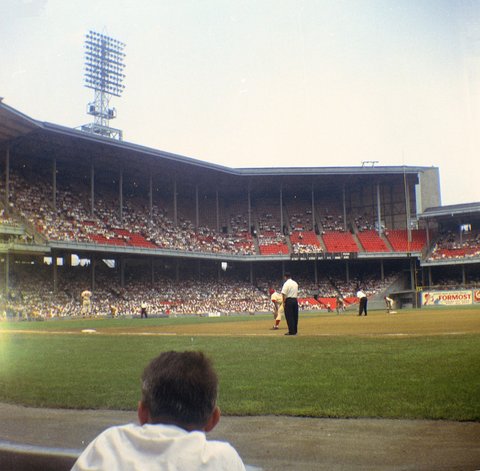
Cover: Shibe Park during a doubleheader on 8 August 1960, photographed by xnedski, CC BY-SA 2.0 via Wikimedia Commons. A baseball crowd, and three years after the Eagles had gone; it is here for the double-decked grandstand the football club rented.
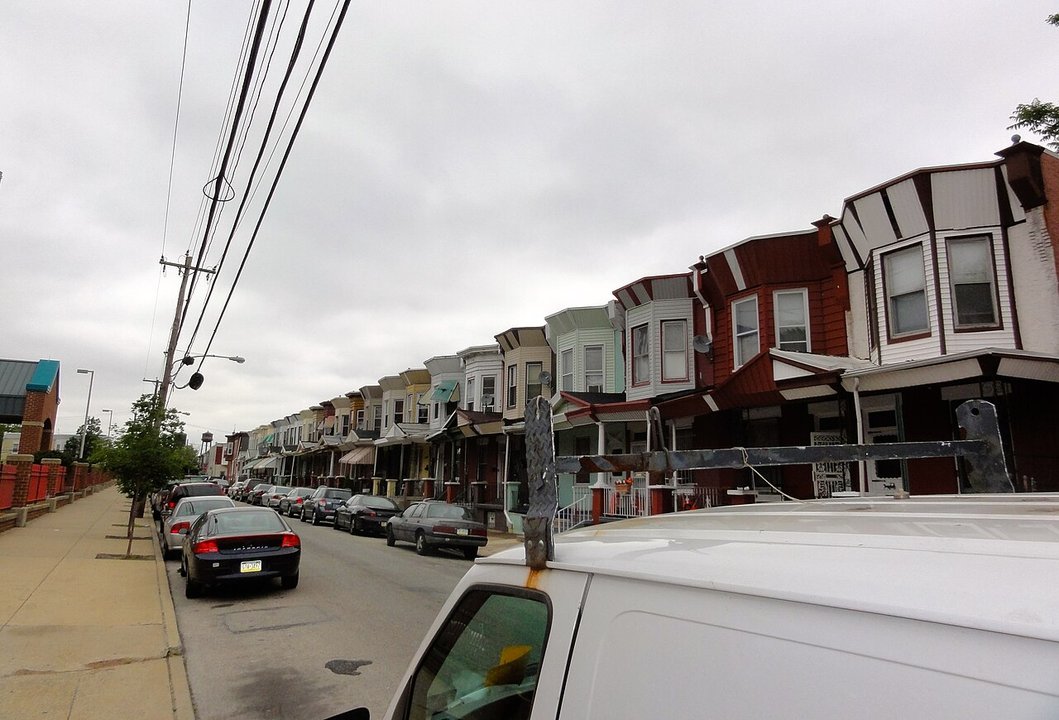
Second image: the North Twentieth Street houses whose roofs overlooked the field, photographed by Delaywaves in May 2011, CC BY 3.0 via Wikimedia Commons. The National Ballpark Museum credits this street with rooftop viewing before Wrigley Field had it. The houses are still there; the ballpark is not.
Third image: the Pennsylvania Historical and Museum Commission marker at the site, photographed by chrisinphilly5448 in January 2008, CC BY-SA 2.0 via Wikimedia Commons. The file is titled as the site of the stadium, but what it actually shows is the marker text discussed above.



 expand_more