NFL History | Franklin Field, Philadelphia — The Title Game That Had to Kick Off at Noon
volume_up
Listen
directions
Directions
The Philadelphia Eagles won the 1960 National Football League championship here, 17-13 over Green Bay, and two of the most conspicuous facts about that afternoon were decided not by either club but by the fact that neither of them owned the building.
Franklin Field belonged to the University of Pennsylvania. A university that played its own football on Saturday afternoons had never needed floodlights, and so there were none. A tenant does not rewire a landlord's stadium. The championship of American professional football therefore kicked off at noon on Monday 26 December 1960 — Christmas had fallen on the Sunday — because the light had to last the whole game.
The second consequence was that Philadelphia could not watch it. The game was blacked out on local television, and Penn Today's account of the day describes supporters driving into neighbouring states to find a signal. There is a particular irony in that happening in this stadium: the building carries a long list of broadcasting firsts, though the sources disagree about which. The Library of Congress catalogue credits it with the first radio broadcast of a football game, in 1922, and an early Philco television transmission; the Philadelphia Inquirer's account of April 2026 places the first broadcast of a college football game here in 1940. What is not in dispute is that in December 1960 the city hosting the championship was the one part of the country forbidden to see it.
Nine months later Congress passed the Sports Broadcasting Act, and the league's control of its own telecasts stopped being a private arrangement between a commissioner and a network and became a statute — the two pages that memory 6790, pinned at the United States Capitol, is about. The blackout at Franklin Field is what that law looked like before it was written down.
The attendance was 67,325, which Penn Today records as the largest crowd at an NFL Championship Game to that date. That figure is worth holding against the building it was in: Franklin Field's listed capacity for the Eagles years was 60,658, and the difference was made up with temporary seating. The championship of the sport was staged by adding chairs to a college track stadium.
The Eagles were here from 1958 to 1970 and went 41-45-2 in the building. They had come from Connie Mack Stadium, a ballpark holding about 39,000, and they left for Veterans Stadium in 1971 — from a baseball club's tenant to a university's tenant to a stadium built for them. Penn Today reports Bert Bell's view that moving the club to Franklin Field was what kept professional football viable in Philadelphia; the remark reaches us second-hand through that account rather than through a contemporaneous document, and Bell died in October 1959, so it is given here as a paraphrase and not as his words.
This pairs with memory 6962, at Shibe Park. Those two games — 1948 and 1960 — are the franchise's only championships before the merger, twelve years apart, and both were won in somebody else's building: a baseball club's, and then a university's.
One claim about this game is repeated almost everywhere in a form that does not survive checking. Vince Lombardi's Green Bay teams lost this title game and are usually said never to have lost another postseason game. His postseason record was 9-1 in the championship bracket, and 1960 is the single loss — but his Packers were also beaten by the Cardinals in the third-place Playoff Bowl after the 1964 season, a game the league itself classified as an exhibition. Whether Lombardi lost one postseason game or two is therefore a decision about how a league categorised a fixture, not a fact about football, and the sentence should carry its own qualifier.
Chuck Bednarik's remark to Jim Taylor as he held him down over the final seconds has been retold for sixty-five years in several incompatible wordings, and no notebook from that afternoon has been traced. It is left here as description rather than quotation.
The building is still working. It hosts the Penn Relays and Penn's football, and seats 52,593 as of April 2026. Penn describes it as the oldest stadium in use for college football today, having opened on 20 April 1895; Harvard describes Harvard Stadium, opened in 1903, as the first purpose-built football stadium, and Penn's athletic communications office calls that distinction semantics. Both claims are true of different things — the older continuously used site, and the older structure built for the game — and neither side is conceding.
Coordinate: 39.9511, -75.1902. This pin rests on a single independent source, the United States Census TIGER geocoder for 235 South 33rd Street, and that is below the two-source standard used elsewhere in this collection; it is stated here rather than hidden. TIGER returns a mailing address, and the offset between a postal address and a stadium footprint is unresolved for this site, which is why the radius is generous. Precision ±150 m. Note for anyone reading the map closely: memory 6235, on the ENIAC at the Moore School, sits about 147 m north of this pin. Different subject, different vertical, and not a duplicate — the Penn campus is simply crowded.
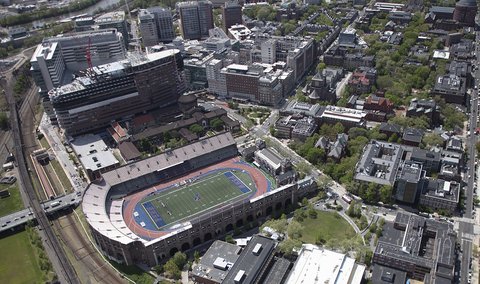
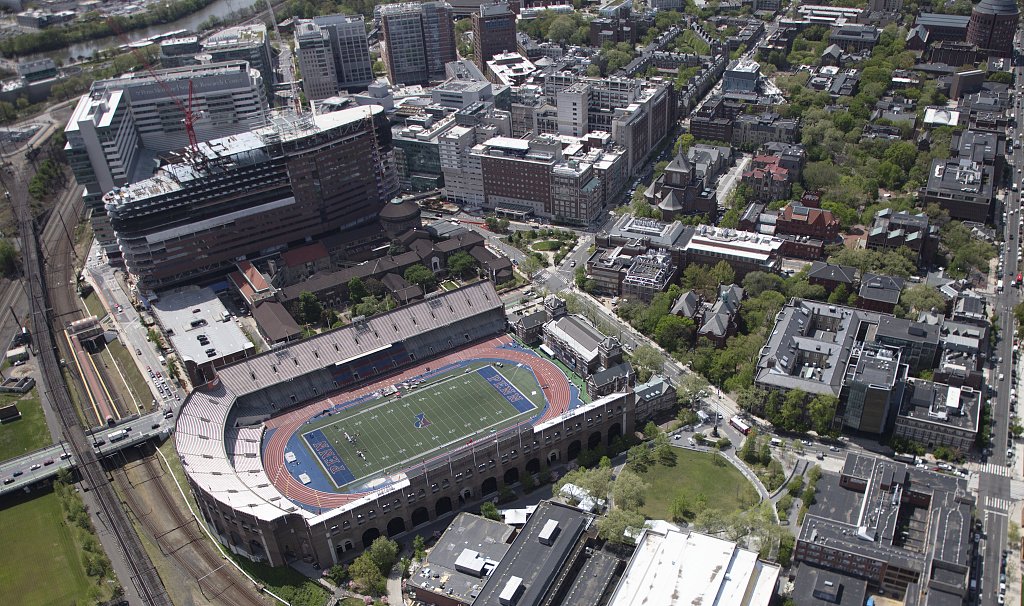
Cover: an oblique aerial view of Franklin Field from the west, showing the horseshoe bowl, its arcaded brick facade, the 1920s upper deck, and the campus and city around it. Photograph by Carol M. Highsmith, 23 April 2019, Carol M. Highsmith Archive, Library of Congress; no known restrictions on publication. It shows the stadium fifty-nine years after this game, with a synthetic playing surface and a running track that were not there in 1960.
Status note: the stadium's current use, its seating figure and the state of the oldest-stadium dispute were checked on 4 September 2026 against the Philadelphia Inquirer's article of 2 April 2026 and the Library of Congress catalogue record. Check before relying on any of it.




































 expand_more