NFL History | Soldier Field, Chicago — The Landmark Renovated Out of Its Own Listing
volume_up
Listen
directions
Directions
Soldier Field was a National Historic Landmark and is not one now, and it lost the status because of what was built inside it.
The Bears arrived here for a reason already familiar in this set of memories. The Illinois Sports Facilities Authority's own history of the stadium says it plainly: after the 1970 merger the league required home stadiums to seat more than fifty thousand, and Wrigley Field did not. The rule that emptied Wrigley, and War Memorial in Buffalo, and Metropolitan Stadium in Bloomington, is the rule that filled this building. The Bears played their first game here on 19 September 1971.
The stadium itself was much older. It opened on 9 October 1924 as Municipal Grant Park Stadium, on lakefront ground the 1909 Burnham and Bennett plan had set aside for athletics, and was renamed Soldier Field on 11 November 1925 as a memorial to the American dead of the First World War. Its distinctive feature was a pair of Doric colonnades. Crowds above a hundred thousand were routine in the 1920s, for the 1926 Army–Navy game and the Dempsey and Tunney rematch of 1927 with its disputed long count. On 27 February 1987 the National Park Service designated it a National Historic Landmark.
Then the interior was removed. Demolition began on 19 January 2002, the Bears spent that season playing at the University of Illinois, and the rebuilt stadium reopened on 29 September 2003. Published costs vary widely, from around $400 million to around $690 million depending on which account and which scope you take, which is itself worth noting before quoting a figure.
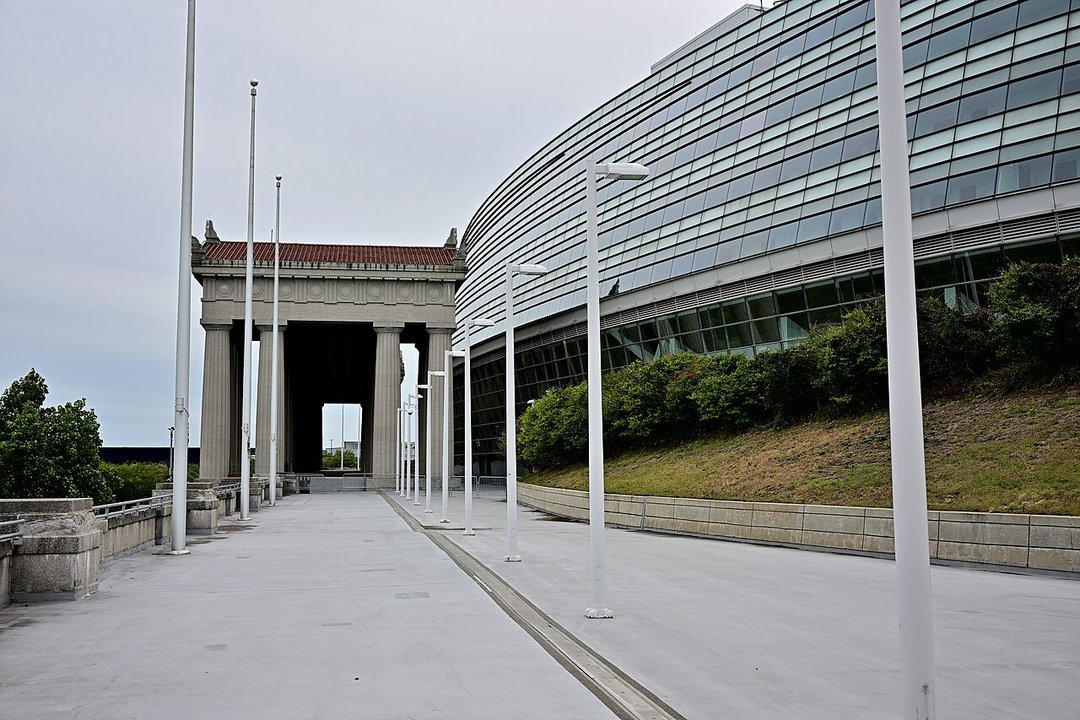
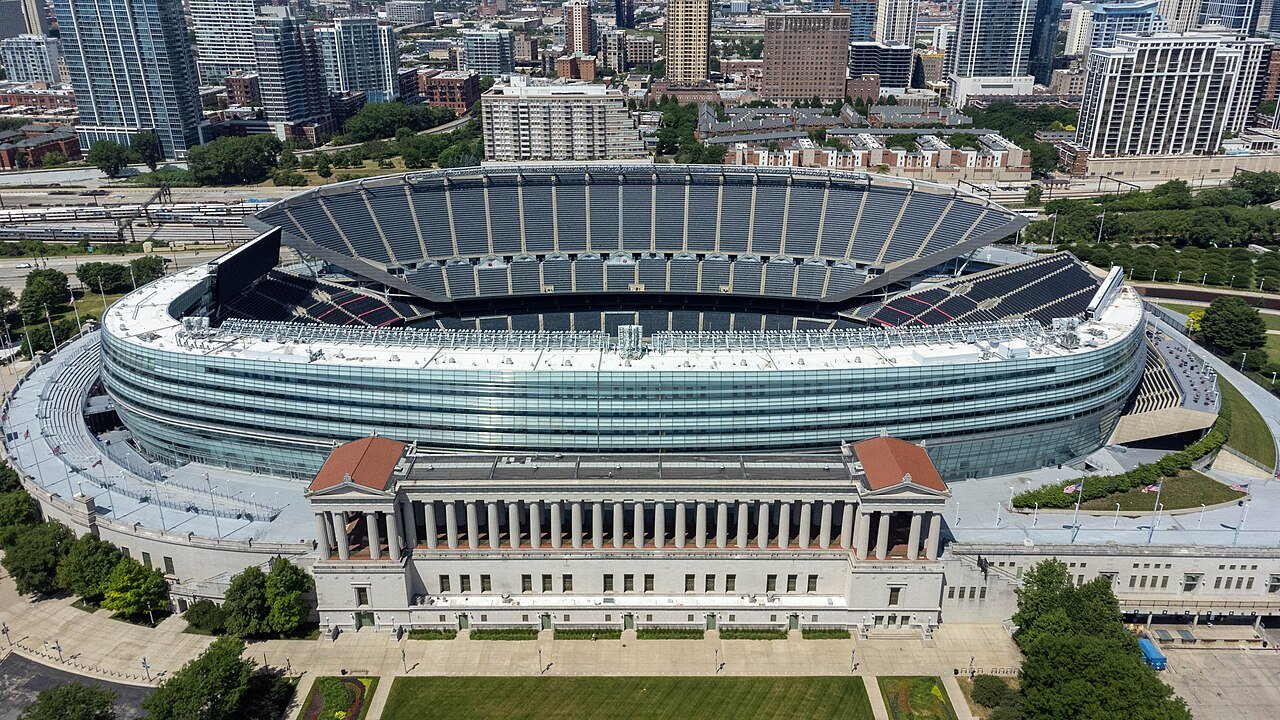
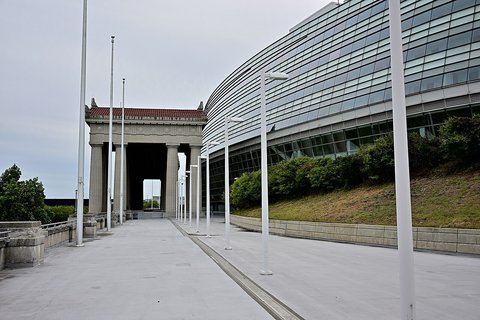
What went in was a new asymmetrical seating bowl in steel and glass, cantilevered over the old walls. The Park Service's own assessment describes the result precisely: the sky boxes extend four storeys beyond the original colonnades on the east side, the cantilevered seating eclipses them on the west, and the view of the colonnades is obstructed from all angles. Since the colonnades were the feature the listing rested on, the listing no longer had a subject.
A federal advisory committee recommended removal in September 2004. The designation was withdrawn on 17 February 2006.
This is a rare and honest piece of public record-keeping, and worth sitting with. The listing was not withdrawn because the building was demolished. It stands, it is the oldest stadium in the league, and it is in constant use. It was withdrawn because the thing that made the building worth listing is now behind something else. The Park Service maintains a page for landmarks whose designation has been withdrawn, and this stadium is on it, with its own before and after photographs.
Two rules, then, working on the same site from opposite ends. A seating minimum written into a merger agreement brought a football club here in 1971. The seats built to keep that club here in 2003 cost the building its place on the register.
Coordinate: Soldier Field. Wikidata and OpenStreetMap agree to within about 7 m. Precision ±80 m.
Cover: the east colonnade in September 2024, with the glass and steel of the 2003 seating bowl rising immediately behind it. Photo: Nairn McWilliams, CC BY-SA 2.0, via Wikimedia Commons. This single frame is what the Park Service's assessment describes.
Second image: the stadium looking west in 2022. Photo: Sea Cow, CC BY-SA 4.0, via Wikimedia Commons.














































 expand_more