NFL History | CenturyLink Field, Seattle — The Pension Was Frozen on a Schedule, Not Abolished
volume_up
Listen
directions
Directions
On the night of 24 September 2012 the Seattle Seahawks beat the Green Bay Packers 14-12 at CenturyLink Field on the last play of the game. The men who ruled on that play were not the league's regular officials. They were replacements, and the reason they were on the field was a labour dispute whose settled terms turned out to be about pay, retirement benefits and how many officials the league was allowed to employ.
The agreement between the league and the NFL Referees Association expired in May 2012, and the league locked its officials out on 3 June. The association's president, Scott Green, told reporters that meeting the union's proposal would cost each of the thirty-two clubs roughly $100,000 a year, a figure smaller than one official's average pay in the season just past, and that seven of the men hired to work in their place had not worked Division I college games, or had not worked in several years. Replacements worked the preseason and the first three weeks of the regular season.
Seattle faced fourth down and ten from the Green Bay 24 with eight seconds left. Russell Wilson threw into the end zone, and the receiver Golden Tate and the Green Bay safety M.D. Jennings came down with the ball between them. The following day the league's officiating department published an account of the play that did two things at once. It said Tate had pushed the cornerback Sam Shields to the ground while the ball was still in the air, that this should have been offensive pass interference, and that the penalty would have ended the game. It also said the foul was not called and could not be reviewed. What could be reviewed was narrower: whether the ball had touched the ground, and who held it. Replay official Howard Slavin stopped the game, referee Wayne Elliott found no indisputable visual evidence to overturn a touchdown, and the officiating department supported him.
Two rules decided the play between them, and neither could reach the thing the league itself said had gone wrong with it. A ruling of simultaneous catch is reviewable in the end zone but not in the field of play, so replay was allowed to ask the question on which the pictures were ambiguous and forbidden the question on which the league said they were clear. This is a different problem from the one argued at Adelphia Coliseum in Nashville, where what decided a famous play was the standard of proof; here it was the scope of the review.
The league and the association reached a tentative agreement on the night of Wednesday 26 September. Roger Goodell lifted the lockout temporarily so the regular crews could work the following night at Baltimore, and the membership ratified on the Saturday by 112 votes to 5. Ed Hochuli, back on the field, put the group at 121 officials.
What the eight-year agreement actually did with the pension was not abolish it. It dated it. The defined-benefit plan stayed in place for serving officials through the 2016 season, or until an official reached twenty years of service, and then froze; from 2017 retirement came through a defined-contribution plan, with league payments the league put at more than $18,000 per official rising to more than $23,000 by 2019. Average pay was to go from about $149,000 in 2011 to $173,000 in 2013 and $205,000 in 2019. And from 2013 the league could employ officials full-time and year-round, and could keep additional officials in training who might be assigned to games.
Set out as a balance of what each side came away with, the league had a conversion of the pension that had not existed before the lockout, deferred by five seasons, and a staffing power it had not held before. The officials had money, and the plan they already had, for a stated period. The league's own account describes the deal as the longest it had made with its game officials.
Two things in the record do not reconcile, and are left open. The officiating department supported the ruling of a simultaneous catch while the same statement described an uncalled foul that would have ended the game before any catch mattered; the document is at once a defence of the call and an account of what went wrong on the play. And Sports Illustrated, revisiting the dispute in March 2026, describes the stoppage as a 110-day lockout and the play by the nickname it acquired, the Fail Mary; the dates in the league's own contemporaneous reporting, locked out on 3 June and a tentative agreement on 26 September, do not produce that total, so this entry gives the dates and no figure. No attendance figure is given here.
Status note, 4 September 2026. The bargaining cycle that followed this one ended differently. UPI reported on 8 May 2026 that the league and the association had ratified a seven-year agreement running through the 2032 season, agreed before the contract then in force was due to expire on 31 May 2026.
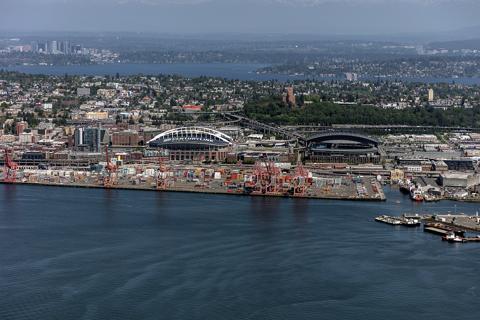
Coordinate: 47.595438, -122.331593, precision about 150 metres. Two separately maintained records were used. The City of Seattle's building energy benchmarking dataset carries a property record named Centurylink Field-Stadium at 800 Occidental Avenue South, classified as Stadium (Open), and gives that position. The United States Census Bureau's TIGER geocoder, queried on the same street address, returns 47.596048, -122.333189, about 138 metres to the north-west. The two disagree in the ordinary way: the federal geocoder places a postal address along a street line, while the municipal record locates the property itself. The stadium bowl is longer than the distance between them. The city's record also carries a year-built value of 1999, which is earlier than the stadium's opening, and nothing here rests on that field. The building was renamed Lumen Field in 2020.
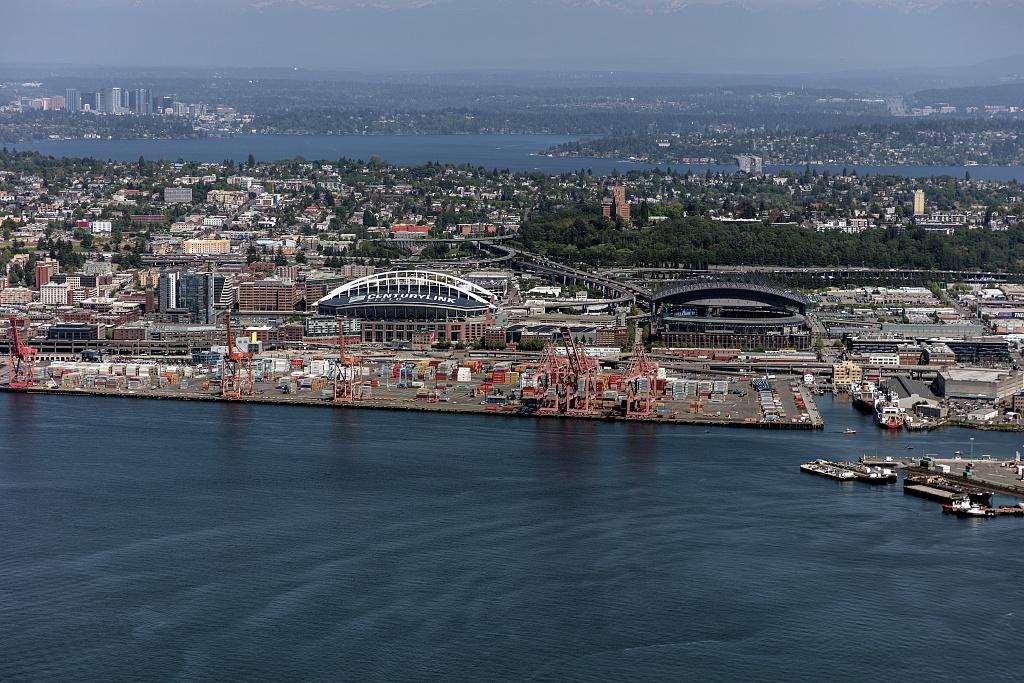
Cover: aerial view of Seattle looking east, photographed by Carol M. Highsmith on 15 May 2018 and held by the Library of Congress, no known restrictions on publication. The stadium at the left of the frame carries its 2012 name spelled across the seating deck, which is what identifies it; the retractable-roofed baseball park to its right is a different building and is not the subject of this entry. The photograph was made almost six years after the game described here.






























 expand_more