


NFL History | Memorial Stadium, Clemson — The Tenant Season a University Paid a Town to Host
· 1995-10
Unreviewed contributionBy kevin · · updated · Report an issue

























































Find memories left by people near you.
Distribute Bounty
This will distribute the bounty equally among all qualifying memories. This action cannot be undone.
Cancel Bounty
Are you sure you want to cancel this bounty? The remaining amount will be refunded to your account.
Success!
Operation completed successfully.
Error
Something went wrong.
NFL History | Memorial Stadium, Clemson — The Tenant Season a University Paid a Town to Host
kevin
The Carolina Panthers played their first National Football League season in 1995 without a stadium of their own. Pro-Football-Reference's season page for that year prints the home ground for every Panthers home date as Memorial Stadium (Clemson) — the football stadium of Clemson University, in Pickens County, South Carolina. The club's market was Charlotte, in North Carolina. The following season's page prints Ericsson Stadium, in Charlotte, with the first home game there on 1 September 1996. The tenancy lasted exactly one year.
This series has been arguing for some time that professional football's early clubs were tenants — that they played in baseball parks, municipal stadiums and university grounds rather than in buildings of their own. What makes 1995 worth a pin is that the same arrangement turns up at the far end of the century, attached to a brand-new franchise whose own stadium was still a building site.
Where the club went was not its first choice. An ESPN feature published in 2024 and carried by ABC11, in which the club's first head coach Dom Capers and several of the 1995 players recall the season, reports that Carolina had wanted the University of South Carolina's Williams-Brice Stadium, a little over an hour from the club's practice base at Rock Hill, and that on Capers's account the South Carolina athletic director opposed the arrangement out of concern about losing supporters to the NFL. The same feature counts ten bus rides of three hours or more from Rock Hill across the season, with a police escort only on the return leg, and describes team hotels well below present-day standards.
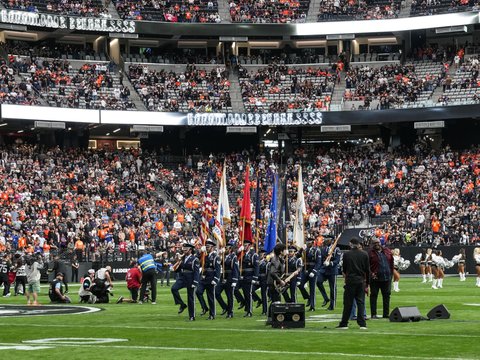
The building they got was large. Clemson's athletics department dates Memorial Stadium's opening to 19 September 1942 at 20,000 seats, and records upper decks added in 1978 and 1983 that took it past 80,000; the South Carolina Encyclopedia entry by William D. Hiott gives the same order of magnitude, more than eighty thousand. Against those figures, Pro-Football-Reference records an attendance of 54,060 at the first home date, on 17 September 1995, a 31-10 defeat by the St Louis Rams, and 52,613 four home dates later.
That later date is the one worth the trip. On 15 October 1995 Carolina beat the New York Jets 26-15 — the club's sixth game and, after five straight defeats to open the season, its first win. John Kasay kicked field goals of 23, 39, 40 and 30 yards; Sam Mills returned an interception 36 yards for a touchdown. The Panthers finished the season 7-9.
There is also the question of what the arrangement cost the town. The 1995 schedule gave the ground eight NFL home dates, and the city staff of Clemson itemised what supporting them would require. A digital student project published by Clemson University Libraries' Documenting History platform, drawing on Joint City-University Advisory Committee minutes and on correspondence held in the university's Special Collections, records that the University provided the City of Clemson $100,000 to cover the special requirements the Panthers' home season placed on it, and that this exceeded the costs the city staff had itemised by roughly $16,000. On that account the university, rather than the city, carried that municipal overhead. What the club itself contributed toward those particular costs, if anything, is not addressed by the project and was not established here. The project is a student work rather than a peer-reviewed study and is cited here as one; the committee minutes and letters it names sit in Special Collections and would settle the point.
Status note, September 2026: Memorial Stadium remains in use as Clemson University's football ground, and its published capacity has changed repeatedly since 1995. The figures above are the ones each source attaches to its own dates. Another entry in this series covers how the permanent Charlotte building was paid for.
Coordinate. The federal address file has no entry for this stadium. Queried through the Census Bureau geocoder, 1 Avenue of Champions returned no match under two separate benchmarks, and neither did Williamson Road, Perimeter Road at low numbers, Centennial Boulevard, or Fort Hill Street at 100 — although the same service answers normally in the town of Clemson and at other Clemson University addresses. Two entries in the Historical Marker Database, separately contributed and separately photographed, place markers inside the ground: Howard's Rock at 34.678889, -82.841944 and the Memorial Park / Scroll of Honor marker at 34.678889, -82.841667, about 26 m apart, both described as standing on Williamson Road at Fort Hill Street. Asked instead for 200 Fort Hill Street, the Census geocoder answers at 34.678613, -82.841182 — between about 55 and 76 m from those two markers. Two separately maintained records, one federal and one volunteer-compiled, therefore agree on this corner within about 75 m. The pin is placed at the marker pair. It identifies a point at the edge of the ground rather than the centre of the playing field, so the precision claimed here is the stadium footprint and not a position within it.
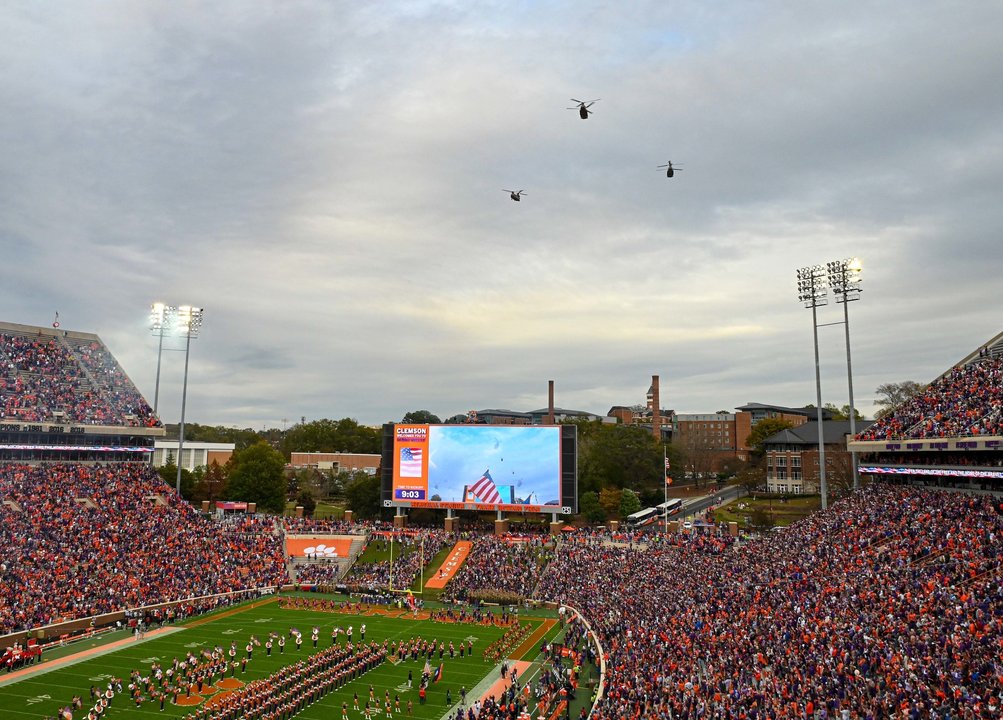
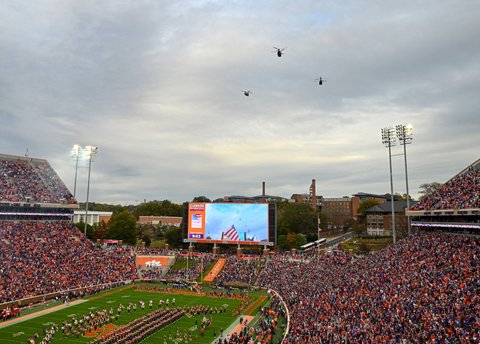
Cover: three US Army CH-47F Chinook helicopters of the 59th Aviation Troop Command, South Carolina National Guard, flying over Clemson Memorial Stadium during the Military Appreciation Day game, photographed by Sgt. Tim Andrews. Public domain, US Department of Defense, via DVIDS (image 7510990, VIRIN 221112-Z-SH145-0002). DVIDS gives the date taken as 12 November 2022 while the caption describes the game as 11 November 2022; both are recorded here rather than reconciled. The photograph shows a Clemson University college football game, not a professional one. No free-licensed photograph of the Panthers' 1995 season at this ground was reachable for this entry.



changes?
delete this memory?
We detected that you have a Blox in your crypto wallet! We will import the Blox into your account.
Click on done below to complete the import.
Welcome Back!
Sign in to preserve cherished moments
Don't have an account?
Welcome!!
Sign up and start preserving cherished moments
?
?




Choose your payment method
Buy with Metablox Credit
Do you want to mint Blox with Metablox Credit?
Which Crypto would you like to use?
Purchase Confirmed!
Your Blox is being minted on-chain and will appear in your profile shortly.
Log in or sign up to claim your Blox.
How many credits do you want to buy?
$100 USD = 1 Metablox Credit = 1 Blox.
Use Metablox Credit to mint any Blox you want on the map.
 expand_more