NFL History | Sun Devil Stadium, Tempe — The Game Two Ballots Took Away and Gave Back
volume_up
Listen
directions
Directions
On 28 January 1996 the Dallas Cowboys beat the Pittsburgh Steelers 27-17 here in the thirtieth Super Bowl. Pro-Football-Reference records the sequence: field goals by Chris Boniol of 42 and 35 yards around a three-yard touchdown pass from Troy Aikman to Jay Novacek, a six-yard scoring pass from Neil O'Donnell to Yancey Thigpen before half time, then rushing touchdowns by Emmitt Smith from one yard and four yards on either side of Pittsburgh closing to within three. The same record gives the attendance as 76,347. Stadiums of Pro Football gives the building's capacity for professional football as 73,234. The two figures are not reconcilable from the sources consulted and are both reported here.
The game is on this ground because of two ballots, and the connection between them was made openly and in advance by the people who ran the league.
United Press International reported on 13 March 1990 that the owners had awarded the 1993 Super Bowl to Sun Devil Stadium, which the report describes as a 72,000-seat building in suburban Tempe. The mechanics were slow: twenty-one votes were required on each of the first four ballots and no city reached that number, after which a simple majority sufficed. The report names the commissioner, Paul Tagliabue; the chairman of the site selection committee, the Philadelphia owner Norman Braman; the governor, Rose Mofford; the Phoenix Cardinals owner Bill Bidwill; and the local organisers Bill Shover, Robert Usdane and Art Hamilton. It records no condition attached to the award about a state holiday.
The holiday question was already live and it had names attached to it. The Pima County Public Library's account records that Governor Evan Mecham rescinded the state's Martin Luther King holiday on taking office in 1987, on the ground that it had been created illegally, and proposed instead a Civil Rights Day to be observed on a Sunday. In November 1990 two measures went to the voters. Proposition 301 would have replaced Columbus Day with a King holiday, leaving the state with ten paid holidays. Proposition 302 would have added a King holiday as an eleventh. Neither passed. Phoenix Magazine puts Proposition 302 at 49 per cent. No official canvass was obtained for this memory: the state's own figures were not retrieved in this run, and Ballotpedia's page for the measure is closed to automated fetching, so the percentages here rest on a magazine account rather than on a returning officer's record.
United Press International reported on 20 March 1991 that the owners had voted the previous night to take the 1993 game away from Phoenix and give it to Pasadena, and that the league had announced its intention to do so the day after the election, roughly five months earlier. The same report sets out what was offered in its place, and the terms are the reason this memory exists. Phoenix was named the preliminary site for the 1996 game, conditional on Arizona voters passing a 1992 measure establishing a paid King holiday, with the final vote of the owners to be taken in March 1993. The report names the Phoenix mayor Paul Johnson, Senator Dennis DeConcini, Bidwill, Tagliabue, Braman, Jerry Colangelo, the university's stadium management director Tom Sadler, and Larry Hilliard of the Phoenix convention bureau. The league did not ask the state to reconsider. It named a price and a deadline, in public, eighteen months before the ballot. The 1993 game went to the Rose Bowl in Pasadena, which this vertical covers at memory 9502.
In November 1992 the voters passed a King and Civil Rights Day holiday. The Pima County Public Library records that Arizona was the last state in the union to install one. Phoenix Magazine identifies the measure as Proposition 300 and puts it at 61 per cent. Phoenix Magazine and a Yahoo Sports retrospective both report the owners awarding the 1996 game to Arizona in March 1993, and Pro-Football-Reference shows it played at Sun Devil Stadium on 28 January 1996.
The ordering is a matter of record. What moved the second vote is not. The same electorate that declined in 1990 approved in 1992, after two years in which the loss of the game and a national boycott of the state were discussed continuously; the Pima County Public Library's account puts the revenue Phoenix was projected to lose at 200 million dollars. Nothing cited here establishes that the money changed anybody's mind, and this memory does not claim that it did. What is established is narrower and, on its own terms, is the point: a league that had taken a game away for a political reason then offered it back on a stated condition, and the condition was met.
The building itself long predates any of this. StadiumDB gives its opening on 4 October 1958 with about 30,000 seats in a single tier, built for a million dollars, expanded through six rounds of work to nearly 75,000 before 1989, and cut back to 53,559 in a rebuild between 2014 and 2018 that cost 307 million dollars. Stadiums of Pro Football records the professional tenancy as seventeen seasons, from a first National Football League game on 12 September 1988 to 2005, with the club known through that period as the Arizona Cardinals.
Status note, 4 September 2026. Arizona State University announced on 2 August 2023 a fifteen-year naming-rights agreement under which the building is called Mountain America Stadium; the university's announcement does not disclose the value. The playing surface has carried the name Frank Kush Field since 21 September 1996, and the university states the new agreement does not change that. StadiumDB gives the present capacity as 53,559. These are live facts and were current on the date given.
Coordinate: 33.4264, -111.9325. Precision plus or minus 250 m. This coordinate does not meet this vertical's two-source standard, and the failure is disclosed rather than concealed. Neither of the two routes this vertical relies on returned anything. The United States Geological Survey's domestic names service at edits.nationalmap.gov returned a 503 on 4 September 2026, as it had on the two preceding days. The United States Census TIGER geocoder returned no match at all for the stadium's street address in any form tried on 4 September 2026, including 500 East Veterans Way under both of the postcodes the sources give, 85281 and 85287, and the street on its own; TIGER does not carry this campus's addressing. StadiumDB publishes the address and no coordinates, and no other reachable source consulted published one either. The figure used here is the value that circulates in general reference works for this stadium. It was not confirmed against a maintained gazetteer in this run, and the radius is set wide to say so. Anyone with access to a state or county parcel service should re-derive it.
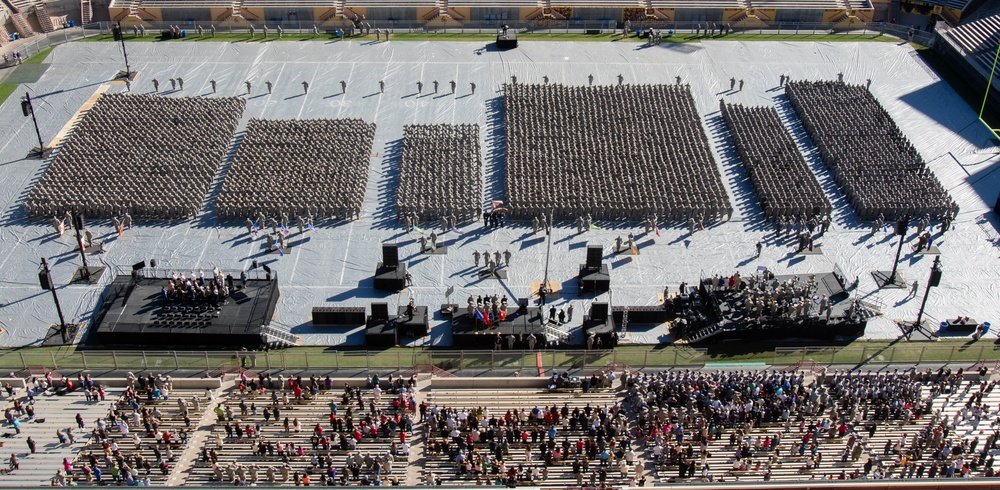
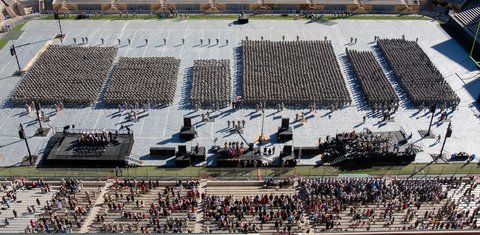
Cover: soldiers and airmen of the Arizona National Guard drawn up in seven blocks on the tarpaulin-covered field at Sun Devil Stadium during the Arizona National Guard Muster of 7 December 2014, photographed from high in the stands with the lower bowl in the foreground and a stage set along the near sideline. The DVIDS caption records more than 3,800 Guard members present. Photograph by Staff Sergeant Brian A. Barbour, Arizona National Guard Public Affairs, distributed through DVIDS; a work of the United States Government, in the public domain. The building is the one this memory is about; the occasion is not. This is a military ceremony eighteen years after the game, and it is not a photograph of Super Bowl XXX or of any football game.





















 expand_more