NFL History | Lambeau Field, Green Bay — A City Bought the Ground, Then Could Not Heat It
volume_up
Listen
directions
Directions
Almost every ground in this series was rented from somebody else — a baseball club, a university, a school board, a city. Green Bay's was voted for.
On 3 April 1956 the city held a referendum on a $960,000 bond issue for a new stadium, with the Packers to pay half. It passed 11,575 to 4,893, better than 62 per cent, and carried every ward. Three days before the vote the league's commissioner, Bert Bell, had written to the Press-Gazette that the Green Bay franchise could be sold for as much as three-quarters of a million dollars. George Halas came to town and told residents to pass it or lose their team.
The club's executive committee then hired Osborn Engineering of Cleveland to assess fifteen sites. The city council took its recommendation by 17 votes to 7: farmland at Highland Avenue and Ridge Road, on the far south-west side. New City Stadium opened on 29 September 1957, under nine months after ground was broken, seating 32,500 — about thirty per cent more than the ground it replaced. It was renamed for Curly Lambeau in 1965.
That is why this address matters more than the game it is remembered for.
On 31 December 1967 the Packers beat Dallas here 21–17 for the NFL championship. It was thirteen below zero Fahrenheit at kickoff and eighteen below late in the game. That summer the club had buried fourteen miles of General Electric heating cable six and a half inches under the turf, installed by Beemster Electric of Green Bay. It did not keep the field playable, and the two accounts of why do not agree. The club's own historian quotes the engineer, John Harrington, saying the system would hold to zero if the field stayed covered but not at sixteen below with wind, and describes condensation freezing to a crust beneath the tarpaulin; Wisconsin Public Radio reports that the condensation short-circuited the cable. Bart Starr scored from about two feet out behind blocks by Jerry Kramer and Ken Bowman. The Pro Football Hall of Fame prints sixteen seconds remaining; the club historian, quoted by Wisconsin Public Radio, says thirteen.
By then the ground held 50,837, and that is the other reason this place is not among the vanished stadiums. When the league set a fifty-thousand-seat minimum for home stadiums after the 1970 merger — the clause that emptied Wrigley Field, War Memorial Stadium and Metropolitan Stadium — the smallest city in the league cleared it by under a thousand seats, in a ground its own voters had paid for and had kept enlarging.
Coordinates 44.501389, -88.062222, from Wikidata (P625) and OpenStreetMap's stadium way, which agree to 51 m. The US Census geocoder places the postal address, 1265 Lombardi Avenue, 204 m north of both: the mailing address sits on the avenue, not at the centre of the bowl. Precision ±80 m. Hagemeister Park, the club's first and fenceless ground, is 5.5 km to the north-east.
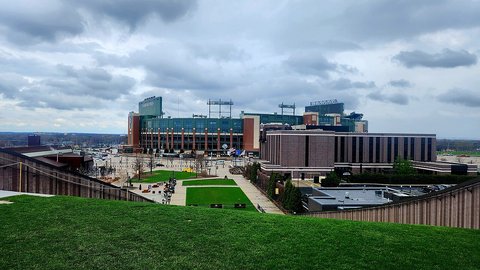
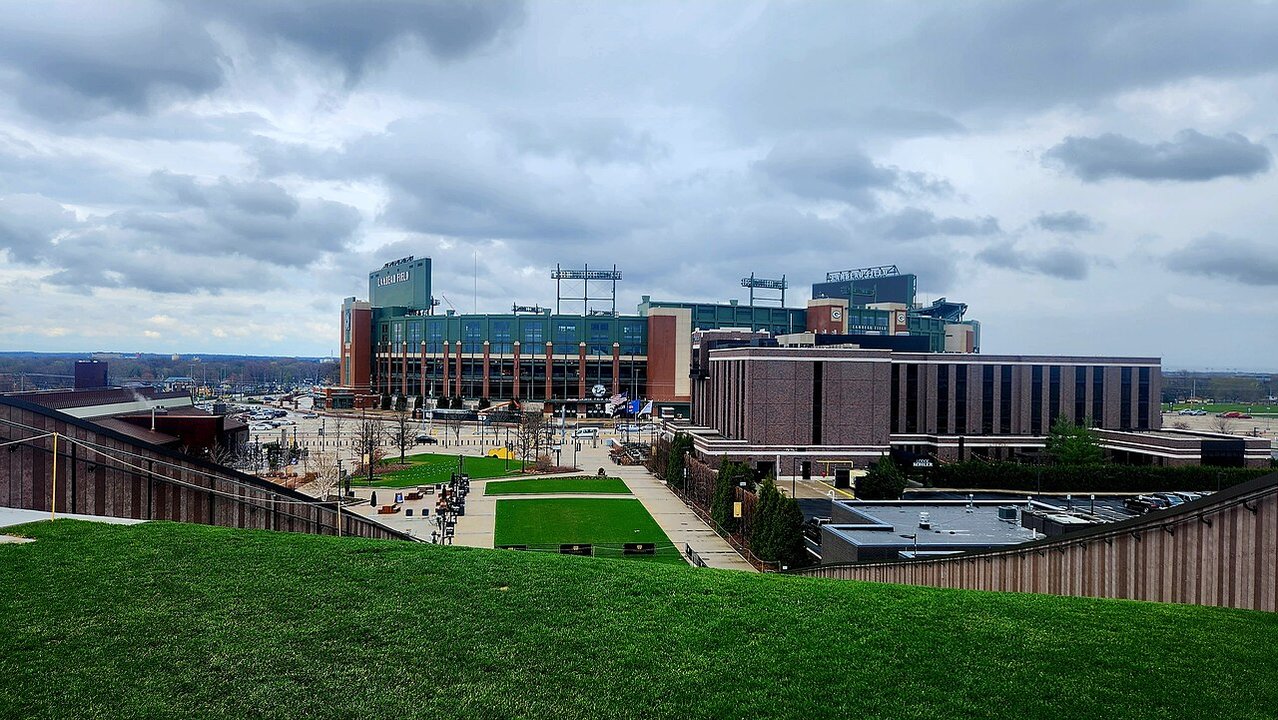
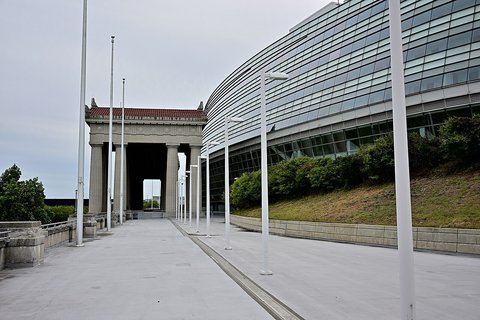
Cover: *Lambeau Field from Titletown* by Gonzo fan2007, CC BY-SA 4.0, via Wikimedia Commons, photographed 17 April 2024. It shows the stadium as rebuilt in 2003, not as it stood in 1967.












































 expand_more